

Executive Overview
In a milestone transaction highlighting the ongoing corporate race to capture the booming "better-for-you" packaged food market, Italian multinational food giant Barilla has announced its definitive intent to acquire Goodles, the high-flying, nutrient-dense macaroni and cheese brand. While financial terms of the acquisition have been kept under wraps, the strategic implications of this deal are monumental. For Barilla—a privately held, 148-year-old titan that generated $5.6 billion in revenues in 2025 and stands as the world’s largest pasta producer—the acquisition represents a calculated bridge into the modern, health-conscious pantry. For Goodles, the backing of a global heavyweight provides the distribution muscle, supply chain resilience, and capital needed to transition from a fast-growing challenger brand into an entrenched household staple.
The acquisition underscores a broader macroeconomic shift across the American food landscape. Today’s consumers are increasingly skeptical of legacy processed foods that offer empty calories and minimal nutritional value. Yet, their appetite for nostalgic comfort foods remains stubbornly robust. Goodles successfully identified and capitalized on this exact tension. Founded six years ago by an entrepreneurial team including Jen Zeszut, Paul Earle, and Hollywood icon Gal Gadot alongside her husband Jaron Varsano, Goodles reimagined a $5.5 billion domestic category that had long suffered from corporate stagnation. By injecting functional nutrition—such as plant-based proteins, dietary fiber, and dozens of hidden micronutrients—into an ultra-familiar format, Goodles proved that consumers are willing to trade up from legacy brands, provided the product offers a compelling fusion of indulgence and wellness.
This transaction also mirrors a classic playbook in the consumer packaged goods (CPG) sector: legacy giants buying agility. As agile upstarts pioneer new product vectors, capture cultural relevance, and build fervent millennial and Gen Z followings, massive conglomerates often find it more efficient to buy innovation rather than build it from scratch. Barilla’s purchase of Goodles is a testament to this dynamic. As the deal moves toward its final closure, industry watchers will be closely examining how Barilla plans to scale Goodles without diluting the disruptive, rebellious brand equity that drove its initial success.
Detailed Chronology: From Direct-to-Consumer Upstart to Global Acquisition
To fully understand the weight of Barilla’s acquisition, it is necessary to trace the trajectory of Gooder Foods, the parent company behind Goodles, and the strategic evolution of its buyer.
The Genesis of Gooder Foods (2019–2021)
Goodles was officially conceptualized in an era marked by shifting consumer habits brought on by pandemic-era dining trends. Co-founders Jen Zeszut and Paul Earle recognized that while the instant mac-and-cheese market was massive—anchored by institutional giants like Kraft Heinz—it was trapped in a 20th-century paradigm. The category was dominated by cheap, shelf-stable boxes marketed primarily to children, utilizing refined white flour and neon-orange cheese powders devoid of nutritional substance.
Enlisting high-profile co-founders including actress Gal Gadot and Jaron Varsano, the founding team set out to engineer a product that checked multiple boxes simultaneously: it had to taste exceptionally decadent, cook in minutes, and deliver genuine nutritional utility. Behind the scenes, food scientists and culinary experts spent months developing proprietary noodle formulations that incorporated chickpea protein, wheat flour, and a suite of plant-based nutrients derived from organic vegetables.
The Direct-to-Consumer Launch and Retail Breakthrough (2021–2023)
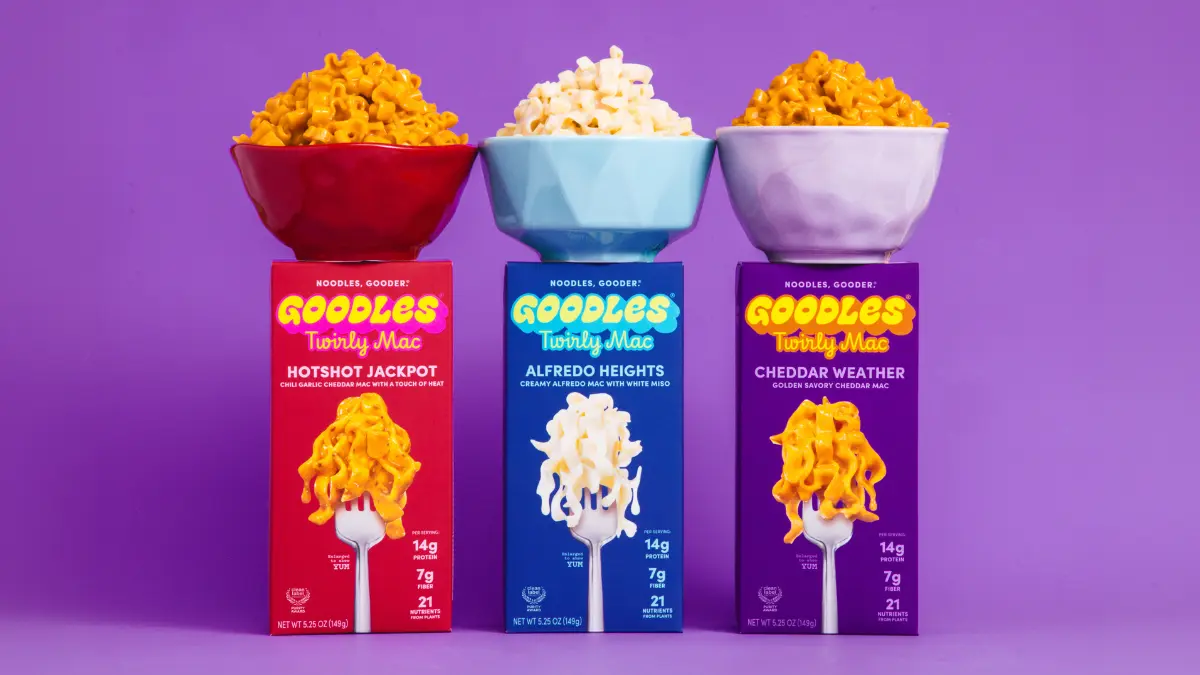
Goodles initially debuted as a direct-to-consumer (DTC) digital brand. This early phase was critical for brand building, allowing the company to engage directly with its core demographic, test bold flavor profiles, and cultivate an army of brand advocates through targeted social media campaigns. Unlike traditional dry pasta lines that relied on understated, heritage-driven packaging, Goodles launched with vibrant, retro-futuristic, highly collectible neon boxes adorned with playful typography.
Capitalizing on rapid digital traction, the brand quickly transitioned to an omnichannel strategy. Goodles secured high-stakes retail distribution across major national grocery and big-box accounts, landing on the shelves of Target, Walmart, and Costco. This retail pivot transformed Goodles from a niche e-commerce curiosity into a formidable supermarket contender, proving that consumers would actively seek out premium-priced boxed meals in aisles traditionally dominated by rock-bottom pricing.
The Barilla Pursuit and Culmination (2024–2026)
According to public disclosures surrounding the acquisition, Barilla Group leadership had been tracking Goodles’ ascent for years. Guido Barilla, chairman of the venerable Italian pasta maker, noted that he was repeatedly struck by the brand’s meteoric trajectory, high consumer retention, and uncompromising product quality.
As Goodles continued to expand its flavor portfolio—venturing into sophisticated, adult-oriented profiles like truffle-infused cheddar, smoky hatch chile, and rich pesto—it caught the eye of strategic investors worldwide. For Barilla, which boasts a sprawling global footprint but has historically navigated the ambient aisle with traditional pasta and sauce lines, acquiring Goodles provides an immediate foothold in the value-added, functional convenience category. The acquisition agreement, announced in early 2026, marks the culmination of Goodles’ rapid six-year sprint from startup whiteboard to multinational portfolio acquisition.
Supporting Context & Metrics: Navigating the Modern Mac-and-Cheese Economy
The macroeconomics of the North American pasta and convenience meal sectors present a fascinating study in contrast, pricing psychology, and shifting demographic demands.
Market Size and Financial Realities
The packaged macaroni and cheese market in the United States is an undeniable juggernaut, valued at approximately $5.5 billion and expanding at a steady compound annual growth rate of roughly 4.5%, according to data compiled by Insight Partners. Historically, however, this segment has been defined by extreme price sensitivity. Private-label store brands and legacy heavyweights have trained generations of shoppers to expect boxed dinners priced under $1.50 per unit.
Goodles shattered this psychological pricing barrier. At national retailers like Target, a standard box of Goodles retails for approximately $3.79, compared to around $1.39 for a classic box of Kraft Mac & Cheese. This stark price premium places Goodles firmly in the "masstige" category—mass-market accessibility coupled with premium, specialty positioning.
Historically, market research from firms like Innova Market Insights has suggested that American consumers show strong resistance to paying premium prices for ambient pasta products. Yet Goodles defied this historical precedent. By reframing mac and cheese from a cheap meal for children into a permissible, nutrient-dense indulgence for adults, Goodles unlocked a new tier of spending within the grocery store.
Nutritional Engineering Meets Cultural Relevance
Goodles’ market differentiation rests heavily on its nutritional profile. While traditional boxed pastas offer little beyond carbohydrates and sodium, Goodles boxes boast 21 plant-based nutrients extracted from organic farm-grown vegetables, alongside significantly higher levels of protein (often around 14 to 15 grams per serving) and dietary fiber.
Furthermore, the brand leaned hard into culinary sophistication. Rather than sticking strictly to standard cheddar, Goodles introduced flavors designed to appeal to adult palates:
- "Cheddy Mac" and "Mates & Dates" for classic comfort seekers.
- "Trufflicious" featuring real black truffle flavor.
- "Shella Good" pairing aged white cheddar with artisanal spirals.
- "Hatch Chile Mac" catering to the booming consumer appetite for bold, spicy, southwestern flavor profiles.
The GLP-1 Wildcard
As food conglomerates evaluate their product pipelines for the remainder of the decade, they must contend with a massive structural shift in consumer behavior: the rise of GLP-1 receptor agonist weight-loss medications (such as Ozempic and Wegovy). These appetite-suppressing drugs have begun to fundamentally alter eating habits across America, dampening consumer demand for ultra-processed, high-carbohydrate convenience foods.
This pharmaceutical trend represents a significant long-term headwind for traditional junk food and legacy instant meals. However, brands positioned at the intersection of convenience and functional nutrition—such as Goodles, with its emphasis on high protein, fiber, and plant-based micronutrients—may be uniquely insulated. By offering functional benefits that support satiety and nutritional intake rather than empty calories, Goodles represents a more resilient asset for Barilla in a post-GLP-1 retail environment.
Official Statements and Industry Perspectives
The announcement of the acquisition elicited strong reactions from leadership on both sides of the transaction, underscoring the mutual respect and strategic alignment driving the deal.
In an official corporate statement, Guido Barilla, Chairman of the Barilla Group, reflected on the acquisition, noting:
"I have been following Goodles closely for some time. I have been deeply impressed by the sheer strength of the brand, the exceptional quality of its products, and the undeniable momentum behind its growth. This partnership represents a shared passion for pasta, culinary excellence, and a dedication to meeting the evolving needs of today’s families."
Goodles executives emphasized that joining forces with a legendary, family-owned global producer like Barilla will amplify their mission rather than dilute it. Jen Zeszut, co-founder and CEO of GoodGooder Foods, pointed to the brand’s category-expanding impact:
"From day one, our goal was to prove that mac and cheese is not just for kids anymore. We set out to reinvent a beloved classic by delivering outrageous flavor alongside real nutritional value. Partnering with Barilla—the undisputed master of pasta—allows us to accelerate our vision, expand our retail footprint, and bring Goodles to millions of new households around the world while maintaining the playful, rebellious spirit our fans love."
Industry analysts have similarly lauded the deal as a masterclass in CPG portfolio expansion. Food retail observers note that while Barilla possesses unmatched manufacturing scale in traditional dry pasta, sauces, and ready-to-eat formats, its portfolio lacked a high-growth, modern, shelf-stable comfort food brand that resonates powerfully with millennial and Gen Z consumers. Goodles fills this strategic gap seamlessly, providing Barilla with an established innovation engine.
Future Outlook: What the Barilla-Goodles Marriage Means for the Aisle
As the integration process unfolds following the finalization of the deal, several key strategic questions and opportunities will define the next chapter for Goodles under the Barilla corporate umbrella.
1. International Expansion and Supply Chain Optimization
To date, Goodles has focused primarily on the North American market, building a commanding retail presence across the United States. With Barilla’s global infrastructure—which spans production facilities, distribution networks, and retail relationships across Europe and international markets—Goodles is primed for an aggressive global rollout. Furthermore, Barilla’s deep expertise in wheat sourcing, milling technology, and pasta extrusion will likely allow Goodles to optimize its supply chain, reduce production costs, and potentially narrow the price gap with legacy competitors without sacrificing profit margins.
2. Product Line Extensions and R&D Synergy
Goodles demonstrated its ability to disrupt mac and cheese, but the brand’s foundational ethos—making comfort food nutritious and fun—is ripe for broader application. Armed with Barilla’s state-of-the-art research and development facilities in Italy and the U.S., the Goodles team can explore adjacent categories. This could include functional ready-to-eat pasta meals, gluten-free variations, organic product lines, or expanded dry pasta offerings that incorporate Goodles’ proprietary nutrient blends.
3. Maintaining Brand Authenticity Within a Corporate Giant
One of the primary challenges in any acquisition of an agile startup by a multi-billion-dollar multinational is the risk of corporate homogenization. Goodles built its cult following on vibrant packaging, witty marketing, and an authentic, founder-led voice. Barilla’s leadership has indicated a strong awareness of this dynamic, signaling that Goodles will retain significant operational autonomy to preserve the creative energy that made it a target in the first place.
If Barilla successfully balances corporate scale with startup agility, the acquisition could serve as a blueprint for how legacy food giants can future-proof their portfolios against shifting consumer preferences.
Conclusion
The acquisition of Goodles by Barilla is far more than a simple corporate transaction; it is a powerful indicator of where the global food industry is heading. As consumers increasingly demand products that balance emotional comfort with physical wellness, legacy brands that fail to innovate risk obsolescence. By welcoming Goodles into its fold, Barilla has secured not just a fast-growing product line, but a vital passport to the future of the modern pantry—proving that even a nearly 150-year-old pasta maker knows that the future belongs to those willing to reinvent the classics.