

Executive Overview
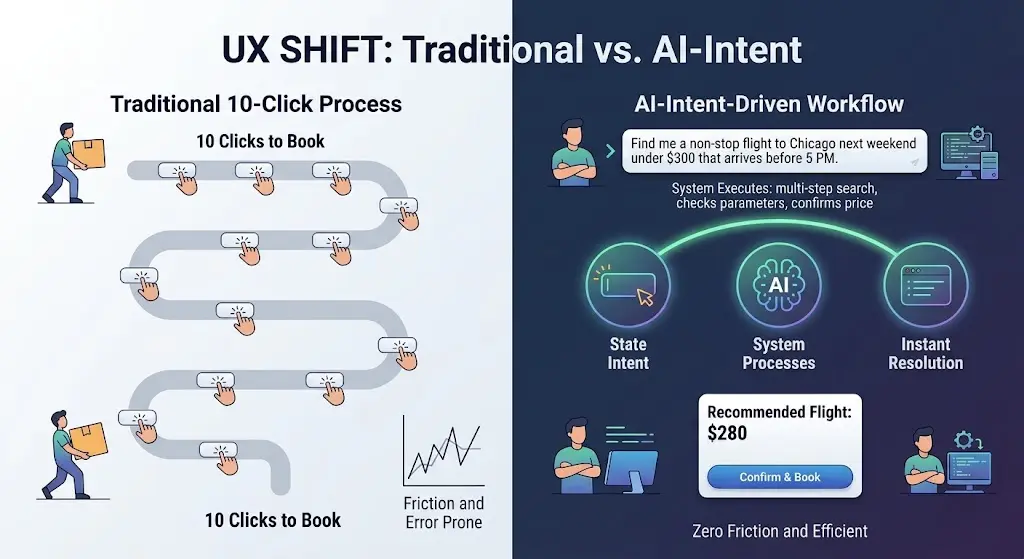
For decades, the digital landscape has been defined by a universal truth: interaction requires friction. Since the commercialization of the Graphical User Interface (GUI) by pioneers like the Xerox Star and its subsequent popularization by the Apple Macintosh, software has relied heavily on point-and-click paradigms. If a user wished to complete a task—whether booking a flight, diagnosing a symptom, or constructing a webpage—they were expected to step inside a digital labyrinth.
This journey typically involved navigating complex menus, adjusting range sliders, filling out multi-step forms, wading through cookie pop-ups, and managing dozens of active browser tabs just to cross-reference basic information. As a society, internet users grew conditioned to spend more time managing software than actually achieving human goals.
That contract is now fundamentally changing. Driven by rapid advances in artificial intelligence and large language models (LLMs), a new paradigm of web design is emerging: Intent-Driven Design. Rather than forcing humans to master intricate user interfaces, click through convoluted sales funnels, or decode rigid navigation structures, the new generation of web platforms operates by capturing high-level human goals and silently executing the grunt work in the background.

This revolution marks a massive ideological shift for UX professionals. The ultimate objective of modern web design is no longer to build prettier buttons, more vibrant micro-interactions, or flashier animations; it is to eliminate the interface entirely. For UX designers, this means transitioning from designing static, visible interfaces to orchestrating transparent, intent-driven AI experiences.
Detailed Chronology: From the GUI to the Autonomous Web
To understand how web design arrived at the doorstep of intent-driven architecture, it is necessary to examine the evolution of human-computer interaction (HCI) over the past half-century.
1. The Command-Line to the Point-and-Click Revolution (1970s–1990s)
In computing’s infancy, interfaces were text-based, requiring users to memorize syntax and type strict command-line prompts. The introduction of the GUI in the 1970s and 1980s democratized computing by translating abstract machine code into visual metaphors: desktops, folders, and clickable buttons. This point-and-click model became the gold standard of digital interaction, laying the foundation for the commercial internet in the 1990s. While revolutionary for its time, the GUI fundamentally anchored the user to a passive role: the computer held the data, and the human manually orchestrated every micro-step to retrieve it.
2. The Era of Infinite Content and Multi-Step Friction (2000s–2010s)
As the web scaled into a global marketplace, digital products began optimizing for engagement metrics—time on site, page views, and click-through rates. This era saw the birth of the "10-click process." Booking a flight, for instance, turned into an arduous ritual:
- Navigate to an aggregator.
- Type departure and arrival cities.
- Select dates using a calendar widget.
- Filter by price, duration, and stops.
- Sort through dozens of results across multiple tabs.
- Select seats, add baggage, decline travel insurance, and finally reach the checkout form.
Websites were intentionally designed to keep users clicking, exposing them to ads, upselling opportunities, and cross-promotional banners at every turn.
3. The Minimalist and "No Interface" Awakening (2010s)
As digital fatigue set in, HCI theorists began pushing back against the clutter of modern software. In 2014, designer Golden Krishna published his seminal book, The Best Interface Is No Interface, arguing that glowing rectangles and constant tapping were symptoms of bad design rather than badges of honor. This philosophy dovetailed with Don Norman’s foundational principles of human-centered design, urging creators to build technology that fits seamlessly into human workflows rather than demanding human adaptation to software.
4. The Rise of Generative AI and Intent-Driven Architecture (2020s and Beyond)
Today, we are witnessing the realization of the "no-interface" philosophy. Large language models and generative AI agents have evolved from novelty chatbots into foundational computing layers. Modern web tools no longer act as passive digital catalogs waiting for human clicks; instead, they capture natural language intent, synthesize disparate data sources, generate dynamic user interfaces on the fly, and execute complex workflows autonomously.
Supporting Context & Metrics: The Friction Cost
The traditional web interface relies on a transactional model that levies a heavy cognitive tax on the user. To quantify this, consider the fundamental differences between traditional UX and intent-driven UX across core digital pillars:
| Pillar | Traditional UX Approach | Intent-Driven UX Approach |
|---|---|---|
| User Input | Micro-actions (Clicks, dropdowns, toggles, form fields) | High-level goals (Natural language, environmental context, behavioral habits) |
| Interface State | Static layouts (Every user sees the exact same visual hierarchy and navigation bar) | Generative UI (Layouts, widgets, and tools rendered dynamically on the fly) |
| Task Execution | Manual execution orchestrated step-by-step by the human user | Autonomous execution handled in the background by AI agents |
Real-World Manifestations of Intent-Driven Web Platforms
This transition is not a theoretical vision of the distant future; it is actively reshaping the products millions of users rely on daily.
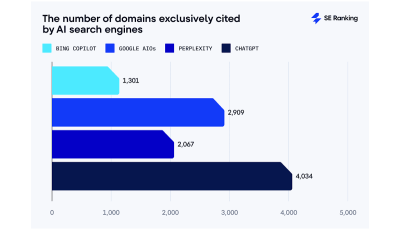
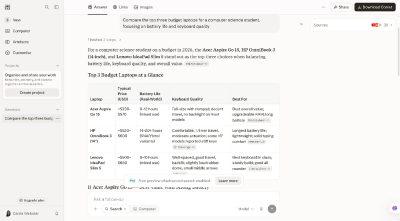
- Perplexity AI (Search Without Open Tabs): Traditional search engines operate as digital directories, rewarding a user’s keyword query with ten blue links. The cognitive labor of opening multiple tabs, skimming long-form articles, dodging display ads, and manually synthesizing an answer falls entirely on the user. Platforms like Perplexity bypass this friction, reading the user’s implicit intent and synthesizing comprehensive, cited answers instantly.
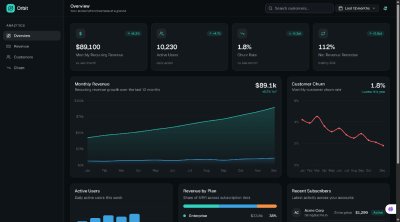
- Vercel v0 (Web Design Without Dragging and Dropping): Historically, building a web layout required manual wireframing in tools like Figma, drawing rectangles, assigning hex codes, and writing CSS. Generative interfaces like v0 allow users to type a natural language prompt—such as "Build a dark-mode SaaS analytics dashboard with real-time charts"—and instantly render fully functional, production-ready UI components.
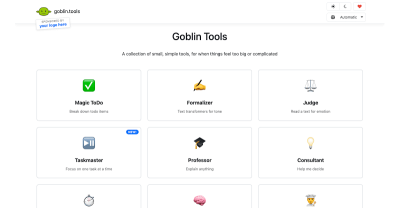
- Goblin.tools (Breaking Down Cognitive Overload): Traditional productivity suites require users to manually construct Kanban boards, assign deadlines, and sort tasks. Tools like Goblin.tools offer purpose-built AI engines designed to deconstruct overwhelming, complex human objectives into manageable, step-by-step micro-checklists with zero configuration required.
Official Perspectives and Expert Frameworks
As the industry pivots toward screenless, agent-driven ecosystems, leading research institutions and industry bodies have established critical guidelines for navigating this transition.
The Nielsen Norman Group on the AI UX Paradigm
In foundational analyses regarding AI as a new user experience paradigm, the Nielsen Norman Group emphasizes that computing is shifting definitively from command-based interaction to outcome-specification. Users no longer need to know how a system processes data; they simply need to articulate what they want accomplished. This enables Generative UI, where interfaces materialize momentarily to serve a specific purpose and dissolve once the goal is reached.
Apple’s Human Interface Guidelines on Contextual & Ambient Design
According to Apple’s Human Interface Guidelines, modern systems must leverage environmental metadata—such as device state, physical location, and historical interaction patterns—to anticipate user needs before an explicit command is issued. An intent-driven interface does not always wait for typing; it reads context to streamline proactive workflows.
The Google PAIR (People + AI Research) Guidebook on Transparency
Because autonomous agents operate behind the scenes, removing traditional visual controls introduces the "black box problem." If a system misunderstands a prompt, troubleshooting can be frustrating. To combat this, the Google PAIR Guidebook advocates for transparent feedback loops. Systems must explicitly state their real-time interpretation—such as displaying text that reads "Searching for non-stop flights to Chicago under $300…"—allowing users to calibrate trust and correct misinterpretations instantly.
Future Outlook: The Responsibilities of the Modern UX Designer
The shift from designing static buttons and rigid forms to orchestrating dynamic, intent-driven AI experiences fundamentally redefines the role of the product designer.
1. Mastering Generative UI
Designers must move beyond creating pixel-perfect, static wireframes. Instead, they must learn to design design systems that are fluid, modular, and capable of assembling themselves on the fly based on contextual prompts and real-time user intent.
2. Balancing Automation with Control
As highlighted by researchers at the Stanford Human-Computer Interaction (HCI) Group and ethical frameworks from the Center for Humane Technology, automated systems must maintain clear boundaries to prevent users from feeling patronized or disoriented. Designers must strike a delicate balance: automate routine execution, but explicitly prompt the user for high-stakes confirmations—such as financial transactions, publishing public content, or altering security settings. Furthermore, safety nets must shift from intrusive prevention pop-ups ("Are you sure?") to frictionless rollback mechanisms like clear "Undo" buttons and transparent audit logs.
3. Redefining Success Metrics
For decades, digital success has been measured by engagement metrics that reward friction: time spent in app, click-through rates, and page views per session. The intent-driven era turns these metrics on their head. Aligned with Golden Krishna’s philosophy and the Center for Humane Technology’s Time Well Spent movement, the ultimate test of a modern digital product is no longer how visually captivating its buttons are, but rather: How effectively did this software solve the problem and get out of the user’s way?
Conclusion
We are entering a defining era where web applications will no longer be measured by the complexity or beauty of their graphical interfaces, but by their ability to render those very interfaces completely obsolete. The future of the web is not found in more interaction, deeper menus, or flashier animations; it is found in seamless, invisible completion. For the modern UX designer, embracing this shift is no longer optional—it is the prerequisite for building the next generation of human-centric technology.