In the hyper-competitive digital landscape of modern search engine optimization (SEO), precise keyword research serves as the bedrock of sustainable, high-converting organic traffic. With search engines continually evolving through artificial intelligence and complex ranking algorithms, marketers can no longer rely on superficial keyword lists or basic volume metrics. To capture targeted visibility, digital strategists require a comprehensive, data-driven approach that encompasses existing content optimization, ruthless competitor analysis, advanced keyword gap identification, topical ideation, and structured topic clustering.
Enter Semrush—an industry-leading digital marketing platform housing a massive database of over 24 billion keywords. This comprehensive guide details a step-by-step masterclass on how to leverage Semrush’s powerful proprietary tools—namely the Organic Research Toolkit, Keyword Magic Tool, Keyword Gap Tool, and Keyword Manager—to architect an unstoppable organic acquisition engine. Whether you are scaling an enterprise e-commerce storefront, generating leads for a local legal practice, or optimizing an affiliate marketing portfolio, mastering these integrated workflows will provide the clarity and execution framework necessary to dominate search engine results pages (SERPs).
Detailed Chronology & Strategic Framework: The Multi-Pruned Approach to Keyword Discovery
Executing a successful SEO campaign requires a disciplined, chronological methodology. Rather than casting a wide net with arbitrary search terms, elite marketers break keyword research down into distinct operational phases: auditing existing assets, exploiting competitor architectures, generating fresh topical relevance, and grouping terms into structural clusters.
Phase 1: Capitalizing on Low-Hanging Fruit via Existing Keyword Audits
For any website with an established content footprint, the most immediate source of organic traffic growth does not require publishing new pages. Instead, it lies in optimizing terms that the domain is already ranking for, specifically those hovering in striking distance on pages one and two (positions 4 through 15).
Accessing the Data: Navigate to the Semrush SEO Toolkit, input your target domain, and open the Organic Research >> Positions report. This will yield a comprehensive ledger of every keyword your site currently ranks for within the top 100 positions.
Applying Advanced Filters: To isolate actionable targets, apply strict parameters tailored to your business model. Filter for Position (4–15), minimum search Volume, and realistic Keyword Difficulty (KD) thresholds. This isolates queries where your domain has established authority but requires a tactical push to break into the top three spots.
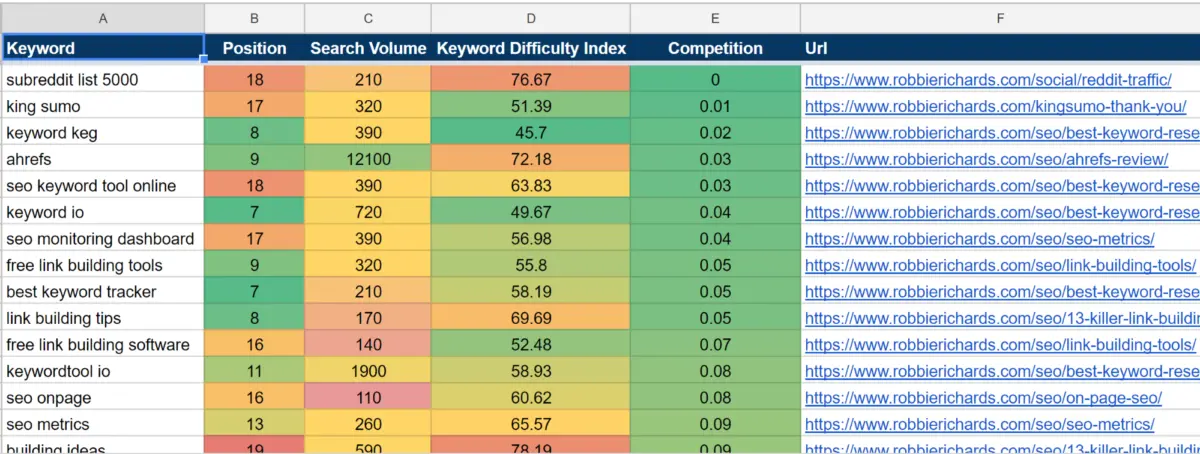
External Automation via Templates: For advanced data manipulation outside the Semrush interface, teams can export these metrics into a standardized Google Sheets template. By organizing terms in descending order of search volume and applying color-coded conditional formatting, analysts can instantly spot high-volume, low-competition keywords ready for immediate on-page optimization.
Phase 2: Reverse-Engineering Competitor Success
If your domain is relatively new, or if you have fully optimized your existing footprint, analyzing industry competitors is the fastest route to high-intent keyword acquisition. Semrush facilitates this through granular subfolder analysis and keyword modifier mapping.
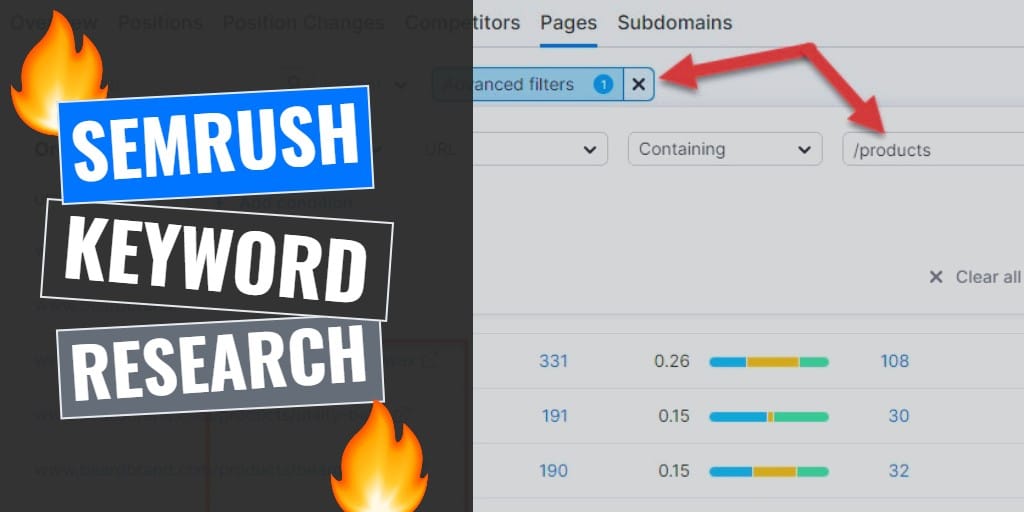
Subfolder & Product-Page Isolation: By examining a competitor’s navigation architecture, you can isolate specific high-value folders. For instance, an e-commerce beard-care brand might filter a competitor like Beardbrand for URLs containing /products, instantly highlighting the top 22 converting product pages. Similarly, a personal injury law firm in Florida can analyze a competitor’s /legal-services/ subfolder to ensure their own practice area pages match every target query driving qualified leads to rival firms.
Modifier-Based Filtering: When competitors lack clean subfolder structures, marketers utilize keyword modifiers (such as "best," "software," "vs," or specific product names) within the Organic Positions report to filter for bottom-of-funnel commercial and transactional intent.
Supporting Context & Metrics: Unlocking Hidden Gaps and Topical Magic
Moving beyond basic keyword tracking requires deep analytical tools designed to expose market blind spots and generate infinite topical variations.
Mastering the Keyword Gap Tool
The Semrush Keyword Gap tool allows strategists to cross-reference their domain against multiple competitors simultaneously, surfacing valuable organic and paid opportunities.
Missing Keywords: Identifies terms for which your competitors rank in the top 100, but your domain does not.
Weak Keywords: Highlights queries where your domain currently ranks, but your position is demonstrably lower than your competitors’, signaling content dilution or insufficient optimization depth.
PPC-Organic Aircover Strategy: Advanced users can perform cross-channel gap analyses. By filtering for keywords where a brand ranks outside the top 3 organic positions and does not currently bid on paid search, marketing teams can deploy targeted PPC campaigns to secure immediate visibility while long-term organic strategies mature.
Armed with the industry’s largest database, the Keyword Magic Tool transforms broad seed terms into thousands of segmented opportunities. By leveraging advanced filters, marketers can target specific buyer-journey stages. For affiliate marketers, filtering seed terms (such as "SEO tools") by consideration-stage modifiers or competitor comparison terms ("Ahrefs vs Semrush") exposes high-intent mid-funnel traffic ready for conversion. Furthermore, isolating question-based keywords ("how to," "what is," "why do") unlocks a vast repository of low-competition informational queries ideal for building top-of-funnel authority.
Official Statements and Industry Insights
As digital marketing ecosystems increasingly integrate artificial intelligence into search algorithms, industry leaders emphasize the critical importance of semantic relevance and topical clustering over isolated keyword targeting.
According to prominent digital marketing educators and SEO strategists, the true power of advanced toolkits like Semrush lies in their seamless ecosystem integration. Rather than forcing marketers to export CSV files across disconnected platforms, integrated suites allow teams to seamlessly push curated keyword lists directly into rank-tracking modules or content-optimization assistants.
"The evolution of search engines demands that we stop treating keywords as isolated strings of text," notes industry analyst Robbie Richards in his comprehensive platform guides. "Modern SEO is about capturing topical authority. By leveraging advanced clustering tools to map out entire semantic landscapes, brands can build structured content hubs that satisfy both search intent and algorithmic evaluation criteria."
Furthermore, Semrush representatives consistently highlight that features like the Keyword Manager and automated clustering algorithms are designed to alleviate data fatigue. By automatically grouping hundreds of disparate queries into cohesive semantic buckets based on SERP overlap, the platform removes the guesswork from content architecture, enabling teams to build streamlined, highly authoritative landing pages that align directly with real-world user intent.
Future Outlook: The Convergence of Intent, AI, and Semantic Clustering
Looking ahead, the future of keyword research will be defined by hyper-personalization, zero-click searches, and generative AI-driven search experiences (such as Google’s Search Generative Experience). As search engines evolve to provide direct answers within the SERP, traditional volume metrics will continue to shift in importance, placing a higher premium on contextual relevance and conversion intent.
Tools like Semrush are already adapting to this paradigm shift by incorporating advanced Intent Filters (Navigational, Informational, Commercial, and Transactional) directly into their core reporting suites. This allows modern SEO professionals to instantly segment keyword lists by user mindset rather than raw search volume alone.
The Rise of Automated Topical Clustering
Manual keyword grouping is rapidly becoming obsolete. The future belongs to automated topical clustering engines capable of ingesting thousands of raw keywords and instantaneously structuring them into parent-child content hierarchies.
Scalable Content Hubs: By identifying "high ranking potential" clusters—groups of terms characterized by high aggregate search demand and low keyword difficulty—enterprises can systematically deploy content hubs that establish instantaneous topical authority.
Workflow Efficiency: The deep integration between research modules (Keyword Manager), tracking modules (Position Tracking), and production modules (SEO Writing Assistant) signifies an industry-wide trend toward all-in-one operational efficiencies.
In conclusion, mastering Semrush for keyword research is no longer merely an optional tactical skill—it is an absolute operational necessity for any organization looking to scale its digital footprint sustainably. By systematically auditing existing rankings, dissecting competitor architectures, closing keyword gaps, and building data-backed topical clusters, marketers can future-proof their organic strategies against algorithmic volatility and secure long-term digital dominance.