

Executive Overview
In the fast-paced ecosystem of search engine optimization (search engine optimization), relying on weekly or monthly rank tracking updates is a recipe for missed opportunities and declining revenue. Because search engine result pages (SERPs) are volatile, algorithms shift unpredictably, and user intent evolves, digital marketers and enterprise SEO teams need real-time intelligence. Organic search positions can skyrocket or plummet within hours due to competitor updates, local algorithm shifts, or sudden alterations in SERP features like featured snippets, local packs, and knowledge graphs.
To maintain competitive parity, SEO professionals have turned en masse to dedicated daily rank tracking software. While virtually all legacy rank checkers allow users to monitor keywords across broad geographies and multiple devices, top-tier platforms distinguish themselves through high-frequency updates, granular local reporting down to the ZIP-code level, robust SERP feature tracking, and on-demand data refreshes.

This comprehensive review examines the mechanics of choosing the optimal daily rank tracker. It evaluates the top 10 market-leading solutions—split between specialized standalone applications and robust all-in-one SEO platforms—to help your business navigate the increasingly volatile modern search landscape.
Detailed Chronology: The Evolution of Rank Tracking
To understand why daily rank tracking has become non-negotiable, it helps to examine how the SEO data landscape has evolved over the past decade.

- The Era of Manual Checks and Weekly Scraping (Early 2010s): In the nascent days of scalable SEO, tracking rankings was resource-intensive. Practitioners relied on desktop-based scrapers that ran on localized servers, often requiring weekly batches to avoid triggering search engine CAPTCHAs or IP bans. Data was inherently stale, and agencies often scrambled to explain sudden traffic dips discovered days after they occurred.
- The Rise of Cloud-Based Automated Monitoring (Mid-2010s): As cloud infrastructure matured, SaaS-based rank trackers emerged. Platforms began scheduling automated daily jobs to pull keyword positions. However, these updates were typically locked into rigid schedules (e.g., once every 24 hours at a predetermined server time), leaving a massive blind spot for campaigns requiring agile, real-time interventions.
- The On-Demand Revolution (Late 2010s to 2020s): Driven by sophisticated enterprise demands, market leaders introduced on-demand data refreshes. Tools began leveraging complex API integrations and distributed proxy networks to fetch live SERP data instantly. Today, modern daily rank trackers are no longer passive monitoring dashboards; they are active intelligence hubs that track micro-fluctuations, monitor over 50 distinct SERP features, and synthesize granular device-level performance metrics on demand.
Supporting Context & Metrics: Key Considerations in Choosing a Daily Rank Tracker
Selecting the right software requires balancing technical capabilities against budgetary constraints and operational scope. Industry benchmarks highlight seven critical pillars that should guide your procurement decision.
1. Accuracy and On-Demand Data Refreshes
Frequency and precision are foundational. Because modern search results are hyper-personalized based on user location, search history, and device type, static tracking is no longer viable. The best tools offer scheduled daily updates supplemented by an on-demand refresh button. This allows analysts to instantly re-check keyword positions after pushing a major site migration, content update, or technical fix.

2. Scalability Across Keywords and User Seats
As digital portfolios grow, software costs can scale unpredictably. When evaluating platforms, analyze how pricing tiers respond to volume expansions. A tool that appears economical for 100 keywords may become cost-prohibitive when scaling to 10,000 keywords across multiple client accounts or enterprise departments.
3. Geographic, Device, and Competitor Granularity
Keywords behave differently on mobile screens versus desktop monitors, and search results vary dramatically across geographic regions—from countrywide searches down to hyper-local ZIP codes. Enterprise-grade rank trackers must provide device segmentation alongside competitor benchmarking features to measure your share of voice relative to market rivals.

4. Multi-Search Engine Support
While Google remains the dominant global search engine, consumer behavior dictates multi-channel visibility. Depending on your vertical, your tracking stack must support alternative search ecosystems, including Bing, Yahoo, international engines like Baidu and Yandex, or specialized retail and video networks like Amazon and YouTube.
5. Comprehensive SERP Feature Monitoring
Securing a top-three blue link is only half the battle. Modern SERPs are dominated by visual elements—featured snippets, image packs, video carousels, local packs, and People Also Ask boxes. A sudden traffic drop is frequently caused by losing a featured snippet to a competitor rather than an overall drop in organic rank. Monitoring these visual real-estate shifts daily is crucial.

6. Historical Data Depth
To diagnose seasonality and algorithm update impacts, software must store historical data efficiently. While many tools retain daily logs for a short window (e.g., 60 days) before rolling data into weekly snapshots, long-term historical visibility is vital for year-over-year performance audits.
7. White-Label and Advanced Reporting
For internal stakeholders and client-facing agencies alike, reporting capabilities are paramount. The ability to generate scheduled, unbranded or custom-branded (white-label) PDF reports, coupled with native integrations into business intelligence suites like Google Looker Studio (formerly Data Studio), ensures stakeholders remain aligned on performance.

The Top 10 Daily Rank Tracking Software Solutions
The market divides neatly into two distinct categories: dedicated standalone rank tracking applications built exclusively for speed and precision, and comprehensive all-in-one SEO suites that incorporate robust rank-tracking modules.
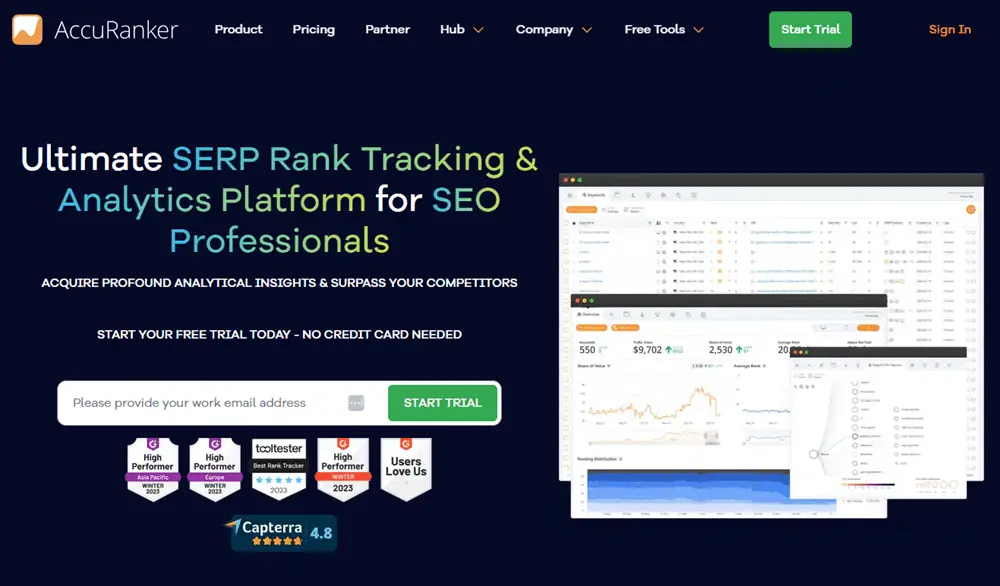
1. AccuRanker (Best Standalone Daily Rank Tracker)
AccuRanker is widely recognized as the market’s fastest and most accurate standalone daily rank tracker. Trusted by over 32,000 companies globally—including enterprise brands like IKEA and Kinsta—it is engineered specifically for speed and massive keyword volume processing.

- Core Strengths: Lightning-fast daily data processing, instant on-demand keyword refreshes, deep integration with Google Data Studio, and advanced SERP feature ownership graphs that track over 50 distinct SERP elements.
- Pricing: Starts at $116/month for 1,000 daily tracked keywords.
2. Semrush (Best Daily Tracker within an All-in-One SEO Platform)
Semrush is an industry-standard, all-in-one digital marketing suite utilized by over 10 million professionals across major brands like Tesla, IBM, and Samsung. Its dedicated Position Tracking tool delivers comprehensive daily desktop and mobile monitoring paired with deep competitive intelligence.
- Core Strengths: Multi-targeting capabilities (device and exact location tracking), extensive historical data storage, robust competitor benchmarking, and seamless integration with a massive suite of on-page and technical SEO tools.
- Pricing: Starts at $119.95/month for 500 daily tracked keywords.
3. Nightwatch (Accurate and Affordable Standalone Tracker)
Nightwatch stands out for its exceptional accuracy and hyper-local capabilities. Trusted by global brands like Shopify and Booking.com, it allows marketers to track rankings down to the precise ZIP-code level across virtually all major search engines.

- Core Strengths: Hyper-local tracking, clean data visualization dashboards, multi-engine support, and highly competitive pricing for SMBs.
- Pricing: Starts at $32/month for 250 daily tracked keywords.
4. Pro Rank Tracker (Best Value with Advanced Reporting)
Pro Rank Tracker is a specialized standalone tool utilized by over 60,000 agencies and brands worldwide, including Fuel Online. It relies on a proprietary algorithmic engine to deliver fast, highly accurate rankings and industry-leading reporting formats.
- Core Strengths: Exceptional progress and benchmark reporting, scalable agency features, and an intuitive user interface.
- Pricing: Starts at $13.50/month for 100 daily tracked keywords.
5. SERPWatcher by Mangools (Most Intuitive User Experience)
SERPWatcher is part of the Mangools all-in-one SEO ecosystem, trusted by over 25,000 customers including Adidas and Airbnb. It is celebrated for its clean, beginner-friendly interface and unique "Performance Index" metric.

- Core Strengths: Extreme ease of use, beautiful visual reporting, and cost-effective bundling with other Mangools research tools.
- Pricing: Starts at $29.90/month for 200 daily tracked keywords.
6. Advanced Web Ranking (Enterprise-Scale Standalone Tool)
Advanced Web Ranking (AWR) is a venerable standalone platform designed to handle massive data loads. Trusted by tech giants and agencies like Microsoft and Amazon, AWR excels at processing extensive keyword portfolios with customizable update frequencies.
- Core Strengths: Massive keyword capacity per tier, highly flexible white-label reporting, and robust multi-device segmentation.
- Pricing: Starts at $99/month for tracking up to 7,000 keywords.
7. Wincher (Simple and Affordable Google Specialist)
Wincher provides a streamlined, highly focused tracking experience tailored specifically for Google search results. It is utilized across 150 countries by brands such as Philips and Bonnier.

- Core Strengths: Minimalist design, low learning curve, and budget-friendly entry points for localized campaigns.
- Pricing: Starts at $39/month for 500 daily tracked keywords.
8. SE Ranking (Scalable All-in-One SEO Suite)
SE Ranking is a versatile all-in-one platform featuring a 100% accurate position tracking module. Trusted by major firms like Zapier and Trustpilot, it offers highly flexible subscription plans tailored to growing agencies.
- Core Strengths: Highly customizable pricing tiers, comprehensive site auditing integration, and detailed competitor ranking visibility.
- Pricing: Starts at $39.20/month for 250 daily tracked keywords.
9. Authority Labs (Automated Updates and Data Recovery)
Authority Labs is a reliable standalone tracker renowned for its automated daily update reliability and its unique ability to help recover insights from "not provided" keyword data pools.

- Core Strengths: Dependable scheduling automation, straightforward reporting, and historical data export options.
- Pricing: Starts at $49/month for 250 daily tracked keywords.
10. Ranktracker (All-in-One Suite with Real-Time Tracking)
Ranktracker rounds out the field as an all-in-one platform featuring a robust real-time tracking module utilized by global marketing teams at brands like Apple and Red Bull.
- Core Strengths: Real-time visibility, integrated keyword research utilities, and accessible price points.
- Pricing: Starts at $24/month for 100 daily tracked keywords.
Bonus: Google Search Console (The Free Baseline)
While not a dedicated daily rank tracking software in the traditional sense, Google Search Console is an essential, 100% free utility provided by Google. It allows publishers to review organic search traffic, impressions, click-through rates, and average positions across actual user queries. However, because it lacks specific keyword targeting controls and real-time on-demand scraping, it serves best as a complementary validation layer alongside paid software.

Future Outlook: The Next Generation of SERP Intelligence
As search engines incorporate generative AI experiences—such as Google’s Search Generative Experience (SGE) and Microsoft Copilot—the nature of ranking positions is undergoing a structural transformation. Traditional top-ten blue links are sharing screen real estate with AI-generated summaries, conversational query boxes, and dynamic media blocks.
Consequently, the future of daily rank tracking software will extend beyond numerical positions (1 through 100). The next wave of tools is projected to incorporate:

- AI Visibility Scoring: Measuring how often a brand is cited within generative search answers.
- Real-Time Volatility Alerts: Predictive machine-learning models that warn marketers of algorithmic shifts before traffic declines hit bottom lines.
- Unified Omni-Channel Dashboards: Blending traditional web search tracking with video, e-commerce marketplace (Amazon), and app store ranking metrics into a single, cohesive daily feed.
Conclusion and Recommendations
Choosing the right daily rank tracker ultimately depends on your organization’s scope and infrastructure:
- If your priority is pure, unadulterated speed, massive keyword scale, and lightning-fast on-demand refreshes from a dedicated application, AccuRanker remains the premier standalone choice.
- If you require a daily rank tracker deeply embedded within a comprehensive, all-in-one marketing suite to manage content, link building, and technical audits simultaneously, the Semrush Position Tracking Tool stands out as an industry gold standard.
Assess your budgetary framework, keyword volume, and reporting requirements, and equip your SEO team with the real-time intelligence needed to outpace algorithmic volatility.