In the high-stakes digital economy, the cost of a friction-heavy interface is no longer measured merely in "lost clicks." Today, it translates to millions of dollars in wasted engineering spend, squandered market share, and eroded brand equity. For decades, corporate leadership boards viewed user experience (UX) design through a superficial lens—treating it as a cosmetic afterthought, a palette of colors, or a layer of paint applied at the tail end of a software development cycle.
However, that paradigm has fundamentally shifted. Veteran digital product designers and industry analysts now recognize user experience for what it truly is: the primary engine of modern business survival and financial growth.
Bridging the gap between the creative design studio and the corporate boardroom requires a universal language, and that language is hard data. Hard data does not merely advocate for the user; it proves that exceptional UX is a non-negotiable prerequisite for a healthy bottom line. This investigative report examines ten clinically proven, data-backed realities that link user experience directly to revenue generation, user retention, and long-term corporate scaling. Furthermore, it explores the broader economic implications of design maturity, the hidden costs of technical debt, and how emerging artificial intelligence paradigms are reshaping the future of human-computer interaction.
Detailed Chronology: The Evolution of UX from Aesthetics to Analytics
To understand the current valuation of UX in the corporate sector, one must examine how the discipline evolved from a niche sub-section of graphic design into an enterprise-level financial driver.
The Early Mobile-First Era (Late 2000s – Early 2010s)
When the smartphone revolution took hold following the introduction of modern mobile operating systems, digital products migrated rapidly from desktop computers to pocket-sized devices. In this chaotic gold rush, speed to market superseded structural integrity. Companies threw features at digital walls to see what stuck. Interfaces were cluttered, mobile networks were unreliable, and design was largely evaluated based on whether a website looked "cool" or "modern."
The Rise of Quantitative Metrics (Mid-2010s)
As digital markets saturated, acquisition costs soared. Business leaders quickly realized that simply driving traffic to a poorly optimized application was the equivalent of pouring water into a bucket full of holes. The mid-2010s marked a cultural pivot where product managers began pairing qualitative feedback with hard analytics. Funnel drop-off rates, bounce rates, and session durations became the new key performance indicators (KPIs). UX professionals shifted their focus from artistic intuition to empirical research, conducting usability tests, heat-mapping sessions, and cohort analyses.
The Modern Boardroom Integration (Present Day)
Today, the line between product design and overall business strategy has completely dissolved. Organizations that treat UX as a continuous optimization loop—rather than a one-off project—consistently outperform their competitors. The modern UX practitioner is as much an economist and data scientist as they are a visual artist. Armed with robust metrics regarding latency, cognitive load, and human psychology, design leaders now sit at executive tables, arguing their cases with financial forecasts rather than subjective opinions.
Supporting Context & Metrics: The 10 Pillars of UX Financial ROI
The following ten factual pillars represent the current reality of the digital marketplace. Backed by extensive industry research, these principles serve as the financial justification for investing heavily in human-centric design.
1. Fixing Issues in the Design Phase is 100 Times Cheaper
One of the most compelling financial arguments for UX is the legendary 1:100 rule. Landmark studies from organizations such as the IBM Systems Institute and Segue Technologies demonstrate that fixing a software defect or usability error after a product has been developed and launched can be up to 100 times more expensive than addressing it during the initial wireframing and prototyping phase.
Think of comprehensive UX research as "engineering insurance." By the time a developer writes the first line of production code, every user interaction should be thoroughly validated. Discovering a fundamental navigation flaw post-launch means an organization is not merely paying for a quick code patch. Instead, it incurs massive technical debt, wastes hundreds of developer hours, and hemorrhages revenue as users struggle with a broken, frustrating digital flow.
2. Performance Directly Impacts Conversion Rates
A visually stunning interface is utterly worthless if the user bounces before the browser finishes rendering the DOM. The data regarding digital performance is uncompromising: approximately 47% of users expect a web page to load in two seconds or less, and failing to meet this threshold triggers a financial catastrophe.
A mere one-second delay can reduce conversions by 20% and customer satisfaction by 16%.
Global retail businesses lose an estimated $2.6 billion annually strictly due to slow page load times.
When a mobile page load time stretches from one second to three seconds, the bounce rate spikes by 32%, and conversion rates typically plummet from 40% down to 29%.
Conversely, microscopic performance improvements yield monumental financial returns. A microscopic 0.1-second improvement can lift retail conversions by 8.4% and travel site bookings by 10.1%. Optimizing metrics like Largest Contentful Paint (LCP) drives direct, measurable spikes in sales revenue. Speed is not merely an engineering metric; it is a core design feature.
3. Fifty Milliseconds to Impress: The Power of Visual First Impressions
Human beings are wired for rapid environmental evaluation. Research indicates that users form a definitive, subconscious opinion about a website’s visual appeal in approximately 50 milliseconds (0.05 seconds). This split-second "gut feeling" is an evolutionary survival mechanism that dictates whether a user stays to explore a value proposition or clicks away immediately.
Data reveals that 94% of first impressions are strictly design-related. If an interface feels dated, cluttered, or aesthetically unaligned with modern standards, users subconsciously project that lack of quality onto the company’s offline products, services, and operational reliability.
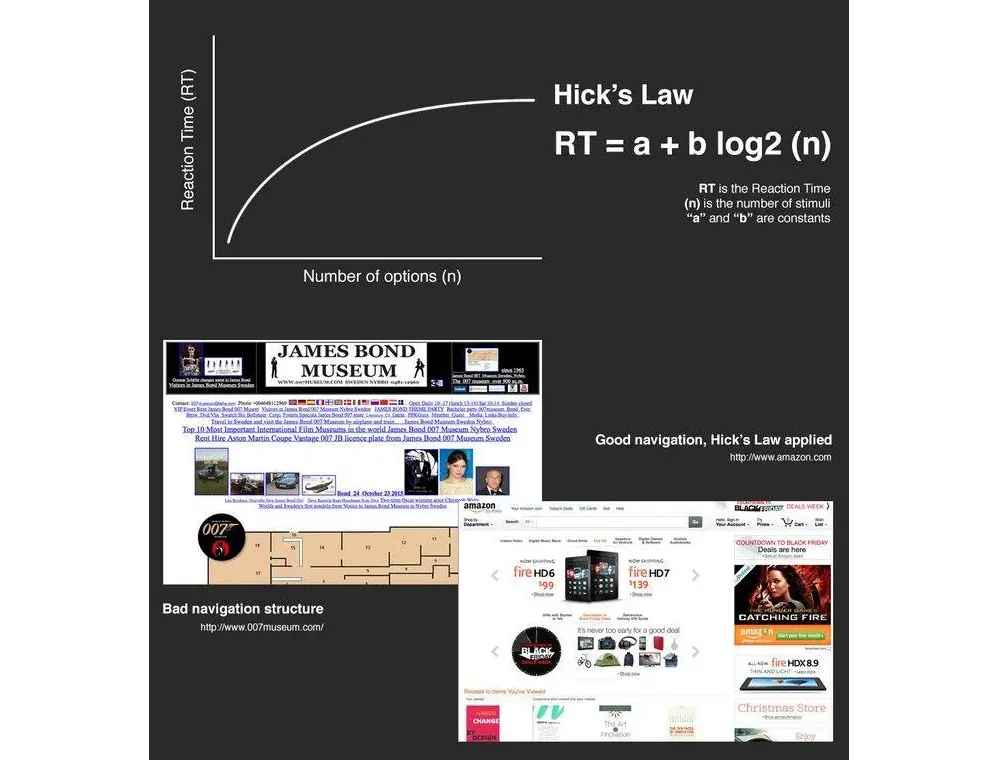
4. Hick’s Law: The Financial Cost of Cognitive Overwhelm
Corporate stakeholders frequently operate under the dangerous assumption that offering more options equals delivering more value to the consumer. Psychology repeatedly proves the exact opposite. Hick’s Law states that the time and cognitive effort required to make a decision increase logarithmically with the number of choices available.
Every superfluous menu item, redundant form field, or competing call-to-action acts as a cognitive "tax" levied upon the user’s brain. Top-performing digital platforms streamline their architectures, achieving conversion rates exceeding 11%, whereas poorly structured competitors languish below 3%. Simplifying user journeys by ruthlessly removing unnecessary friction is one of the fastest paths to higher revenue.
5. White Space is a Tool for Focus, Not Wasted Real Estate
To untrained eyes, "white space" (or negative space) often appears as empty, wasted digital real estate. In professional UX design, it is utilized as an active tool for psychological focus. Strategic implementation of white space can increase content comprehension by up to 20%.
By giving the user’s eyes room to rest, designers actively reduce cognitive load and guide attention toward primary conversion elements, such as "Buy Now" or "Sign Up" buttons. In an era where human attention spans hover around eight seconds, visual simplicity is the ultimate luxury and a powerful driver of digital engagement.
6. The Goal Gradient Effect: Harnessing "Fake" Progress
One of the most fascinating psychological hacks in product design is that users will complete a multi-step task significantly faster if they believe they have already made tangible progress toward the goal. Known as the Goal Gradient Effect, this phenomenon is vividly illustrated by classic loyalty-card studies: a 10-stamp coffee card featuring two pre-filled stamps is completed much faster than an empty 8-stamp card, despite the total requirement being identical.
In digital onboarding flows, displaying a progress bar that starts at 15% immediately upon account creation increases completion rates by over 40%. Designers are not merely arranging pixels; they are managing dopamine pathways and human momentum.
7. Typography, Line Height, and Reading Comprehension
Many content publishers and enterprise stakeholders attempt to cram excessive text "above the fold" to maximize exposure. Data from accessibility and typography studies proves this practice is counterproductive. Proper typography—specifically optimized line spacing (leading), font weight, and comfortable paragraph widths—can increase content comprehension and reading speed by up to 20%.
An optimal line height (typically 1.5 times the font size) eliminates visual noise, enabling the human brain to process information with minimal cognitive friction. If content is physically painful or exhausting to read, users bounce. Legibility is, at its core, a conversion tool.
8. The 20% Rule: Designing for Scanners, Not Readers
Closely tied to typography is the reality of human reading habits on the web. Users do not read digital content linearly; they scan it. On a typical web page, users consume only about 20% to 28% of the total text present.
Because modern audiences scan web pages using an "F-pattern" or "Spotted pattern," designing for deep, academic reading is a tactical error. Effective web layouts rely heavily on clear subheadings, bulleted lists, bolded keywords, and scannable visual hierarchies to ensure core messages are absorbed instantly.
9. Why User Testing with Five People is the Magic Number
Many corporate entities mistakenly believe that comprehensive user research requires massive, six-figure budgets involving hundreds of participants. Usability engineering proves that testing with just five representative users uncovers approximately 85% of usability flaws within a digital product.
This represents a distinct mathematical threshold of diminishing returns. After the fifth user, the frequency of discovering new interface bugs drops precipitously. Consequently, agile organizations gain a massive competitive advantage by conducting small, highly frequent user-testing sprints—testing with five users, iterating rapidly, and repeating the cycle.
10. The Staggering Financial ROI of 9,900%
Perhaps the most persuasive statistic in the entire digital economy is the aggregate return on investment for UX initiatives. Industry benchmarks compiled by enterprise research firms consistently show that every $1 invested in user experience returns an average of $100.
This staggering 9,900% ROI is not mystical; it is the cumulative result of skyrocketing conversion rates, dramatically reduced customer acquisition costs, and slashed support overhead. When a digital product is inherently intuitive, customers do not need to flood call centers or chat support lines with basic troubleshooting queries. Furthermore, Forrester research notes that fully optimized UX designs can improve baseline conversion rates by up to 400%.
Official Statements and Enterprise Perspectives
Industry leaders across the global corporate landscape have increasingly codified these realities into their operational philosophies.
"UX design is no longer a team you hire to ‘make things look nice.’ It is the research-driven, data-backed discipline that ensures your digital product isn’t just a cost centre, but a revenue-generating machine."
In-depth studies conducted by global consultancy McKinsey & Company reinforce this perspective, revealing that companies with high design maturity achieve 32% higher revenue growth and 56% higher total returns to shareholders compared to their design-lagging industry peers.
However, a profound disconnect remains prevalent in the global market. According to comprehensive data from Bain & Company, 80% of companies believe they deliver a "superior customer experience," yet only 8% of customers actually agree with that assessment. This massive "experience gap" represents an extraordinary market opportunity for forward-thinking organizations willing to align their product roadmaps with empirical UX data.
Future Outlook: The Role of Artificial Intelligence in Modern UX
As the digital landscape evolves, discussions surrounding user experience inevitably turn to the integration of artificial intelligence (AI). Far from rendering fundamental UX principles obsolete, AI acts as an exponential accelerator for solving longstanding interface challenges.
AI-driven analytics platforms can now track user hesitation, drop-off points, and micro-interactions in real-time, dynamically altering layouts, personalizing content recommendations, and tailoring form fields to match individual user profiles. Artificial intelligence has successfully transformed static digital maps into living, breathing, adaptive guides.
Nevertheless, the foundational laws of human psychology—our 50-millisecond visual judgments, our aversion to cognitive overload, and our evolutionary need for white space and structured progression—remain immutable. AI does not replace the necessity for deep user empathy and data-driven design; rather, it provides practitioners with sharper scalpels to execute them.
Conclusion
The era of relying on subjective opinions, gut feelings, and executive whims in digital product development has officially drawn to a close. The quantitative data is clear, the psychological principles are proven, and the financial return on investment is undeniable.
Organizations that treat user experience as an afterthought risk falling behind competitors who embrace design as an enterprise-wide strategy. By leveraging the ten data-backed truths outlined in this report—prioritizing performance, reducing cognitive friction, valuing early-stage design interventions, and maintaining a commitment to continuous usability testing—businesses can transform their digital touchpoints from operational cost centers into powerful, self-sustaining revenue engines.