

Executive Overview
In the lifecycle of web development, installing a third-party library is often treated as a permanent solution to a temporary problem. Developers pull down a package to solve a specific engineering hurdle, confirm that the automated tests pass, and move on. Years later, those same dependencies remain buried deep within the application’s package.json, silently anchoring bloated bundle sizes and carrying legacy technical debt.
However, the modern web platform has not remained static. Driven by rapid, coordinated efforts across browser engine vendors, the gap between "you need a library for this" and "the browser handles this natively" is closing faster than at any previous point in web history. For a typical mid-sized JavaScript application, developers can routinely uncover between 60 KB and 90 KB of minified and gzipped dependencies—and several times that in uncompressed weight—that the browser platform can now execute natively.
Tasks that once demanded dedicated utility modules—such as date and number formatting, network requests, complex modal logic, focus trapping, deep cloning, and data grouping—are increasingly solved directly by the browser. Despite this paradigm shift, many development teams fail to audit their dependency trees against modern web standards. While security audits via tools like npm audit are standard practice, organizations rarely ask the fundamental architectural question: Is this library still executing functionality that the native browser engine cannot?
To reclaim control over performance, engineering teams must transition from passive dependency consumers to active platform auditors. By evaluating packages in strategic clusters, applying a rigorous decision framework, and leveraging standardized platform metrics like Baseline, developers can systematically shed hundreds of kilobytes of redundant JavaScript without sacrificing functionality.
Detailed Chronology: The Evolution of Web Platform Capabilities
The transformation of the browser from a simple document viewer into a sophisticated, feature-rich application runtime did not happen overnight. It is the result of years of collaborative standardization and implementation milestones orchestrated by groups like the WebDX Community Group and browser engine teams (Chromium, Firefox, and WebKit).
The Era of Polyfills and Helper Libraries
For much of the 2010s, JavaScript developers operated in a fragmented ecosystem. Inconsistent browser implementations necessitated extensive user-land abstractions. Handling internationalization required heavy third-party codebases for pluralization and date manipulation. Grouping datasets or performing deep copies of objects required external utility suites like Lodash. Managing accessibility constraints within modal dialogs required complex JavaScript orchestration libraries to trap focus and manipulate the DOM’s top layer.

The Rise of the Baseline Standard
To resolve the ambiguity surrounding feature support, the industry introduced Baseline. Maintained by the WebDX Community Group, Baseline provides clear, standardized definitions regarding the safety of web features across major commercial browsers (Chrome, Edge, Firefox, and Safari).
- Newly Available: A feature becomes "Newly" available when it is supported across all major browser engines.
- Widely Available: After a mandatory 30-month maturation window following its initial cross-browser availability, a feature graduates to "Widely" available.
This 30-month window represents a critical operational distinction for engineering audits. Widely available features offer safe, universal drop-in replacements for third-party packages today. Conversely, Newly available features require careful validation against an application’s specific user analytics and audience demographics, or must be protected behind lightweight progressive enhancement checks.
The Current Landscape (2024–2026)
Between 2024 and 2026, a massive wave of native JavaScript and CSS features reached standardization and deployment. The introduction of native grouping (Object.groupBy and Map.groupBy), structured cloning (structuredClone), modern internationalization APIs (Intl.RelativeTimeFormat, Intl.ListFormat), native dialog elements (<dialog>), the Popover API, and CSS Anchor Positioning has fundamentally altered the math of web performance. Technologies that once required specialized packages are now standard primitives of the web platform.
Supporting Context & Metrics: Auditing by Dependency Clusters
Rather than examining a monolithic package.json file line by line, engineering audits yield the highest returns when executed in functional clusters. Performance wins naturally compound when entire categories of third-party wrappers are excised simultaneously.
Cluster 1: Internationalization and Formatting
Internationalization (i18n) represents one of the most immediate opportunities for bundle reduction. Applications frequently bundle packages like timeago.js, numeral, pluralize, and various formatting utilities, accumulating roughly 14 KB of gzipped overhead.
- Relative Time: Instead of relying on
timeago.jsto translate timestamps into strings like "3 hours ago," developers can leverage the Widely availableIntl.RelativeTimeFormat. Combined with a minimal mathematical helper to determine the appropriate time unit, native APIs deliver localized, performant relative formatting. - Numbers and Lists:
Intl.NumberFormathandles currency conversion, thousands separators, percentages, and compact notations natively. Similarly,Intl.ListFormatseamlessly manages sentence construction and Oxford commas without requiring custom array-joining helpers. - Durations: While libraries like
humanize-durationconvert milliseconds into readable strings, the native platform equivalentIntl.DurationFormatprovides a robust alternative. However, because it is currently classified as Newly available, engineering teams must evaluate its compatibility against their user bases or apply conditional loading strategies.
Cluster 2: HTTP Clients and Network Abstractions
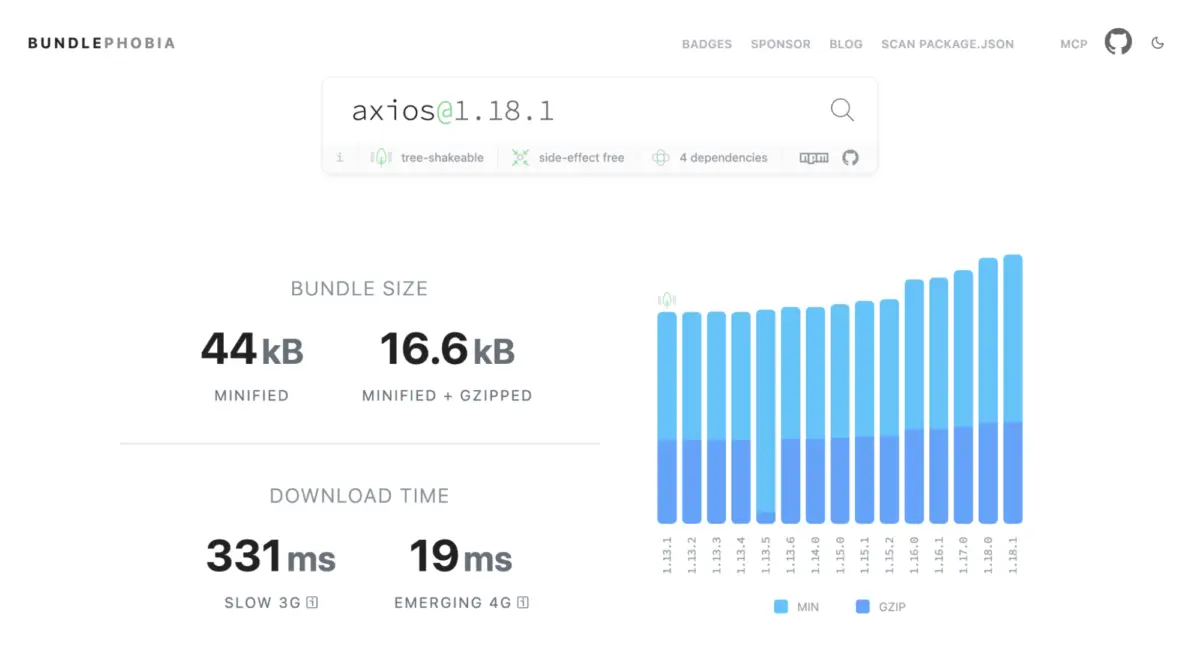
Heavy network libraries such as axios (approximately 17 KB gzipped) and superagent (19 KB gzipped) are frequently installed out of habit. For standard data-fetching operations, the native fetch API, paired with AbortController, provides a powerful, built-in alternative.

While fetch requires explicit handling—such as manually invoking .json() on responses—it eliminates the hidden overhead of large libraries. For advanced capabilities like timeout management, developers no longer need custom wrappers; AbortSignal.timeout() handles request cancellation cleanly at the platform level:
const response = await fetch("/api/data",
  signal: AbortSignal.timeout(5000), // Automatically aborts after 5 seconds
);
const data = await response.json();
While specialized requirements like request interceptors or automated retries may still prompt some teams to retain abstraction layers, basic GET and POST workflows can safely abandon heavy network dependencies.
Cluster 3: UI Primitives and Accessibility Architecture
Historically, implementing accessible user interface components required assembling a fragile stack of external packages: modal dialog managers, focus-trapping utilities (focus-trap), body scroll lockers (body-scroll-lock), and tooltip positioning engines (tippy.js / Popper). Combined, these UI primitives frequently consume upwards of 24 KB gzipped.
The modern web platform replaces this fragmented stack with three native features:
- The
<dialog>Element: Widely available, native dialogs automatically manage focus shifting, background inertness,Escapekey listeners, and top-layer rendering without competing with complexz-indexstylesheets. - The Popover API: Offering light-dismiss behavior and top-layer display out of the box, the Popover API eliminates custom JavaScript for dropdowns and tooltips.
- CSS Anchor Positioning: Handling the complex mathematics of pinning floating elements to trigger targets, anchor positioning replaces external libraries like Popper with clean, declarative CSS rules.
Additionally, background scroll locking—previously requiring dedicated packages—is now elegantly achieved via native CSS pseudo-classes:
body:has(dialog:modal)
  overflow: hidden;
Cluster 4: Lodash and Utility Suites
Utility libraries are rarely imported in their entirety today, but standalone packages like lodash.clonedeep, lodash.groupby, and full Lodash builds continue to bloat production bundles.

- Grouping Datasets:
Object.groupByandMap.groupByorganize collections into plain objects or maps natively, eliminating the need for external utility functions. - Deep Cloning:
structuredCloneoffers a performant, Widely available mechanism for deep copying data structures. Unlike JSON serialization workarounds,structuredClonecorrectly preserves dates, maps, sets, array buffers, and circular references. - Set Operations: Native
Setobjects now support built-in mathematical operations includingintersection,union,difference,symmetricDifference, and subset/superset validations.
Official Statements and Architectural Frameworks
To prevent regressions or user-facing bugs during a dependency audit, teams must implement a structured decision framework before removing packages. Industry experts recommend evaluating every migration candidate against three core questions:
- Is the replacement Baseline-safe for my specific audience?
Development teams must cross-reference native platform features against user analytics and configuration data rather than abstract standards. B2B dashboards populated by users on modern, evergreen browsers present very different risk profiles than consumer-facing portals accessed via legacy mobile hardware. - What are the actual performance costs of the swap?
Replacing a lightweight utility library with a massive native polyfill can inadvertently increase total bundle size. For instance, premature migrations to emerging APIs likeTemporalcurrently require substantial polyfills that outweigh traditional date libraries likedayjs. - Does the native platform feature cover edge-case usage?
Third-party libraries often bundle auxiliary features alongside core functionality. Teams must audit their internal codebase usage to ensure that dropping a dependency does not leave critical application logic unimplemented.
Future Outlook: The Horizon of Platform Evolution
As the web platform continues its aggressive expansion, the boundary between native capabilities and user-land libraries will shrink further.
Features currently tracking toward broad standardization—such as advanced date-time math via Temporal, expanded CSS nesting primitives, and sophisticated state-driven animations—promise to render even more specialized libraries redundant. However, the true metric of architectural maturity is not the total elimination of dependencies, but the deliberate and continuous evaluation of what the browser can handle on its own.
Engineering organizations that institutionalize a quarterly dependency audit routine will consistently ship smaller, faster, and more maintainable applications. By aligning development practices with modern Baseline standards, teams can effectively hand redundant workloads back to the browser engine, ensuring a leaner, higher-performance experience for users across the globe.