

Executive Overview
Every website hits its operational and aesthetic zenith on the exact day it launches. The final git branch is successfully merged, the deployment scripts execute without a hitch, and the production URL goes live reflecting an immaculate, precisely engineered vision. In that singular moment, the site is technically and stylistically flawless.
And it will never be that good again.
This steady, predictable regression has long been accepted as an immutable law of digital physics. Not because the underlying code breaks or servers fail, but because the world outside the browser continues to move. Markets pivot, brand messaging evolves, competitors deploy aggressive new feature sets, and design systems mature. Slowly, imperceptibly, the carefully crafted digital asset stops matching the living, breathing enterprise it is meant to represent. A year into its lifecycle, a website ceases to be a cutting-edge communication tool and becomes a period piece—functional, perhaps, but fundamentally behind the curve.
For decades, development teams, product managers, and marketing departments have recognized this systemic decay, treating it as an inevitable overhead cost of doing business. However, the maturation of autonomous AI agents promises to fundamentally disrupt this paradigm. Platforms like Fimo are pioneering an era where websites do not drift away from their launch-day perfection, but instead continuously, quietly optimize themselves in the background while human teams focus on higher-order creative and strategic problems.
Yet, as engineers and platform architects take the concept of total website autonomy to its logical conclusion, they inevitably collide with a profound paradox: almost nobody actually wants a website that changes entirely on its own.
This article explores the architectural, psychological, and design challenges of building fully autonomous web systems, drawing on insights from Pierre Burgy and the development of Fimo. We examine why "total autonomy" is a flawed initial target, how teams must rethink control boundaries, and why the ultimate goal of artificial intelligence in web development is not to replace human oversight, but to eliminate digital decay.
Detailed Chronology: From Static Deploys to Autonomous Loops
To understand the current shift toward autonomous web infrastructure, it is helpful to trace how web maintenance has evolved over the past three decades.
Era 1: The Manual Epoch (1995–2010)
In the early days of the commercial web, websites were collections of static files uploaded via FTP. Every update—whether fixing a broken hyperlink, updating a copyright year, or overhauling a product page—required manual intervention. Maintenance was labor-intensive, reactive, and prone to human error. If a company grew or its messaging shifted, the website was often the last entity to reflect those changes.
Era 2: The Content Management System (CMS) Revolution (2010–2020)
The rise of platforms like WordPress, Drupal, and later headless CMS architectures democratized publishing. Content could be updated without touching raw code. However, while CMS platforms made publishing easier, they did not solve the underlying problem of maintenance fatigue. Broken links, uncompressed images, accessibility regressions, and out-of-sync design tokens still accumulated over time. Maintenance remained a chore that competed directly with product development and strategic innovation.
Era 3: The CI/CD and DevOps Era (2020–2024)
Modern frontend frameworks (React, Vue, Svelte) and continuous integration/continuous deployment (CI/CD) pipelines streamlined how sites were built and shipped. Automated testing tools could catch broken builds or failing unit tests before code hit production. Yet, these systems remained strictly deterministic. They only checked what humans explicitly told them to check, and they lacked the contextual awareness to recognize when a piece of copy felt stale or when a design system token update failed to propagate across legacy pages.
Era 4: The Autonomous Agent Paradigm (2024–Present)
We have now entered an era defined by goal-directed, autonomous software agents. Unlike static scripts or deterministic CI/CD pipelines, modern AI agents possess contextual understanding, multimodal reasoning capabilities, and the agency to execute multi-step workflows.
When applied to web infrastructure, these agents promise a radically different operational model. Imagine a typical morning: while internal teams sleep, an autonomous agent detects that last week’s design-system color token change failed to propagate to the edge cases on the pricing page, and automatically patches it. Another agent flags a set of high-resolution product images that were shipped uncompressed during a rushed late-night release, optimizing their payloads without sacrificing visual fidelity. A third agent identifies an accessibility regression introduced by a newly deployed React component, automatically generating a patch or flagging it for human review.
The user wakes up to a website that is measurably superior to the one they left the evening before, accompanied by a concise, high-signal audit log of the few critical decisions that genuinely required human eyes. This is the promise of the autonomous web.
Supporting Context & Metrics: The Anatomy of Digital Decay
The hidden tax of maintaining a modern digital presence is staggering. According to industry benchmarks compiled across enterprise and mid-market web operations:
- 80% of routine web maintenance consists of repetitive, rule-bound tasks: verifying WCAG accessibility compliance, updating metadata tags, compressing newly uploaded assets, and fixing broken inbound/outbound links.
- Over 65% of websites suffer from design-system fragmentation within six months of launch, where rapid feature deployments introduce inconsistent UI components, mismatched typography, and divergent color tokens.
- The average enterprise digital team spends upward of 30% of its engineering and design cycles managing technical debt and visual drift rather than building core product experiences.
When Pierre Burgy and his engineering team set out to build Fimo—an autonomous website platform—their initial thesis was straightforward: make the website entirely autonomous. They assumed that complete automation was the ultimate feature, the logical endpoint of applying advanced LLMs and agentic workflows to web development.
However, user behavior quickly challenged this assumption. When placed in front of a fully autonomous website engine that could rewrite, edit, optimize, and publish changes without human intervention, users did not celebrate. They hesitated.
This hesitation did not stem from a fundamental distrust of artificial intelligence. Rather, it exposed a foundational organizational reality: a website has no single owner.
Different segments of a web property belong to different stakeholders across an organization—designers, developers, copywriters, product managers, and executives. Crucially, each stakeholder maintains a radically different tolerance for autonomy. A blanket "on/off" switch for AI agency fails because the boundary between what should be automated and what must remain human-controlled varies wildly depending on who is looking at the screen.
Official Statements & Architectural Insights
To navigate this complexity, the Fimo team realized that building an autonomous web platform required dismantling the monolithic "all-or-nothing" approach to AI delegation. They categorized web operations into three distinct operational tiers:
1. The No-Brainer Chores (The 80%)
At the base of the operational pyramid lies the vast majority of web maintenance: rule-bound, repetitive, and entirely devoid of creative joy.
- Ensuring WCAG contrast ratios remain compliant as pages dynamically update.
- Propagating global design-system token updates.
- Catching obsolete meta tags, uncompressed image assets, or broken hyperlinks caused by historical URL restructuring.
As Pierre Burgy notes, none of this is where human talent thrives. "Nobody was hired because of their gift for spotting a missing alt attribute." Handing these tasks over to autonomous agents does not threaten human employment; it relieves professionals of tedious operational overhead.
2. The Untouchable Core (The Judgment Zone)
At the opposite end of the spectrum lies work that cannot be delegated at any price. An agent can verify that a new landing page adheres to structural rules, passes contrast checks, and aligns with an existing style guide. However, an agent cannot inherently decide what a page should feel like, nor can it evaluate whether a creative direction possesses artistic merit.
This subjective judgment is precisely why creative professionals are hired. While critics of AI often point to this category to argue against web autonomy, they mistake the exception for the rule. This untouchable core represents only a tiny fraction of total web operations, yet it matters more than everything else combined. Protecting this domain is essential, but it should not preclude automating the surrounding infrastructure.
3. The Personal Boundary (The Stakeholder Divide)
Between the undeniable chores and the untouchable core lies a vast middle ground where no out-of-the-box product setting can succeed, because the boundary line runs through different places for different people.
Consider a concrete scenario: changing the default site theme to dark mode for incoming visitors.
- The Developer: For a software engineer focused on system optimization and user preferences, this is a one-line default with a clear rationale. They would happily let an agent apply the change and move on.
- The Brand Designer: For the designer who owns the organization’s visual identity, the default theme is not a trivial setting; it is an intentional statement regarding how the brand wishes to be perceived first. They demand absolute control over that decision.
The underlying task is identical, yet the required amount of human judgment varies completely based on the stakeholder’s role. Consequently, product architectures must abandon global toggles in favor of granular, role-specific, and task-specific agent composition.
Future Outlook: Composing Agents, Not Configuring Settings
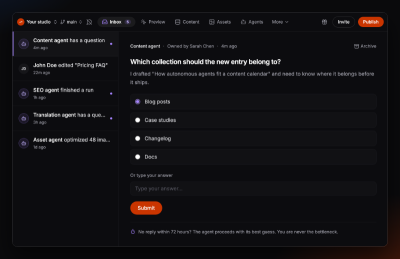
The realization that autonomy is deeply personal transformed how platforms like Fimo approach software architecture. Users do not simply choose between "approve" and "delegate" via a binary settings menu. Instead, they compose agents, defining precisely what each specialized digital worker is permitted to touch.
+-------------------------------------------------------------------------+
<span>                  FIMO AUTONOMOUS AGENT ECOSYSTEM                        </span>
+-------------------------------------------------------------------------+
|                                                                         |
|  [Accessibility Agent] ---> Trusted Unattended Execution (Rules-based)  |
|  [Asset Optimization]  ---> Continuous Background Compression           |
|  [Localization Agent]  ---> Contextual Translation & Cultural Check     |
|  [Content Agent]       ---> Human-in-the-Loop Review (Brand-facing)     |
|                                                                         |
+-------------------------------------------------------------------------+
Organizations can deploy an accessibility agent with full autonomy to run unattended, while keeping a content agent on a strict human-approval leash for any copy that touches core brand positioning.
Crucially, these agents are dynamic. They learn from operational history, error logs, and direct human feedback. The boundary set during week one does not remain fixed forever. Tasks that initially required rigorous manual approval gradually transition into autonomous workflows as the agent earns institutional trust through transparent, auditable performance. Every automated run maintains a clear change log with before-and-after states, ensuring that oversight remains frictionless and verifiable.
Conclusion: Eliminating the Frozen Site
As we look toward the future of digital product development, the greatest threat to an organization is no longer accidental breakage caused by an overzealous algorithm. The real risk is a site that never changes at all.
A frozen website does not preserve security or brand integrity; it simply drifts backward into obsolescence while the enterprise it represents continues to evolve. By reframing artificial intelligence not as a mechanism to replace human creativity, but as an engine to eradicate digital decay, autonomous web platforms are redefining what it means to build and maintain a presence on the modern internet.
The point of web autonomy was never to remove humans from their websites. It was to remove the decay.