

Executive Overview
The prevailing narrative in the contemporary tech ecosystem is built upon a foundational, unexamined premise: that humanity is collectively gasping for more artificial intelligence. Corporate boardrooms, venture capital syndicates, and Silicon Valley product roadmaps operate under the silent assumption that every workflow, application, and consumer product can—and should—be infused with generative AI. The corporate dream envisions a frictionless utopia where outdated human practices are magically bulldozed by autonomous algorithms, conversational chatbots, and proactive AI agents.
Yet, a profound chasm has opened between what technology leaders project and what the market actually tolerates. Behind closed doors, in productivity metrics, and through rising rates of user attrition, a different reality is taking shape. People do not want more AI. At least, not in the uninvited, disruptive, and poorly integrated ways it is currently being forced upon them.
While enterprise deployment costs skyrocket and reputational risks mount, studies reveal that many touted AI features suffer from remarkably low long-term adoption and retention. Rather than sparking joy or unbridled enthusiasm, the relentless rush to "bolt on" AI tools often induces anxiety, workflow fragmentation, and digital fatigue. This investigative report explores why the AI-first revolution is alienating its intended beneficiaries, what users actually require from technology, and how the industry must pivot toward an "AI-second" paradigm to reclaim genuine utility.
Detailed Chronology: The Evolution of the AI Push and the Backlash
To understand how the current friction materialized, it is necessary to examine the trajectory of the AI boom over recent years.
Phase 1: The Gold Rush and the "Bolt-On" Era (2022–2023)
Following the explosive public debut of advanced generative models, organizations panicked. Fearing obsolescence, corporate leadership initiated a frantic race to infuse AI into every existing product line. Software suites that had functioned reliably for decades suddenly found themselves retrofitted with floating chat windows, generative text generators, and automated summaries. During this phase, speed of delivery superseded thoughtful design. "Powered by AI" was treated as a self-contained value proposition, with little regard for whether the underlying problems actually required algorithmic intervention.
Phase 2: The Reality Check and Workflow Fracturing (2024–2025)
As the novelty wore off, enterprise users began to push back. Instead of saving time, employees found themselves hopping across an increasingly fragmented ecosystem of disconnected tools. Every new AI feature demanded a separate login, a new paradigm of prompting, and—crucially—endless hours spent hunting down and correcting "hallucinations." Rather than reducing labor, AI began to intensify it. Workers reported spending more time managing notifications, reviewing machine-generated "slop," and fixing predictable errors than they would have spent executing the tasks manually.
Phase 3: The Awakening and the Call for "AI-Second" Design (2026 and Beyond)
Today, the industry stands at an inflection point. Data from workplace tracking studies and prominent usability research institutions (such as the Nielsen Norman Group) paint an undeniable picture: AI features that disrupt established mental models are being resisted or silently ignored. The conversation is finally shifting away from speculative automation toward calm, ambient, and deeply integrated utility. The market is demanding a transition from "AI-first" disruption to "AI-second" support.
Supporting Context & Metrics: The Human Cost of Forced Automation
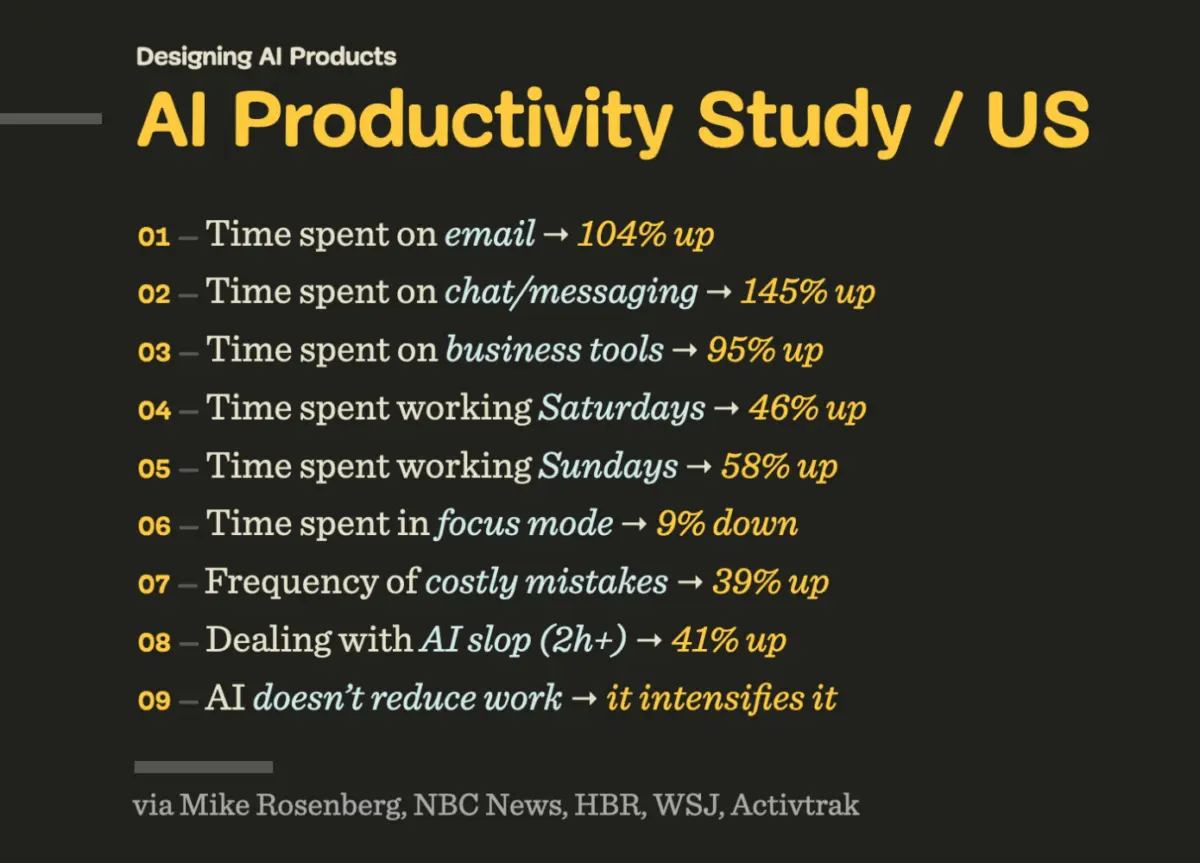
The corporate enthusiasm for generative tools is frequently divorced from empirical ground truths regarding productivity and psychological well-being. A comprehensive cross-industry productivity study synthesizing data from NBC News, Harvard Business Review, the Wall Street Journal, and ActivTrak reveals a startling paradox: AI does not reduce work; it intensifies it.

The Numbers Behind the Fatigue
- Email & Communication: Time spent managing email surged by 104%, while chat and messaging tool usage jumped by 145%.
- Business Tool Overload: Utilization of general business applications rose by 95%.
- Erosion of Rest: Weekend work saw sharp increases, with working on Saturdays up 46% and Sundays up 58%.
- Cognitive Decline: Focus mode metrics dropped by 9%, while costly errors and mistakes escalated by 39%.
- Content Pollution: Dealing with low-quality automated outputs ("AI slop") required 41% more administrative cleanup.
These statistics expose the fallacy of the automated workplace. When organizations deploy AI as an intrusive overlay rather than an organic enhancement, it creates an avalanche of superficial output. Employees spend their days policing machine logic rather than exercising strategic thought.
Furthermore, as noted by strategic UX and design experts, AI is exceptionally good at amplifying existing organizational shortcomings. If a company suffers from poor data quality, broken internal communication, or toxic politics, dropping an LLM into the mix will not resolve those structural defects. Instead, the AI takes those internal inconsistencies and hands them directly to the user as a polished, confident hallucination.
Official Statements and Expert Perspectives
The friction generated by ubiquitous AI integration has prompted sharp critiques from prominent thinkers, designers, and organizational leaders who argue that the technology is overstepping its bounds.
The Value Proposition Fallacy
UX pioneers and design authorities have repeatedly warned that "Powered by AI" is not a valid value proposition. In a widely referenced analysis, David Bland’s Business Model Canvas adaptations clarify that AI properly belongs in Key Activities and Key Resources, never as the core Value Proposition itself. Users do not buy products because they contain neural networks; they buy products because they solve specific problems reliably.

The Humanistic Viewpoint
Perhaps no statement captures the cultural resistance to unbridled AI better than the viral commentary shared by corporate leader and strategist Bo Young Lee:
"I don’t want to read books written by AI. I don’t want to gaze upon paintings by AI. I don’t want AI to teach my children. I don’t want to have an AI therapist. I don’t want AI making my medical decisions. I want AI to do all the physical and mental labor that taxes me so I can read books written by humans and go to art galleries to engage with art made by humans. I want AI that makes my life easier rather than forces me to change myself."
This sentiment underscores a fundamental truth about human psychology: people do not compare software features to theoretical algorithms; they compare features to other features. If an AI feature is unpredictable, unreliable, or slow compared to a deterministic piece of software, it will be rejected. Users crave predictability, accessibility, and absolute reliability. They want technology that respects their intelligence and preserves their agency.
Future Outlook: Moving Toward "AI-Second" Design
If the current trajectory of forced AI adoption is unsustainable, what does the future hold? The path forward requires a fundamental inversion of how product designers and enterprise architects approach intelligent systems.

1. Embracing the "AI-Second" Philosophy
The most successful tools of tomorrow will not shout their algorithmic lineage from the rooftops. They will be subtle, humble, calm, and ambient. They will operate quietly in the background, handling the most mundane, repetitive, and mentally draining administrative labor without demanding constant supervision. By taking on the heavy lifting of data formatting, scheduling cleanup, and basic synthesis, these tools will return precious hours to human workers.
2. Respecting Established Mental Models
Users have spent decades fine-tuning cognitive frameworks for how they interact with software. AI must adapt to these existing mental models rather than forcing users to learn erratic new behaviors, endless prompting techniques, or conversational interfaces where a simple button click would suffice. Good design means the technology bends to human habits, not the other way around.
3. Preserving Creative Joy and Human Agency
Automation should eliminate drudgery, not craftsmanship. Many professions most exposed to AI automation—such as software development, public relations, and design—possess deeply rewarding, creative dimensions that rely on human intuition, empathy, and taste. When AI strips away the mechanical labor while preserving the human core of these disciplines, productivity rises and job satisfaction follows.
However, if organizations continue to use AI as a blunt instrument to downsize staff, accelerate superficial output, and devalue human expertise, they will encounter fierce internal resistance and eventual system failure.

Conclusion
The market has delivered its verdict: People do not need more AI in their lives; they need fewer obstacles.
The true promise of artificial intelligence lies not in creating synthetic art, robotic companions, or unpredictable autonomous agents that meddle in our daily lives, but in quietly absorbing the exhausting administrative toil that drains human energy. By shifting away from flashy, uninvited "AI-first" gimmicks and embracing thoughtful, background "AI-second" integration, the tech industry can finally align its innovations with what humans have always wanted: reliable, fast, accessible tools that give us more time to spend doing what we love—with the people we love.