

Executive Overview
Every second, an incomprehensible torrent of invisible, nearly mass-free particles washes over our planet. Trillions of them pass unhindered through the Earth, through the structural steel of our cities, and directly through our human bodies, leaving no biological trace or physical friction in their wake. Known as neutrinos, these mysterious fundamental particles are among the most elusive phenomena in the observable universe. For decades, they remained purely theoretical constructs—a mathematical fix for what appeared to be violated laws of physics.
Today, however, the paradigm has shifted. Thanks to monumental engineering feats and decades of theoretical persistence, humanity has developed the technological capacity to capture these phantom travelers. This breakthrough era of neutrino astronomy was recently underscored when physicist Francis Halzen was awarded a Nobel Prize in Physics for his decisive contributions to the IceCube Neutrino Observatory and the landmark discovery of high-energy neutrinos of astrophysical origin.
By erecting colossal detectors deep within the Antarctic ice and high atop the arid peaks of the Chilean Andes, contemporary physicists are transforming neutrinos from invisible anomalies into cosmic messengers. These particles offer an entirely unprecedented lens through which to investigate extreme astrophysical environments, including the crushing gravitational grips of black holes, the cataclysmic death throes of collapsing stars, and the primordial furnace of the Big Bang itself.
Detailed Chronology: From Theoretical Despair to Antarctic Triumphs
The story of the neutrino is a textbook example of theoretical physics outrunning experimental capability by decades. Its origins stretch back to the early 20th century, setting off a winding historical timeline that has redefined our understanding of the cosmos.
The 1930s: Wolfgang Pauli’s "Terrible Thing"
In the early 1930s, nuclear physics faced a profound crisis. During observations of beta decay—a specific type of radioactive decay where a neutron transforms into a proton while emitting an electron—physicists noticed that energy seemed to be disappearing. The conservation of energy, one of the most sacredly guarded laws of physics, appeared to be routinely violated.
Refusing to abandon this fundamental law, Austrian physicist Wolfgang Pauli proposed a radical hypothesis in 1930. He suggested that an undetected, electrically neutral particle was quietly carrying away the missing energy during the decay process. Originally, Pauli dubbed this hypothetical entity the "neutron" (though James Chadwick would later apply that name to a much heavier nuclear particle). Recognizing the sheer improbability of ever capturing such a slippery entity, Pauli famously lamented to a gathering of physicists: "I have done a terrible thing, I have postulated a particle that cannot be detected."
1956: Project Poltergeist and the First Proof
For a quarter-century, Pauli’s ghost particle remained strictly a mathematical ghost. That changed definitively in 1956, when American physicists Clyde Cowan and Frederick Reines successfully detected neutrinos for the first time in an ambitious setup known as "Project Poltergeist." Utilizing a nuclear reactor as an intense source of neutrinos, Cowan and Reines proved that these particles were real, physical entities rather than mere theoretical conveniences. This breakthrough confirmed the existence of the neutrino, but it also revealed the immense technical hurdle required to observe them: capturing even a single interaction demanded massive screening apparatuses placed near high-energy nuclear environments.
The 1990s: Francis Halzen and the Vision for the South Pole
As decades passed, physicists realized that Earth-bound nuclear reactors could only tell them so much. The most energetic neutrinos were coming from deep space, carrying pristine data from active galactic nuclei, gamma-ray bursts, and stellar nurseries. However, catching these cosmic interlopers required a detector of staggering proportions.
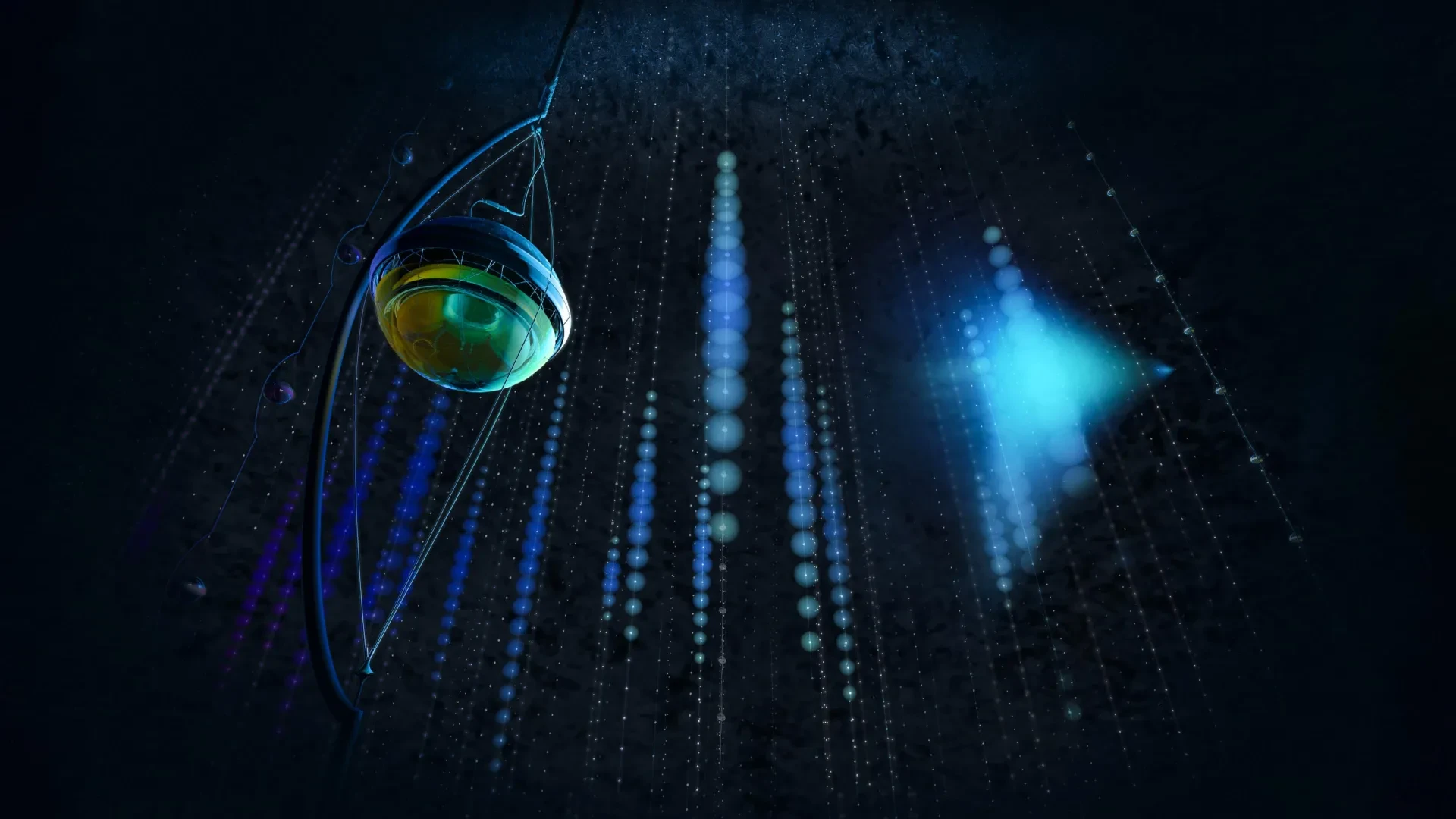
During the 1990s, physicist Francis Halzen recognized that the Earth itself—specifically the most remote and pristine environments on the planet—could be transformed into a particle detector. He championed the vision of utilizing the colossal, ultra-clear ice sheets of the South Pole. Free from bubbles and industrial contaminants, the deep Antarctic ice possessed the optical clarity necessary to spot the faint, fleeting blue flashes of light produced when a rare neutrino collided with an atomic nucleus. This vision eventually materialized into the IceCube Neutrino Observatory, anchoring a new chapter in multi-messenger astronomy.
Supporting Context & Metrics: The Physics of the Phantom
To understand why capturing neutrinos requires kilometer-scale telescopes embedded in miles of ice, one must first examine the bizarre properties that govern these subatomic nomads.
The Anatomy of an Elementary Particle
Neutrinos belong to the elite class of elementary particles, which contemporary physics models suggest have no internal substructure. They manifest in three distinct "flavors," tied to charged leptons:
- Electron neutrinos
- Muon neutrinos
- Tau neutrinos
Unlike protons, electrons, or quarks, neutrinos possess no electric charge, rendering them completely immune to electromagnetism. While they do have mass, it is extraordinarily infinitesimal—potentially ten million times lighter than an electron. Because their exact mass scale remains unmeasured, determining how these masses are generated stands as one of the most pressing quests in modern particle physics.
Furthermore, neutrinos are governed almost exclusively by the weak nuclear force—a fundamental interaction roughly 20 orders of magnitude weaker than electromagnetism. This staggering weakness is why neutrinos can traverse light-years of solid lead as if it were absolute vacuum.
Scale of the Invisible Storm
The ubiquity of neutrinos is matched only by their elusiveness. Cosmological estimates suggest that the universe contains approximately $10^89$ neutrinos. To put that in perspective, there are roughly one billion neutrinos for every single atom in existence.
Locally, the numbers are equally staggering. Approximately 100 billion neutrinos pass through every square centimeter of the human body every single second. Yet, because their interactions with ordinary matter are so vanishingly rare, we walk through this silent, dense storm completely oblivious to its presence.
Official Statements & Expert Perspectives
The profound implications of neutrino research have drawn the life’s work of some of physics’ most brilliant minds. Dr. George Fuller, a Distinguished Professor of Physics at the University of California San Diego, has spent decades unraveling the interplay between nuclear physics, particle astrophysics, and cosmology. Having collaborated with Francis Halzen on foundational papers regarding the conceptualization of IceCube, Fuller offers unique insight into the slippery nature of these particles.
"Neutrinos are truly ghost-like particles," Fuller states, capturing the frustration and fascination of experimental physicists worldwide. "It’s hard to stop them. It’s hard to catch them. How do we even know they exist or where they are?"
Discussing their capacity to penetrate dense matter without slowing down, Fuller emphasizes the sheer scale of their resilience:
"Because the interaction is so weak, neutrinos can get through almost anything. Light years of lead—depending on their energy, they would go right through it."
This resilience is precisely what makes them valuable. While electromagnetic radiation—such as visible light, X-rays, and gamma rays—can be scattered, absorbed, or blocked by intervening dust clouds and gas fields, neutrinos escape dense stellar nurseries and collapsing black holes completely unscathed. They serve as uncorrupted telegrams from the most violent edges of the universe.
Reflecting on the monumental achievement of IceCube and the ultra-high-energy detections that continue to baffle theorists, Fuller notes the pioneering nature of Halzen’s contributions:
"Some ultra-high-energy neutrinos detected at IceCube have roughly 10 billion times the energy of a typical neutrino from the Sun. One detected by a similar experiment has an energy 200 times higher than that. We don’t really know where that neutrino came from. The fact that it got here at all may be saying something profound about the universe. In that sense, Halzen really is at the frontier of experimental fundamental particle physics."
Future Outlook: Beyond Antarctica and into the Big Bang
While the IceCube Neutrino Observatory in the South Pole has revolutionized high-energy astrophysics, the scientific crusade to decode neutrinos is expanding rapidly across multiple geographical and technological frontiers.
High in Chile’s arid Atacama Desert, researchers are deploying entirely different methodologies to capture the echoes of neutrino history. UC San Diego physicists are deeply involved in the operation of the Simons Observatory, situated at an elevation where Earth’s atmosphere thaws into the thin air of space. Led by researchers including UC San Diego Distinguished Professor of Physics Brian Keating, the Simons Observatory primarily targets the cosmic microwave background (CMB)—the primordial radiation left over from the immediate aftermath of the Big Bang.
Although the CMB is essentially ancient light, it holds encoded signatures of the ancient neutrinos that populated the infant universe. By studying minute fluctuations in this primordial radiation, the Simons Observatory aims to extract data regarding the density, behavior, and types of relic neutrinos that formed seconds after the universe began.
The convergence of deep-ice particle detectors like IceCube and high-altitude cosmological instruments like the Simons Observatory marks a golden age for multi-messenger astronomy. By triangulating data from light, gravitational waves, and neutrinos, humanity is gradually assembling a complete, high-definition picture of cosmic evolution.
As George Fuller aptly summarizes:
"Halzen’s work, and the work of those he inspired with his vision, was foundational in giving humanity a new window on the universe and on the mysterious and notoriously slippery neutrino."
As these collaborative global efforts press forward, the ghost particles that have haunted theoretical physics for nearly a century are finally beginning to speak, promising to rewrite our understanding of space, time, and the fundamental laws of nature.