

Executive Overview
The digital advertising and media ecosystem is currently navigating a period of unprecedented regulatory reckoning and technological upheaval. From monumental legal shifts forcing Big Tech to alter its core architecture, to an intensifying battleground for programmatic market share, the industry’s status quo is fracturing.
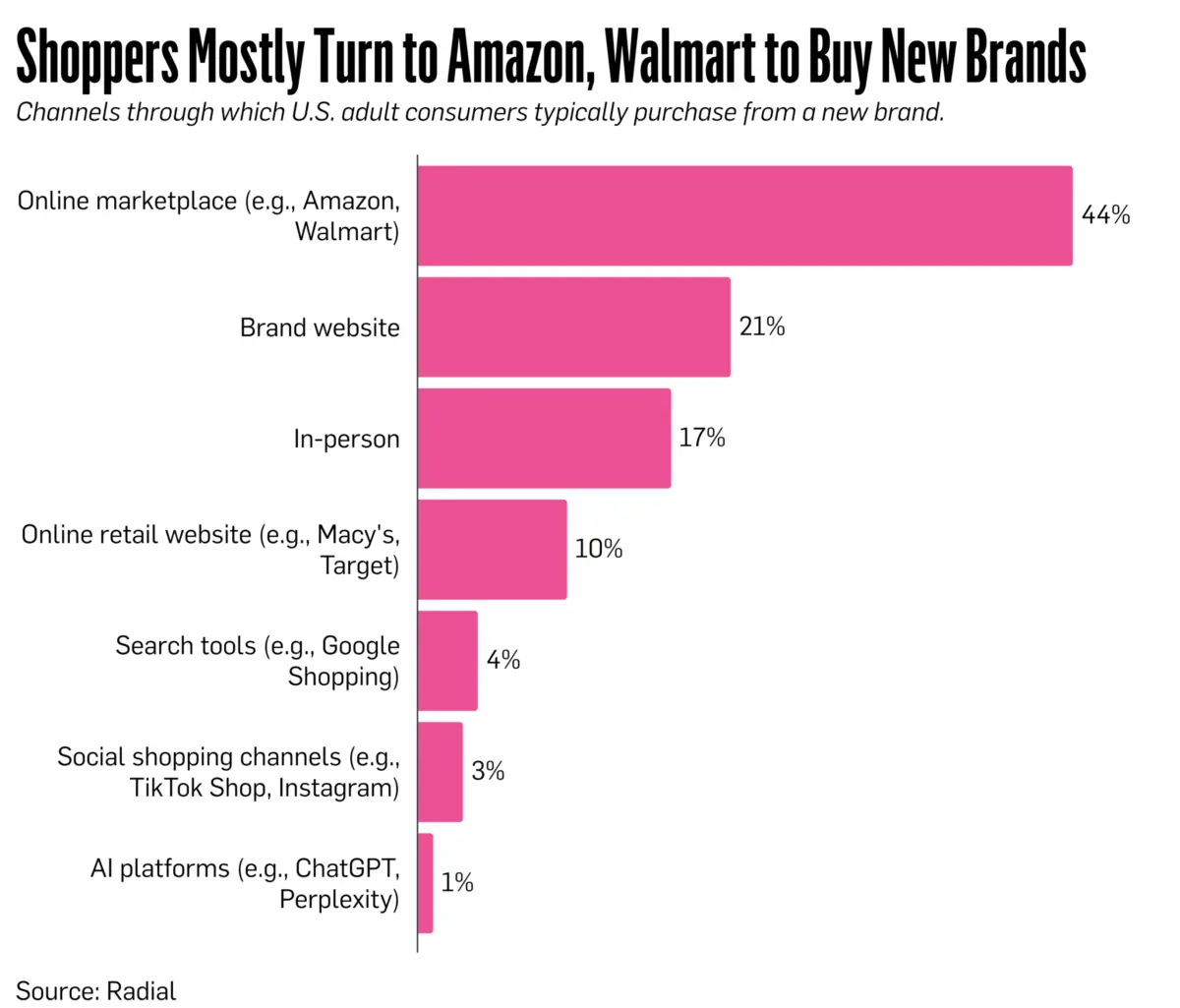
In a historic blow to social media platforms, Meta has agreed to a staggering $17.1 billion settlement with 47 states, conceding to strict limits on addictive design features, beauty filters, and a mandatory two-hour daily cap for minors—a move that fundamentally threatens its advertising funnel. Simultaneously, the e-commerce landscape is experiencing a structural pivot: recent data reveals that digital marketplaces like Amazon and Walmart have officially overtaken brand websites and brick-and-mortar stores as the premier discovery engines for new consumer brands.
Amidst these macro-level transformations, the adtech sector is experiencing its own high-stakes drama. The Trade Desk, once the undisputed Wall Street darling of programmatic advertising, is fighting to orchestrate a dramatic turnaround. Grappling with sluggish revenue growth, severe pricing pressures, executive departures, and a divisive product rollout, the company is betting its future on "agentic" AI. By overhauling its flagship Kokai platform into "Kokai Zuma," ditching its controversial periodic table interface for a streamlined dashboard, and deploying a conversational AI assistant powered by Koa agents, CEO Jeff Green is staking the company’s infrastructure on the promise of autonomous media buying.
This report provides an in-depth, authoritative analysis of these converging pressures, exploring the structural changes reshaping monetization, consumer behavior, and enterprise strategy across the advertising ecosystem.
Detailed Chronology: A Transformative Week in Media and Adtech
The convergence of regulatory enforcement, platform rearchitecting, and shifting executive rosters has created a volatile operating environment for media and marketing leaders.
Meta’s Historic Youth-Safety Settlement
The legal pressure surrounding the mental health and safety of minor users on social networks reached a watershed moment. After years of mounting litigation regarding addictive algorithms and dark patterns, Meta finalized a record-breaking settlement framework with a coalition of 47 states. Beyond the $17.1 billion financial penalty—the most material regulatory consequence the tech giant has faced to date—the agreement introduces sweeping operational constraints.
Meta has agreed to restrict high-engagement features, heavily regulate aesthetic filters, and enforce a strict two-hour daily usage ceiling for users classified as minors on Instagram and Facebook. For brand marketers, this settlement introduces immediate friction. With adolescent screen time curtailed and personalization vectors restricted, advertisers face a contracting inventory pool for targeting younger demographics, forcing a reevaluation of youth-marketing strategies.

The Trade Desk’s Executive Shakeup and Product Pivot
As Meta reeled from regulatory fallout, programmatic titan The Trade Desk commanded industry headlines with a simultaneous leadership exodus and a desperate product redemption arc. The demand-side platform (DSP) bid farewell to its top engineer, Aravind Chandrasekharan, capping off more than 12 years of service and adding momentum to an expanding roster of high-profile executive departures.
However, the company’s leadership chose this exact moment of internal transition to unveil a sweeping reboot of its central ad-buying interface. Following months of sluggish growth and severe user pushback regarding its clunky, periodic-table-inspired layout, the company introduced the "Kokai Zuma" refresh. The update reverts the platform to a more traditional, intuitive dashboard design while embedding a central AI assistant capable of executing complex workflows via specialized Koa agents.
Leaked internal product roadmaps for the second half of the year underline this pivot, revealing a strategic bet that agentic workflows can reverse months of stagnation, restore advertiser trust, and fend off aggressive incursions from competitors like Amazon and Yahoo.
Supporting Context & Metrics: The Shift to Marketplaces and the Growth Disconnect
To fully understand the urgency driving adtech transformations, industry participants must analyze the underlying macroeconomic data and shifting consumer shopping behaviors.
Consumer Discovery Migrates to Retail Media Networks
Traditional brand-building models are facing empirical disruption. According to comprehensive new research published by ecommerce fulfillment provider Radial, digital marketplaces have firmly established dominance at the top of the consumer purchase funnel.
[Consumer Discovery Channels for New Brands]
==================================================
Digital Marketplaces (Amazon, Walmart, etc.)  [ 44% ]
Brand-Owned Websites                          [ 21% ]
In-Store / Brick-and-Mortar Retail            [ 17% ]
Other Channels                                [ 18% ]
==================================================
As illustrated above, 44% of U.S. adults now identify digital marketplaces as their primary destination for discovering and purchasing a new brand for the first time. In stark contrast, only 21% of consumers initiate new brand relationships directly on a brand-owned website, while a mere 17% make these discoveries through traditional in-store, brick-and-mortar shopping.
This seismic shift validates the massive migration of ad budgets toward retail media networks (RMNs). As consumer intent concentrates on platforms equipped with point-of-sale data, traditional open-web demand-side platforms are forced to evolve or risk marginalization.

The Growth Disconnect: Macroeconomics vs. Execution
The imperative for structural reform at companies like The Trade Desk is further underscored by divergent financial trajectories across the digital advertising landscape. During the most recent earnings cycle, tech giants demonstrated robust resilience against macroeconomic headwinds. Meta reported a stellar 27% year-over-year ad revenue increase, Amazon expanded its advertising arm by 26%, and Google posted solid 14.5% growth.
Against this backdrop, The Trade Desk shocked markets by posting its weakest quarterly revenue growth since 2020, crawling upward by just 3% to $715 million. Furthermore, its third-quarter guidance of $650 million fell drastically short of Wall Street consensus estimates, which hovered around $840 million.
While CEO Jeff Green attributed the miss to broader macroeconomic pressures—citing inflation, tariffs, and weak consumer spending across 14 separate instances during the earnings call—market analysts and investors have increasingly pointed toward internal execution hurdles, aggressive pricing competition from Amazon and Yahoo, and deteriorating relationships with supply-side partners as the primary drivers of the slowdown.
Official Statements & Industry Perspectives
The friction points dividing supply-side platforms (SSPs), demand-side platforms (DSPs), and agency holding companies have broken out into the open, with industry leaders sparring over the true definition and utility of "agentic" artificial intelligence.
Jeff Green on the Promise of Agentic AI and Competitive Posturing
Addressing shareholders and analysts, Jeff Green doubled down on artificial intelligence as the definitive catalyst for the industry’s next era, while issuing a sharp rebuke to competitors attempting to capitalize on the buzzword.
"Agentic is one of the biggest opportunities that advertising will ever see," Green stated during the earnings call, outlining plans to continuously make the platform easier to use while expanding capability through autonomous workflows.
However, Green did not mince words when evaluating competing offerings from supply-side platforms and alternative ad networks. He criticized rivals for package-deal mechanics wrapped in shiny marketing terminology:

"They argue that their cheap fee will compensate for their lack of objectivity and their decisions that favor publishers rather than the buyer who is footing the bill."
This critique extends Green’s long-standing crusade against supply-side practices. Earlier in the year, he famously compared certain SSPs to "house flippers" who artificially inflate prices along the supply chain without adding intrinsic value. By accusing competitors of slapping an "agentic" label onto basic, fixed-price programmatic guarantees, Green is positioning The Trade Desk as the only truly objective, buy-side-aligned infrastructure provider in the market.
The Supply-Side Responds
Competitors have been swift to counter these assertions, aggressively deploying their own orchestration layers to capture market share.
- PubMatic has rolled out AgenticOS, positioning its operating system as a direct conduit for agent-to-agent advertising integrated seamlessly with private market deals.
- Magnite has introduced advanced buyer agents alongside an overarching orchestration layer designed to bridge buy- and sell-side operational functions.
- Kargo launched Project Kera, an AI-backed interface explicitly built to automate end-to-end media planning and creative execution.
To reinforce his personal belief in The Trade Desk’s long-term infrastructure play, Green put capital behind his conviction, executing a personal stock buyback of approximately 6 million shares. Additionally, the company has methodically rebuilt its executive leadership team, welcoming former Target Roundel mastermind Kristi Argyilan as Chief Commercial Officer, Nate Olmstead as Chief Financial Officer, former Zendesk executive Sarah Gavin as Chief Marketing Officer, and former Google and LinkedIn executive Penry Price to its Board of Directors.
Future Outlook: Navigating the Next Era of Programmatic and Retail Media
As the advertising industry looks toward the closing quarters of 2026 and beyond, several defining trends will dictate market leadership.
- The Maturation of Agentic Workflows: The race to integrate autonomous AI agents into media buying is no longer experimental; it is table stakes. However, the market will quickly weed out superficial implementations—those merely repackaging fixed-price deals—in favor of platforms capable of executing deep, multi-variable optimizations across audience targeting, frequency capping, and performance measurement.
- The Fallout from Retail Media Dominance: With 44% of consumers discovering new brands via digital marketplaces, retail media networks will continue to siphon budgets away from the open web. DSPs that fail to establish seamless interoperability with major retail data silos will find themselves isolated from brand discovery loops.
- Regulatory Constraints on Youth Targeting: Meta’s historic settlement signals a permanent shift in how platforms handle data collection and feature engagement for minors. Advertisers must diversify their targeting methodologies, pivoting toward contextually safe environments and robust first-party data strategies that do not rely on high-engagement behavioral tracking of younger demographics.
Ultimately, the resilience of adland’s major players will depend on their agility. Whether through structural interface overhauls like Kokai Zuma, aggressive executive restructuring, or genuine technological innovation in AI, companies that successfully align their incentives with the end-buyers footing the bill will author the next chapter of digital commerce.