

Executive Overview
In today’s hyper-fragmented media ecosystem, building and sustaining brand relevance is arguably the most complex challenge confronting modern marketers. As consumers are inundated with an endless stream of content, choices, and platforms, the traditional rules of engagement have been completely upended.
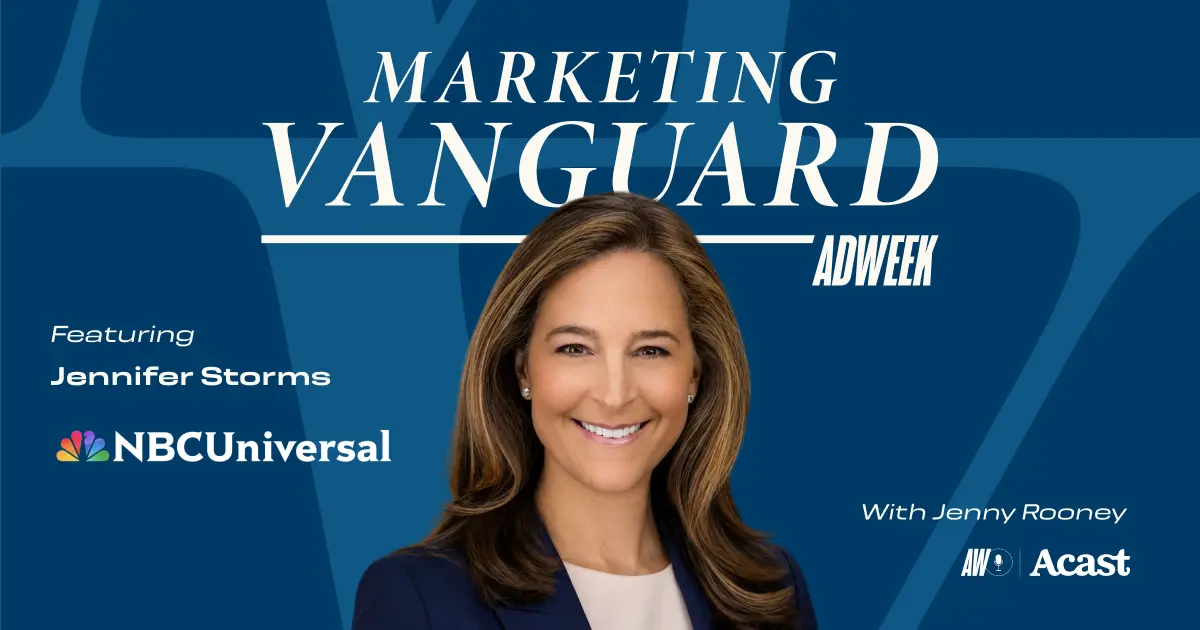
To explore what it truly takes to command attention, drive enterprise growth, and future-proof major media brands, Marketing Vanguard host Jennifer Rooney sat down for an exclusive, wide-ranging conversation with Jennifer Storms, Chief Marketing Officer of NBCUniversal Television and Streaming.
Storms, a seasoned industry veteran whose career spans elite sports marketing, consumer packaged goods (CPG) giants, and premier media networks, oversees brand strategy, integrated marketing, media, and consumer engagement across a massive portfolio that includes NBC, Peacock, Bravo, and NBC Sports. Throughout the discussion, Storms provided a masterclass in modern storytelling, detailing how NBCUniversal navigates the brutal attention economy by moving away from isolated advertising campaigns and toward the creation of living, breathing, year-round cultural franchises.
This report unpacks Storms’ strategic framework for success, examining her journey from the athletic fields to the corporate boardroom, the tactical imperative of brand salience in streaming, the innovative restructuring of marquee live events like the Olympics and "Legendary February," and the indispensable role of adaptability and live sports in the future of marketing.
Detailed Chronology: A Career Forged in Sports, CPG, and Media
To understand how Jennifer Storms approaches the massive portfolio of NBCUniversal today, one must examine the diverse foundational steps of her professional journey. Storms’ career is a testament to the power of cross-disciplinary experience, having transitioned from athletic administration to sports marketing, and subsequently through the rigorous ranks of blue-chip consumer goods before scaling the heights of television and streaming.
From Olympic Dreams to Corporate Strategy
Storms’ early career was deeply intertwined with the world of elite athletics, notably through her work with the United States Olympic and Paralympic Committee (USOPC) and Turner Broadcasting. These formative years instilled in her a profound appreciation for the raw power of live competition, community building, and the unique emotional currency that sports hold over consumers.
However, the pivotal turning point in her strategic evolution occurred during her tenure at PepsiCo. Serving on the brand side of one of the world’s most aggressive consumer conglomerates fundamentally transformed her perspective on consumer behavior.
As Storms recounted during the podcast, her time at PepsiCo taught her what it truly means to operate as a "chief architect of consumer experience." This role demanded more than high-level creative vision; it required an intimate understanding of the mechanical and physical realities of retail. Storms spent hours standing in grocery store aisles and convenience stores, analyzing shelf space, linear feet, inventory constraints, and immediate purchase behaviors.
This hyper-practical, ground-level education provided her with a rare lens. While many entertainment marketers view their work strictly through the abstract prism of creative output and viewership metrics, Storms evaluates audience journeys with the precision of a CPG product manager. She understands that a media platform, a streaming app, or a television network is, at its core, a product competing for shelf space—and the "shelf" is the consumer’s limited time and cognitive bandwidth.
Scaling the NBCUniversal Portfolio
Bringing this wealth of multi-industry experience to NBCUniversal, Storms was tasked with unifying and elevating some of the most recognizable brands in media. Under her leadership, the organization has had to bridge the gap between traditional linear television—such as the historic broadcast network and cultural juggernaut Bravo—and the hyper-growth, digital-first landscape of the Peacock streaming service.
Her mandate has not merely been to promote individual shows, but to architect an overarching brand architecture where legacy prestige and modern streaming innovation reinforce one another. By applying the disciplined consumer insights learned at PepsiCo to the high-stakes world of media, Storms has helped steer NBCUniversal through a period of profound structural and technological transformation.
Supporting Context & Metrics: Navigating the Attention Economy and Streaming Salience
The modern media landscape is defined by an overabundance of supply and a strictly finite amount of human attention. In what industry observers frequently term a "brutal attention economy," traditional advertising models are losing efficacy, and audience churn on streaming platforms remains a constant threat.
The Dual Challenge of Streaming Salience
Within a sprawling "house of brands" like NBCUniversal, marketers often grapple with a strategic dilemma: Should marketing dollars and creative efforts be poured exclusively into promoting individual titles (such as a breakout streaming series or a hit reality show), or should they build equity in the parent network or platform itself?
Storms argues that this is a false dichotomy—the answer is not an "either/or" proposition. While consumers naturally connect with specific shows, characters, and storylines, long-term platform viability depends on robust, overarching brand affinity.
When a viewer sits down on the couch, opens their television or device, and faces the universal modern dilemma of "What should I watch tonight?", NBCUniversal’s brands must be front and center in their consideration set. This is the essence of brand salience. In a crowded, frictionless streaming world where switching platforms is only a click away, being actively remembered and trusted is half the battle. If Peacock, NBC, or Bravo do not possess distinct psychological salience, the platform risks becoming a mere utility rather than an essential destination.
Transforming Campaigns into Living Franchises
One of the most significant evolutions in Storms’ strategic playbook is the systematic shift away from transient marketing campaigns and toward permanent, scalable franchises.
Historically, entertainment marketing operated on a cyclical, transactional cadence: a show premieres, a marketing blitz ensues, the season concludes, and the campaign winds down until the next cycle. Storms asserts that this model is no longer sufficient to capture cultural mindshare.
"We are Hollywood," Storms notes, emphasizing the company’s unmatched storytelling advantage. But the true breakthrough has been leveraging that storytelling muscle to ensure major entertainment and sports moments live well beyond their active broadcast windows.
A prime example of this philosophy in action is the strategic reinvention of the Olympic Games. Rather than treating the Olympics as a localized, two-week broadcast event that occurs every few years, NBCUniversal rebuilt the property into a year-round franchise. By maintaining continuous storytelling, athlete profiling, digital engagement, and cultural touchpoints between Games, the property sustains audience engagement and advertising momentum 365 days a year.
Similarly, NBCUniversal successfully executed this franchise-building mindset with "Legendary February," a monumental programming strategy that collapsed three separate, high-profile live events into a single, unified cultural moment. By weaving together disparate live properties into an overarching narrative event, the network amplified the cumulative cultural impact far beyond the sum of its individual parts.
Official Statements and Industry Insights
Reflecting on the core tenets of modern leadership, team dynamics, and the psychological mechanics of engagement, Storms shared several critical insights during her conversation with Jennifer Rooney:
-
On Anticipating Consumer Needs:
"At PepsiCo, I learned what it means to be the chief architect of consumer experience. That meant understanding not only what consumers need now, but what they will need next." — Jennifer Storms
-
On the Psychology of Streaming Choices:
"Consumers should connect with shows, but they should also have strong affinity for NBC, Peacock, Bravo and NBC Sports. The goal is brand salience: when someone sits down and wonders what they want to watch, NBCUniversal’s brands need to be top of mind. In a crowded streaming world, being remembered is half the battle." — Jennifer Storms
-
On the Power of Hollywood and Enterprise Growth:
"We are Hollywood. But the real shift has been moving from campaigns to franchises… The goal is to keep the franchise alive in culture even when the show or event is not actively on." — Jennifer Storms
-
On the Essential Traits of Modern Marketers:
"The best marketing teams need range. Specialists matter, but so do people with varied experiences, different backgrounds, curiosity and the ability to shift across business needs. Marketing today is not what it was five years ago… The real skill is not pretending to know everything. It is staying curious enough to keep asking better questions." — Jennifer Storms
-
On Live Sports as the Ultimate Marketing Engine:
"At the core of sports is life. Live events create urgency, attention, community and connection, which is exactly what brands are trying to earn. If you miss the moment, you miss the memory… Do not just take advantage of the live moment. Plan the pre, the during and the post, and think about how the moment can build more business." — Jennifer Storms
Future Outlook: The Intersection of Live Sports, AI, and Adaptability
As the media and marketing industries look toward the horizon of 2026 and beyond, the roadmap outlined by Jennifer Storms offers a compelling vision for navigating ongoing disruption.
Live Sports as the Ultimate Attention Engine
In an era where asynchronous, on-demand viewing has fragmented audiences, live sports remain the undisputed anchor of collective human attention. Storms emphasizes that live sports are fundamentally about life itself—they generate unscripted drama, immediate urgency, and visceral community connection that pre-recorded entertainment struggle to replicate.
However, her cautionary advice to brand marketers is vital: simply buying ad space during a major live broadcast is no longer enough. Successful marketers must master the holistic lifecycle of the event. This requires meticulous planning across three distinct phases:
- The Pre-Game: Building anticipation, narrative stakes, and early consumer engagement.
- The During: Executing high-impact, real-time creative that captures the unfiltered energy of the live moment.
- The Post-Game: Extending the life of the event through digital recaps, community conversations, and sustained brand recall.
The Imperative of Adaptability and AI Literacy
Looking inward at the structure of marketing teams, Storms stresses that the velocity of technological and consumer change requires a radical commitment to continuous learning. Emerging capabilities, particularly artificial intelligence (AI), are rapidly altering how content is produced, targeted, and optimized.
According to Storms, the most successful leaders and teams in the coming years will not be those who claim to possess all the answers, but those who maintain the intellectual curiosity to ask better, more incisive questions. The combination of specialized functional expertise and broad cross-sector adaptability will define the elite marketing organizations of tomorrow.
Conclusion
Jennifer Storms’ trajectory—from the athletic arenas of the Olympic movement to the retail trenches of CPG and the premiere echelons of NBCUniversal—illustrates a vital truth for the modern media landscape: relevance is not given; it is systematically engineered.
By treating platforms like products, transforming fleeting marketing campaigns into enduring cultural franchises, and leveraging the unmatched pulling power of live sports, NBCUniversal is proving that even in the most brutal attention economy, brands that master the art of year-round storytelling and consumer connection will continue to shape what’s next.