For the past several years, the technology sector has operated under a monolithic, unquestioned assumption: that humanity is collectively holding its breath for the next wave of artificial intelligence. Tech leaders, venture capitalists, and corporate boardrooms routinely project a future where every workflow, consumer appliance, creative pursuit, and interpersonal interaction is mediated, enhanced, or outright replaced by AI. We are told that people are craving novel AI features, products, and agents that will magically sweep away legacy friction and outdated ways of working.
Yet, a mounting body of user research, workplace productivity data, and fundamental human pushback reveals a startlingly different reality. Most people do not want more AI—at least not in the grandiose, all-consuming manner envisioned by Silicon Valley executives.
While corporate adoption metrics often paint a picture of rapid deployment, they frequently mask low long-term user retention, expensive delivery costs, and a looming threat of brand damage. Far from driving unbridled excitement, uninvited and poorly integrated AI tools are breeding change fatigue, anxiety, and a deep-seated resistance to transformation.
The core thesis is clear: AI is not a standalone value proposition. When organizations treat artificial intelligence as a magic wand capable of erasing years of structural debt, broken internal politics, and poor data quality, they merely amplify organizational shortcomings. Users are left to navigate fragmented systems, clean up unpredictable "AI slop," and pay the cognitive tax of error-checking hallucinations.
What individuals actually want is not an "AI-first" world that forces them to constantly adapt to unpredictable machines. Instead, they desire an "AI-second" paradigm—humble, ambient, reliable technology that quietly takes over tedious, mentally exhausting labor, freeing humans to spend more time engaging with the work and the people they genuinely care about.
Detailed Chronology: The Evolution of the AI Over-Promise
To understand how the technology industry reached this profound disconnect with its user base, it is helpful to trace the trajectory of the modern generative AI boom and its subsequent operational fallout.
Phase 1: The Gold Rush of "Powered by AI" (2022–2023)
Following the mainstream democratization of large language models, businesses rushed to capitalize on the hype cycle. The prevailing industry strategy was simple: sprinkle "AI" across marketing materials, pitch decks, and feature roadmaps. During this period, artificial intelligence was framed as a universal solvent. Companies assumed that simply branding a tool as "smart" or "AI-powered" would automatically generate customer delight and competitive advantage. UX design principles were frequently bypassed in favor of rushing wrappers and chat boxes to market.
Phase 2: The Integration Backlash and Productivity Paradox (2024–2025)
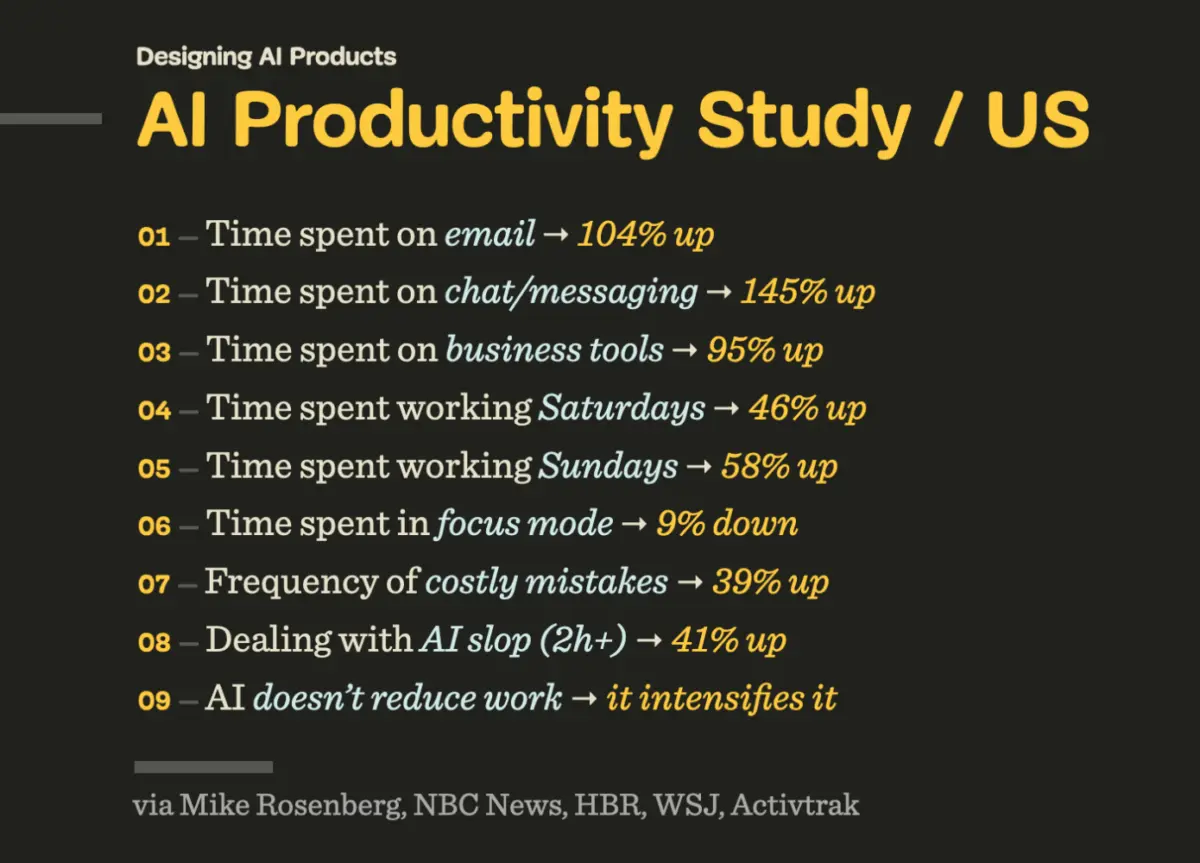
As organizations mandated the use of these newly bolted-on AI features, the initial euphoria gave way to friction. Employees found themselves context-switching between fragmented software ecosystems, forced to interact with yet another disconnected tool. Rather than reducing workloads, comprehensive studies tracking enterprise productivity revealed an alarming trend: time spent managing emails, internal chat channels, and business tools escalated dramatically. Weekend work increased, focus time plummeted, and professionals spent hours sorting through AI-generated errors and hallucinations. The industry realized that AI was not automatically saving time; it was intensifying the cognitive load of knowledge work.
Phase 3: The Reckoning and the Rise of "AI-Second" Design (2026 and Beyond)
Today, the conversation has shifted from blind acceleration to pragmatic sustainability. Design leaders, user experience researchers, and enterprise strategists are actively pushing back against the "magical chat box" paradigm. The industry is currently undergoing a painful course-correction, recognizing that successful technological integration must respect human mental models, prioritize absolute reliability over novelty, and remain invisible in the background. The focus is pivoting from disruptive replacement to supportive augmentation.
Supporting Context & Metrics: The Hidden Costs of Forced Automation
The gap between executive expectations and frontline reality is quantified by recent workplace studies and business analyses. Far from streamlining operations, uncalibrated AI implementation often introduces severe operational drag.
Key Productivity and Workplace Findings
Comprehensive workplace productivity tracking highlights the unintended consequences of aggressive AI rollouts:
Amplified Communication Overhead: Studies show significant spikes in daily operational friction, with corporate email and messaging time rising sharply as teams attempt to coordinate around unpredictable AI outputs.
The Toll on Focus: Deep, uninterrupted focus time has steadily declined as employees are forced to constantly monitor, correct, and clean up after automated systems.
Increased Error Rates: The hidden cost of verifying AI-generated content has led to substantial jumps in costly workplace mistakes and the proliferation of low-quality "AI slop."
Work Intensification: Rather than shortening the workweek, AI integration has frequently expanded operational hours—driving up weekend work commitments as employees struggle to reconcile fragmented workflows.
Business Model Realities: AI Belongs in Key Activities, Not Value Propositions
Strategic frameworks, such as those championed by innovation expert David Bland, emphasize a crucial distinction in product strategy: AI is a Key Activity and a Key Resource, but it is rarely a Value Proposition on its own.
[ Traditional Business Model Canvas ]
--------------------------------------------------
| Key Partners   | [AI = Key Resources &         |
|                |  Key Activities]              |
|                |                               |
|                |  NOT Value Propositions       |
--------------------------------------------------
When companies market "AI" as the core value proposition, they fail to answer the fundamental question asked by end users: Does this reliably solve my problem better than existing tools? Consumers and enterprise workers do not compare software to human unreliability; they compare features to features. If a traditional feature works predictably every single time, and an AI feature behaves stochastically and requires constant error-checking, users will invariably choose predictability.
Official Statements and Industry Perspectives
The backlash against unbridled, unnecessary AI integration extends far beyond frustrated software developers. Thought leaders across technology, business ethics, and human experience design are articulating a unified boundary for where artificial intelligence belongs—and where it does not.
In a widely shared perspective that resonated across global business communities, corporate strategist and author Bo Young Lee captured the sentiment of millions:
"I don’t want to read books written by AI. I don’t want to gaze upon paintings by AI. I don’t want AI to teach my children. I don’t want to have an AI therapist. I don’t want AI making my medical decisions. I want AI to do all the physical and mental labor that taxes me so I can read books written by humans and go to art galleries to engage with art made by humans. I want AI that makes my life easier rather than forces me to change myself."
This sentiment underscores a vital philosophical truth: human beings do not harbor a deep-seated desire to outsource their humanity, their cultural touchstones, or their emotional connections to algorithms.
Furthermore, user experience experts, such as Vitaly Friedman—creator of specialized UX curricula like Design Patterns For AI Interfaces—have consistently argued that interface design must stop treating users as passive guinea pigs for tech experiments. When AI arrives uninvited, disrupting long-standing mental models and forcing users into unfamiliar workflows, it triggers deep-seated anxiety about job security and societal relevance. Resistance to change is not born out of Luddite stubbornness; it is a rational defense mechanism against unreliable systems being shoved down consumers’ throats in the name of corporate innovation.
As the hype cycle matures, the future of artificial intelligence in product design and enterprise software hinges on a quiet revolution: the transition from AI-first to AI-second architecture.
What the Future Demands of Product Designers
Invisibility and Ambient Support: The most successful future applications of AI will not demand attention. They will not require users to open a separate chat window, prompt a magical box, or manage autonomous agent swarms in their bank accounts. Instead, they will operate silently in the background.
Respect for Existing Mental Models: Rather than forcing humans to adapt to how machine learning models process information, future tools will adapt to decades-old human workflows, making data entry, summarization, and logistical sorting effortless.
Relentless Reliability: Predictability must take precedence over generative novelty. If an automation tool fails to perform reliably 99% of the time, its utility is instantly negated by the human tax required to audit its mistakes.
Focus on Meaningful Labor: Technology companies must redirect their engineering efforts away from automating art, emotional counseling, and human storytelling, and focus squarely on the administrative and cognitive drudgery that drains human energy.
Conclusion: Reclaiming Human Time
Ultimately, the ultimate metric of successful technology is not how many AI features a company can cram into a quarterly release cycle. It is whether those features genuinely give people more time, headspace, and peace of mind to engage with the world around them.
People do not want to spend more of their lives managing algorithms, untangling conflicting priorities handed down by messy corporate structures, or cleaning up AI slop. They want tools that work quietly, predictably, and effectively—so they can close their laptops, step away from the screen, and spend time with the human beings they love.