

Executive Overview
When a high-stakes branding project fails, the post-mortem almost never points to the final week of design execution. The breakdown almost always occurs upstream, deep within the strategy phase, where vague adjectives like modern, trustworthy, premium, friendly, and disruptive are accepted at face value without ever being operationally defined.
This creates an invisible chasm between what a corporate brand is theoretically built to communicate and what a designer is intuitively expected to create. To bridge this divide, design and strategy teams must master what can be termed the "pre-concept" phase.
The strongest visual identities do not start in Figma; they start with the right questions. The pre-concept phase encompasses the crucial work that takes place after the project kickoff but long before the first original design concepts are drafted. It is a dedicated period of deep research into brand context, uncovering hidden stakeholder assumptions, and turning shared strategic direction into a robust visual foundation.
By utilizing targeted discovery frameworks, competitor perception mapping, and structured visual exercises, teams can eliminate ambiguity, separate personal aesthetic preferences from brand imperatives, and ensure that the first round of visual concepts feels less like a blind guess and more like an inevitable evolution.
Detailed Chronology: Navigating the Pre-Concept Roadmap
The journey from a blank brief to a cohesive visual direction requires a methodical sequence. Rather than leaping straight from a business strategy presentation to logo sketches, brand architects must guide stakeholders through a progression of structured milestones.
Phase 1: Researching Brand Context and Perception
A traditional brand discovery workshop will naturally cover standard baseline topics: the nature of the business, primary commercial goals, the product or service ecosystem, the competitive landscape, and the target audience. However, exceptional brand identity design requires digging deeper into the architecture of perception.

As Marty Neumeier famously articulated in The Brand Gap, "A brand is a person’s gut feeling about a product, service, or company." Because a brand ultimately lives entirely within the subjective mind of the consumer, discovery workshops must pivot from collecting dry business facts to clarifying desired perceptions.
Consider the real-world case of a health-tech company developing a digital platform for large government medical institutions. During early stakeholder interviews, the executive team insisted the brand needed to feel modern, trustworthy, and disruptive.
At first glance, disruptive implied a push toward something bold, loud, and unconventional. However, protracted discussions revealed a critical nuance: within the context of conservative government medical bureaucracy, a hyper-rebellious or visually aggressive identity would actively destroy trust. Their functional definition of "disruptive" had to manifest as exceptional clarity, seamless efficiency, and unshakeable institutional confidence. Language without context is dangerously elastic.

Phase 2: Active Stakeholder Alignment via Exercises
To prevent stakeholders from remaining passive recipients of strategy decks—where they might nod along to terms they define in completely different ways—designers must deploy active mapping and metaphor exercises.
Exercise 1: Competitor Perception Mapping
Before entering a workshop, strategy teams should curate a broad spectrum of competitor touchpoints, including website interfaces, marketing collateral, social media assets, and product screens. During the session, the stakeholder team places these references onto a two-axis map.
The axes are deliberately chosen to isolate the specific market tensions the brand must navigate. For instance, a fintech startup aiming to stand out without sacrificing security might map competitors across an Understated-to-Bold axis and an Accessible-to-Exclusive axis. This exercise instantly exposes fractures in how leadership views the market. When one stakeholder reads a competitor as progressive while another labels it generic, the team uncovers the exact ambiguities that would otherwise sabotage subsequent design reviews.

Exercise 2: Visual Brand Drivers
To bypass literal corporate descriptions, teams use the Visual Brand Driver exercise. Stakeholders are asked to select images representing the company across unrelated categories:
- Transport (e.g., a quiet electric vehicle versus a heavy freight train)
- Furniture (e.g., a modular minimalist desk versus an executive boardroom table)
- Architecture, animals, and beverages
Crucially, participants must choose images that represent the company, not their personal aesthetic preferences, and back them up with four to five descriptive adjectives. This method forces leadership to think through metaphor, exposing underlying patterns and contradictions in organizational self-image before any color palettes or typography choices are ever debated.
Phase 3: Establishing the Intermediate Design Layers
Once perception and market context are mapped, the team transitions into an intermediate working layer. This sits directly between raw strategy and creative execution, structured around three core pillars:

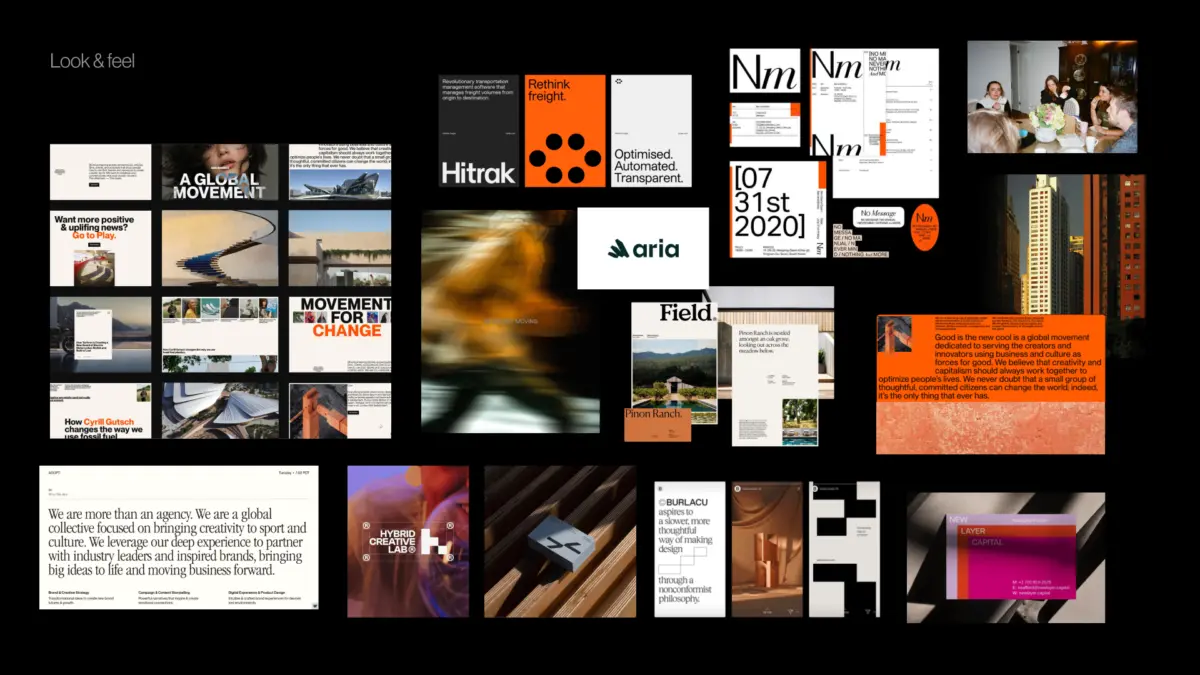
- Look and Feel Boards: Curated collections of third-party visual references used exclusively to discuss mood, character, and category tension rather than final design elements.
- Design Codes: The translation of core brand values into operational visual principles. For example, a core value of “research-backed support for real life” for a parenting application might translate directly into data infographics, editorial doctor profiles, and clean layout structures.
- Brand Asset Direction: Early explorations into typography classes, color temperature ranges, and photographic styles that establish hard boundaries for the subsequent concept phase.
Supporting Context & Metrics: The Cost of Ambiguity
The necessity of the pre-concept phase is underscored by empirical observations in digital product design and brand development. Industry case studies indicate that up to 70% of design revision cycles stem not from poor creative execution, but from unresolved strategic misalignment during initial kickoff phases.
When adjectives like premium are left undefined, creative teams are forced to operate in an informational vacuum. One stakeholder’s interpretation of "premium" may mean editorial minimalism, quiet confidence, and generous whitespace, while another’s may mean rich jewel tones, high-contrast gold accents, and exclusive gating.
By investing time in pre-concept alignment frameworks—such as the Three-Hour Brand Sprint popularized by GV—project teams drastically reduce redundant iterations. Structured pre-concept phases have been shown to cut project review times by nearly 40%, transforming subjective, emotionally charged feedback ("I don’t like this shade of blue") into objective, strategy-driven evaluations ("Does this visual system accurately project institutional security?").

Official Industry Perspectives on Brand Strategy
Leading voices in design methodology consistently emphasize that aesthetic excellence is impossible without rigorous upstream alignment.
"The point of these exercises is to make the abstract idea of ‘our brand’ into something concrete."
— Jake Knapp, author and design sprint pioneer
Design agencies and brand strategists echo this sentiment, noting that clients often confuse personal taste with institutional identity requirements. By introducing structured reference boards and perception mapping before pixel-pushing begins, agencies shift the dynamic from a guessing game to a collaborative engineering process.

According to studio leads specializing in digital product brands, treating the pre-concept phase as a distinct, billable, and mandatory milestone ensures that executive leadership owns the strategic constraints long before designers touch vector illustration software.
Future Outlook: The Evolution of Brand Strategy in AI-Driven Design
As artificial intelligence and automated generative design tools lower the technical barrier to creating polished visual assets, the value of raw execution is rapidly commoditizing. Anyone can prompt an AI tool to generate a slick logo, a vibrant color palette, or a modern interface mockup in seconds.
Consequently, the future of high-value brand identity design will not be won in the execution phase, but entirely within the pre-concept and strategic framing phase.

As automated tools flood the market with visually competent design variations, brands will increasingly suffer from a sea of generic, indistinguishable aesthetics. The differentiator for elite design studios and forward-thinking enterprises will be their ability to decode deep stakeholder assumptions, navigate complex market nuances, and establish airtight conceptual boundaries.
The pre-concept phase is evolving from a helpful design workshop into the ultimate strategic moat—ensuring that human designers and emerging technologies alike are always solving the right problem for the right audience.