

Executive Overview
In the grand pantheon of agricultural journalism, few subjects command the visceral, unadulterated passion of heirloom and specialty fruit evaluation. As the autumn harvest reaches its zenith, the modern agricultural landscape finds itself inundated with obscure cultivars, regional oddities, and historical throwbacks that challenge the monolithic supremacy of supermarket staples like the Red Delicious or the Gala.
Welcome, Apple Snack Gang, to the bleeding edge of pomological critique. Following a fiercely contested initial batch of evaluations, this second installment dives deeper into the subterranean world of specialty pomology. From rugged, tannin-heavy cider anomalies to unexpected flavor profiles mirroring mid-century chewing gum, the current harvest offers a chaotic array of triumphs and failures.

This report provides a rigorous, data-driven breakdown of seven distinct apple cultivars evaluated during the peak of the autumn season. By examining structural integrity, flavor complexity, historical provenance, and subjective sensory metrics, we illuminate the vast, often eccentric spectrum of modern fruit production. Whether battling jaw fatigue from dense, gym-honed cultivars or unpacking the colonial lore of New Jersey orchards, this investigation offers an authoritative compass for the discerning fruit consumer.
Detailed Chronology of the 2026 Harvest Trials
The trials commenced in the early weeks of autumn, a period traditionally defined by cooler temperatures and the gradual transition of regional orchards into peak yield. Over a rigorous testing window, each specimen was subjected to standardized sensory evaluations: immediate tactile inspection, structural resistance upon initial bite, internal moisture profiling, primary and secondary flavor extraction, and post-consumption residual profiling.

1. Kickapoo Spice
- Metric Score: 6.9 / 10
- Physical Profile: Dense structure; high surface and structural mass; non-juicy interior matrix.
- Sensory Breakdown: The Kickapoo Spice immediately commands attention through nomenclature alone, invoking immediate cultural touchstones while presenting a remarkably dense physical architecture. Upon incision and mastication, the cultivar reveals an exceptionally high spice component, leaning heavily into robust notes of nutmeg, supplemented by subtle undertones of cinnamon and clove. However, the evaluation noted a distinct lack of internal juiciness. A peculiar aftertaste reminiscent of freshly cut grass lingered on the palate—a structural defect likely attributable to suboptimal cold-storage duration. Apples, notoriously capricious in their post-harvest maturation, often inhabit a narrow window between optimization and rapid structural decay. Despite these anomalies, the Kickapoo Spice secures a respectable, if amusingly balanced, 6.9 out of 10.
2. St Edmunds Pippin
- Metric Score: 8.3 / 10
- Physical Profile: Rough dermal layer; high internal pressure; explosive acoustic crispness upon impact.
- Sensory Breakdown: Serving as the opening salvo of the serious seasonal tasting window, the St Edmunds Pippin defied initial skepticism inspired by its rugged, sandpapery skin—a tactile experience colloquially likened to moving backward across the dermal plates of a selachian. The initial bite delivered a singularly satisfying acoustic and physical pop, accompanied by an aggressive, sharp-breaking crunch. Internally, the fruit proved exceptionally juicy and bright, marrying herbal complexity—specifically distinct fennel pollen notes—with a harmonious sweet-tart baseline. Delivering a masterclass in funky, unconventional balance, the St Edmunds Pippin easily establishes itself as an elite contender in the autumn lineup.
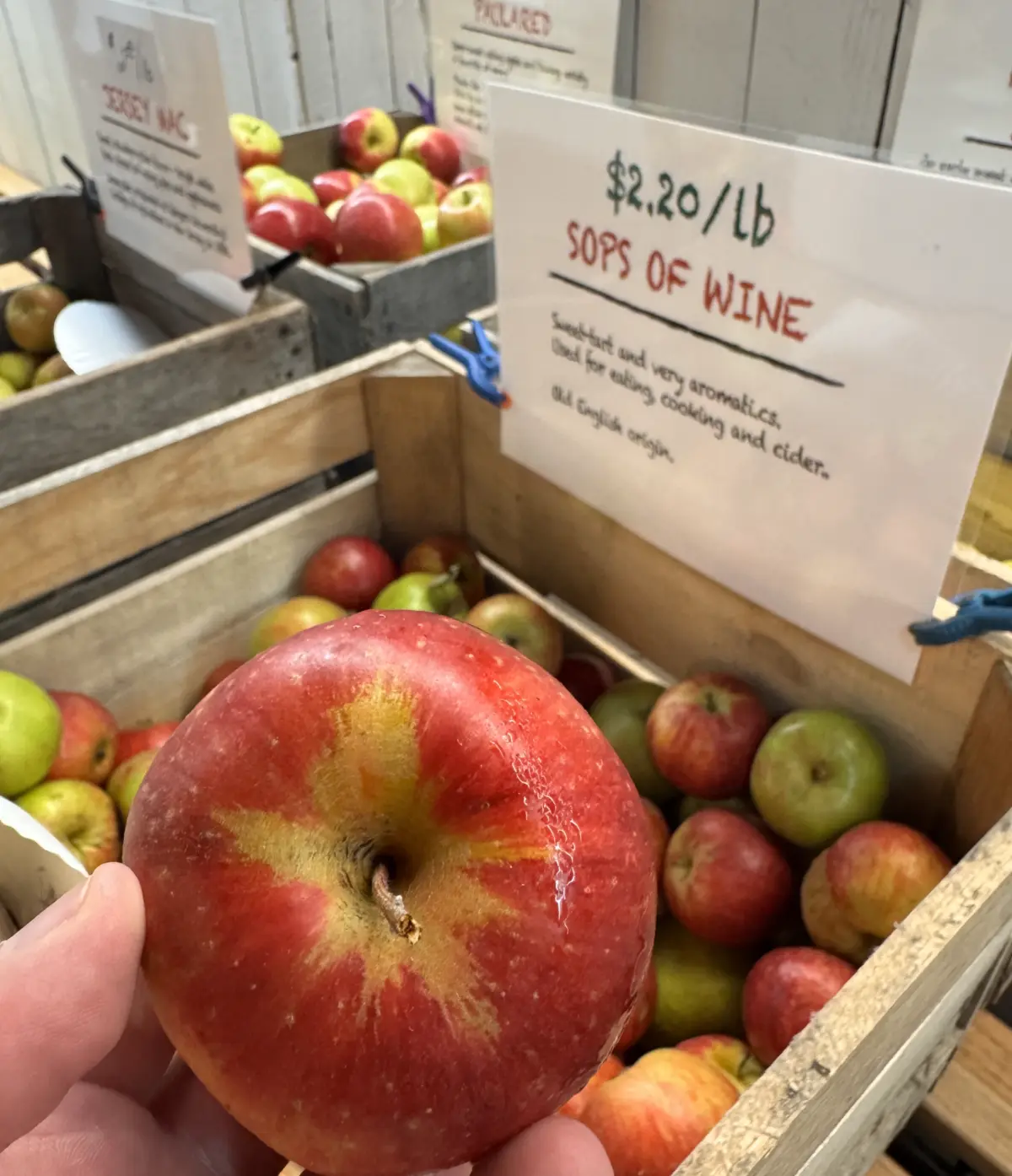
3. Sops of Wine
- Metric Score: 3.5 / 10
- Physical Profile: Mealy interior matrix; gritty mouthfeel; inconsistent pigmentation.
- Sensory Breakdown: Etymological and cultural resonance often colors culinary evaluation, and the "Sops of Wine" cultivar proved no exception, triggering involuntary literary echoes of dramatic historical cinema. Unfortunately, the sensory reality failed to match the poetic nomenclature. Harvested and consumed within a standard post-purchase window, the fruit exhibited severe structural degradation: mealy, gritty, and decidedly past its prime. While faint aromatic traces of vanilla and secondary spices attempted to anchor a subacid flavor profile (leaning marginally sweeter than tart), the textural collapse proved fatal to the rating. Compounding the confusion was an absence of the anticipated red-fleshed internal staining, leaving pomologists to ponder whether "Sops of Wine" represents a cohesive botanical variety or merely a catch-all umbrella term for a disparate assortment of legacy windfalls.
4. Fenceline Surprise
- Metric Score: 1.0 / 10
- Physical Profile: Deceptively resilient exterior; internally compromised, mealy pulp.
- Sensory Breakdown: Proving that nomenclature is not always an indicator of culinary delight, the Fenceline Surprise delivered precisely what its title threatened: universal disappointment. Despite visual indicators and signage classifying it as a "firm apple," the interior presented as a bland, unstructured mush. A fleeting top note of artificial pear essence offered a momentary diversion before dissipating entirely, leaving behind a textural sensation likened to fine beach sand. Whether suffering from terminal post-harvest senescence or originating from an inherently flawed orchard batch, this cultivar registered as an absolute failure of structural integrity. Only its handsome exterior skin prevents it from scoring an absolute zero.
5. Americus Crab
- Metric Score: 2.5 / 10
- Physical Profile: Miniature, rugged architecture; high tannin concentration; aggressive structural defense.
- Sensory Breakdown: Navigating the precarious domain of crabapples requires a distinct recalibration of human expectations. The Americus Crab—a moniker evoking the eccentric world of 19th-century inventors or maritime vigilantes—is fundamentally unsuited for casual, fresh-off-the-branch consumption. The fruit presents an intensely savory, fiercely tart, and aggressively tough profile, saturated with high levels of astringent tannins. While entirely lacking the approachable sweetness of table apples, it possesses a certain wild, unbridled charm for foragers and culinary daredevils willing to look past its defensive chemistry.
6. Campfield (False?)
- Metric Score: 4.1 / 10
- Physical Profile: Dense, chewy elasticity; high tannin load; structural resistance.
- Sensory Breakdown: Labeled intriguingly as "(false)" in its cataloging, the Campfield specimen offered a bewildering mastication experience akin to chewing a callused thumb. Balancing an aggressive surplus of sugar against an overwhelming wall of tannins, the fruit actively fought back during consumption, creating the uncanny sensation that the apple was consuming the taster in equal measure. Botanical logic explains this phenomenon: the Campfield is a classic cider apple, biologically engineered not for the human dining table, but for the transformative alchemy of fermentation.
7. Graham
- Metric Score: 8.0 / 10
- Physical Profile: Armored structural integrity; glacier-like fracture mechanics; extreme density.
- Sensory Breakdown: The final contender of the session tested the literal structural limits of human dental anatomy. The Graham apple is so preternaturally dense and hardened that it poses an immediate occupational hazard to the consumer’s jaw. Upon applying sufficient force, the fruit fractured with the geological violence of a calving glacier. Yet, the reward for this physical exertion was astonishing: an intense, unmistakable, and entirely unironic flavor profile matching classic, commercial Juicy Fruit chewing gum. Despite requiring rigorous, jaw-smashing effort to penetrate its armored shell, the sheer novelty and delivery of its flavor profile secure the Graham a stellar score.
Supporting Context & Historical Metrics
To fully contextualize these evaluations, one must look beyond the immediate sensory experience and examine the deep historical roots of American and European pomology. The historical lineage of regional orchards is inextricably linked to early colonial migration and the foundational necessity of cider production.
Consider the historical provenance associated with cultivars like the Campfield. Archival records trace the lineage of the Campfield apple directly to Matthew Canfield (variously spelled Campfield), an anti-royalist Puritan who arrived from Harleston, England, during the Great Puritan Migration prior to 1637. As a founding father of the New Haven Colony, Norwalk, and Newark—where historical records indicate some of the era’s finest hard cider was produced—Canfield’s legacy is baked into the very soil of early American agriculture.

Town records from New Haven and Newark dictate that early "freeholders" (those granted voting rights) were legally mandated to cultivate a minimum of four acres, with explicit requirements to plant fruit trees. Canfield’s civic duties—ranging from assessing damage inflicted by rogue swine to inspecting municipal fences—ran parallel to his contributions to the local pomological economy, including transactions involving "three barrels of good cider made of winter fruit." The presence of legacy cultivars in modern tasting trials underscores a continuous, centuries-long horticultural dialogue between historic European imports and North American microclimates.
Official Statements and Industry Insights
As the specialty produce sector experiences a renaissance driven by heirloom reclamation projects and direct-to-consumer orchard sales, professional tasters and arborists emphasize the critical importance of post-harvest handling.

Pomological experts note that the boundary between a transcendent tasting experience—such as the sharp-breaking brilliance of the St Edmunds Pippin or the astonishing confectionary notes of the Graham—and structural collapse (as observed in the Sops of Wine and Fenceline Surprise) is governed entirely by cold-chain logistics and storage duration.
Furthermore, industry insiders stress the necessity of categorizing culinary apples separately from cider and crabapple variants. Evaluating a tannin-heavy cider specimen like the Campfield against a dessert apple without accounting for its intended fermentation pathway yields predictable friction. True appreciation of regional orchards requires acknowledging that certain cultivars are explicitly designed to be "mutated by the goblins of fermentation" rather than consumed raw.

Future Outlook
As the autumn harvest shifts geographic theaters, the focus of pomological investigation turns northward. With upcoming field research expeditions slated across New York state, New England, and the expansive orchards of Canada, the search for anomalous, historic, and hyper-local cultivars accelerates.
The upcoming weeks promise an influx of regional variations shaped by northern microclimates, shorter growing seasons, and deep-rooted colonial agricultural traditions. Consumers, orchardists, and apple enthusiasts alike can anticipate a continued expansion of the specialty market, driven by a growing cultural appetite for biodiversity over industrial uniformity.

For those along the upcoming migration routes: bring your appetites, prepare your jaws for high-density cultivars, and keep the orchards well-stocked. The great pomological audit has only just begun.