

Executive Overview
For years, front-end developers have chased a singular holy grail: eliminating JavaScript in favor of native browser features. When a pull request swaps out fifty lines of complex ResizeObserver boilerplate for a sleek, three-line CSS container query—leaving a diff glowing entirely in red—it feels like an unmitigated win. It is clean, declarative, and approved by the team before lunch.
Yet, a week later, mysterious bugs emerge. A dashboard card vanishes entirely. A typography heading balloons on tablets for reasons no one can trace. The spacing within nested components fractures inexplicably. None of these regressions exist in the handful of lines written for the PR; instead, they arrive as unintended collateral damage from the new styles.
As modern CSS evolves into a remarkably powerful, intelligence-driven language—capable of handling conditional logic, structural containment, and relational state via features like @container, :has(), and native nesting—the industry faces a paradox. As developer Gabriel Shoyombo points out, a CSS feature can radically simplify a localized piece of code while drastically compounding the broader application’s systemic complexity.
This deep-dive investigation explores what happens when application logic is split or migrated between CSS and JavaScript, how isolated local simplicity often masks systemic architecture chaos, and what practical engineering frameworks developers must adopt to keep frontend complexity in check.
Detailed Chronology: The Anatomy of a Flawed Migration
To understand how modern CSS features introduce application-wide instability, we must examine the architectural ripple effects across four distinct operational vectors—affectionately conceptualized as "housemates" sharing the same digital ecosystem.
Scenario 1: The Multi-Owner Behavior Trap
The friction often begins when JavaScript and CSS attempt to share component behavior during an incomplete migration. Consider a responsive card that dynamically switches to a multi-column layout when space permits. Historically, this required a ResizeObserver paired with a class toggle:
const card = document.querySelector('.card');

new ResizeObserver(([entry]) =>
  card.classList.toggle('card--wide', entry.contentRect.width > 480);
).observe(card);
Paired with the corresponding CSS:
.card--wide .card__body
  display: grid;
  grid-template-columns: 160px 1fr;

.card--wide .card__title
  font-size: 1.5rem;
By leveraging modern CSS Container Queries, developers can supposedly eradicate the script entirely:

.card
  container-type: inline-size;


@container (width > 480px)
  .card__body
    display: grid;
    grid-template-columns: 160px 1fr;
The trap lies in execution. Migrations are rarely atomic. The developer adds the @container rule and purges the .card--wide .card__body rule, but the ResizeObserver script survives because it lives in a separate utility bundle. Furthermore, the .card__title rule survives because nobody searched for the modifier class.
When a product designer later requests a breakpoint update to 600px, the developer updates the container query. Between 480px and 600px, the card now exists in an unwritten, zombie state: a single-column body paired with an oversized wide-layout title. To debug this, an engineer must simultaneously reason across two distinct, unlinked owners of the exact same component behavior.
Scenario 2: The Unintended Layout Rearrangement (Block Formatting Contexts)
When a developer declares container-type: inline-size, their intent is modest: "Let my children query my width." However, the browser’s rendering engine interprets this declaration as a mandate for style and inline-size containment. This single line silently forces the element to establish a new Block Formatting Context (BFC).
This architectural shift triggers cascading side effects:
- Margins Stop Collapsing: Margins that previously bled out of the element to merge with surrounding sibling elements become trapped, instantly altering vertical rhythm and inflating component dimensions.
- Floats Push Elements Aside: The element’s layout relationship with adjacent floated content fundamentally changes, frequently shifting the container out of alignment.
- Content-Sized Cards Collapse: Size containment aggressively prevents an element from deriving its dimensions from its contents. If an explicit or contextual size is missing, content-sized components instantly collapse to a width or height of
0px, making cards entirely vanish from the viewport.
Scenario 3: The Overreaching Selector (:has() and Nesting)
The advent of relational pseudo-classes like :has() and native CSS nesting has unlocked expressive power, but it has also given birth to dangerously broad selectors.
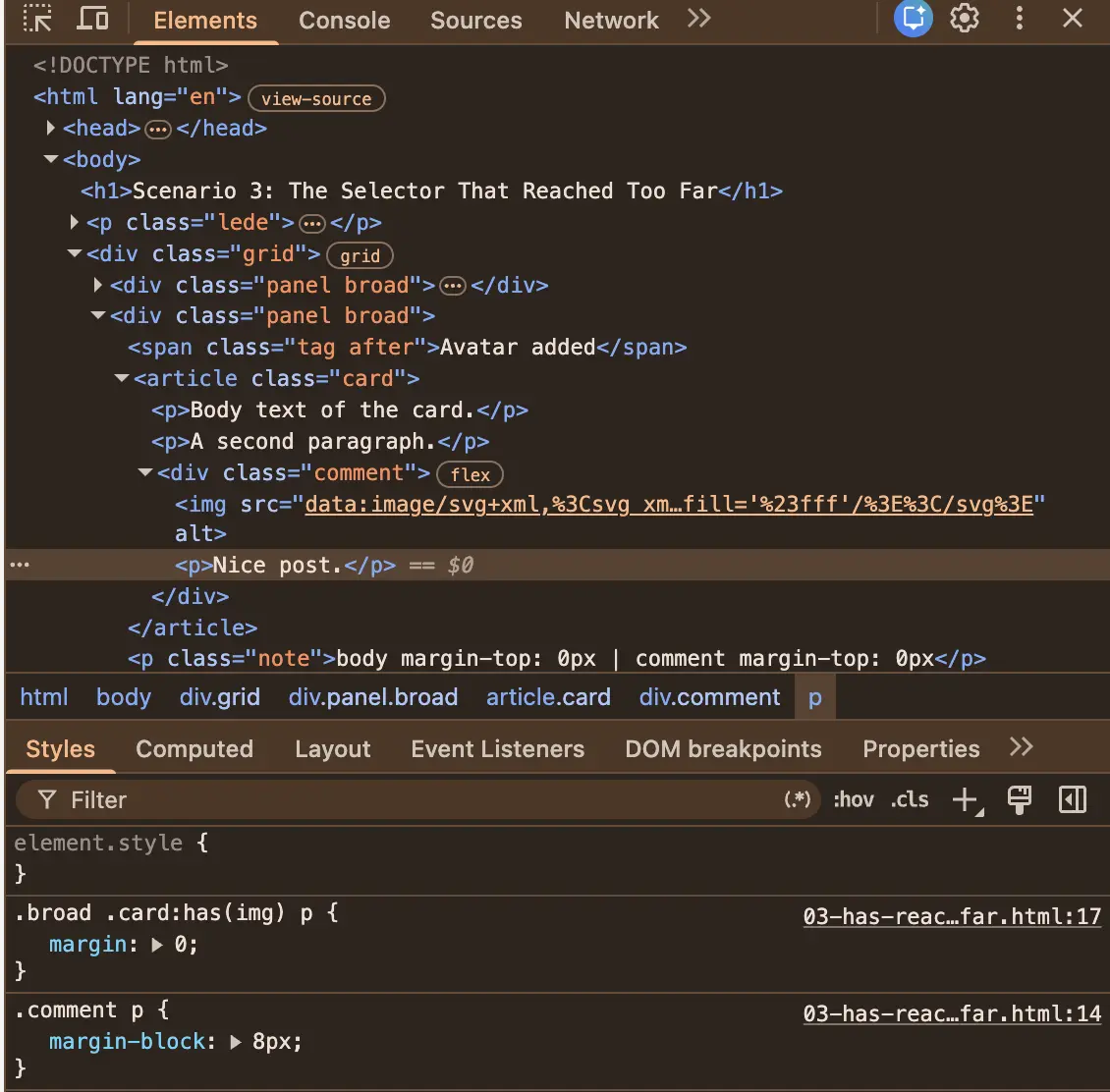
Consider an attempt to strip paragraph margins from cards containing a hero image:
.card:has(img) p
  margin: 0;
If a nested sub-component—such as an interactive user comment block containing an avatar image—is introduced elsewhere, the scope of this selector reaches far beyond its intended target. Every paragraph inside unrelated comment blocks loses its spacing. Because this state changes dynamically at runtime based on user-generated content, reproducing and tracing these layout bugs from a vague user report ("spacing looks off sometimes") becomes a nightmare.
Scenario 4: The Performance Tax of Unmeasured Reflows
A common refrain in pull request reviews is: "We moved the logic to CSS, so it’s inherently faster." While native CSS execution avoids JavaScript’s main-thread bottleneck, shifting code does not inherently reduce computational work; it merely hands the invoice to the browser’s rendering engine.

Complex queries, particularly expansive :has() selectors anchored high up the DOM tree (such as body:has(...)), force browsers to re-evaluate style calculations across massive subtrees on every DOM mutation. In performance profiling simulations involving thousands of rows, poorly scoped relational selectors can inadvertently trigger cascading style recalibrations across thousands of elements simultaneously, instantly degrading frame rates and causing jank.
Supporting Context & Metrics: Greenfield vs. Brownfield Realities
To contextualize these frontend architecture challenges, the broader developer community has engaged in fierce debates regarding accidental versus essential complexity.
In April 2026, Igor Roztropiński published a seminal essay titled "Modern Frontend Complexity: Essential or Accidental?", questioning whether a leaner paradigm could be built from scratch given modern browser evolution. The resulting discussions on developer forums exposed a profound philosophical schism:
- The Skeptics argue that articles championing "less code" often deliver less functionality under the guise of minimalism, shifting hidden cognitive overhead from explicit scripts to implicit cascade rules.
- The Pragmatists counter that modern CSS features eliminate bloated JavaScript frameworks and runtime virtualization layers that introduced far more accidental complexity than they resolved.
The core realization bridging these viewpoints is simple: Most technical documentation and feature showcases are written from a greenfield perspective, whereas enterprise engineering teams almost exclusively ship migrations into brownfield codebases.
| Migration Strategy | Primary Architectural Risk | Debugging Complexity | Main-Thread Performance Impact |
|---|---|---|---|
| JavaScript to Container Queries | Zombie state synchronization between surviving scripts and native CSS | High (Multi-owner logic) | Negligible to Low |
| Manual Layouts to Size Containment | Unintentional BFC creation, collapsed elements, uncollapsed margins | Moderate (Layout isolation rules) | Low |
Broad Relational Selectors (:has()) |
Over-matching selectors altering unintended nested components | High (Cascade specificity and runtime state) | Moderate to High (Depending on DOM depth) |
| Native Nesting & Specificity Creep | Unintended specificity inflation bypassing component boundaries | Moderate (Cascade origin conflicts) | Low |
Future Outlook: The Path Toward Sustainable Frontend Architecture
As native browser capabilities continue to advance at a rapid pace, the frontend engineering discipline must mature alongside them. The solution to systemic complexity is not a retreat into JavaScript-heavy paradigms, nor is it reckless adoption of every new CSS specification that lands in baseline browser support.
Future architectural health relies on disciplined boundaries. Developers must accept that code reduction on paper does not automatically equate to cognitive reduction in practice. Moving forward, teams must treat CSS features not as isolated styling tricks, but as powerful logical systems that actively negotiate with the application’s layout engine, cascade, and runtime state.
References
- Shoyombo, Gabriel Ayomide. "Modern CSS Might Make Your Frontend More Complex." Smashing Magazine, 2026.
- Roztropiński, Igor. "Modern Frontend Complexity: Essential or Accidental?" Binary Igor, 2026.
- MDN Web Docs. "CSS Container Queries Guide." Mozilla Developer Network.
- W3C Working Group. "CSS Selectors Level 4:
:has()Performance Considerations." GitHub Issues, 2022. - Google Developers. "Render-Blocking CSS and Layout Performance Best Practices." Web.dev, 2025.