

Executive Overview
For the past several years, the technology sector has operated under a collective, unwritten dogma: consumers and enterprise workers are starving for more artificial intelligence. Corporate boardrooms, venture capital funds, and product development labs have quietly assumed that the simple addition of the letters “A” and “I” to any software feature, product workflow, or corporate strategy acts as an immediate, magical salve for stagnation.
Yet, beneath the glossy marketing campaigns and inflated quarterly earnings calls, a starkly different reality is taking shape. Users are not craving endless cascades of generative AI features, autonomous multi-agent systems, or chatbot-driven interfaces forced onto them at breakneck speeds. In fact, mounting data indicates that many heavily promoted AI tools suffer from dismally low long-term adoption and retention rates. They come tethered to exorbitant delivery costs, hidden productivity taxes, and a severe risk of brand and reputational damage.
The core disconnect lies in a fundamental misdiagnosis of what value actually means. Artificial intelligence, as experts and user experience (UX) designers increasingly emphasize, is not a value proposition in and of itself. Rather, it is a foundational capability—akin to cloud computing or databases—that belongs firmly in the realm of key activities and key resources. When organizations treat "Powered by AI" as a standalone selling point, they frequently burden users with fragmented, unpredictable, and uninvited tools that disrupt established mental models.
This article investigates the widening chasm between executive ambition and human utility. By analyzing workplace productivity metrics, user psychology, and the shifting philosophy toward "AI-second" design, we explore why the future of technology lies not in replacing human creativity, but in quietly eliminating the administrative toil that stifles it.
Detailed Chronology: The Evolution of the AI Push and the Resulting Backlash
To understand how the tech industry arrived at the current fatigue surrounding artificial intelligence, it is necessary to examine the chronological progression of the generative AI boom and its subsequent operational fallout.
- The Generative Awakening (Late 2022 – 2023): Following the public rollout of advanced large language models, corporations rushed to capitalize on the zeitgeist. The initial wave was characterized by "bolt-on" mechanics: rapid integrations of chatbot sidebars, automated summaries, and generative writing assistants slapped onto existing software suites. During this period, speed of delivery was king. Companies vied to be the first to market, assuming that any AI integration would be inherently welcomed by users eager to experiment.
- The Integration Reality Check (2024): As the initial novelty faded, enterprise workers and consumers began interacting with AI features under real-world pressures. Instead of experiencing seamless liberation from labor, users found themselves acting as uncompensated editors for AI hallucinations and inconsistencies. Organizations noticed a paradoxical phenomenon: while individual tasks occasionally accelerated, the cognitive overhead required to check, verify, and correct AI outputs began to counteract the intended efficiency gains.
- The Productivity Paradox and Burnout (2025 – Present): Comprehensive workplace studies began revealing a sobering reality. Far from reducing working hours, the proliferation of disconnected AI systems and chat interfaces intensified workloads. Employees reported spending significantly more time managing communication channels, sorting through low-quality AI-generated output ("AI slop"), and navigating overlapping software ecosystems. Concurrently, public skepticism deepened, with users actively pushing back against uninvited automation in sensitive domains, from creative arts to interpersonal services.
Supporting Context & Metrics: The True Cost of Forced Integration
The assumption that AI universally boosts productivity has been heavily scrutinized by recent workplace analytics. While corporate leadership often champions automation as a silver bullet for corporate efficiency, empirical studies present a far more complex—and troubling—picture.
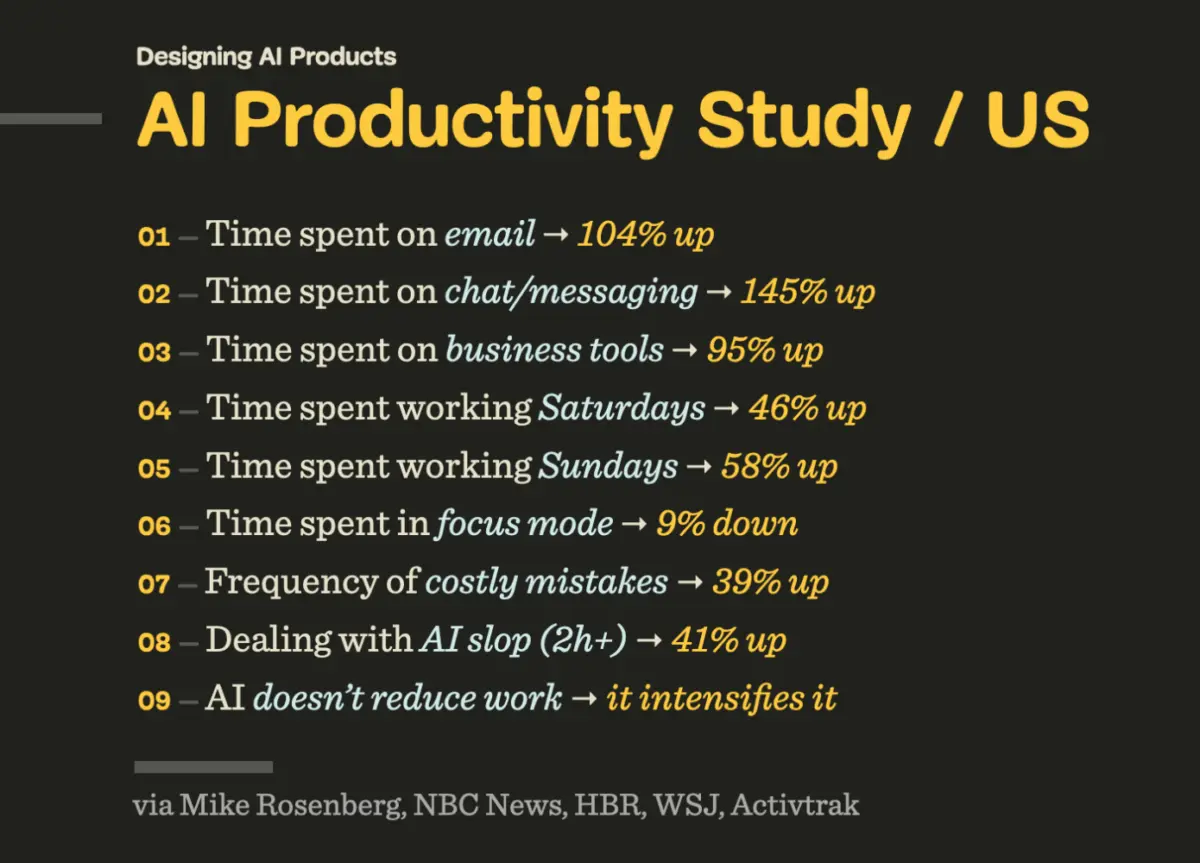
The AI Productivity Study: Intensification, Not Reduction
Recent cross-industry data compiled from workplace monitoring and organizational studies highlight how the influx of fragmented AI tools has reshaped daily labor:
- Surging Communication Volume: Time spent managing business emails has spiked by over 100%, while corporate chat and messaging activity has surged by roughly 145%.
- Expanded Work Hours: Weekend labor has seen noticeable jumps, with Saturday work hours rising by 46% and Sunday work by 58% in heavily digitized sectors, as employees struggle to process an ever-growing backlog of digital artifacts.
- Erosion of Deep Work: Dedicated focus mode utilization has dropped by nearly 10%, crushed under the weight of constant system notifications and context-switching.
- The Quality Penalty: Costly professional errors have climbed by roughly 39%, driven largely by the invisible tax of dealing with low-grade AI content ("slop") and the fatigue of constant error-checking.
As analysts frequently summarize: AI doesn’t reduce work; it intensifies it.

Amplifying Organizational Shortcuts
A critical flaw in the deployment of enterprise AI is its tendency to act as an amplifier for pre-existing structural defects. Organizations frequently attempt to use software patches to resolve years of accumulated technical debt, broken corporate cultures, fragmented data silos, and dysfunctional internal politics.
AI cannot magically heal a broken decision-making process. Instead, it mirrors these inconsistencies back to the user. When data quality is poor and cross-departmental priorities conflict, an AI tool operating on top of that infrastructure simply packages those contradictions into eloquent, persuasive, but fundamentally incorrect outputs. Employees are then left to untangle the resulting mess, transforming what was supposed to be a time-saving assistant into an administrative liability.
Official Statements and Industry Perspectives
The growing resistance to omnipresent artificial intelligence is not merely a fringe movement among tech-skeptics; it is increasingly articulated by prominent thought leaders, designers, and executives who advocate for a more human-centric approach to software development.
In the realm of UX design, industry veterans have long argued against treating AI as a universal panacea. Jakob Nielsen and other usability experts have repeatedly stressed that "Powered by AI" is not a value proposition. Users do not evaluate software based on the algorithmic complexity humming beneath the hood; they judge it by its reliability, speed, predictability, and how seamlessly it fits into their cognitive workflows.

Perhaps the sentiment of the modern user is best captured by Bo Young Lee, whose widely shared perspective on corporate technology resonates deeply across industries:
"I don’t want to read books written by AI. I don’t want to gaze upon paintings by AI. I don’t want AI to teach my children. I don’t want to have an AI therapist. I don’t want AI making my medical decisions. I want AI to do all the physical and mental labor that taxes me so I can read books written by humans and go to art galleries to engage with art made by humans. I want AI that makes my life easier rather than forces me to change myself."
This distinction cuts to the heart of the matter. People do not dream of a world populated by artificial companions, automated art museums, or a relentless requirement to converse with a chat box for every trivial transaction. They value human stories, shared emotional experiences, and authentic interaction. When technology demands that humans alter their fundamental behaviors to accommodate erratic software, it ceases to serve humanity and instead demands servitude from it.
Future Outlook: The Rise of "AI-Second" Design
As the technology sector matures past its initial infatuation with unbridled generative hype, the pendulum is swinging toward a more mature, grounded philosophy: AI-second design.

Shifting from Replacement to Augmentation
The future of successful software does not lie in replacing human judgment, intuition, and taste. Many professions most exposed to automation—such as software engineering, public relations, creative writing, and design—possess core elements that are deeply human. These roles require a unique point of view, emotional resonance, and contextual nuance that algorithms cannot replicate.
When AI is deployed correctly, its true value emerges not as an intrusive focal point, but as a quiet, ambient background utility. Moving forward, the most effective tools will adhere to several key principles:
- Deep Workflow Integration: Rather than forcing users to open disconnected sidebars, jump between fragmented systems, or learn complex prompt engineering, AI capabilities must be woven invisibly into the existing tools and mental models users have spent decades refining.
- Relentless Predictability: Software must be reliable every single time. A feature that works ninety percent of the time but hallucinates unpredictably is worse than no feature at all, because it forces the user into a permanent state of hyper-vigilant error-checking.
- Targeting the Mundane: The ultimate promise of automation is the elimination of soul-crushing, repetitive, and administrative drudgery—data entry, formatting, scheduling, and basic sorting—leaving humans with the cognitive bandwidth to focus on creative, strategic, and interpersonal work.
Conclusion: Reclaiming Human Connection
Ultimately, people do not yearn for more artificial intelligence in their daily lives; they yearn for more time. They want tools that quietly shoulder the burden of mechanical labor so that they can redirect their energy toward what truly matters: human relationships, community, art, and shared experiences.
The next era of product design will reward companies that step back from the "AI-first" frenzy and embrace a calmer, more humble approach. By designing technology that respects human boundaries and enhances—rather than disrupts—our daily routines, the tech industry can finally deliver on its original promise: making life simpler, more productive, and profoundly more human.