

Executive Overview
In the contemporary digital ecosystem, the demand for high-volume, high-engagement textual content has outpaced human writing capacity. From multinational marketing agencies to solo e-commerce entrepreneurs, content creators face immense pressure to maintain active blogs, dynamic social media channels, and optimized search engine profiles. This operational bottleneck has catalyzed a technological revolution: the commercialization of Artificial Intelligence (AI) content generation.
Modern AI writing tools have evolved far beyond simple predictive text models. Utilizing advanced Large Language Models (LLMs)—such as iterations of the Generative Pre-trained Transformer architecture—these platforms can synthesize context, mimic specific tonal guidelines, structure long-form essays, and optimize copy for search engine algorithms within seconds.
However, the rapid influx of generative platforms presents a paradoxical challenge for digital professionals: market saturation. With dozens of tools claiming superior performance, identifying the ideal software requires granular analysis of pricing structures, generation methodologies, and target use cases. This report provides an authoritative, comprehensive review of the top 10 AI content generators, evaluating their operational frameworks, financial tiers, and strategic advantages to help digital architects make informed decisions.

Detailed Chronology of the Generative AI Content Market
The journey from rudimentary natural language processing (NLP) to sophisticated content generation platforms did not happen overnight. Understanding the current marketplace requires a brief look at how these technologies matured into commercially viable SaaS (Software-as-a-Service) products.
Phase One: The Rule-Based and Template Era (Pre-2019)
Before the mainstream deployment of advanced neural networks, automated content generation relied heavily on data-to-text templates and synonym-swapping "spinners." These early iterations produced mechanical, often grammatically incoherent text that required extensive human rewriting. They were predominantly utilized for low-tier search engine optimization (SEO) PBNs (Private Blog Networks) rather than legitimate marketing campaigns.
Phase Two: The Advent of Neural Text Generation (2019–2021)
The release of early transformer-based models fundamentally altered the landscape. Developers recognized that deep learning could capture the nuances of human syntax and semantics. Early pioneers began wrapping these foundational models in user-friendly dashboards, giving rise to dedicated writing assistants. During this period, tools like Jarvis (later rebranded as Jasper) entered the market, introducing specialized commands and templates for marketing copy, sparking widespread commercial interest.
Phase Three: The Proliferation and Specialization Era (2022–Present)
By 2022, the market transitioned from generalized text generation to hyper-specialization. Platforms began dividing into distinct categories: some focused purely on programmatic, keyword-to-article automation (such as Article Forge and Kafkai), while others prioritized deep SEO integration and content grading (such as Frase). Simultaneously, e-commerce-focused tools emerged, tailoring their training data specifically to product descriptions and conversion rate optimization (CRO). Today, the ecosystem features advanced multi-modal capabilities, plagiarism integrations, and real-time data fetching, transforming AI from a novelty into a foundational pillar of modern digital content operations.
Supporting Context, Metrics, and Platform Analyses
To evaluate the true utility of these platforms, we must analyze the market leaders individually, examining their core architectures, pricing, and functional profiles.
1. Jasper AI (Formerly Jarvis)
Jasper stands as one of the most widely recognized pioneers in the AI writing space. Designed primarily to identify optimal vocabulary and syntactic structures tailored to a user’s specific brand voice, Jasper excels in versatility.

- Core Architecture: Utilizes advanced LLMs trained across a vast corpus of internet data to execute complex commands.
- Key Features: Advanced workflow templates, custom brand voice training, and its high-tier "Boss Mode" for long-form document creation.
- Financial Tiers: Features structured scaling, with elite tiers such as Boss Mode priced around $99 per month.
- Strategic Advantage: Exceptional for enterprise-level marketing teams requiring consistent tonal alignment across high-volume campaigns.
2. Copy.ai
Positioned firmly as a marketing powerhouse, Copy.ai streamlines the creation of short-form copy, social media posts, advertising hooks, and email newsletters.
- Core Architecture: Built upon more than 90 distinct templates designed to transition raw bullet points into polished, conversion-oriented copy.
- Key Features: Rapid short-form generation, digital ad variations, and user-friendly ideation tools.
- Financial Tiers: Offers a functional 7-day free trial with daily run limits, transitioning into professional plans starting at roughly $49 per month (or scaled down to $35 per month with annual billing).
- Strategic Advantage: Ideal for social media managers and growth hackers who need a high volume of creative variations quickly.
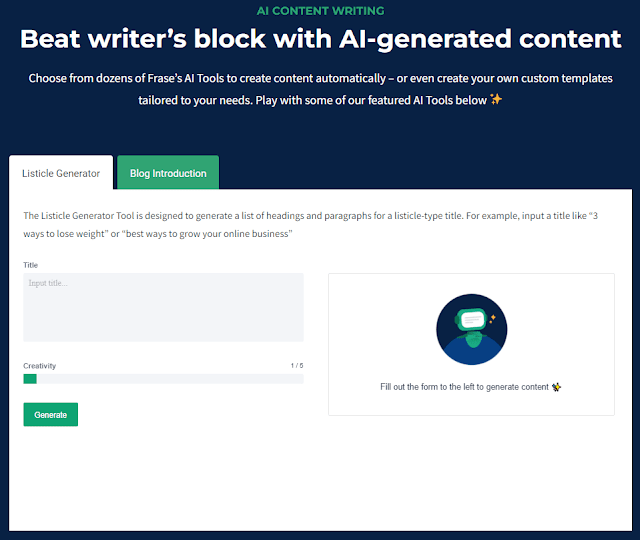
3. Frase AI
Unlike pure creative writing tools, Frase operates at the intersection of AI generation and technical SEO optimization. It is engineered to assist users throughout the entire content lifecycle—from initial research to final optimization.
- Core Architecture: Integrates search engine scraping with generative text, analyzing top-ranking competitor pages to construct data-backed content briefs.
- Key Features: Automated content outlining, topic model analysis, and live SEO scoring metrics.
- Financial Tiers: Categorized into Solo ($14.99/mo), Basic ($44.99/mo), and Team ($114.99/mo) plans, with flexible annual discounts and optional SEO add-ons.
- Strategic Advantage: The premier choice for organic search strategists and content marketers focused on outranking competitors via data-driven optimization.
4. Article Forge
Article Forge disrupts traditional AI workflows by prioritizing absolute efficiency and automation. While platforms like Jasper require detailed prompts and ongoing guidance, Article Forge operates on minimal input.
- Core Architecture: End-to-end article generation triggered exclusively by a target keyword or sub-topics.
- Key Features: Automated image and video integration, end-to-end multi-paragraph synthesis, and guaranteed Copyscape-passing outputs.
- Financial Tiers: Basic plan starting at $27/month (25k words), Standard at $57/month, and an Unlimited tier at $117/month. Backed by a 30-day money-back guarantee.
- Strategic Advantage: Unmatched for programmatic SEO campaigns where speed and scale supersede granular editorial control.
5. Rytr
Rytr.me has carved out a significant market share by offering an accessible, lightweight, and highly affordable AI writing assistant tailored for solopreneurs, students, and small business owners.
- Core Architecture: A nimble assistant optimized for generating concise, targeted snippets, emails, and short blog sections.
- Key Features: Built-in plagiarism checking, multi-language support, and tone selection capabilities.
- Financial Tiers: Features a generous free tier (limited to 5,000 characters per month) alongside economical paid options like the Saver Plan at $9 per month.
- Strategic Advantage: The ultimate entry-level tool for budget-conscious creators needing a reliable daily writing companion.
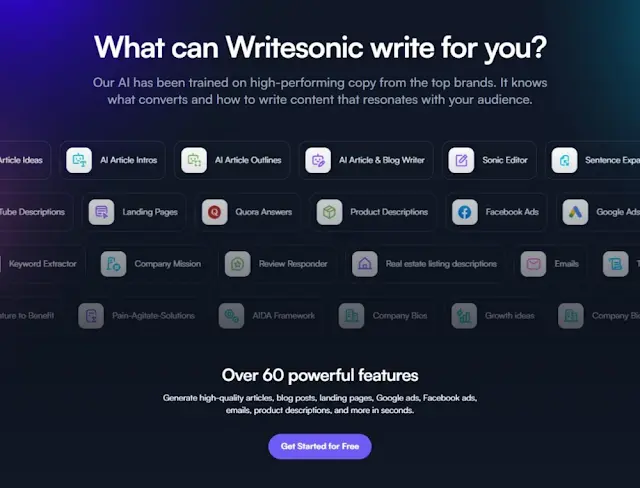
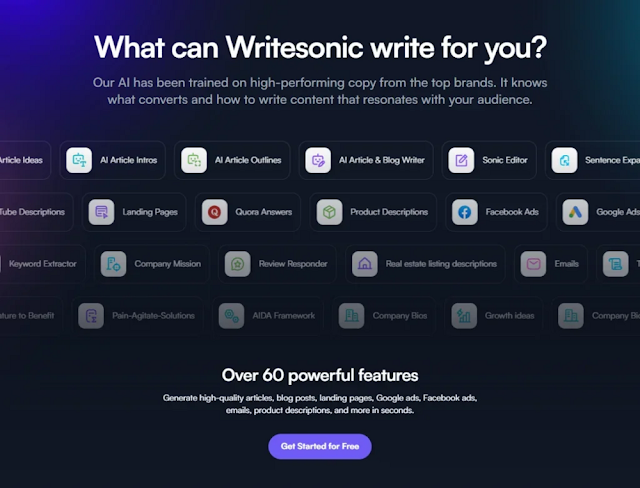
6. Writesonic
Writesonic bridges the gap between marketing copy and long-form journalism, integrating advanced grammar and plagiarism verification directly into its generation suite.
- Core Architecture: Dual-engine architecture supporting both short-form conversion copy and extended article creation.
- Key Features: Landing page generators, article rewriting tools, and integrated grammar enhancement.
- Financial Tiers: Offers a trial credit system, with short-form plans beginning at $15 per month and long-form options scaling from $19 per month.
- Strategic Advantage: Excellent for agencies managing both website copy and long-form thought leadership articles under one roof.
7. CopySmith
Engineered specifically for enterprise scaling, CopySmith focuses on bulk content generation, making it a favorite among large e-commerce departments and digital agencies.

- Core Architecture: High-throughput processing pipelines designed to output hundreds of product descriptions or ad variants simultaneously.
- Key Features: Bulk generation capabilities, team collaboration workflows, and native platform integrations (e.g., Shopify, WooCommerce).
- Financial Tiers: Starter plans begin around $19 per month, scaling up to custom-tailored enterprise agreements.
- Strategic Advantage: Essential for retail businesses managing massive product inventories that require unique, SEO-friendly descriptions.
8. Hypotenuse.ai
Hypotenuse.ai carves its niche deeply within the e-commerce sector, offering specialized workflows designed to turn raw product specifications into compelling sales copy and visual assets.
- Core Architecture: E-commerce-trained machine learning models focused on conversion psychology and attribute-based writing.
- Key Features: Automated product description generation, batch processing, and integrated content enrichment tools.
- Financial Tiers: Starter plans begin at $29 per month, with Growth plans at $59 per month, supplemented by a trial period.
- Strategic Advantage: The definitive tool for online merchants seeking to automate catalog descriptions without sacrificing persuasive selling power.
9. Kafkai
Kafkai approaches AI generation from a distinctly SEO-centric perspective, specializing in the production of niche-specific articles at scale.
- Core Architecture: Unsupervised machine learning models trained on broad industry verticals to generate organic-style informational articles.
- Key Features: Niche content specialization, bulk article generation, and highly competitive per-article cost scaling.
- Financial Tiers: Ranging from the Writer plan ($29/mo for 100 articles) up to the Industrial Printer plan ($199/mo for 2,500 articles).
- Strategic Advantage: Highly cost-effective for affiliate marketers and SEO practitioners managing large portfolios of niche websites.
10. Peppertype.ai
Rounding out the top tier, Peppertype.ai functions as a virtual content marketing team housed inside an intuitive, clean dashboard.

- Core Architecture: Rapid-fire micro-copy and long-form synthesis engine designed for ease of use.
- Key Features: Content ideation, blog outlining, and multi-format repurposing.
- Financial Tiers: Personal plans begin at $35 per month, with Team tiers at $199 per month, alongside exploratory trials.
- Strategic Advantage: Perfect for content creators who value minimalist user interfaces and fast, intuitive prompt execution.
Official Statements and Industry Insights
The proliferation of AI content tools has sparked intense debate among industry leaders, ethicists, and search engine architects.
Speaking on the integration of AI-generated text within search ecosystems, representatives from major search engines have consistently emphasized quality over origin. Official guidance clarifies that while automation is not inherently penalized, low-quality, unedited, or manipulative mass-produced content designed purely to manipulate search rankings violates webmaster quality guidelines. The emphasis across the industry has shifted toward "AI-assisted human curation"—using artificial intelligence to accelerate research and drafting, while relying on human expertise to inject original insights, fact-checking, and editorial polish.
Marketing executives and agency heads echo this sentiment. Industry case studies indicate that while AI content generators can reduce initial drafting time by up to 70%, human oversight remains non-negotiable to maintain brand authenticity and factual integrity.
Future Outlook: The Next Evolution of Digital Content
As we look toward the future of digital publishing and marketing, several key trends are poised to redefine the AI content generation landscape:
- Multi-Modal Integration: The boundary between text generation and visual asset creation is dissolving. Future platforms will seamlessly blend article writing with real-time infographic generation, custom AI imagery, and automated video script production within a single workspace.
- Hyper-Personalized Real-Time Data Fetching: Next-generation models will move beyond static training datasets, connecting directly to live web analytics and proprietary corporate databases to generate hyper-contextualized, up-to-the-second reports and marketing copy.
- Ethical Guardrails and Provenance Tracking: As regulatory bodies scrutinize copyright laws and synthetic media, content platforms will increasingly adopt cryptographic watermarking and strict compliance frameworks to verify content originality and protect intellectual property.
Ultimately, artificial intelligence is no longer a futuristic concept; it is an active operational utility. Whether selecting a robust enterprise suite like Jasper or an economical niche tool like Rytr, digital creators must align their software choices with clear strategic objectives, balancing the undeniable efficiency of machine automation with the irreplaceable depth of human creativity.