

Executive Overview
The landscape of search engine optimization (SEO) has undergone a fundamental transformation. Gone are the days when digital marketers could rely on static, manually updated Microsoft Excel spreadsheets to monitor a handful of keyword rankings once a week. In 2025, search engine results pages (SERPs) are volatile, hyper-localized ecosystems dictated by real-time algorithm shifts, aggressive zero-click environments, and the omnipresence of AI-driven features like Google’s AI Overviews.
![7 Best SERP Tracking Tools for 2022 [In-Depth Review]](https://www.robbierichards.com/wp-content/uploads/2020/05/Best-SERP-Trackers.jpg)
To validate SEO efforts, protect market share, and prove tangible return on investment (ROI) to stakeholders, modern enterprises, agencies, and in-house teams require robust, highly accurate SERP tracking infrastructure. Modern SERP tracking software does far more than simply log numerical ranking positions. These platforms monitor over 50 distinct SERP features, execute deep competitor cross-analysis, aggregate multi-device data down to the exact zip code, and map keyword movements directly to revenue pipelines.
![7 Best SERP Tracking Tools for 2022 [In-Depth Review]](https://www.robbierichards.com/wp-content/uploads/2020/04/image16-2.png)
This in-depth review evaluates the market’s leading SERP tracking solutions for 2025. By analyzing a curated shortlist of specialized, standalone trackers and comprehensive all-in-one SEO platforms, this report establishes a definitive framework for selecting the ideal software to match your organization’s operational scale and strategic objectives.
![7 Best SERP Tracking Tools for 2022 [In-Depth Review]](https://www.robbierichards.com/wp-content/uploads/2020/04/image2-3.png)
Detailed Chronology & Industry Evolution
The evolution of rank tracking mirrors the maturation of the search engine optimization industry itself.
![7 Best SERP Tracking Tools for 2022 [In-Depth Review]](https://www.robbierichards.com/wp-content/uploads/2020/04/image6-2.png)
- The Early Era (Pre-2010s): SEO professionals relied heavily on basic web scraping scripts or manual browser checks. Data was notoriously unreliable, often skewed by local data centers, personalized search history, and a lack of standardized device segmentation.
- The Rise of Cloud SaaS (2010–2018): As search engine algorithms grew more complex—factoring in localized intent, mobile-first indexing, and a proliferation of rich snippets—the market demanded automated, cloud-based SaaS solutions. Platforms like Advanced Web Ranking and early iterations of major all-in-one suites began offering scheduled daily updates. However, latency remained a bottleneck, with users frequently waiting hours or days for bulk ranking updates to clear.
- The Real-Time & Multi-Engine Epoch (2019–2023): Platforms like AccuRanker disrupted the market by introducing on-demand, instant data refreshing architectures. Tracking expanded beyond Google to encompass international engines like Baidu and Yandex, alongside YouTube and Bing. Integration with business intelligence tools like Google Data Studio (now Looker Studio) and Databox became a baseline requirement for client reporting.
- The AI-Driven Paradigm (2024–2025): Today, SERP trackers operate in an environment heavily dominated by generative artificial intelligence, localized map packs, and continuous algorithmic churning. Modern trackers are no longer passive logging tools; they are proactive intelligence engines capable of identifying content decay, highlighting missed AI-feature opportunities, and closing the gap between search visibility and bottom-line revenue.
Supporting Context & Essential Metrics: What to Look for in a SERP Tracker
When evaluating modern SERP tracking tools, software buyers must look past superficial marketing claims and focus on core architectural capabilities. Industry veterans agree that a world-class SERP tracker must deliver across nine critical vectors:
![7 Best SERP Tracking Tools for 2022 [In-Depth Review]](https://www.robbierichards.com/wp-content/uploads/2020/04/image15.jpg)
1. Accurate, On-Demand Ranking Updates
Search visibility fluctuates by the hour. Waiting days for batch updates leaves teams blind to sudden algorithmic penalties or traffic spikes. Leading platforms like AccuRanker execute automated 24-hour cycles while empowering users to trigger instantaneous, on-demand data refreshes with a single click.
![7 Best SERP Tracking Tools for 2022 [In-Depth Review]](https://www.robbierichards.com/wp-content/uploads/2020/04/image12-1.png)
2. Comprehensive SERP Feature Monitoring
Securing a traditional organic position #1 is no longer the sole metric of success. Modern SERPs are crowded with AI Overviews, People Also Ask (PAA) boxes, featured snippets, video carousels, and local packs. Advanced tracking suites index 50+ distinct SERP features simultaneously, allowing teams to identify precisely which keywords trigger these lucrative real estate slots and formulate actionable plans to capture them.
![7 Best SERP Tracking Tools for 2022 [In-Depth Review]](https://www.robbierichards.com/wp-content/uploads/2020/04/image13-2.png)
3. Multi-Engine & International Coverage
While Google commands the lion’s share of search volume globally, international campaigns often require robust tracking across Bing, Baidu, Yandex, and YouTube. Enterprise-grade tools accommodate these multi-engine environments without sacrificing data fidelity.
![7 Best SERP Tracking Tools for 2022 [In-Depth Review]](https://www.robbierichards.com/wp-content/uploads/2020/04/image3.jpg)
4. Granular Geographic and Device Segmentation
A keyword ranking at the national level may look vastly different from its performance in a specific state, city, or zip code. Effective software allows marketers to toggle seamlessly between desktop and mobile environments while slicing data down to hyper-local geographic coordinates.
![7 Best SERP Tracking Tools for 2022 [In-Depth Review]](https://www.robbierichards.com/wp-content/uploads/2018/08/rj-employee_Robbie-color-new.png)
5. Revenue and Conversion Mapping
Visibility without monetization metrics is a vanity metric. Advanced tracking tools integrate directly with web analytics suites (such as Google Analytics and Adobe Analytics) to merge ranking data, search volume, and Share of Voice (SoV) with downstream business metrics like organic sessions, bounce rates, goal completions, and generated revenue.
![7 Best SERP Tracking Tools for 2022 [In-Depth Review]](https://www.robbierichards.com/wp-content/uploads/2020/05/Databox-SEO-dashboard-1.jpg)
6. Historical Data Retention
Point-in-time snapshots are insufficient for trend analysis. Organizations need access to deep historical archives to evaluate how specific terms have trended across multiple algorithm updates, seasonal cycles, and competitive shifts over years.
![7 Best SERP Tracking Tools for 2022 [In-Depth Review]](https://www.robbierichards.com/wp-content/uploads/2020/04/image4-2.png)
7. Competitor Benchmarking
SEO is a zero-sum game. To defend market share, trackers must group keywords into logical performance buckets (e.g., positions 1–3, 4–10, 11–50) and continuously benchmark your domain’s visibility distribution against your fiercest competitors.
![7 Best SERP Tracking Tools for 2022 [In-Depth Review]](https://www.robbierichards.com/wp-content/uploads/2020/04/image5.jpg)
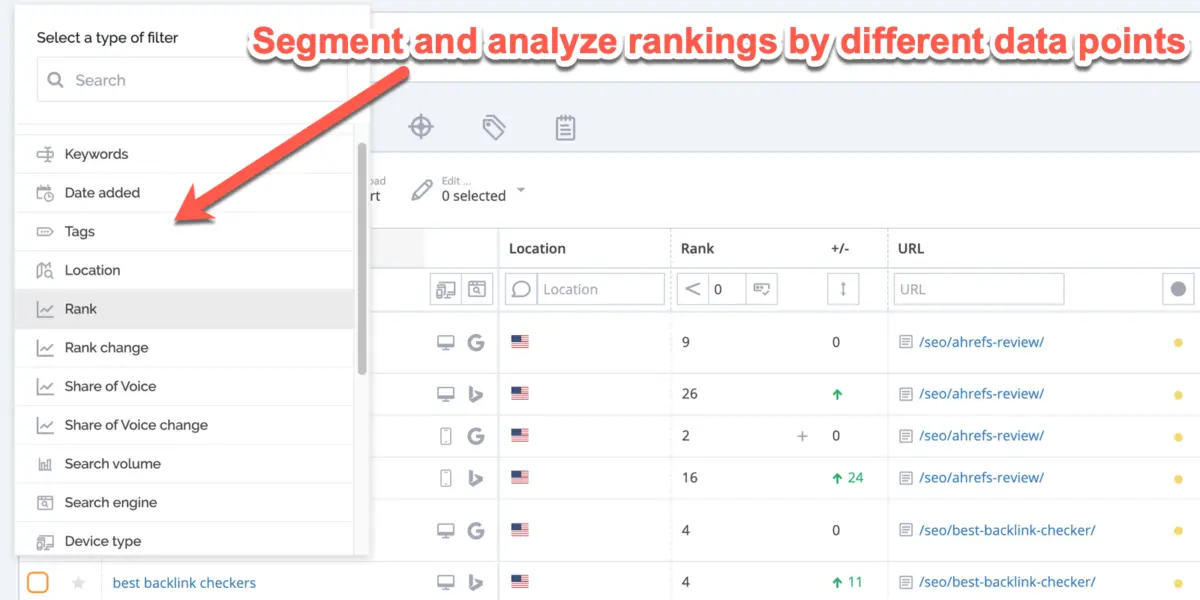
8. Advanced Tagging and Segmentation
Not all keywords hold equal business value. Robust tagging systems enable teams to categorize terms by conversion funnel stage, content asset type, topic cluster, or business unit, facilitating targeted reporting and strategic pivoting.
![7 Best SERP Tracking Tools for 2022 [In-Depth Review]](https://www.robbierichards.com/wp-content/uploads/2020/05/AccuRanker-Google-Data-Studio-integration.jpg)
9. White-Label Reporting & Integrations
For agencies and enterprise consultancies, client-facing deliverables must be pristine. Native white-label scheduling and seamless API connectors to visualization platforms like Looker Studio and Databox are non-negotiable requirements.
![7 Best SERP Tracking Tools for 2022 [In-Depth Review]](https://www.robbierichards.com/wp-content/uploads/2018/11/Ian-Howells2.png)
The 7 Best SERP Tracking Tools for 2025
The market features countless options, but a select group of platforms consistently rises to the top. Below is an exhaustive breakdown of the three best standalone SERP trackers and four premier all-in-one SEO platforms.
![7 Best SERP Tracking Tools for 2022 [In-Depth Review]](https://www.robbierichards.com/wp-content/uploads/2019/01/Google-Data-Studio-KW-rankings-dashboard.png)
1. AccuRanker (Best Dedicated Standalone Tracker)
- Overview: Trusted by over 32,000 major global brands including HubSpot, IKEA, and Kinsta, AccuRanker is widely considered the gold standard for dedicated, high-speed rank tracking.
- Core Strengths: Unmatched data update speeds, instantaneous on-demand data refreshes, exceptional SERP feature analysis spanning 50+ layouts, and deep Landing Pages reporting that merges rank data with Google Analytics revenue metrics.
- Best For: Agencies, enterprise brands, and SEO professionals demanding lightning-fast, highly accurate data without the bloat of an all-in-one suite.
- Pricing: Scaled subscription models based on tracked keyword volume, starting at approximately $116/month for up to 1,000 keywords.
2. Semrush Position Tracker & SERP Gap Analyzer (Best All-in-One Solution)
- Overview: Serving over 10 million users globally—including enterprise giants like Samsung and Vodafone—Semrush is a titan in the digital marketing software space. Its dedicated Position Tracking tool and specialized App Center extensions rival the accuracy of any standalone tracker.
- Core Strengths: Hyper-accurate daily tracking from national to local zip-code levels, extensive mobile/desktop comparison matrices, and the proprietary SERP Gap Analyzer app, which scans thousands of search result pages to automatically surface under-optimized content and quick-win opportunities.
- Best For: Marketing teams and enterprises seeking an exhaustive, all-in-one digital marketing suite coupled with elite-tier rank tracking capabilities.
- Pricing: Subscription tiers begin at $139.95/month.
3. ProRankTracker (Best Cost-Effective Scalable Tracker)
- Overview: Utilized by over 60,000 users worldwide, ProRankTracker provides a robust, highly scalable standalone tracking environment geared toward international and multi-device campaigns.
- Core Strengths: Comprehensive multi-language support, accurate local pack tracking across global coordinates, and advanced video rank tracking capabilities for YouTube marketers.
- Best For: Ecommerce brands, video marketers, and digital agencies managing massive keyword volumes on a lean budget.
- Pricing: Accessible plans starting at $39/month.
4. Advanced Web Ranking – AWR (Best for Enterprise & Custom Reporting)
- Overview: A seasoned veteran in the SEO tooling space, AWR is deployed by thousands of in-house teams and enterprise brands (including Microsoft) for massive scale data harvesting and bespoke reporting.
- Core Strengths: Unlimited user seat models on enterprise tiers, powerful white-label reporting engines, and robust API access for custom data pipelines.
- Best For: Large in-house marketing departments and enterprise agencies requiring granular multi-tiered user access permissions.
- Pricing: Plans begin at $99/month.
5. SERPWatcher by Mangools (Best for Simplicity & Usability)
- Overview: Developed by Mangools, SERPWatcher is celebrated for its remarkably clean user interface and its proprietary Performance Index, which aggregates ranking movements into a single, easy-to-understand organic traffic potential score.
- Core Strengths: Zero learning curve, visually engaging dashboards, and bundled access to complementary tools like SERPChecker.
- Best For: Small business owners, startups, and freelancers who prioritize intuitive design and straightforward metrics.
- Pricing: Bundled Mangools plans start at $29.90/month.
6. SE Ranking (Best Feature-Rich Mid-Market Platform)
- Overview: SE Ranking has carved out a dominant space as a versatile all-in-one SEO toolkit. Its Position Tracking module simulates authentic user behavior across precise geographic targets to ensure data integrity.
- Core Strengths: 100% accurate location-based simulation, comprehensive competitor historical data, and flexible pricing models.
- Best For: Small-to-medium agencies and growing businesses seeking a balanced mix of tracking depth and broader SEO auditing tools.
- Pricing: Daily update plans for 500 keywords start at $52/month.
7. Nightwatch (Best for Hyper-Local & Global Scale)
- Overview: Trusted by enterprise brands like Shopify and Coinbase, Nightwatch stands out for its ability to extract precise ranking data from over 107,296 global locations.
- Core Strengths: Unrivaled geographic coverage, sophisticated data segmentation, and clean, modern visualization dashboards.
- Best For: Global enterprises, international franchises, and multi-location businesses.
- Pricing: Plans begin at $32/month for up to 250 keywords, backed by a 14-day free trial.
Future Outlook: The Next Generation of SERP Intelligence
As we look toward the remainder of the decade, the role of SERP tracking software will continue to evolve rapidly. The expansion of generative AI search experiences means that traditional 10-blue-link tracking is no longer sufficient. Future platforms must adapt to measure brand visibility within conversational search outputs, AI-generated summaries, and zero-click answer boxes.
![7 Best SERP Tracking Tools for 2022 [In-Depth Review]](https://www.robbierichards.com/wp-content/uploads/2025/01/AccuRanker-home-page.jpg)
Organizations that invest in sophisticated, real-time SERP tracking infrastructure today will possess the empirical agility required to outmaneuver competitors tomorrow. Whether you opt for a specialized standalone powerhouse like AccuRanker or an expansive ecosystem like Semrush, aligning your tracking capabilities with rigorous data governance and revenue attribution will remain the ultimate differentiator for SEO success in 2025 and beyond.