In the high-stakes world of search engine optimization (SEO) and digital marketing, choosing the right toolkit can make the difference between a thriving digital enterprise and a buried domain. With thousands of articles in the SERPs offering endless "Top 10" or "Top 100" tool lists, marketers are frequently left overwhelmed and no closer to making a concrete decision.
To cut through the noise, search marketing strategist Robbie Richards went straight to the source. He posed a deceptively simple question to 139 search marketing professionals, international SEO directors, and agency founders:
“If you could only use 3 tools for keyword research, which 3 would you choose?”
The goal was clear: strip away the marketing fluff and see which keyword research solutions organically rise to the surface when seasoned practitioners are forced to narrow down their arsenals. The resulting data paints a definitive picture of an industry dominated by a few powerhouse platforms, supplemented by agile niche scrapers and foundational data sources.
At the top of the leaderboard stand Semrush, the Google Keyword Planner, and Ahrefs. This comprehensive report explores the quantitative results, structural methodologies, expert insights, and strategic frameworks revealed by the 139 participating specialists.
Detailed Chronology & Leaderboard Breakdown
As the digital marketing landscape has evolved, so too have the strategies required to achieve first-page visibility. Modern SEO is no longer just about matching exact-match vanity keywords; it requires deep topical authority, semantic context, complex search intent mapping, and robust competitor analysis.
When aggregated, the votes from the 139 experts established a clear hierarchy among the top tools:
Semrush (87 Votes)
Google Keyword Planner (57 Votes)
Ahrefs (55 Votes)
1. Semrush: The Undisputed Industry Leader
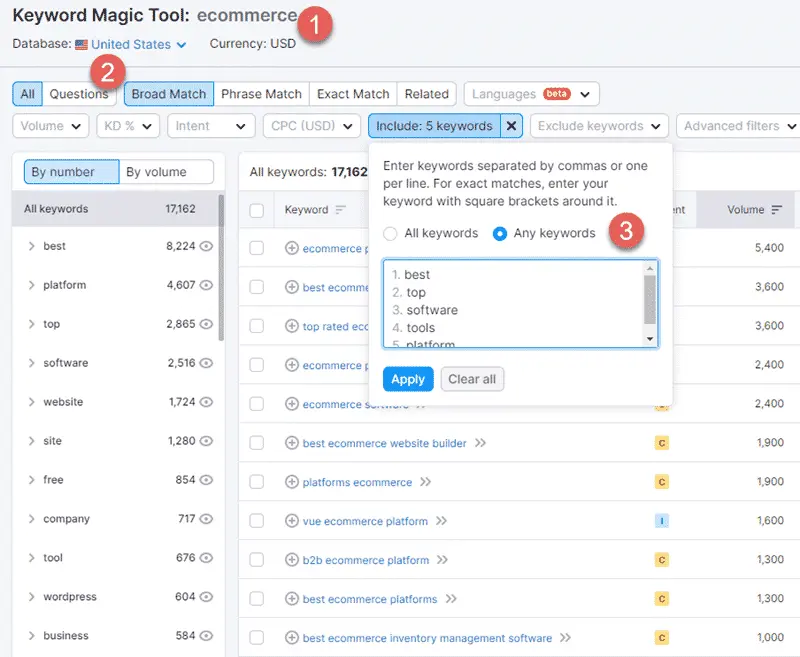
Capturing an impressive 87 votes, Semrush emerged as the definitive favorite among the surveyed experts. Boasting a massive database of over 23 billion keywords spanning 142 international markets, Semrush offers an all-in-one SEO and PPC suite.
Experts repeatedly highlighted two standout features:
The Keyword Magic Tool: Allows marketers to group keywords by topic, search intent, question type, and SERP features, streamlining the creation of comprehensive content clusters.
The Keyword Gap Tool: Facilitates side-by-side keyword comparisons of up to five competitors, letting users effortlessly uncover missed organic and paid search opportunities.
2. Google Keyword Planner: The Foundational Standard
Despite its limitations for pure organic SEO—such as restricting precise search volume data primarily to active Google Ads users—the Google Keyword Planner secured 57 votes. Marketers continue to rely on it as a foundational baseline. Because the data comes straight from the source, it remains trusted for checking macro-level search trends, geo-targeted volume, and basic PPC bidding metrics.
3. Ahrefs Keywords Explorer: The SEO Powerhouse
Trailing closely with 55 votes, Ahrefs is celebrated for its robust database, lightning-fast reporting, and unique metrics. Experts prize the Keyword Ideas Report for its cross-engine capabilities (pulling data from Google, Bing, YouTube, Amazon, and Yahoo) and its precise traffic potential calculations based on real-world click behavior rather than sheer search volume.
Supporting Context & Metrics: How the Experts Operate
Beyond the top three tools, the 139 contributors revealed a diverse ecosystem of specialized software, Chrome extensions, and unconventional research methods designed to unearth hidden opportunities.
The Rise of Semantic and Intent-Based Research
A recurring theme among enterprise SEOs is that traditional keyword research—treating keywords as isolated strings of text—is effectively dead.
Brendan Hufford (Active Campaign) emphasized that chasing single keywords while missing long-tail search intent is a recipe for failure. He relies on Ahrefs to reverse-engineer consistently ranking content, combined with his own human analysis of user intent pyramids.
Suganthan Mohanadasan (Snippet Digital) highlighted Keyword Insights, a machine learning tool that leverages natural language processing (NLP) and SERP data to cluster keywords automatically, identifying whether a query requires a single comprehensive article or multiple distinct product pages.
Scraping, Suggest, and Long-Tail Discovery
Many experts supplement their core enterprise platforms with specialized tools designed to mine autocomplete engines and user behavior:
AnswerThePublic & alsoasked.com: Widely cited by contributors like John Doherty, Adam Connell, and Brogan Renshaw, these tools visually map out questions, prepositions, and long-tail variations, making them invaluable for building FAQ sections and targeting featured snippets.
Keywords Everywhere: Frequently mentioned as an essential Chrome extension, it injects search volume and CPC data directly into Google SERPs, Google Keyword Planner, and search autocomplete boxes.
KeywordTool.io: Praised by international SEO managers like Luke Monaghan for extracting long-tail variants across YouTube, Amazon, and Google.
The Human Element: Talking to Real Customers
Several seasoned practitioners reminded the industry that software should never entirely replace human intuition.
Kurt Frankenberg shared that his most successful local SEO strategy relies on physical interactions: asking actual paying customers on phone calls how they found his business and what exact phrasing they typed into search bars.
Carrie Hill (Sterling Sky) echoed this sentiment, noting that customer service teams hold a wealth of knowledge regarding the exact vocabulary everyday users employ—vocabulary that automated tools sometimes miss.
Official Insights from Industry Leaders
A cross-section of the 139 expert responses reveals how different professionals orchestrate their tool stacks:
Luke Monaghan (International SEO Manager, lululemon): Relies on Semrush for competitive insights, SISTRIX for historical domain visibility charts, and Keywordtool.io for long-tail variants.
Chris Dreyer (CEO, Rankings.io): Combines Ahrefs Keywords Explorer (for SERP overview and position history), Semrush (for PPC and organic overlap), and Google Search Console (as an underutilized goldmine for actual user queries).
Erin Munson (Consumer Attorney Marketing Group): Uses Semrush as her daily driver, Ahrefs for a second opinion and featured snippet tracking, and Ryte for its advanced Content Optimizer.
Joe Williams (Founder, Tribe SEO): Champions Keywords Everywhere for instant inline data, Semrush (specifically Guru plans) for historical keyword data dating back to 2012, and Ahrefs as an all-in-one powerhouse.
Future Outlook: The Next Evolution of Keyword Research
As search engines become increasingly sophisticated through machine learning, artificial intelligence, and semantic parsing, the future of keyword research is shifting toward entity-based optimization.
Marketers can no longer rely on simplistic volume metrics alone. As demonstrated by the insights of enterprise leaders like Andrew Shotland—who invests in custom machine learning models to classify millions of keywords at scale—the competitive edge now belongs to those who can:
Harmonize data across multiple platforms (e.g., cross-referencing Semrush competitive intelligence with Google Search Console performance).
Automate content clustering and search intent mapping using AI-driven NLP tools.
Ground their digital strategies in real-world consumer language gathered through customer interviews and support logs.
That’s a Wrap!
Ultimately, as Robbie Richards and his 139 expert contributors demonstrate, you do not need dozens of expensive tools to build a profitable marketing campaign. By anchoring your workflow with an enterprise-grade suite like Semrush or Ahrefs, validating data with Google Keyword Planner, and extracting nuanced search intent with tools like AnswerThePublic or Keywords Everywhere, you can build a resilient, high-performing organic search strategy designed to dominate the SERPs for years to come.


![139 Experts Reveal Best Keyword Research Tools [Leaderboard]](https://www.robbierichards.com/wp-content/uploads/2021/01/Best-Keyword-Research-Tools-for-SEO.jpg)
![139 Experts Reveal Best Keyword Research Tools [Leaderboard]](https://www.robbierichards.com/wp-content/uploads/2021/10/Semrush-home-page-screenshot.jpg)
![139 Experts Reveal Best Keyword Research Tools [Leaderboard]](https://www.robbierichards.com/wp-content/uploads/2022/05/image12.png)
![139 Experts Reveal Best Keyword Research Tools [Leaderboard]](https://www.robbierichards.com/wp-content/uploads/2022/06/Keyword-Gap-Tool.jpg)
![139 Experts Reveal Best Keyword Research Tools [Leaderboard]](https://www.robbierichards.com/wp-content/uploads/2018/08/rj-employee_Robbie-color-new.png)
![139 Experts Reveal Best Keyword Research Tools [Leaderboard]](https://www.robbierichards.com/wp-content/uploads/2022/06/Google-Keyword-Planner.jpg)
![139 Experts Reveal Best Keyword Research Tools [Leaderboard]](https://www.robbierichards.com/wp-content/uploads/2022/06/Ahrefs-home-page.jpg)
![139 Experts Reveal Best Keyword Research Tools [Leaderboard]](https://www.robbierichards.com/wp-content/uploads/2021/08/Luke-Monaghan-headshot.jpg)
![139 Experts Reveal Best Keyword Research Tools [Leaderboard]](https://www.robbierichards.com/wp-content/uploads/2021/08/Gael-Breton-headshot.jpg)
![139 Experts Reveal Best Keyword Research Tools [Leaderboard]](https://www.robbierichards.com/wp-content/uploads/2015/04/KW-Expert-Roundup.jpg)
![139 Experts Reveal Best Keyword Research Tools [Leaderboard]](https://www.robbierichards.com/wp-content/uploads/2019/05/John-Doherty-150x150.jpg)
![139 Experts Reveal Best Keyword Research Tools [Leaderboard]](https://www.robbierichards.com/wp-content/uploads/2015/04/ana_hoffman.jpg)
![139 Experts Reveal Best Keyword Research Tools [Leaderboard]](https://www.robbierichards.com/wp-content/uploads/2021/08/Paul-Shapiro-headshot.jpg)
![139 Experts Reveal Best Keyword Research Tools [Leaderboard]](https://www.robbierichards.com/wp-content/uploads/2021/08/Chris-Castillo.jpg)
![139 Experts Reveal Best Keyword Research Tools [Leaderboard]](https://www.robbierichards.com/wp-content/uploads/2021/08/Matthew-Barby-headshot.jpg)
![139 Experts Reveal Best Keyword Research Tools [Leaderboard]](https://www.robbierichards.com/wp-content/uploads/2017/08/Chris-Dreyer-Rankings.io_-150x150.jpg)
![139 Experts Reveal Best Keyword Research Tools [Leaderboard]](https://www.robbierichards.com/wp-content/uploads/2017/06/Adam-Connell-Blogging-Wizard-150x150.jpg)
![139 Experts Reveal Best Keyword Research Tools [Leaderboard]](https://www.robbierichards.com/wp-content/uploads/2021/08/Rich-Missey-headshot.jpg)