In the high-stakes world of modern search engine optimization (SEO), the tools you choose can make or break your digital marketing campaigns. With countless software platforms, web scrapers, and extensions flooding the market, marketers are frequently paralyzed by choice. Long gone are the days when a simple keyword density checker or generic free tool could secure a top spot on Google’s search engine results pages (SERPs). Today, building a profitable online presence requires a surgical approach to keyword research, search intent matching, and competitive intelligence.
To cut through the noise of endless "Top 10" lists, a comprehensive industry study surveyed 139 top-tier search marketing experts, asking them one definitive question:
“If you could only use 3 tools for keyword research, which 3 would you choose?”
By going straight to the source—consulting the international SEO managers, agency founders, and content strategists building high-performing campaigns for global brands—a clear consensus emerged. Rather than relying on dozens of disparate applications, the industry’s elite lean heavily on a select group of powerhouse platforms. This report provides an exhaustive, authoritative breakdown of the leaderboard, dissecting the standout features of the top tools, analyzing expert insights, and outlining the strategic frameworks required to dominate the SERPs.
Detailed Chronology & Methodology: Cutting Through the SERP Clutter
The digital marketing landscape is littered with superficial software roundups designed more for affiliate commissions than practical utility. To deliver actionable, data-backed insights, this research initiative bypassed automated listicles and targeted practitioners who manage multi-million-dollar organic and paid search portfolios.
Over successive review cycles, the survey aggregated responses from 139 distinguished search marketing professionals. While individual workflows vary—spanning everything from enterprise-level technical SEO to bootstrapped niche site building—the cumulative data revealed an undeniable hierarchy. The overwhelming majority of respondents anchored their strategies around three primary heavyweights: Semrush, Ahrefs, and Google Keyword Planner, heavily supplemented by niche discovery tools like AnswerThePublic, Keywords Everywhere, and KWFinder.
The Leaderboard: A Closer Look at the Industry Giants
When the votes were tallied, three platforms emerged as the undisputed pillars of modern keyword research. Here is how the top contenders rank by expert vote count and functionality.
1. Semrush (87 Votes) — The Undisputed All-in-One Leader
Semrush captured the lion’s share of expert endorsements, cementing its status as the industry-leading all-in-one SEO and PPC toolset. Boasting one of the largest keyword databases in existence—spanning over 23 billion keywords across 142 international markets—Semrush provides unparalleled depth for competitive intelligence.
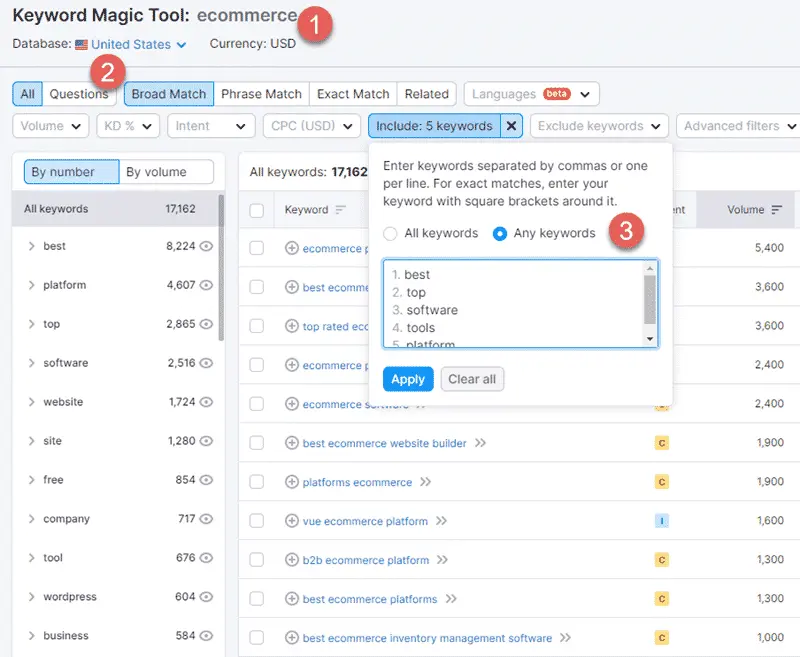
The Keyword Magic Tool: This feature allows marketers to dynamically group keywords by topic, search intent, question type, and SERP features. Users can instantly filter out noise, assess keyword difficulty metrics, and seamlessly push targeted lists directly into position-tracking modules or PPC campaigns.
The Keyword Gap Tool: A favorite among enterprise SEOs, this feature enables side-by-side comparative analysis against up to five competitors, identifying immediate content and ranking gaps.
2. Google Keyword Planner (57 Votes) — The Baseline Authority
Despite shifting toward a paid-centric model that reserves granular search volume data for active Google Ads users, Google Keyword Planner remains a foundational tool for the SEO community.
Direct-from-the-Source Data: While critics note its lack of advanced SEO filters and its reliance on paid search metrics, experts value GKP for baseline relative traffic data, local market targeting, and validating seed terms straight from the search engine itself.
3. Ahrefs Keywords Explorer (55 Votes) — The Content & Link Powerhouse
Trailing Semrush by a razor-thin margin, Ahrefs commands fierce loyalty among content marketers and technical SEOs alike.
Keyword Ideas Report: Similar to Semrush’s keyword mapper, Ahrefs allows users to pull thousands of keyword opportunities from multi-engine databases including Google, Bing, YouTube, Amazon, and Yahoo.
SERP Overview & Click Metrics: Ahrefs stands out by providing advanced click-through-rate (CTR) estimates, return rates, and robust backlink data within its SERP overview, helping marketers determine whether a high-volume keyword is actually worth the competitive effort.
Supporting Context & Metrics: Insights from the Expert Trenches
While the big three command the highest vote counts, the qualitative insights shared by the 139 experts reveal that successful SEO requires a synergistic "stack" rather than a one-size-fits-all solution.
The Shift Toward Search Intent and Topic Clusters
A recurring theme among top practitioners is that traditional, isolated keyword targeting is dead. Modern SEO requires a deep understanding of why a user is searching.
Brendan Hufford (Growth Content Marketer, ActiveCampaign) emphasizes that matching search intent trumps raw keyword volume every time: "The best content ranks for thousands of keywords… simply putting the keywords in the right places won’t help you rank if you don’t match the search intent."
Suganthan Mohanadasan (Co-Founder, Snippet Digital) highlights advanced NLP tools like Keyword Insights, which utilize machine learning and SERP data to automatically cluster keywords, determining whether a query demands a single comprehensive article or multiple distinct product pages.
Leveraging Competitor Reverse-Engineering
Many experts pointed to competitive intelligence as the fastest route to high-ROI keywords.
Georgi Todorov (Founder, Digitalnovas) uses Ahrefs to uncover "low-hanging fruit"—identifying low-authority blogs currently ranking for high-volume keywords and creating superior, targeted content to capture that traffic.
Luke Monaghan (International SEO Manager, Lululemon) relies on Semrush and SISTRIX to extract competitor keyword profiles, gaining invaluable insight into historical performance and international visibility trends.
Human-Centric Keyword Discovery
Not all data lives in software databases. Several veteran marketers advocate for qualitative research methods.
Kurt Frankenberg (Shoestring101) champions direct customer interaction: "My first, second, and third SEO tool is actual human interaction… ask customers how THEY might go about finding you if they had used the internet."
Tools like AnswerThePublic, alsoasked.com, and Seed Keywords bridge this gap by visualizing natural language queries, prepositions, and long-tail question formats that traditional keyword tools often miss.
Official Statements & Key Takeaways from the Panel
To encapsulate the strategic diversity of the 139 contributors, here is how key industry figures organize their daily workflows:
Jon Doherty (Founder, Credo): Relies on Ahrefs for topic research, Semrush for domain-level competitor analysis, and AnswerThePublic for question-based keyword generation.
Aleyda Solis (International SEO Consultant, Orainti): Combines Semrush, SISTRIX, and KWFinder for precise international keyword scaling.
Brian Dean: Consistently leverages comprehensive data stacks to uncover high-impact backlink and keyword pairings.
Robbie Richards (Host & SEO Strategist): Utilizes Semrush for granular subfolder and product category analysis, combined with Ahrefs’ SERP overview reports to qualify keyword opportunities through robust link data.
Future Outlook: The Evolution of Keyword Research
As we look toward the future of search, the methodology of keyword research continues to evolve at a breakneck pace. The integration of artificial intelligence, natural language processing, and zero-click search features means that marketers can no longer rely on rigid spreadsheets of exact-match terms.
The experts have spoken: the winning formula for modern SEO lies in synergy. By pairing enterprise-grade competitive intelligence tools (like Semrush and Ahrefs) with intent-mapping utilities (like AnswerThePublic and Keyword Insights) and grounding strategies in direct customer feedback, digital marketers can build resilient, highly profitable organic growth engines.
Whether you are managing an international e-commerce brand or bootstrapping a localized service business, the tools and frameworks outlined by these 139 experts provide the definitive roadmap for conquering the SERPs in 2023 and beyond.