

Executive Overview
For the contemporary freelance writer, the traditional interview is a high-stakes, high-friction bottleneck. A standard 20-minute conversation with a subject matter expert (SME) routinely yields upwards of 3,000 words of raw industry insights. Historically, capturing these exchanges meant choosing between two deeply flawed methodologies: frantically scribbling shorthand notes—thereby sacrificing conversational engagement and missing critical narrative nuances—or spending upwards of an hour meticulously reviewing raw audio recordings multiple times just to extract accurate quotes.
Enter AI-powered real-time transcription tools. Among them, Otter.ai has emerged as an industry standard since its widespread adoption in the early 2020s. Used extensively by professional journalists, copywriters, and content creators across fast-paced sectors like fintech, SaaS, and health tech, Otter promises to eliminate the friction of manual transcription.
This comprehensive review investigates whether Otter.ai’s Pro tier—priced at approximately $100 annually—delivers genuine return on investment (ROI) for working freelance writers. By analyzing real-world workflows, time-saving metrics, pricing tiers, and inherent technical limitations, this report provides an authoritative assessment of how artificial intelligence is permanently reshaping the economics of freelance journalism.
Detailed Chronology: The Evolution of the Interview Workflow
To truly understand the value proposition of modern transcription software, one must examine the chronological evolution of how writers transition a spoken conversation into a published article.
Phase 1: The Manual Era (Pre-2018)
Prior to automated machine learning models, writers relied entirely on analog methods or basic digital recorders.
- The Interview: The writer conducts a phone or video call while keeping a split focus on typing notes. Key quotes are missed because the writer is busy capturing a previous sentence.
- The Review: Post-call, the writer listens to the audio file at 0.75x speed, pausing repeatedly to type out quotes. A 20-minute interview routinely required 60 to 90 minutes of dedicated transcription labor.
- The Outline: With notes scattered across digital documents, the writer laboriously pieces together a narrative thread.
Phase 2: The Rise of Human Transcription Agencies
Recognizing the administrative burden, agencies offering human-based transcription services gained popularity. While accuracy was near 100%, structural bottlenecks remained:
- The Turnaround Lag: Human transcribers typically required three to five business days to return a completed file.
- The Cost Barrier: Premium rush fees were often mandatory for tight journalistic deadlines. For a freelance writer operating on a strict one-week turnaround for research, interviewing, drafting, and editing, human transcription was frequently too slow and cost-prohibitive.
Phase 3: The AI Revolution (2020–Present)
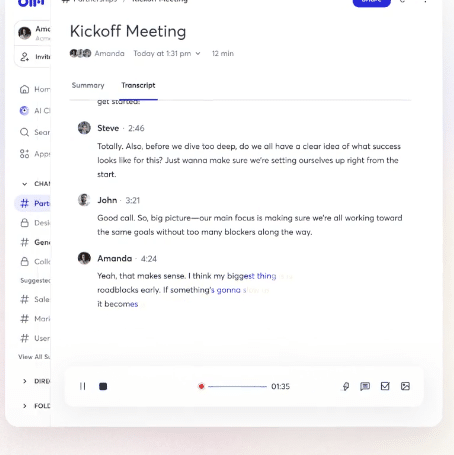
The integration of automated speech recognition (ASR) and natural language processing (NLP) compressed the timeline from days to seconds. Tools like Otter.ai shifted the paradigm:
- Instant Capture: Transcripts are generated concurrently with the meeting or instantly upon its conclusion.
- Interactive Verification: Audio playback is hyperlinked directly to the transcript text, allowing writers to click any word and immediately hear the corresponding audio segment.
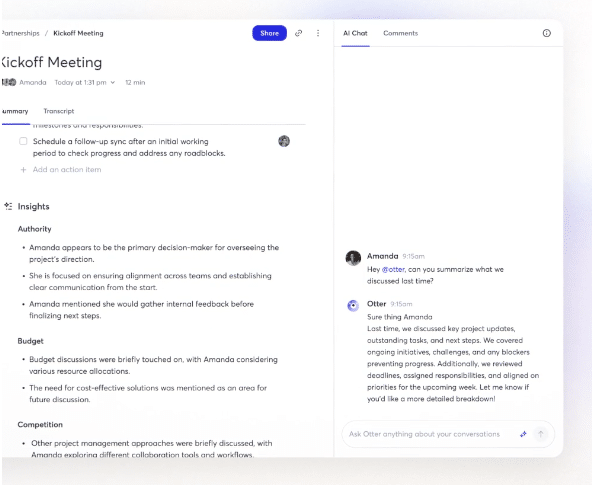
- Conversational AI Search: Rather than scrolling endlessly through text, writers can query the transcript via an embedded chatbot, extracting specific thematic discussions in seconds.
Supporting Context & Metrics: The Mathematics of Freelance ROI
In the freelance economy, time is not merely a convenience—it is literal currency. To evaluate whether a $100/year investment in Otter.ai is mathematically sound, we must break down the economic impact on an average assignment.
The Standard Project Breakdown
Consider a standard freelance commission: an in-depth 1,000-word article backed by a single SME interview, commanding a fee of $1,200.
-
Traditional Workflow:
- Research & Prep: 1 hour
- Interview & Manual Transcription: 1 hour (interview) + 1 hour (transcription) = 2 hours
- Outlining & Drafting: 3 hours
- Editing & Polishing: 1 hour
- Total Time Invested: 7 hours
- Effective Hourly Rate: $171.42/hour
-
AI-Assisted Workflow (Using Otter.ai):
- Research & Prep: 1 hour
- Interview & Instant Transcription: 20 minutes (interview) + 10 minutes (cleanup) = 30 minutes
- Outlining & Drafting: 3 hours
- Editing & Polishing: 1 hour
- Total Time Invested: 5.5 hours
- Effective Hourly Rate: $218.18/hour
Cumulative Time Savings
By eliminating manual transcription, a writer saves roughly 1.5 hours per article. For a professional producing four interview-driven pieces per month, this compounds to 6 hours of saved labor monthly—translating to 72 hours annually.
Given that the Otter.ai Pro subscription costs roughly $100 per year, the platform effectively pays for itself within the first assignment of the month. The remaining time can be redirected toward prospecting high-paying clients, conducting deeper research, or scaling output.
Technical Deep-Dive: Features, Limitations, and Operational Realities
While the quantitative metrics favor adoption, any professional tool must be evaluated through its practical execution. Otter.ai offers powerful features, but it also presents distinct operational hurdles that users must navigate.
Core Strengths
- Immediate Post-Call Availability: The transcript is ready the moment the virtual meeting ends. This removes deadline anxiety and accelerates the transition from reporting to writing.
- AI Chat Querying: If an expert meanders during a call and touches on "credit card fraud" in minute 5 and returns to the topic in minute 18, the AI chat function can instantly isolate, summarize, and cross-reference those disparate mentions.
- Audio-Text Synchronization: Clicking any line in the text jumps the audio player directly to that exact syllable, making verification fast and seamless.
- Low Barrier to Entry: The generous free tier (Basic plan offering 300 minutes per month with 30-minute session caps) allows creators to thoroughly test the software within their actual work environments before committing financially.
Operational Limitations and Workarounds
Professional transparency requires acknowledging where automated transcription falls short:
- The Speaker Mode Constraint: When utilizing wired or wireless headphones, Otter frequently captures only the user’s voice, failing to pick up the incoming audio from the interviewee. Workarounds require routing audio through computer speakers or utilizing dedicated virtual audio cables, which can introduce privacy or ambient noise challenges in non-isolated environments.
- Real-World Accuracy (80%–85%): While marketing materials frequently cite high accuracy benchmarks, complex industry terminology, niche acronyms, and proper nouns routinely cause parsing errors. Writers cannot blindly copy-paste text; verifying quotes against the source audio remains a mandatory step.
- Speaker Diarization Inconsistencies: In multi-party calls, webinars, or interviews featuring voices with similar tonality, the software occasionally misattributes dialogue, labeling participants as generic identifiers (Speaker 1, Speaker 2) that require manual correction.
Pricing Structure & Strategic Tiers
Understanding the financial commitment requires analyzing Otter.ai’s tiered ecosystem:
- Basic Plan (Free):
- 300 monthly transcription minutes
- 30-minute limit per individual conversation
- Ideal for casual users or trial evaluations.
- Pro Plan ($8.33/month billed annually / ~$100/year):
- 1,200 monthly minutes (up to 90 minutes per conversation)
- Custom vocabulary training (crucial for specialized writers)
- Advanced export options (Word, PDF, SRT)
- The Sweet Spot: This tier aligns precisely with the operational needs of full-time freelance journalists and content creators.
- Business Plan ($19.99/month billed annually):
- 6,000 monthly minutes (up to 4 hours per conversation)
- Centralized billing, team analytics, and admin controls. Designed primarily for agencies, editorial teams, and corporate communications departments.
Future Outlook: The Trajectory of AI in Content Creation
As artificial intelligence models advance, the landscape of freelance writing will continue to transform. We are moving rapidly past the era where AI is viewed merely as a transcription novelty; it is becoming an active architectural partner in the research phase of journalism.
In the near future, tools like Otter.ai will likely evolve to offer automated narrative structuring, generating preliminary story outlines directly from conversational transcripts based on editorial guidelines provided by the writer. Furthermore, improvements in speaker diarization and noise-cancellation neural networks will bridge the gap between machine transcription and human stenography, pushing baseline accuracy rates past 95% even in acoustically challenging environments.
For freelance writers, the strategic takeaway is clear: technology will not replace the nuance, investigative curiosity, and storytelling skill of a human writer. However, writers who leverage AI administrative tools will consistently outperform those who cling to legacy workflows. By offloading mechanical friction to machines, modern professionals can reclaim their most valuable asset: time to think, report, and write better stories.