

Executive Overview
Long before the first dinosaurs walked the Earth—and tens of millions of years before the flowering plants that define modern landscapes evolved—the region that is now the bustling, concrete-paved metropolis of Illinois was an unrecognizable world. During the Carboniferous period, approximately 309 million years ago, the American Midwest sat near the equator, blanketed by a vast, sweltering expanse of tropical swampy river deltas, dense fern forests, and meandering waterways.
Today, this ancient ecosystem is locked away in one of the world’s most celebrated paleontological repositories: the Mazon Creek fossil beds. It was from these storied deposits that a unique fossil was excavated decades ago, eventually finding its way into the permanent collections of Chicago’s Field Museum. For years, the specimen sat quietly, misidentified and filed away alongside similar specimens under a broad, catch-all classification.
Now, a team of researchers—spearheaded by two undergraduate student scientists participating in the museum’s prestigious Women in Science internship program—has rewritten the history books. Following a meticulous anatomical re-evaluation, the specimen has been officially recognized as an entirely new genus and species: Jeanerpeton mazonensis.
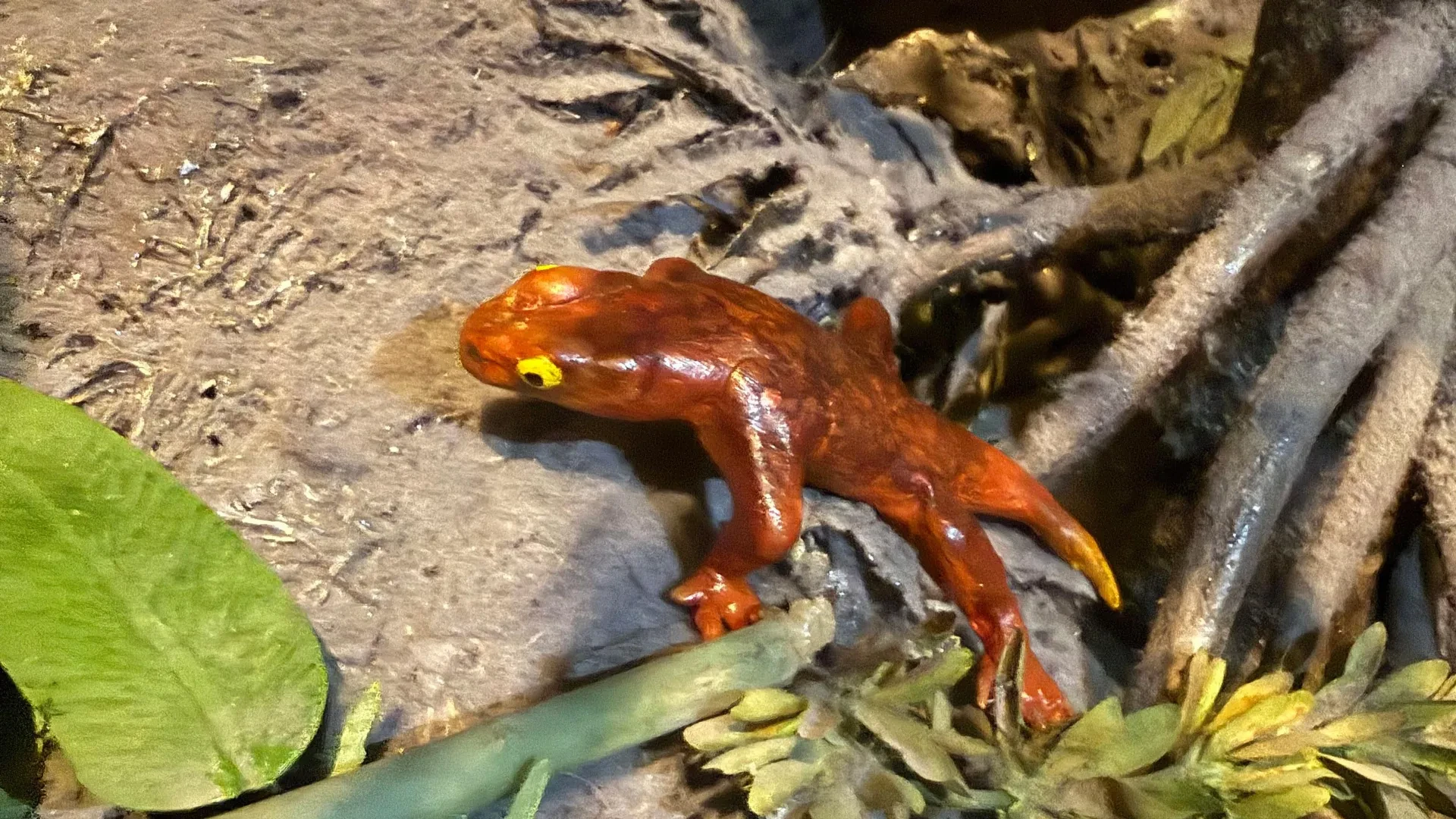
Resembling a hybrid between a modern salamander and a stout, short-bodied frog, Jeanerpeton mazonensis provides unprecedented insights into the morphology of early tetrapods. Its formal description, recently published in the Journal of Vertebrate Paleontology, not only rescues the animal from a historical taxonomic "waste bin" but also highlights the untapped potential held within the deep storage vaults of natural history museums worldwide. This comprehensive report explores the chronological discovery of the fossil, the sophisticated techniques used to differentiate it from known species, the profound ecological context of Carboniferous Illinois, and the inspiring journey of the young scientists who brought this prehistoric creature back to life.
Detailed Chronology
The Ancient Genesis: Illinois, 309 Million Years Ago
To fully understand the significance of Jeanerpeton mazonensis, one must travel back through the deep corridors of geologic time to the Pennsylvanian epoch of the Carboniferous period. At this juncture in Earth’s history, global atmospheric oxygen levels were significantly higher than they are today, paving the way for the evolution of colossal arthropods—such as dragonflies with wingspans reaching two feet—and a dazzling array of primitive land-dwelling vertebrates.
The Mazon Creek biota, preserved within the Francis Creek Shale member of the Carbondale Formation, owes its existence to a catastrophic geologic event. As periodic floods swept across the ancient tropical delta, vast amounts of sediment were rapidly dumped over deceased flora and fauna. This instantaneous burial sealed the biological remains away from scavengers and oxygen-rich waters, halting the normal decomposition process.
As the surrounding iron-rich minerals precipitated around the organic matter, they formed hard, oval-shaped nodules known as concretions. Over millions of years, these concretions hardened into stone, preserving not only the sturdy bones of ancient vertebrates but also extraordinarily fragile soft-tissue impressions—including skin outlines, scales, and delicate muscle structures—that are almost universally lost to the fossil record.
From Earth to Archive: The Initial Discovery
Millennia later, as industrial coal mining operations exposed the fossil-bearing shales of Grundy and surrounding Illinois counties, amateur fossil collectors began scouring the spoil heaps. It was during this era of enthusiastic amateur discovery that the specimen destined to become the holotype of Jeanerpeton mazonensis was unearthed.
Recognizing the value of their find, the collector donated the concretion to the Field Museum. Upon its arrival, curators and researchers performed an initial assessment. Given the primitive state of preparation techniques at the time and the superficial similarities shared among small Paleozoic tetrapods, the fossil was categorized as Amphibamus grandiceps—a well-known, small-bodied temnospondyl amphibian relative that populated the same geographic area.
For decades, the fossil rested in the museum’s climate-controlled drawers, functionally hidden in plain sight. It was treated as a representative example of a known species rather than a focal point for novel research, illustrating a common phenomenon in paleontology where museum collections quietly house groundbreaking discoveries waiting for the right pair of eyes.
The Modern Renaissance: The Mann Lab and the Women in Science Program
The turning point for the fossil arrived through the collaborative framework of the Field Museum’s Negaunee Integrative Research Center. Under the guidance of Dr. Arjan Mann, assistant curator of fossil fishes and early tetrapods, the museum fosters a rigorous, hands-on environment for emerging researchers.
In 2025, the laboratory welcomed two exceptional undergraduate interns through the Field’s Women in Science program: Payton Kohlberg and Allison Sefcovic. Designed to break down systemic barriers and encourage young women to pursue rigorous careers in STEM, the internship paired Kohlberg and Sefcovic with postdoctoral researcher Cam So and Dr. Mann.
Tasked with re-examining historical Mazon Creek tetrapod specimens that had long been lumped together, the research team began systematically opening drawers, cracking open old assumptions, and applying modern comparative anatomy frameworks to decades-old rocks. It was during this systematic audit that the specimen labeled as Amphibamus grandiceps began to reveal its true, unique identity.
Supporting Context & Metrics
Anatomy of a Pioneer: What Jeanerpeton mazonensis Tells Us
The scientific name Jeanerpeton mazonensis is rich with both biological and personal meaning. The genus name translates to "Jean’s crawler," directly honoring the mothers of the two student co-lead authors—both of whom are named Jean. The specific epithet, mazonensis, pays homage to the Mazon Creek fossil locality that preserved the animal for over three centuries of millions of years.
Morphologically, Jeanerpeton is an evolutionary marvel. While it belongs to an extinct lineage of early tetrapods that eventually gave rise to modern amphibians (frogs, salamanders, and caecilians), it possesses a body plan that bridges the gap between primitive fish-like ancestors and modern lissamphibians.
- Skeletal Proportions: Unlike the elongated, slender bodies typical of many early salamander-like tetrapods, Jeanerpeton featured a conspicuously short, stocky torso reminiscent of a modern frog.
- Soft-Tissue Preservation: Because of the unique siderite concretion formation at Mazon Creek, the fossil preserved intricate details that standard bones cannot convey. Researchers were able to map out distinct scales along the animal’s back and identify tiny, hair-like ventral ribs known as gastralia.
- Cranial and Sensory Impressions: Most astonishingly, the fossil retains clear impressions of the creature’s eyes and delicate toe pads, providing direct evidence of how this ancient predator interacted with its muddy, arboreal, or aquatic substrate.
Dismantling the "Waste Bin Taxon"
In paleontology, a "waste bin taxon" (formally known as a form taxon or wastebasket taxon) represents a frustrating reality of classification. When researchers encounter fragmentary fossils or specimens that share superficial resemblances, historical convention often led them to dump these fossils into existing, broad species categories rather than investing the exhaustive time required to prove they represent something entirely new.
For generations, Amphibamus grandiceps functioned as just such a waste bin for small Carboniferous tetrapods in Illinois. Too many distinct specimens with subtle, uncataloged anatomical variations were swept under its umbrella, obscuring the true biodiversity of the ancient delta.
By conducting high-magnification visual analyses, comparative osteological measurements, and phylogenetic placement matrices, the research team proved that Jeanerpeton possessed distinct cranial proportions, vertebral structures, and dermal armor patterns that separated it definitively from Amphibamus.
"What we’re finding from the Field Museum’s collection are a bunch of things that historically were grouped together into this waste bin taxon known as Amphibamus grandiceps," explains Dr. Cam So, co-author of the study. "Jeanerpeton is one of those species. And now, we’ve found enough evidence to support it being an anatomically distinct animal. With this publication, we officially pull Jeanerpeton out of this waste bin taxon."
Official Statements & Expert Perspectives
The discovery of Jeanerpeton mazonensis has sent ripples through the international paleontological community, serving as a testament to the power of institutional archives and mentorship-driven science education.
The Student Perspective: Overcoming Imposter Syndrome
For co-lead authors Payton Kohlberg and Allison Sefcovic, stepping into the world of professional paleontology was initially a daunting prospect. Neither student possessed a background heavily rooted in vertebrate paleontology prior to joining the Mann Lab.
"Before working in the Mann Lab, I didn’t know much about paleontology," reflects Payton Kohlberg. "My experience at the Field and in the Women in Science program has made me more confident in my abilities to try something new. It is scary to take on a project when you feel like you don’t know as much as you should, but I learned with my practical experience that it is possible to overcome that fear with hard work."
Allison Sefcovic echoes these sentiments, emphasizing the sheer aesthetic and scientific wonder of working with Mazon Creek material:
"What’s really cool about Mazon Creek is that it preserves all of these unusual details—things like toe pads and body outlines," says Sefcovic. "In the fossil of Jeanerpeton, we can see some of the scales on its back and tiny ‘belly ribs’ called gastralia. You can even see the eye impressions! It’s so cool to see."
Institutional Impact and Future Legacy
The Field Museum houses millions of geological and biological specimens, operating essentially as an active research library where the books are written in stone. Dr. Arjan Mann and his colleagues emphasize that discoveries like Jeanerpeton validate the continuous funding and preservation of these vast archives.
Rather than relying solely on expensive, high-risk field expeditions into remote badlands, modern paleontologists can make world-class discoveries by systematically reviewing historical drawers with next-generation analytical tools. The success of the Women in Science program further underscores the museum’s dedication to diversifying the scientific workforce, proving that fresh perspectives are often the key to unlocking secrets that have sat undisturbed for decades.
Future Outlook
The formal description of Jeanerpeton mazonensis in the Journal of Vertebrate Paleontology marks a definitive milestone, but it is far from the conclusion of the research team’s work.
Expanding the Taxonomic Audit
With Jeanerpeton successfully rescued from the Amphibamus waste bin, the Mann Lab at the Field Museum is turning its attention to other drawers in the collection. Researchers suspect that additional misidentified or lump-classified specimens are waiting to be recognized as distinct species. A systematic review of Carboniferous tetrapods across North American museums is currently underway, which could radically revise our understanding of Paleozoic ecosystem resilience and evolutionary radiation.
Micro-CT Scanning and Internal Anatomy
While the external surface of the Jeanerpeton concretion offers breathtaking views of scales, eyes, and gastralia, future research phases will likely incorporate non-destructive micro-computed tomography (micro-CT) scanning. By bombarding the ironstone nodules with X-rays, scientists can generate high-resolution 3D digital models of the internal cranial bones and endocranial cavity without risking damage to the delicate fossil matrix. This technology promises to reveal inner ear structures and neuro-anatomical traits that can shed light on how early amphibian relatives navigated their damp, dynamic environments.
Inspiring the Next Generation
Beyond the academic metrics of new species publication and phylogenetic trees, the Jeanerpeton project stands as a blueprint for inclusive scientific mentorship. By integrating undergraduate interns directly into high-level, publishable research, programs like the Field Museum’s Women in Science initiative ensure that the future of paleontology will be shaped by diverse, resilient, and rigorously trained minds.
As researchers continue to unpack the treasures of Mazon Creek, Illinois’s ancient tropical swamps will continue to speak across the millennia—reminding us that beneath our modern landscapes lie stories of deep time, evolutionary trial and error, and the enduring human curiosity to understand where we came from.
