

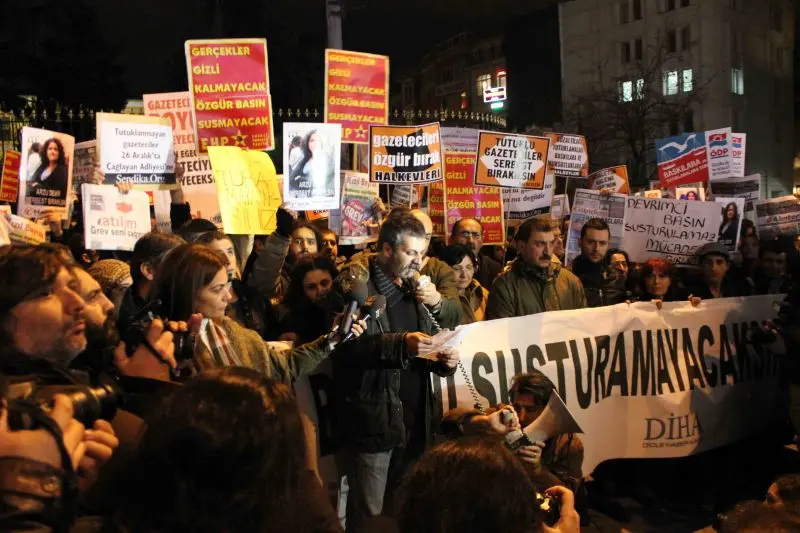
ISTANBUL — In a development that has sent ripples through Turkey’s media landscape and international political circles, an Istanbul court ordered the release of four journalists on Monday pending the outcome of their trial. Among those freed are Ahmet Şık and Nedim Şener, two high-profile investigative reporters whose 375-day imprisonment had become a global symbol of the erosion of free speech in Turkey.
The conditional release of Şık and Şener—along with co-defendants Coşkun Musluk and Sait Çakir—marks a pivotal moment in a high-stakes legal saga. All four men had been held under the sprawling, highly controversial "Ergenekon" conspiracy trials, an investigation into an alleged ultranationalist shadow government accused of plotting to overthrow the ruling, Islam-rooted Justice and Development (AK) Party.
While the release was welcomed by government officials and jubilant crowds gathered outside Silivri Prison on the outskirts of Istanbul, international press freedom watchdogs and domestic advocates emphasize that the fight for expression in Turkey is far from over. With approximately 100 journalists still languishing behind bars, Monday’s decision is viewed less as a sweeping victory for human rights and more as a cautious, heavily scrutinized gesture by a state facing relentless global pressure.
Executive Overview
The decision by the Istanbul court to release the four defendants was officially attributed to the "likelihood of reclassifying the crime" and the substantial "time spent under custody," according to the semi-state-run Anatolia News Agency. The men deny all charges, maintaining that their incarcerations were politically motivated punitive measures designed to silence critical reporting.
The case centers on allegations that the defendants formed the media arm of Ergenekon, a clandestine network allegedly plotting a violent coup against the AK Party administration. However, civil rights organizations, foreign governments, and the defendants themselves argue that the charges are a fabrication meant to intimidate journalists, academics, and political dissidents.
While the freedom of Şık, Şener, Musluk, and Çakir brings temporary relief to their families and colleagues, six other defendants in the same legal orbit remain behind bars. These include prominent editors from Oda TV, a hard-line secularist online publication known for its scathing critiques of the AK Party.
As the legal proceedings limp toward their next scheduled hearing on June 18, the case remains a profound stress-test for Turkish democracy, highlighting the tense friction between a powerful, centralized government and a beleaguered Fourth Estate.
Detailed Chronology and Case Background
To understand the weight of Monday’s court order, one must examine the timeline of fear, investigation, and detention that preceded it. The arrests of Ahmet Şık and Nedim Şener in early 2011 shocked the Turkish public and galvanized international condemnation.
The Arrests and the "Ergenekon" Web
The Ergenekon investigations, launched in 2007, initially aimed to dismantle a deep-state network allegedly responsible for decades of political turmoil, assassinations, and instability in Turkey. However, as the scope of the investigation expanded over the years, critics began to notice a troubling pattern: the net was increasingly catching not just rogue military officers and ultra-nationalist operatives, but also journalists, human rights defenders, Kurdish activists, and political opponents of the government.
Ahmet Şık and Nedim Şener were swept into this expanding dragnet in March 2011. Prior to his arrest, Şık had been working on a meticulously researched book exploring the alleged infiltration of the Turkish police force by followers of Fethullah Gülen, a powerful, self-exiled Turkish Muslim preacher residing in Pennsylvania. In a move that chilled the journalistic community, police raided publishing offices and confiscated draft copies of Şık’s unpublished manuscript immediately following his detention.
Nedim Şener, an award-winning investigative reporter for the daily newspaper Milliyet, was targeted for his relentless pursuit of truth surrounding the 2007 assassination of Armenian-Turkish journalist Hrant Dink. Şener had spent years investigating the murder, publishing work that argued state security apparatuses willfully ignored intelligence pointing directly to the assassination plot.
For 375 days, both men were held in pre-trial detention—a period that critics argue was weaponized by the state to inflict psychological pressure and preemptively muzzle their investigative work.
The Prison Gates and Defiant Returns
As the prison gates opened on Monday, emotional scenes unfolded outside Silivri Prison. A dense, impassioned crowd waving Turkish flags and holding banners greeted the freed journalists with chants of "Free press cannot be silenced."
Addressing the gathered media and supporters, Ahmet Şık immediately broadened the scope of the discourse beyond his personal ordeal.
"This is not just about press freedom, this is about freedom of expression," Şık declared. "There are 100 journalists in jail, but freedom of expression is not just a problem for journalists."
Şık drew attention to the broader systemic crisis, noting that approximately 60 students and thousands of other Turkish citizens remain imprisoned under Turkey’s draconian anti-terrorism laws, which critics argue are routinely exploited to criminalize dissent.
Nedim Şener struck an equally defiant tone, vowing to pick up right where he left off. Standing outside the prison parking lot, Şener confirmed his commitment to uncovering the truth behind Hrant Dink’s murder.
"The truth cannot be imprisoned," Şener stated, adding that true justice would only be realized when the architects of the false allegations against them are held accountable.
Supporting Context & Metrics: The Crisis of Press Freedom in Turkey
The release of the four journalists occurs against a backdrop of deep international alarm regarding the state of democratic institutions and civil liberties in Turkey.
Alarming Statistics
According to data compiled by the Committee to Protect Journalists (CPJ), Turkey maintains the dubious distinction of having one of the highest incarceration rates for journalists in the world. Approximately 100 members of the press are currently either imprisoned following conviction or held pending trial.
- The Kurdish Minority: The vast majority of jailed journalists in Turkey are of Kurdish origin, often targeted under anti-terrorism statutes for covering the Kurdish conflict or working for pro-Kurdish media outlets.
- Pre-Trial Detention as Punishment: Under Turkish criminal procedure codes, pre-trial detention periods have historically been excessively long, transforming the pre-trial phase into a form of premature punishment without a formal verdict of guilt.
The Legislative Framework
At the heart of the crisis are Turkey’s penal code and anti-terrorism laws, which feature vague, sweeping definitions of what constitutes "terrorist propaganda" or "membership in an armed organization." Human rights organizations argue that these statutes are so loosely worded that virtually any critical commentary about state policy, the military, or government officials can be prosecuted as a national security threat.
International bodies, including the European Union—which Turkey formally aspires to join—have repeatedly warned Ankara that its judicial harassment of journalists is incompatible with European democratic standards. The United States State Department has also voiced sharp criticisms, urging Turkish authorities to respect fundamental freedoms.
Official Statements and Reactions
The court’s decision elicited a spectrum of responses, ranging from cautious optimism within government ranks to guarded skepticism from international watchdogs.
Government Response
Turkish Deputy Prime Minister Bülent Arınç welcomed the release in a televised address, striking a surprisingly moderate tone compared to previous defensive postures adopted by executive officials.
"It is pleasing," Arınç said. "Long periods under custody should not turn into punishment."
Despite these conciliatory words, the government maintains its official stance that the detained journalists are not being prosecuted for their journalistic output, but rather for their alleged involvement in illegal plots against the constitutional order. Critics, however, dismiss this defense as a rhetorical smokescreen designed to placate international critics while maintaining domestic control.
International and Watchdog Demands
Civil society organizations were quick to point out that Monday’s releases, while welcome, do not resolve the systemic crisis.
In a formal press statement issued following the court session, the Committee to Protect Journalists (CPJ) stated:
"The government must go beyond this mere gesture and release all journalists incarcerated under Turkey’s vague penal and anti-terror laws. Fundamental reform of the country’s legislation to align it with international standards is also essential."
Similar sentiments were echoed by Amnesty International and Reporters Without Borders, both of which have campaigned tirelessly for the dismantling of the legal mechanisms used to silence dissenting voices in Turkey.
Future Outlook
While Ahmet Şık, Nedim Şener, Coşkun Musluk, and Sait Çakir taste temporary freedom, their legal troubles are far from over. The next major milestone in the case is scheduled for June 18, when the trial will resume in Istanbul.
Furthermore, the fate of the six remaining defendants—including the key figures behind Oda TV—hangs in the balance, serving as a reminder that the judicial sword of Damocles continues to hover over independent media outlets in the country.
Observers and international diplomats will be watching the June hearing closely to determine whether Monday’s decision represents the beginning of a genuine liberalization of Turkish judicial policy, or merely a calculated public relations maneuver designed to weather a temporary storm of foreign criticism.
For now, the journalists who walked out of Silivri Prison have stepped back into a altered reality—one where the public support is palpable, but the legal battles ahead remain dauntingly complex.