

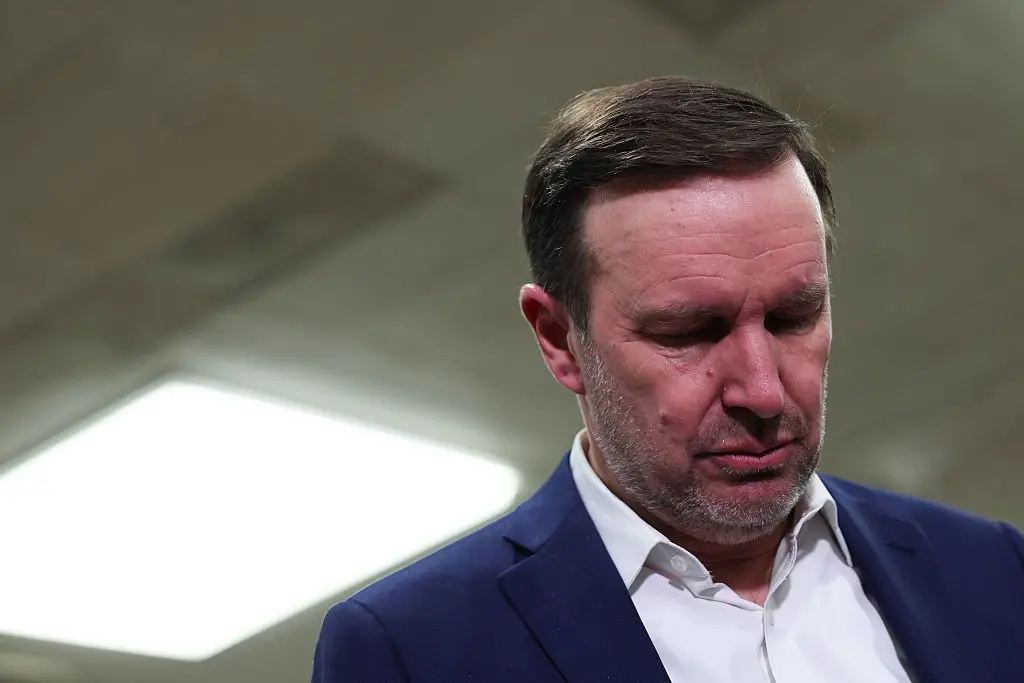
WASHINGTON — U.S. Senator Chris Murphy of Connecticut is currently recovering at Johns Hopkins Hospital in Baltimore after suffering a stroke over the weekend. The 53-year-old Democratic lawmaker experienced sudden physical symptoms while attending his son’s hockey game on Saturday afternoon, triggering an immediate medical response that ultimately led to his transfer to one of the nation’s premier neurological centers.
The incident, which was formally announced by Murphy’s office on Sunday, November 1, 2026, has sent ripples through Capitol Hill. It places a temporary pause on the senator’s high-profile national campaigning schedule just days before crucial midterm elections, while also drawing renewed scrutiny to the health and physical resilience of contemporary political leaders.
Executive Overview
According to statements released by his congressional office, Senator Chris Murphy began experiencing localized numbness in his arm while sitting in the stands at a local ice hockey rink on Saturday afternoon. Recognizing the potential severity of the symptoms, he was swiftly transported to a nearby medical facility.
Attending physicians quickly diagnosed the episode as a stroke. To ensure specialized neurological care and comprehensive ongoing monitoring, Murphy was subsequently transferred across state lines to Johns Hopkins Hospital in Baltimore, Maryland.
Chief of Staff Allison Herwitt issued an optimistic statement addressing the senator’s current condition:
"Yesterday afternoon, Senator Murphy started experiencing numbness in his arm while at his son’s hockey game. He was taken to a local hospital, where it was discovered he had experienced a stroke. He was transferred to Johns Hopkins for further monitoring and is responding well to treatment. The doctors are encouraged by his progress, he is awake and alert, and we are optimistic he will make a full recovery."
As of Sunday evening, medical personnel at Johns Hopkins remain encouraged by Murphy’s trajectory. While no definitive timeline for his discharge has been established by his office or medical team, the senator is reportedly resting comfortably, fully conscious, and responsive to medical interventions.
Detailed Chronology of Events
The unfolding of events leading to Senator Murphy’s hospitalization highlights the sudden and unpredictable nature of cerebrovascular incidents.
- Friday, October 30, 2026: Senator Murphy maintains a rigorous public-facing schedule, appearing alongside Connecticut Governor Ned Lamont at campaign events within his home state. Colleagues and staffers report no visible signs of distress or physical impairment.
- Saturday, November 1, 2026 (Afternoon): While attending his son’s competitive hockey game, Murphy experiences localized numbness in one of his arms. Prompted by the sudden onset of this neurological warning sign, he seeks immediate medical evaluation.
- Saturday, November 1, 2026 (Evening): Initial diagnostic testing at a local medical facility confirms that Murphy has suffered a stroke. Medical professionals stabilize the senator and initiate primary treatment protocols.
- Late Saturday / Early Sunday: To leverage advanced neuro-intensive care and continuous monitoring, medical coordinators arrange for Murphy’s transfer to Johns Hopkins Hospital in Baltimore.
- Sunday, November 2, 2026 (Afternoon): Chief of Staff Allison Herwitt publicly breaks the news via media channels and social platforms, reassuring the public that the senator is awake, alert, and responding positively to care.
The rapid identification of symptoms—often summarized by the medical acronym FAST (Face drooping, Arm weakness, Speech difficulty, Time to call 911)—is widely credited by medical professionals with minimizing long-term tissue damage during strokes. In Murphy’s case, recognizing arm numbness as an acute symptom allowed for immediate intervention.
Supporting Context & Metrics: A Troubling Trend in the U.S. Senate
Senator Murphy’s medical emergency highlights a broader, statistically notable phenomenon within the modern United States Senate: the occurrence of strokes among Democratic lawmakers in recent years. With this diagnosis, Murphy becomes the fourth Senate Democrat to experience a stroke since 2022.
Precedent Among Senate Democrats
- Sen. Ben Ray Luján (D-N.M.): In February 2022, Luján suffered a stroke at the age of 50. He experienced dizziness and fatigue before checking himself into a hospital, where a cerebellar stroke was diagnosed. Following a period of rehabilitation, Luján returned to Capitol Hill with a clean bill of health.
- Sen. Chris Van Hollen (D-Md.): In May 2022, Van Hollen experienced a minor stroke while delivering a speech in Maryland, noting lightheadedness and blurred vision. He spent several days receiving inpatient treatment at Walter Reed National Military Medical Center before making a full recovery.
- Sen. John Fetterman (D-Pa.): In May 2022, just days before his primary election, Fetterman suffered a major stroke caused by atrial fibrillation and cardiomyopathy. His recovery required significant lifestyle adjustments, and he currently utilizes live-captioning technology during congressional hearings to manage auditory processing challenges.
The Demographics and Pressures of Congressional Life
While strokes can affect individuals across all age brackets and professions, the high-stress, itinerant lifestyle of federal lawmakers creates a unique environment of risk factors. Members of Congress frequently endure chronic sleep deprivation, irregular dietary habits, high-stakes political pressure, and relentless cross-country travel between Washington, D.C., and their home states.
At 53 years of age, Murphy is relatively young compared to the average age of the 119th Congress, yet cardiovascular and cerebrovascular events remain a leading cause of long-term disability and medical intervention in the United States. According to the American Heart Association, stroke remains a primary health emergency, underscoring the critical need for public awareness regarding sudden neurological symptoms.
Official Statements and Bipartisan Well-Wishes
News of Senator Murphy’s hospitalization prompted an immediate outpouring of support from across the political spectrum. Colleagues in both the Democratic and Republican caucuses took to public forums to express solidarity and wish him a rapid recovery.
Connecticut Governor Ned Lamont, who had stood side-by-side with Murphy on the campaign trail just 48 hours prior, released a heartfelt statement:
"Ann and I are keeping Chris, Alison, and their entire family in our thoughts and prayers. Chris is a tireless public servant and a resilient fighter. We are praying for his swift and complete recovery."
Senate colleagues who have navigated similar medical journeys also reached out. Senator John Fetterman, intimately familiar with the physical toll of a high-profile stroke while holding federal office, offered words of encouragement alongside veteran lawmakers like Senator Chuck Grassley (R-Iowa), demonstrating a momentary bridging of partisan divides in the face of personal health crises.
Future Outlook: Political and Legislative Implications
The immediate consequence of Senator Murphy’s medical leave involves the suspension of his aggressive travel and campaigning schedule leading up to the fast-approaching midterm elections.
Impact on the Midterm Elections
Murphy had been scheduled to travel to New Hampshire on Sunday to rally voters alongside Democratic congressional candidates Chris Pappas and Stefany Shaheen. Those appearances were immediately canceled. Because Murphy himself is not up for re-election on Tuesday, his absence will not directly alter the composition of the Senate ballot in Connecticut, but it removes one of the party’s most effective national surrogates from the closing days of the campaign cycle.
Legislative Schedule and 2028 Speculation
Beyond the immediate electoral horizon, Murphy’s health trajectory intersects with significant national responsibilities. Having served in the Senate since 2013—following three terms in the U.S. House of Representatives—Murphy has cultivated a powerful national platform. He is widely recognized as a leading legislative voice on gun violence prevention, foreign policy regarding the Middle East, and comprehensive immigration reform.
Furthermore, political analysts have increasingly viewed Murphy as a viable contender for the Democratic presidential nomination in 2028. While that long-term political calculus is naturally secondary to his immediate health and recovery, the coming weeks will require a careful balancing act between his senatorial duties and necessary medical rehabilitation.
For now, medical staff at Johns Hopkins Hospital are managing his recovery, with family, colleagues, and constituents waiting anxiously for updates on his progress toward a full and healthy return to public life.