

Executive Overview
In the volatile chronology of digital technology, few brands carry the polarizing historical weight of LimeWire. Once synonymous with the early-2000s peer-to-peer (P2P) file-sharing revolution—a decentralized Wild West of MP3 downloads, legal battles, and cultural ubiquity—the name has undergone one of the most radical corporate and technological pivots in modern tech history. Today, LimeWire has been resurrected not as a decentralized music-swapping client, but as a cutting-edge, AI-powered content publishing platform and Web3 creative ecosystem.
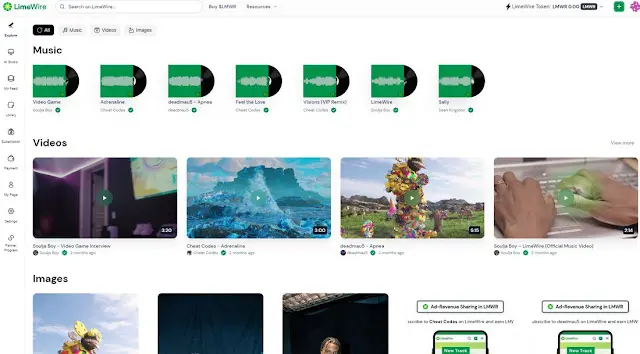
Positioned squarely at the intersection of generative artificial intelligence and blockchain-based digital asset management, LimeWire Studio bridges the gap between creative expression and monetization. The platform empowers creators, designers, musicians, and digital artists to generate state-of-the-art AI imagery, automatically mint those creations as Non-Fungible Tokens (NFTs) on high-throughput blockchains, and distribute their work through flexible public or subscription-based models.
Furthermore, LimeWire has engineered a unique economic flywheel. By integrating its native utility token, LMWR, and offering robust ad-revenue-sharing tiers, the platform has transformed passive digital consumers into active economic participants. High-profile endorsements from mainstream cultural figures—including Deadmau5, Soulja Boy, and Sean Kingston—signal that this reinvented iteration of LimeWire is capturing the attention of the modern creator economy. This in-depth analysis explores the mechanics, economic architecture, toolsets, and future roadmap of LimeWire’s ambitious ecosystem.
Detailed Chronology: From Peer-to-Peer Infamy to AI Innovation
To understand the magnitude of LimeWire’s current trajectory, one must trace its historical evolution—a narrative defined by legal upheaval, dormancy, and strategic reinvention.
Phase I: The P2P Era (2000–2010)
Founded in 2000 by Mark Gorton, LimeWire originally operated as a Java-based file-sharing client that connected millions of users globally. Utilizing the Gnutella network, it became a cornerstone of internet culture, allowing users to effortlessly trade music, software, and films. However, its decentralized structure placed it at the center of fierce legal battles with the Recording Industry Association of America (RIAA). The landmark 2010 federal court ruling (Arista Records LLC v. Lime Wire LLC) effectively crippled the original service, resulting in a permanent injunction and a prolonged period of legal and brand dormancy.
Phase II: The Acquisition and Strategic Pivot (2021–2022)
A full decade after its shutdown, the dormant LimeWire brand was acquired by Austrian entrepreneurs Julian and Paul Zehetmayr. Recognizing the immense residual brand recognition—coupled with a radically shifted digital landscape defined by digital scarcity, smart contracts, and decentralized finance—the new leadership abandoned the idea of returning to file-sharing. Instead, they envisioned a platform tailor-made for the emerging creator economy.
Phase III: Launch of the Web3 Marketplace and AI Integration (2023–Present)
Initially launched as a digital collectibles marketplace for music and art, LimeWire rapidly pivoted into generative AI. Recognizing that the future of content consumption lay in user-generated AI media, the platform deployed its proprietary AI Studio. By integrating foundational machine learning models (such as Stable Diffusion and DALL-E) with automated blockchain minting on Polygon and Algorand, LimeWire successfully repositioned itself as an end-to-end publishing engine for modern digital creators.
Supporting Context & Metrics: Inside the LimeWire AI Studio Architecture
At the operational core of the platform is the LimeWire AI Studio, an all-in-one content creation suite designed to eliminate the technical friction traditionally associated with digital art generation and Web3 distribution.
Advanced Generative AI Models
LimeWire does not rely on a single, isolated machine learning architecture. Instead, it aggregates industry-leading open-source and proprietary text-to-image models into a unified dashboard, including:
- Stable Diffusion 2.1 & Stable Diffusion XL (SDXL): Offering high fidelity, nuanced prompt adherence, and exceptional detail rendering.
- DALL-E 2 Integration: Providing alternative stylistic interpretations and robust conceptual mixing.
Users can interface with these tools through simple text prompts, ranging from basic descriptive sentences to complex parameter strings. Crucially, the platform features a granular styling engine that allows creators to effortlessly toggle between diverse visual aesthetics—including cinematic, photorealistic, digital art, pixel art, anime, and analog film. Advanced users can leverage custom samplers, prompt guidance scales, and negative prompts to fine-tune their outputs.
Automated Blockchain Minting
One of LimeWire’s most frictionless innovations is its approach to digital ownership. Once a user generates an image, music track, or video clip and decides to publish it, the platform automates the entire minting process.
Using either the Polygon or Algorand blockchains, LimeWire mints the creation as an NFT behind the scenes. Creators do not need to grapple with complex gas fees, wallet configurations, or smart contract deployments prior to publishing. This automated minting imbues every digital artifact with a verifiable cryptographic signature, establishing provenance, authenticity, and immutable ownership rights in the decentralized web.
Flexible Distribution Models: Public vs. Exclusive
LimeWire recognizes that modern creators require diverse monetization strategies. Consequently, the platform offers dual publishing tracks:
- Public Discovery: Creators can push their minted assets into the open LimeWire marketplace. Here, content is discoverable by the global community, fostering organic engagement, social sharing, and secondary market trading.
- Subscriber-Only Exclusivity: For creators looking to cultivate direct-to-fan monetization, LimeWire supports a gated community model. Creators can restrict specific image, video, or audio drops exclusively to paying subscribers, establishing recurring revenue streams reminiscent of Patreon or Substack, but underpinned by cryptographic access control.
Official Statements and Economic Mechanics: The LMWR Token & Revenue Share
LimeWire’s value proposition extends far beyond creative tooling; it is fundamentally an economic platform designed to return value to the artists and designers driving engagement.
The Ad-Revenue Sharing Model
In a departure from traditional social media platforms where algorithmic engagement primarily benefits corporate balance sheets, LimeWire redistributes ad revenue directly to its creator base.
When users consume content on LimeWire—whether browsing public AI art, listening to AI-generated music, or viewing video content—advertisements are served. Creators receive up to 70% of all ad revenue generated from views on their published content. This financial incentive transforms casual experimentation into a viable side income for digital artists.
The LMWR Ecosystem and Utility Token
All financial distributions and platform interactions are anchored by LMWR, LimeWire’s native utility token.
- Monthly Payouts: Creator earnings—derived from ad revenue shares, subscription fees, and secondary market royalties—are distributed monthly in LMWR tokens.
- Exchange Liquidity: Creators can easily off-ramp their earnings, as LMWR is actively traded on major centralized and decentralized cryptocurrency exchanges, including Kraken, ByBit, and Uniswap.
- Platform Currency: Beyond cash-outs, LMWR serves as internal fuel. Users can utilize LMWR tokens to purchase additional generation credits, pay for prompt enhancements, and settle transaction fees within the ecosystem.
Secondary Market Royalties
The economic loop is completed through programmatic royalties. Whenever a digital asset originally minted on LimeWire is traded on the secondary market between collectors and fans, the original creator automatically receives a 2.5% royalty fee on the transaction. This guarantees that successful artists continue to benefit downstream as their digital collectibles appreciate in cultural and financial value within the community.
Subscription Tiers and Pricing Architecture
To accommodate everyone from casual hobbyists to professional digital studios, LimeWire offers a structured tiered pricing model paired with a freemium onboarding experience.
| Tier Name | Monthly Cost | Credits Per Month | Approximate Image Generations | Ad Revenue Share | Key Perks |
|---|---|---|---|---|---|
| Free Plan | $0 | 10 Credits | Up to 20 images/day | 50% | Basic model access, community features |
| Basic Plan | $9.99 | 1,000 | Up to 2,000 | 50% | Pro profile badge, creation history, faster generations, ad-free |
| Plus Plan | $29.00 | 3,750 | Up to 7,500 | 60% | Early access to new AI models, higher revenue share, Pro badge |
| Advanced Plan | $49.00 | 5,000 | Up to 10,000 | 70% | Maximum ad revenue tier, priority rendering queues |
| Pro Plan | $99.00 | 11,250 | Up to 22,500 | 70% | Enterprise-grade allocation, maximum credits, full API access |
All paid subscription tiers eliminate third-party advertisements for the user, grant access to a customized Pro creator profile badge, ensure accelerated image rendering queues, and maintain a comprehensive historical archive of all generated assets.
Future Outlook: Beyond Image Generation
As generative artificial intelligence matures from a speculative novelty into foundational infrastructure, LimeWire’s strategic roadmap indicates aggressive expansion.
While the platform’s current technical capabilities are anchored primarily in sophisticated text-to-image generation and digital asset tokenization, executive leadership has confirmed imminent rollouts for AI music generation and AI video creation tools. By incorporating auditory and moving-image modalities into the LimeWire Studio ecosystem, the platform aims to evolve into a multidisciplinary content creation engine.
For digital artists, musicians, and web3 enthusiasts, LimeWire represents a compelling case study in brand resurrection and market adaptation. By successfully marrying accessible machine learning tools with automated blockchain infrastructure and aggressive revenue-sharing models, LimeWire has shed its controversial P2P past to build a forward-looking, creator-first digital economy.