

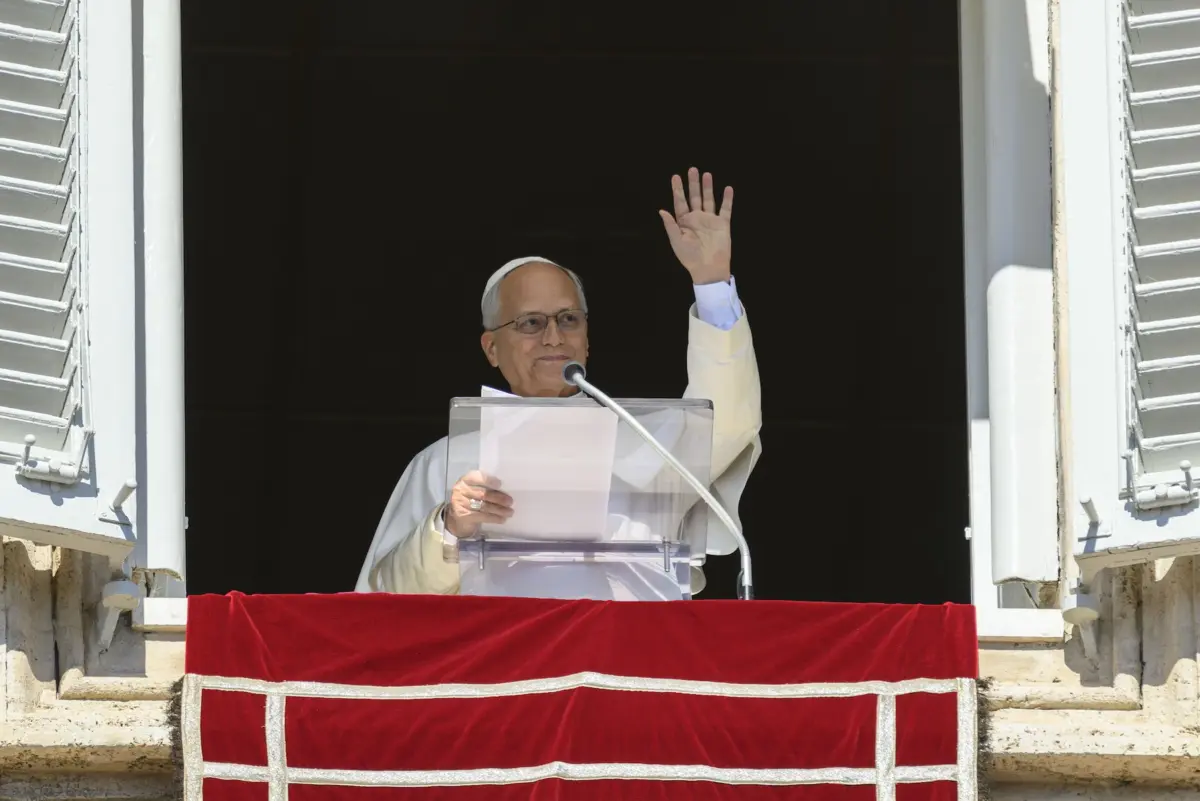
VATICAN CITY — In an unexpected and sobering announcement delivered to thousands of the faithful gathered beneath the autumn sun in St. Peter’s Square, Pope Leo XIV revealed on Sunday that he will undergo thoracic surgery in the coming days to remove a localized nodule discovered in his lung.
The pontiff, addressing the crowd during his traditional Sunday Angelus prayer before simultaneously releasing a formal statement across his official social media channels, struck a tone of calm reassurance. He emphasized that the anomaly had been caught during routine diagnostic screenings at a remarkably early stage, giving medical teams a distinct window for proactive intervention.
While the Vatican has confirmed that the upcoming procedure will necessitate a standard post-operative hospital stay of approximately one week—likely at Rome’s historic Gemelli Hospital—questions immediately loom regarding the sovereign pontiff’s rigorous international travel schedule, specifically an 11-day pastoral tour of South America slated for early November.
As the global Catholic community processes the news, medical experts, Vatican analysts, and international journalists are closely monitoring the unfolding situation, parsing the delicate balance between the physical demands of the papacy and the personal health of the 21st-century leader of the global Church.
Executive Overview
The announcement marks a significant juncture in the pontificate of Pope Leo XIV, bringing questions of papal health directly to the forefront of global attention. According to Vatican communications and direct statements from the Holy Father, the timeline for the intervention is compressed, with surgery scheduled for early next week.
- The Medical Finding: A small, well-localized lung nodule detected via recent routine medical examinations.
- The Treatment Plan: Surgical removal of the nodule, advised by a medical consensus that early intervention is the safest course of action.
- The Location: Rome’s Gemelli Hospital, renowned for its specialized medical suites dedicated to the treatment of sovereign pontiffs.
- Expected Recovery: An anticipated inpatient recovery period of roughly one week, during which routine governance of Vatican City State will continue, though matters requiring direct papal sign-off will be temporarily paused.
- Potential Schedule Impacts: An 11-day Apostolic Journey to Uruguay, Argentina, and Peru, currently scheduled to begin on November 6, hangs in the balance as medical teams evaluate post-surgical healing trajectories.
Detailed Chronology of Events
The discovery of the pulmonary nodule unfolded rapidly over the course of several days, culminating in Sunday’s public disclosure. While the Vatican has historically maintained a guarded approach to the private health records of reigning popes—a practice only modestly reformed in recent decades—Pope Leo XIV opted for a transparent, direct-to-the-faithful communication strategy.
The Diagnostic Phase
Medical evaluations leading to the discovery were conducted as part of the pontiff’s ongoing, scheduled health maintenance. Modern papal health protocols have grown increasingly rigorous, particularly following the protracted public illnesses of Pope John Paul II and the respiratory sensitivities that occasionally impacted Pope Benedict XVI and Pope Francis. During these recent diagnostic scans, attending physicians identified an isolated density within the lung tissue.
The Consultation and Decision
Upon reviewing the diagnostic imagery, a medical board determined that while the nodule was small and localized, monitoring it passively carried unnecessary risks compared to a targeted surgical resection. The medical team formally recommended intervention. Following a period of reflection and prayer, Pope Leo XIV accepted his physicians’ advice, authorizing the scheduling of the operation for the days immediately following the public announcement.
The Sunday Angelus and Social Media Rollout
At precisely noon on Sunday, addressing pilgrims from the window of the Apostolic Palace overlooking St. Peter’s Square, the Pope departed briefly from his standard theological reflections to address his personal health.
"Dear friends, during some recent medical examinations, the doctors found a small, localized nodule in my lung," Pope Leo XIV told the assembly. "It was detected at a very early stage and is well-localized. The doctors believe that it is best to intervene, so, following their advice, I have decided to undergo surgery to remove it. The operation is already scheduled to take place in the coming days."
Simultaneously, the announcement was published via the official @Pontifex X (formerly Twitter) account, ensuring instantaneous global dissemination across multiple languages. The pontiff concluded his public remarks with a deeply personal appeal: "I thank you for your spiritual closeness and entrust myself to your prayers."
Supporting Context & Medical Metrics
In the wake of the announcement, global health agencies, pulmonary specialists, and medical journalists have sought to contextualize the nature of lung nodules, the implications of early-stage intervention, and the specific logistical capabilities of Rome’s medical infrastructure.
Understanding Pulmonary Nodules
Pulmonary nodules—often colloquially referred to as "spots on the lung"—are common findings in diagnostic imaging, frequently appearing as small, roundish shadows on chest X-rays or computed tomography (CT) scans. According to epidemiological data from health organizations such as the American Lung Service and CNN medical analysts:
- Benign vs. Malignant: The vast majority of incidental lung nodules—estimated at well over 90% in general screenings—are benign (non-cancerous). They are frequently the residual scars of past minor respiratory infections, fungal exposures, or localized inflammations.
- The Role of Early Detection: When a nodule is identified at an early stage and is explicitly described as "well-localized," surgical excision (often performed via minimally invasive Video-Assisted Thoracoscopic Surgery, or VATS) serves both a diagnostic and therapeutic purpose. It removes the anomalous tissue entirely while allowing pathologists to perform immediate, definitive biopsies.
- Precautionary Interventions: Thoracic surgeons routinely advocate for the removal of localized nodules in patients of advanced age or high-profile responsibility if diagnostic imaging suggests a non-zero risk of malignancy, thereby neutralizing potential threats before systemic spread can occur.
The Role of Gemelli Hospital
The procedure is expected to take place at the Agostino Gemelli University Polyclinic in Rome. The hospital holds a historic and vital role in the medical care of the modern papacy.
- The Papal Suite: Gemelli Hospital famously houses a dedicated, highly secure ten-room medical suite on its top floor, frequently referred to as the "Vatican Third Floor." This facility was extensively utilized by Pope John Paul II during his numerous hospitalizations and has since served as the primary staging ground for papal medical procedures, surgeries, and post-operative recoveries.
- Multidisciplinary Care: The hospital brings together leading specialists in pulmonology, oncology, anesthesiology, and thoracic surgery, ensuring that the head of the Roman Catholic Church receives world-class, integrated medical attention within a secure environment.
Official Statements and Institutional Response
The announcement triggered an immediate wave of solidarity from religious leaders, heads of state, and international organizations, alongside formal operational updates from the Secretariat of State within the Vatican.
The Holy See’s Operational Update
In a supplementary briefing issued shortly after the Pope’s Angelus address, the Holy See Press Office outlined the administrative protocol that will govern the Vatican during the pontiff’s hospitalization.
- Continuity of Governance: Daily operations of the Roman Curia and the administration of Vatican City State will proceed without interruption. Heads of dicasteries will continue their administrative functions.
- The Papal Sign-Off: Per standard Vatican protocol during medical incapacitations or surgical recoveries, decisions requiring the explicit signature, decree, or direct personal intervention of the Sovereign Pontiff will be temporarily held in abeyance until the Pope is discharged and has resumed his full schedule. No formal delegation of supreme legislative or executive authority has been deemed necessary for a routine, short-term surgical recovery of this nature.
Global Reactions
Ecumenical leaders, interfaith partners, and political figures quickly mobilized social media and official channels to express support and offer prayers for a swift recovery:
- Episcopal Conferences: National bishops’ conferences across the globe—from North America to Asia and Africa—issued statements calling for special prayer vigils and intentions during Mass for the Pope’s upcoming operation.
- Ecumenical Partners: Representatives from Eastern Orthodox patriarchates, Anglican leadership, and Protestant bodies conveyed warm wishes, underscoring the universal respect Pope Leo XIV commands across Christian denominations.
Future Outlook: The South American Itinerary and Beyond
While the medical prognosis for the removal of an early-stage, localized lung nodule is statistically favorable, the immediate aftermath introduces critical scheduling questions for the final quarter of the year.
The Pending South American Apostolic Journey
On November 6, Pope Leo XIV is formally scheduled to depart Rome for an intensive 11-day pastoral tour of South America, with planned stops in Uruguay, Argentina, and Peru. The journey involves:
- Multiple long-haul trans-Atlantic flights.
- High-altitude environments in parts of Peru.
- Exhausting daily public appearances, mass celebrations, and diplomatic engagements.
Medical Evaluation of Travel Readiness
Vatican medical officials have indicated that a definitive decision regarding whether the South American tour will proceed as scheduled, be postponed, or undergo itinerary modifications will not be made until the surgery is successfully completed and the post-operative recovery trajectory can be accurately assessed.
- The Recovery Window: A standard one-week hospital stay places the Pope’s discharge near the middle or end of the week following the surgery. This leaves a narrow window of roughly two to three weeks before the scheduled November 6 departure date.
- Physician Guidance: Thoracic recovery mandates the avoidance of strenuous physical exertion, rapid changes in atmospheric pressure (such as commercial or charter air travel too soon after lung tissue operations), and exhaustive schedules. Medical teams will evaluate lung re-expansion capacity and overall stamina before clearing the pontiff for intercontinental travel.
Long-Term Papal Vigor
For the global Church, the episode serves as a reminder of the human vulnerability of the papacy. Yet, the upfront and transparent communication style adopted by Pope Leo XIV has been widely praised by Vatican observers as a modern, reassuring approach to papal health. By framing the medical intervention as a routine, early-stage preventative measure, the Vatican has sought to project stability, calm resolve, and unwavering faith as the pontiff prepares to enter the operating theater.