

Executive Overview
Years ago, marketing strategist Jim Lecinski introduced a foundational concept that fundamentally reshaped how brands approached consumer behavior: the Zero Moment of Truth (ZMOT). This manifesto argued that the traditional point of purchase—whether standing in a physical retail aisle or browsing a car dealership lot—was no longer where buying decisions were truly made. Instead, modern consumers embark on an investigative journey long before reaching the register. They scour the digital landscape for evidence, seeking validation, comparison, and proof of credibility to decide which products deserve their hard-earned money.
For decades, many marketers have operated from an inside-out perspective: Who are we? What do we want to sell? What creative message can we deploy to persuade the masses? However, the industry’s elite practitioners have always operated in reverse. They begin by examining the consumer’s underlying intent—what job the customer is trying to accomplish, how they navigate their purchase journey, what friction points arise, and which specific touchpoints shape their trust. They then align their go-to-market strategies backward from those insights.
Today, the proliferation of digital platforms and artificial intelligence has dramatically fractured and complicated that consumer decision journey. Rather than relying on a single campaign or a linear sequence of ads, today’s buyers consult an intricate web of digital touchpoints. They search, cross-reference, read peer reviews, watch video creators, and increasingly turn to AI assistants to synthesize complex recommendations.
Consequently, the classic three-pillar ZMOT framework—comprising search engines, social conversations, and ratings and reviews—has expanded. To remain competitive, modern marketers must incorporate two powerful new forces into their strategies: content creators and AI assistants. This shift demands a radical evolution in executive mindset. Marketers can no longer focus solely on outbound message management; they must master decision-evidence management, ensuring that the totality of information found by humans and machines alike paints a cohesive, credible, and compelling portrait of the brand.
Detailed Chronology: From Linear Funnels to the Five-Source Ecosystem
To fully understand the modern imperative of decision-evidence management, one must trace the evolution of the consumer decision journey from predictable, linear models to today’s hyper-connected, AI-driven reality.
The Genesis of ZMOT (The Three-Source Era)
When the Zero Moment of Truth was first conceptualized, the digital landscape was fundamentally less conversational and machine-reliant. A traditional stimulus—such as a television commercial, a billboard, or a digital banner—would trigger consumer awareness or activate an immediate need.
Before committing to a transaction, the consumer would enter the ZMOT window. During this phase, they relied heavily on three primary information streams:
- Search Engines: Traditional keyword-based queries designed to unearth brand websites, product specifications, and journalistic roundups.
- Social Conversations: Peer-to-peer dialogues happening across emerging social networks, forums, and message boards.
- Ratings and Reviews: Quantitative star ratings and qualitative consumer testimonials hosted on e-commerce marketplaces and dedicated review hubs.
During this era, marketing success heavily relied on search engine optimization (SEO), reputation management, and community engagement to capture attention during the pre-purchase window.
The Rise of the Creator Economy and Multi-Platform Discovery
As digital consumption shifted toward mobile devices and video-first platforms, a massive cultural shift occurred. Consumers grew increasingly skeptical of polished corporate advertising and turned instead to peers, experts, and independent content creators.
Platforms like YouTube, TikTok, and Instagram transformed how buyers evaluate product categories. Content creators didn’t just review products; they contextualized them. They demonstrated real-world utility, unboxed merchandise, highlighted hidden flaws, and provided deeply nuanced comparative analyses. Consumers began utilizing creator content not merely for entertainment, but as an indispensable pillar of their purchase evaluation process.

The AI Revolution: Synthesis and Automated Curation
The most profound transformation in recent years is the integration of artificial intelligence into every facet of consumer search and decision-making. AI assistants, conversational chatbots, and generative search overviews have fundamentally altered how information is surfaced and consumed.
Unlike traditional search engines that simply return a list of blue links for the user to manually sift through, modern AI engines ingest, analyze, and synthesize data from across the entire web. They act as automated arbiters of truth—evaluating consumer reviews, parsing social media sentiment, absorbing creator video transcripts, and analyzing brand specifications to construct tailored consideration sets on the buyer’s behalf.
Today, these five sources do not operate in silos; they form a deeply interconnected, symbiotic ecosystem:
- Search results routinely surface online community discussions, customer reviews, and creator videos.
- Creator content directly influences human consumer sentiment and feeds into the training data and real-time retrieval parameters of AI assistants.
- AI assistants draw from this vast ocean of digital artifacts, synthesizing the consensus to recommend—or outright omit—specific brands.
Supporting Context & Metrics: The Mechanics of AI Search and Multi-Modal Dominance
The expansion from three sources to five is not merely a theoretical observation; it is backed by profound shifts in digital traffic patterns, consumer behavior, and search engine architecture.
The Dominance of Video in AI Optimization
As large language models (LLMs) and multimodal AI architectures grow more sophisticated, their appetite for rich, verified content has evolved. Text-based web pages are no longer the sole primary input for machine-generated insights. Video content—specifically video hosted on platforms with deep indexing capabilities—has emerged as a critical driver of machine trust.
Recent data from BrightEdge highlights a striking reality for modern brands: a robust presence on YouTube represents an unprecedented, high-value pathway to AI optimization. Because major AI search engines—including Google’s AI Overviews—heavily prioritize multimodal content and direct video citations, YouTube has solidified its position as the dominant video platform in AI search. Industry metrics indicate that YouTube content currently captures nearly 30% of all AI citations within Google’s AI Overviews. Brands that fail to optimize their video assets within the creator economy effectively blind themselves to nearly a third of all automated recommendations.
The Mechanical Shift in Advertising Formats
Recognizing that AI is no longer a separate novelty but an embedded infrastructure across social media, e-commerce, and productivity tools, major technology platforms are rapidly evolving their advertising architectures.
For instance, Google’s recent announcements regarding advanced ad formats—such as Conversational Discovery Ads, Direct Offers, and Highlighted Ads—demonstrate that traditional display advertising is giving way to interactive, analytical placements. These new ad formats do not just shout a brand message; they answer consumer questions, supply deep contextual analysis, and offer tailored suggestions directly inside the ad creative.
The Vulnerability of Traditional SEO
This technical evolution exposes a dangerous blind spot for many legacy marketing teams. Historically, securing a top-tier ranking in traditional search engine results pages (SERPs) was treated as the ultimate finish line. Today, strong search rankings no longer guarantee visibility in AI-generated answers or overviews.
A brand may maintain an immaculate, polished corporate website while third-party reviewers, social commentators, and video creators tell an entirely different story elsewhere. Furthermore, inconsistencies in product specs, pricing, or brand positioning across any of the five sources can cause an AI assistant to flag contradictions, surface recurring criticisms, or—worst of all—completely omit the brand from consumer consideration sets.

Official Statements and Industry Insights
To understand the strategic gravity of this shift, marketing leaders are increasingly speaking out about the necessity of transitioning from traditional promotional tactics to holistic evidence architecture.
"Many marketers still begin the marketing process from the company out: Who are we? What do we want to sell? What message can we create to persuade people to buy? In effect, they are working their way from the product to the customer. Great marketers, however, work the other way around," notes Jim Lecinski, outlining the foundational philosophy behind modern brand strategy.
Great marketers begin by examining the exact mechanics of the consumer’s journey: what functional or emotional job the customer is trying to complete, how they navigate between touchpoints, what questions arise at every stage, and which specific sources ultimately forge their confidence and choice.
Industry analysts emphasize that because these five sources—search, social, reviews, creators, and AI—heavily overlap and cross-pollinate, brands can no longer manage them through fragmented, siloed departmental structures. Public relations, search engine optimization, influencer marketing, and customer service must operate under a unified mandate.
Furthermore, digital commerce experts stress that AI assistants are fundamentally different from legacy discovery channels because they possess a dual identity. They are simultaneously a source that consumers consult directly and a synthesizer that aggregates and interprets the other four sources. When an AI model evaluates a product category, it actively looks for corroborating evidence. If it detects fragmented pricing, poor review sentiment, or a complete absence of authoritative creator validation, the AI’s generative reasoning engine will quietly bypass the brand, rendering billions of dollars in traditional media spend entirely invisible to the modern buyer.
Future Outlook: Mastering Decision-Evidence Management
As we look toward the future of commerce, the mandate for marketing professionals is clear: The era of message-only management is over.
Winning the Zero Moment of Truth no longer relies exclusively on crafting clever ad copy or securing prime billboard space. Success requires meticulous management of the entire decision-evidence ecosystem—the accumulated body of information, digital experiences, product claims, peer reviews, live demonstrations, social conversations, and third-party validations that shape what both human consumers and artificial intelligence systems understand and believe about a brand.
The Five-Source Evidence Check: A Practical Diagnostic for Modern Marketers
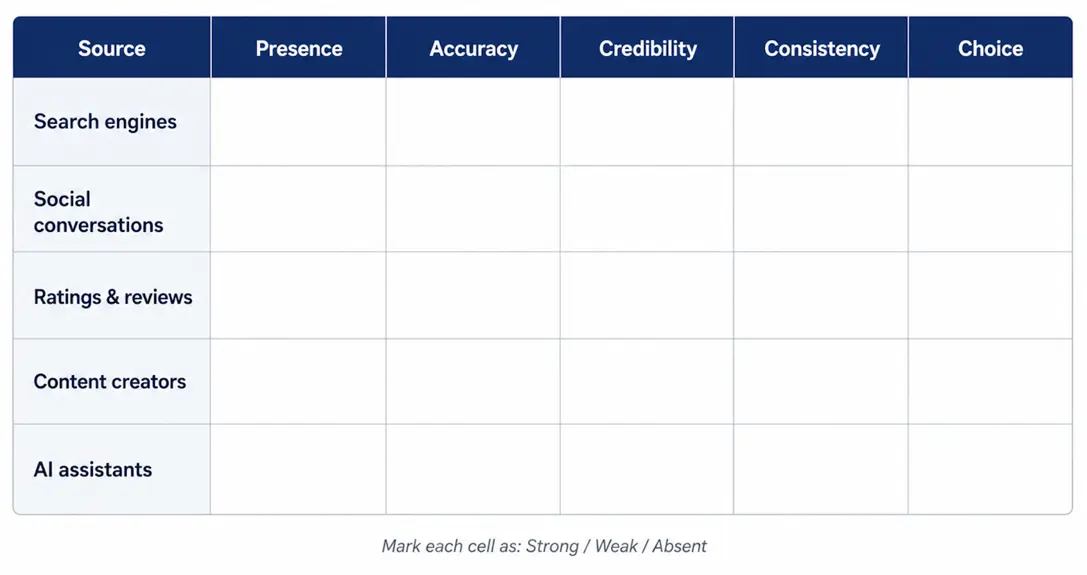
To operationalize this shift and bridge the gap between legacy marketing and modern evidence management, brands must adopt rigorous internal auditing procedures. By utilizing a structured diagnostic framework—such as the Zero Moment Five-Source Evidence Check—marketers can systematically evaluate their brand’s health across the entire digital landscape.
- Define Core Consumer Questions: Identify the three to five critical questions your target audience asks during their pre-purchase evaluation phase (e.g., Which model offers the best durability? How does this brand compare on price-to-performance? What do real users say about long-term reliability?).
- Audit the Five Sources: For each core question, examine what a consumer (or an AI agent) would uncover across search engines, social conversations, ratings and reviews, content creator videos, and AI assistants.
- Assess Performance Metrics: Score your brand’s presence across each source as Strong, Weak, or Absent.
- Identify and Close Gaps: Focus immediately on weak or absent areas that carry the highest risk of alienating prospective buyers or causing AI omission. Assign clear accountability across internal teams to shore up underlying evidence through enhanced content, corrected product data, proactive review management, creator partnerships, and credible third-party validation.
- Iterate Continuously: Because consumer behavior, search algorithms, and generative AI models evolve at a relentless pace, this evidence check must be conducted on a recurring, systematic basis.
Conclusion
The ultimate challenge for the contemporary marketer is no longer simply about getting the right message in front of the right customer at the right time. It is ensuring that when human buyers—and their increasingly autonomous AI agents—go hunting for proof, they unearth an unassailable body of accurate, credible, and consistent evidence that fulfills the brand promise. In the age of AI and multi-source discovery, the brands that win the Zero Moment of Truth will be those that master the art of being undeniably, demonstrably true.
