

By the Smashing Editorial Desk
Executive Overview
The landscape of digital product design, marketing, and software development is undergoing a paradigm shift. Following the official implementation of the European Union’s transparency obligations on August 2, 2026, panic and confusion have rippled across corporate boardrooms, legal departments, and design studios. Sensationalized headlines have warned of "drastic measures," "exorbitant fines," and "sweeping new AI bans."
However, a closer, more pragmatic examination of the legislation—specifically Article 50 of the EU AI Act and its accompanying Codes of Practice—reveals a much narrower, highly sensible set of requirements. At its core, the legislation is not about stifling innovation or penalizing businesses. Instead, it is designed to establish baseline trust in the digital ecosystem by ensuring that when artificial intelligence generates or significantly modifies content that could be mistaken for human work, users are informed clearly and unambiguously.
Crucially, these mandates are not isolated to European entities. Mirroring the jurisdictional reach of the General Data Protection Regulation (GDPR) and the European Accessibility Act (EAA), the rules apply globally to any organization—regardless of geographic location—whose AI-generated or AI-manipulated output is consumed by citizens within the European Union.
As digital product teams race to adapt, the old standby of dropping a generic "sparkle" icon into an interface to denote artificial intelligence is no longer legally compliant or user-friendly. This article provides an exhaustive, authoritative breakdown of what the new regulations demand, where the boundaries lie between human editorial oversight and machine generation, how design systems must evolve, and why this regulatory wave is becoming a global standard.
Detailed Chronology & Regulatory Framework
To understand where the industry stands today, it is essential to trace the legislative timeline that brought these transparency mandates into formal execution.

The Path to Enforcement
- The Legislative Genesis: The European Union began laying the groundwork for comprehensive AI governance years ago, culminating in the formal political agreement on the EU AI Act. Lawmakers recognized that while predictive and generative AI offer immense productivity and creative benefits, they simultaneously introduce unprecedented risks regarding misinformation, deepfakes, and public deception.
- The Transition Period: Following the formal adoption of the AI Act, organizations were granted a transitional window to audit their software pipelines, update their design libraries, and re-architect how AI-assisted features communicate with end-users.
- August 2, 2026 — The Enforcement Milestone: On this date, the transparency obligations outlined under Article 50 of the AI Act officially took effect. Companies serving EU citizens are now legally required to ensure that machine-generated text, audio, images, and video carry clear, distinguishable disclosures.
- The Code of Practice Releases: Alongside the core legislation, the European Commission released detailed Codes of Practice and official AI icon sets. These guidelines clarify that mere aesthetic markers are insufficient, pushing the industry toward standardized, accessible, plain-language labelling paradigms.
Providers vs. Deployers: Shared Legal Liability
A critical misconception among software vendors and enterprise adopters is that legal liability rests solely with the creators of foundational large language models (LLMs) or generative image tools. The EU AI Act explicitly divides responsibilities between two distinct actors:
- Providers: Organizations that develop an AI system or have a system developed and placed on the market under their own name or trademark. Providers must embed technical markers (such as watermarking or metadata tags) into the output.
- Deployers: Businesses, agencies, or individuals that utilize an AI system under their authority (e.g., a marketing agency using a third-party image generator to create campaign posters).
Similar to GDPR compliance, a company cannot evade its transparency duties simply by licensing a commercial AI tool off-the-shelf. If a deployer presents AI-generated output to the public without proper labelling, both the deployer and potentially the provider face regulatory scrutiny and potential penalties.
What Actually Needs Labelling?
Not every pixel of text or stroke of color produced with the assistance of algorithms requires a disclaimer. The legal threshold is specifically targeted at content that mimics human creation in areas where deception could cause tangible harm or mislead the public.

+-----------------------------------------------------------------+
                 IS THE CONTENT AI-GENERATED?
+-----------------------------------------------------------------+
                                |
             +------------------+------------------+
             |                                     |
            YES                                    NO
             |                                     |
  +----------+----------+               Standard Human Workflow
  |                     |               (No Label Required)
Is it purely              Does it touch
assistive edits?        "Public Interest"
(spellcheck, crop)      (Health, Politics, etc.)?
  |                     |
 YES ---> NO LABEL    YES ---> MANDATORY LABEL
The Scope of Article 50(4)
According to the European Commission, mandatory labelling applies to specific use cases designed to protect public trust:
- Synthetic Media and Deepfakes: Any image, audio, or video content that depicts real persons, places, objects, or events in a realistic manner that a reasonable person would assume is authentic photography or footage.
- Text Published in the Public Interest: AI-generated articles, reports, or communications that address topics of public interest—defined broadly as health, safety, environmental matters, economic policy, finance, politics, science, and culture.
- Interactive AI Services and Chatbots: When users interact with automated conversational agents, they must be explicitly informed at the outset that they are communicating with an artificial intelligence, unless it is blatantly obvious from the context.
The Public Interest Boundary
Law firms and compliance experts frequently emphasize the breadth of the "public interest" definition. If an e-commerce platform utilizes generative AI to draft product safety descriptions, environmental claims, or financial guidance, those outputs fall directly under the transparency mandate. Conversely, internal memos or fictional creative writing intended purely as entertainment occupy a grayer area, though commercial prudence often dictates erring on the side of transparency.
The Fine Line Between "Edited" and "AI-Generated"
One of the most complex challenges facing product designers and content creators is determining where human authorship ends and machine generation begins. If an editor uses AI to draft an outline, heavily rewrites it, and injects personal voice, is the resulting piece still legally classified as AI-generated?

Permissible Assistive Edits
The European Commission’s guidance explicitly exempts minor, assistive interventions from mandatory disclosure. These include:
- Spellchecking and basic grammar correction.
- Formatting and layout adjustments.
- Cropping, color correction, and baseline image filtering.
- AI-generated machine translation (provided the source material was human-authored).
These tools are viewed as mechanical enhancements rather than creative generation. A software developer fixing code syntax via an autocomplete tool or a copyeditor correcting typos via an automated plugin does not need to flag the final work as AI-generated.
Substantive Generation
Conversely, the following workflows always require explicit disclosure:

- AI-generated summaries of lengthy documents.
- Composite imagery constructed or heavily altered by diffusion models.
- Substantive rewrites where the core arguments, prose, or structures are generated by the model.
- Adding, removing, or fundamentally altering objects within a photograph.
Furthermore, the legal threshold is not satisfied by a mere token gesture. The Commission has explicitly noted that a human merely "skimming" an AI-generated text before publishing does not constitute editorial review. To bypass the labelling requirement, the human intervention must be substantive, with a named individual or legal entity taking explicit editorial responsibility for the content.
Why AI Sparkles Are Not Enough
For years, the digital design community has relied on a shorthand visual vocabulary to denote artificial intelligence features: the universal "sparkle" icon ($mathitunicodex2728$). Whether tucked into a writing assistant’s toolbar or floating above a photo-editing button, sparkles have signaled magic, speed, and algorithmic assistance.
However, UX research—including foundational studies by the Nielsen Norman Group—demonstrates that the sparkle icon is failing users.

The Ambiguity Problem
The primary issue with the sparkle icon is its ambiguity. In modern software interfaces, sparkles are routinely used to indicate AI-powered features (e.g., "Click here to let AI rewrite this paragraph") rather than AI-generated outputs (e.g., "This specific paragraph was entirely written by a machine").
When a user encounters a page filled with text, images, and data visualizations, a stray sparkle icon provides no discernible context regarding which elements are human-crafted and which are synthetic. This lack of clarity directly violates the EU AI Act’s mandate that disclosures must be "clear, distinguishable, and unambiguous."
The Official EU Icon Set and Design Systems
To bridge the gap between regulatory compliance and clean user experience, the European Commission has introduced an official AI icon set. These specific visual markers are engineered to be distinct from decorative UI elements.

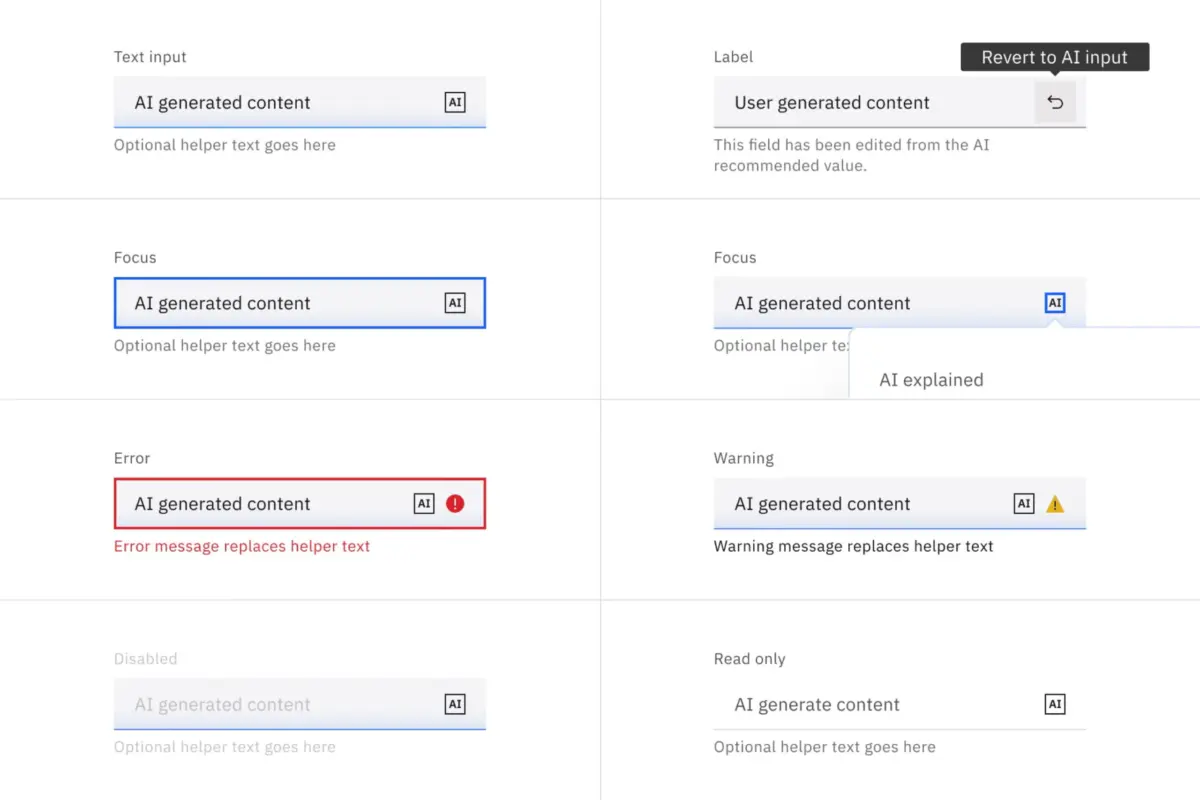
Leading enterprise design systems—such as IBM’s Carbon Design System—have already pioneered comprehensive AI labelling frameworks that comply with these rigorous standards. Effective AI labelling typically incorporates a multi-layered approach:
- Inline Visual Identifiers: A dedicated, standardized icon paired with plain-text typography (e.g., an explicit "AI-generated" tag).
- Persistent Metadata: The label cannot be a fleeting UI element that vanishes upon mouseover or flashes for a second; it must persist even when content is downloaded, exported, or reshared across platforms.
- Explainability Panels: Advanced implementations allow users to click or tap the AI label to open an overlay explaining precisely how the content was generated, which model was used, and the extent of human review.
Global Regulatory Alignment
While European regulations frequently dominate technology news cycles due to their strict enforcement mechanisms, the push toward AI transparency is far from a localized phenomenon. Product teams operating on a global scale face an evolving matrix of international mandates:
- United States Federal and State Initiatives: While the US lacks a singular federal AI transparency act akin to the EU AI Act, a patchwork of state-level laws is rapidly expanding. Several states have enacted strict disclosure requirements targeting synthetic human performers (protecting actors’ likenesses), political advertising, and deceptive consumer-facing applications.
- Asia-Pacific Developments: Nations across Asia, including China, South Korea, and Singapore, have instituted robust labelling and watermarking requirements for synthetic media, particularly concerning deepfakes and algorithmic recommendations.
This convergence signals a definitive global pattern. Transparency is no longer an optional "nice-to-have" feature; it is becoming a mandatory pillar of digital governance. Organizations that bake robust labelling frameworks into their product design systems today will avoid costly retrofits and legal penalties tomorrow.

Future Outlook & Recommendations for Product Teams
As organizations adapt to the reality of August 2, 2026, and beyond, product managers, UX designers, and engineers must collaborate to operationalize compliance without degrading user experience.
- Audit Existing AI Touchpoints: Conduct a comprehensive inventory of all software features, marketing assets, and content pipelines that utilize generative AI. Determine which outputs cross the legal threshold into the "public interest" or "synthetic media" categories.
- Revise Design Systems: Retire reliance on ambiguous sparkle icons for content attribution. Adopt standardized, accessible iconography paired with plain-text labels that remain visible across viewports and export formats.
- Establish Clear Editorial Workflows: Implement strict content governance protocols. Ensure that human editors making substantive changes understand their legal responsibilities, and maintain clear audit trails for human-reviewed materials.
- Prioritize User Trust: Frame transparency not merely as a regulatory burden, but as a competitive advantage. In an era saturated with automated noise—often referred to pejoratively as "AI slop"—clearly demarcated, authentic human work will command a premium of trust from consumers.
Meet "Design Patterns For AI Interfaces"
For product designers, UX architects, and developers seeking practical, real-world guidance on navigating these exact challenges, industry expert Vitaly Friedman has launched Design Patterns For AI Interfaces.
This comprehensive video course features practical examples drawn from cutting-edge products, exploring how to design intuitive, ethical, and legally compliant AI interactions. Coupled with live UX training workshops and extensive design system case studies, the course provides the definitive playbook for modern interface design.

- Jump to a free preview: Watch on YouTube
- Explore the video course: Design Patterns For AI Interfaces
- Attend upcoming workshops: SmashingConf Online Workshops
Useful Resources & Official Documentation
- Official European Commission Statement on AI Transparency Obligations
- Article 50(4) of the EU AI Act — Full Legal Text & FAQs
- EU Commission Code of Practice on AI-Generated Content
- Official EU AI Icon Set and Labelling Guidelines
- Carbon Design System AI Label Usage Guidelines
- Nielsen Norman Group Research on the AI Sparkle Icon Problem
(yk)