

Executive Overview
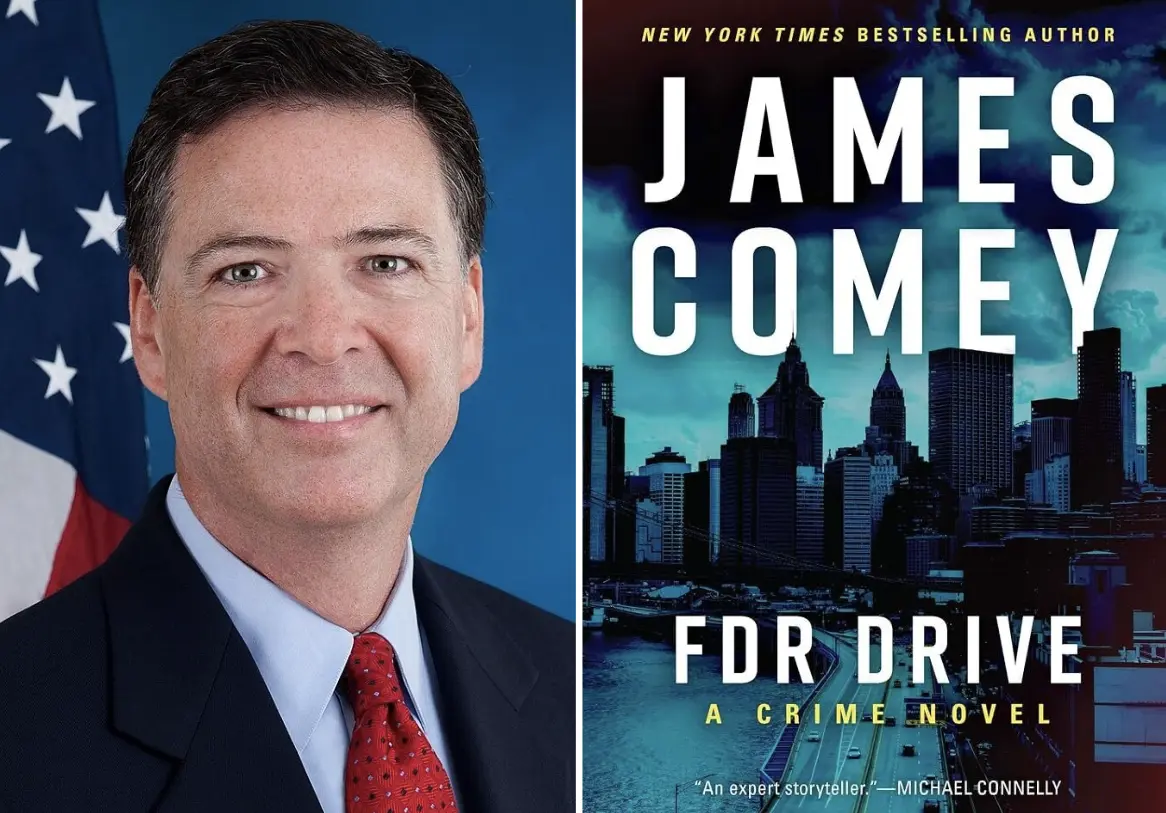
In an unprecedented convergence of creative literature, high-stakes political conflict, and constitutional law, federal prosecutors have turned to a work of fiction to bolster criminal charges against former FBI Director James Comey. The Department of Justice (DOJ) alleges that Comey made a illegal threat against the life of President Donald Trump. To substantiate the claim that a social media post contained an insidious, covert call to violence, government attorneys have cited Comey’s 2025 crime thriller, FDR Drive, drawing explicit parallels between the novel’s plot devices and Comey’s real-world communications.
The criminal prosecution originates from a photograph posted by Comey featuring seashells arranged on a beach to spell out the numerical sequence “86-47.” Prosecutors contend that the posting was not benign political commentary, but a coded directive advocating the assassination of the 47th President of the United States—interpreting "86" as standard colloquial slang for "eliminate" or "kill."
To overcome a motion to dismiss filed by Comey’s defense team, federal prosecutors submitted a supplemental brief arguing that Comey utilized a specific technique showcased in his novel: broadcasting veiled signals to incite followers into committing acts of violence against political adversaries. To bolster the legitimacy of the book as evidence of Comey’s mindset and methodology, the DOJ filing even incorporated a starred review from Publishers Weekly, which praised Comey’s narrative craft.
The government’s legal strategy has ignited intense debate across the legal and literary communities. Legal scholars and civil liberties advocates argue that using an author’s fictional work to prove criminal intent (mens rea) sets a alarming precedent for First Amendment jurisprudence. As the court deliberates on Comey’s motion to dismiss, the case stands at the intersection of protected political hyperbole, artistic expression, and the statutory limits of federal threat prosecutions.
Detailed Chronology
[Initial Event] Comey posts photo of seashells spelling "86-47"
       │
       ▼
[DOJ Action] Federal investigation launched; Indictment handed down alleging threats against President Trump
       │
       ▼
[Defense Motion] Comey's legal team files Motion to Dismiss, citing First Amendment protections
       │
       ▼
[Prosecution Strategy] DOJ files response introducing "FDR Drive" & PW review as evidence of coded intent
       │
       ▼
[Public Backlash] PEN America & constitutional scholars issue formal condemnations of the DOJ tactic
       │
       ▼
[Pending Ruling] Court evaluates whether creative fiction can substantiate federal criminal charges
Phase I: The Beach Post and Political Fallout
The controversy began when James Comey published a photograph on social media displaying small seashells arranged in the sand to form the numbers "86-47." Within hours, the image circulated widely across social platforms, igniting immediate political commentary. Critics and conservative allies of President Trump interpreted "86" as a criminal imperative—drawing on the term’s origin in the restaurant industry, which evolved into slang meaning to eject, discard, or murder—and "47" as a direct reference to Donald Trump, the 47th President of the United States.
Comey’s supporters countered that the image was a form of political expression expressing a desire to see President Trump removed from office through lawful, democratic, or political means. However, the Trump administration’s Department of Justice initiated a formal investigation, asserting that given Comey’s former position as the head of the nation’s premier domestic law enforcement agency, his public statements carried unique weight and potential for dangerous incitement.
Phase II: The Indictment and Motion to Dismiss
Following the federal investigation, a grand jury returned a criminal indictment charging Comey under federal statutes prohibiting threats against the President of the United States. Comey’s defense counsel swiftly responded by filing a comprehensive motion to dismiss the charges.
The defense argued that:
- The post constituted non-violent political expression protected under the First Amendment.
- The phrase "86-47" lacks the explicit, unambiguous, and imminent threat required to meet the legal threshold of a "true threat."
- The government’s prosecution represented an arbitrary weaponization of the criminal justice system to penalize a prominent political critic.
Phase III: The DOJ’s Novel Legal Filing
In response to the defense’s attempt to throw out the case, federal prosecutors submitted an opposition brief that shifted the legal battleground. To demonstrate that the "86-47" photograph was intended as a covert signal to initiate violence, the DOJ introduced Comey’s 2025 mystery novel, FDR Drive, published by Otto Penzler’s Mysterious Press.
In the filing, prosecutors argued that FDR Drive exposes Comey’s awareness and endorsement of using "coded messages" to incite third parties. Specifically, the prosecution pointed to a storyline in the novel featuring a radical podcaster who broadcasts subtle, sub rosa cues to his listener base, subtly directing them to eliminate a political antagonist without issuing an overt, legally actionable command. The DOJ asserted that Comey was deploying the exact strategy described in his fiction.
Furthermore, prosecutors alleged a commercial motive, claiming Comey posted the controversial beach image to manufacture publicity and drive sales for his book. To establish that FDR Drive was a significant, deliberate creative work reflecting Comey’s personal perspective, the DOJ included a starred review from Publishers Weekly, quoting its conclusion that "Comey the crime novelist is here to stay."
Supporting Context & Legal Analysis
Comparative Analysis: Literary Plot vs. Prosecutorial Allegations
| Dimension | Fiction: FDR Drive (2025) | Prosecution Allegation: United States v. Comey |
|---|---|---|
| Medium | Mystery Novel (Mysterious Press) | Social Media Photograph ("86-47" Seashells) |
| Mechanism | Podcaster broadcasts sub rosa cues to listeners | Author posts numeric symbolism to online followers |
| Target | Political antagonist within narrative plot | The President of the United States |
| DOJ Theory | Coded narrative device used to incite third parties | Coded digital signal carrying real-world criminal intent |
| Evidentiary Use | Cited as proof of author’s tradecraft awareness | Submitted to prove mens rea and combat dismissal |
The "True Threat" Standard and First Amendment Jurisprudence
To successfully prosecute a charge under federal threat statutes—such as 18 U.S.C. § 871 (Threats against President and successors to the Presidency)—the government faces a demanding burden of proof. Under long-standing Supreme Court precedent, the First Amendment protects political hyperbole, aggressive rhetoric, and symbolic speech, safeguarding everything short of a "true threat."
The foundational framework derives from Watts v. United States (1969), in which the Supreme Court overturned the conviction of an 18-year-old anti-war protester who declared at a rally, "If they ever make me carry a rifle the first man I want to get in my sights is L.B.J." The Court ruled that context matters, and that political rhetoric—even when coarse, inflammatory, or hostile—does not constitute a true threat unless it expresses a serious, objective intent to commit unlawful violence against a specific individual.
More recently, in Counterman v. Colorado (2023), the Supreme Court emphasized the mental state required for threat prosecutions, establishing that the government must prove the speaker held a subjective understanding of the threatening nature of their communications. By introducing FDR Drive, the DOJ is attempting to construct Comey’s subjective intent, offering the novel as proof that he possessed sophisticated knowledge of how to issue a directive while maintaining plausible deniability.
The Chilling Effect of Using Art as Evidence
The prosecution’s reliance on Comey’s creative writing revives a controversial legal practice: using an individual’s artistic output as evidence in criminal proceedings. While this tactic has historically appeared in gang-related prosecutions involving rap lyrics, its application to published political fiction represents an unprecedented expansion.
Legal analysts point out several constitutional hazards inherent in this approach:
- Conflation of Author and Narrator: Conflating an author’s fictional characters or plot devices with their personal intent undermines the standard of evidence required in federal courts.
- Chilling Creative Expression: If authors face criminal exposure based on the actions or techniques depicted by antagonists in their books, creative expression across genres—from thriller writing to investigative fiction—could face significant self-censorship.
- Speculative Intent: Using a published book review to argue that an author had a "financial incentive to stir up controversy" introduces speculative motives that fall short of establishing criminal intent.
Official Statements & Reaction
The Department of Justice’s filing triggered swift reactions from free speech advocacy groups, literary organizations, and legal commentators.
PEN America
PEN America, a leading advocacy group for free expression and literary freedom, issued a sharp rebuke of the prosecution’s tactics. Mara Gassmann, Legal Director at PEN America, released a statement warning of the severe constitutional risks posed by the DOJ’s arguments:
"Citing a novel to save an indictment that is constitutionally dubious is a desperate Hail Mary and should be rejected. A political message, expressed through a photo of seashells, is no true threat; now, the government’s use of Comey’s work of fiction to support this prosecution compounds the First Amendment concerns. Extreme caution should be taken any time creative works are used to support criminal charges to protect the free expression rights of us all."
Publishing Industry & Defense Counsel
Representatives for Mysterious Press and its founder, veteran crime fiction publisher Otto Penzler, maintained an official stance of non-comment regarding the DOJ’s inclusion of FDR Drive in the brief. However, sources within the publishing industry expressed surprise at the inclusion of a commercial literary review—specifically the Publishers Weekly starred review—as formal evidence in a federal criminal brief.
Defense attorneys for James Comey reiterated their stance in supplemental filings, calling the government’s theory "an absurd stretch that transforms routine political symbolism into a criminal conspiracy by misrepresenting a work of fiction." The defense maintained that the seashell photograph represented benign, constitutionally protected political dissent aimed at the upcoming election, devoid of any genuine threat of violence.
Future Outlook
The legal battle now rests with the presiding federal district judge, who must rule on Comey’s motion to dismiss the indictment. The court’s ruling will carry profound implications for the limits of federal prosecution, the protection of symbolic speech, and the evidentiary use of artistic works.
Key Legal Scenarios Facing the Court
                         ┌── [Scenario A: Motion Granted] ──────────────────────────┐
                         │   Court dismisses indictment; rules post is protected   │
                         │   speech and fiction cannot serve as intent evidence.   │
                         │                                                          │
[Court Ruling Pending] ──┼── [Scenario B: Limited Proceeding] ───────────────────────┤
                         │   Court allows case to proceed but strikes novel         │
                         │   and literary evidence from the record.                 │
                         │                                                          │
                         └── [Scenario C: Motion Denied] ───────────────────────────┘
                             Court accepts DOJ theory of coded intent; case         │
moves to trial, setting a revolutionary precedent. │- Dismissal of Indictment (Scenario A): The judge may grant Comey’s motion to dismiss, ruling that a photo of seashells spelling "86-47" is protected political speech under the First Amendment and that a work of fiction cannot be used to impute criminal intent. Such a ruling would reinforce existing standards established in Watts and Counterman, firmly rejecting the government’s attempt to use creative writing as evidence of real-world threats.
- Striking of Literary Evidence (Scenario B): The court could deny the motion to dismiss based on the primary statutory language, but issue an evidentiary order striking all references to FDR Drive and the Publishers Weekly review from the case. This would limit the prosecution strictly to proving whether the "86-47" post, standing on its own, constitutes a true threat under federal law.
- Proceeding to Trial (Scenario C): If the judge denies the motion to dismiss and permits the DOJ to present FDR Drive to a jury, the case will establish a groundbreaking precedent. It would mark one of the first times in modern American legal history that an author’s fictional plot device was formally admitted to demonstrate criminal intent behind political expression.
Beyond the courtroom, the case serves as a landmark test of civil liberties during an era of heightened political polarization. The outcome will shape not only the future of former government officials engaging in political commentary, but also the boundaries separating creative literature from federal criminal liability.