In recent weeks, digital policy circles and tech industry forums have been awash with frantic headlines warning of "drastic measures," "crippling fines," and "sweeping new AI mandates" across the European Union. However, cutting through the panic reveals a regulatory framework that is far more targeted, nuanced, and fundamentally sensible than anticipated. At its core, the European Union’s latest transparency guidance is designed to achieve a singular, straightforward objective: ensuring that when artificial intelligence generates or manipulates content, human users are explicitly, unambiguously informed.
With official enforcement milestones taking effect, legal AI-labeling obligations now apply to any company—regardless of whether its headquarters are in Berlin, San Francisco, or Tokyo—that serves EU citizens and deploys artificial intelligence outputs to people within the bloc. Much like the extraterritorial reach of the General Data Protection Regulation (GDPR) and the European Accessibility Act (EAA), ignorance of geographic jurisdiction is no defense.
Crucially, the new rules do not demand that every single AI-assisted workflow or tool be branded with an intrusive marker. Instead, they draw a definitive line between minor assistive corrections (such as spellcheck, syntax formatting, and automated translation) and substantive, autonomous generative work (such as synthetic imagery, automated textual summaries, and composite media). Furthermore, the European Commission has made it clear that the ubiquitous UI "sparkle" icon—long used as a generic shorthand for "AI-powered features"—is no longer enough to satisfy compliance. Product teams and UX designers must transition toward clear, plain-language disclosures and standardized icon sets to protect their users and insulate their operations from regulatory penalties.
Detailed Chronology and Regulatory Timeline
To understand how we arrived at the current enforcement landscape, it is helpful to trace the deliberate, step-by-step evolution of the EU AI Act and its accompanying transparency codes. The path toward mandatory AI watermarking and labeling has been years in the making, reflecting a measured legislative process designed to give industry stakeholders adequate time to adapt.
[2021-2023] ──> Initial Drafts & Debates ──> Focus on High-Risk AI Systems
[Early 2024] ──> Formal Adoption of AI Act ──> Integration of Article 50 Transparency Rules
[Late 2025] ──> Code of Practice Drafts ──> Publishing of Official EU AI Icon Sets
[August 2026] ──> Full Enforcement Date ──> Mandatory Labeling for Public-Facing Synthetic Media
1. The Formative Years (2021–2023): Drafting the Framework
When the European Commission first tabled the overarching EU AI Act, the primary legislative focus centered heavily on high-risk applications, biometric surveillance, and critical infrastructure. However, as generative artificial intelligence exploded into the mainstream via consumer-facing chat interfaces and high-fidelity image generators, policymakers realized that a distinct blind spot existed: the average consumer’s inability to distinguish between authentic human-created media and synthetic content.
2. Formal Codification and Article 50 (Early 2024)
As the AI Act moved through its final legislative hurdles, Article 50 was refined to address transparency obligations specifically. Article 50(4) established clear legal duties for providers (those who build or supply AI models) and deployers (those who implement them in commercial products). This laid the groundwork for mandatory machine-readable watermarking and human-readable labeling for deepfakes, synthetic text intended to inform the public on matters of public interest, and realistic AI-generated imagery.
3. The Code of Practice and the Standardization of Icons (Late 2025)
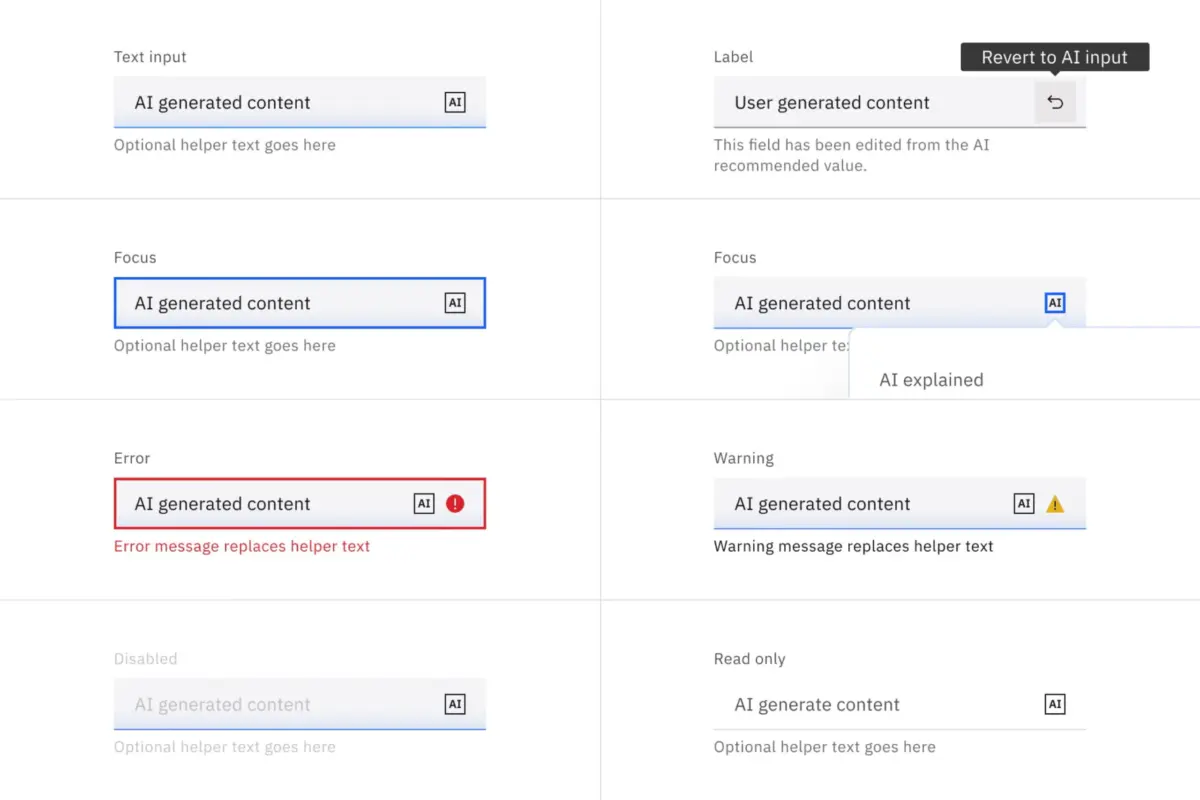
Recognizing that industry compliance would suffer in the absence of visual design standards, the European Commission collaborated with UX experts, legal scholars, and technology providers to release a comprehensive Code of Practice. This phase introduced the official EU AI icon set—distinguishing between basic AI interaction, fully generated content, and partially modified media—to move the industry away from ambiguous aesthetic choices like floating star clusters and sparkles.
4. Full Enforcement and Operational Reality (August 2026)
The official enforcement date arrived, marking the transition from a theoretical compliance debate to an active legal requirement. Companies operating within or selling into the European market can no longer rely on vague disclaimers, hidden footer notices, or momentary flash-in-the-pan UI hints. Compliance is now a continuous operational metric that requires rigorous tracking throughout the software development lifecycle.
Supporting Context & Metrics: What Must Be Labeled (and What Can Be Ignored)
One of the most widespread misconceptions surrounding the EU guidelines is that every line of code written by GitHub Copilot, every email drafted with ChatGPT assistance, and every design asset refined with generative Photoshop tools must bear a heavy administrative warning label. This is fundamentally untrue.
The Boundaries of Article 50(4)
According to the European Commission’s implementation guidelines, disclosure obligations are triggered primarily under specific conditions:
Public Interest Content: Text or media that addresses topics of public interest—including health, safety, environmental protection, economics, finance, politics, science, and culture—must be explicitly disclosed if it is autonomously generated by AI.
Synthetic Media Resembling Reality: AI-generated illustrations, photographs, videos, or audio recordings that depict real people, places, objects, or events in a realistic manner require prominent labeling to prevent consumer deception.
Chatbots and Virtual Assistants: Systems interacting directly with natural persons must disclose that the user is communicating with an artificial intelligence, unless it is obvious from the context.
The Human-in-the-Loop Exception
Crucially, the regulations carve out a major exception for human-edited content. If an AI generates a draft, but a human professional thoroughly reviews, edits, and takes explicit editorial responsibility for the final piece—with their name or legal entity attached—the strict labeling requirement typically falls away.
However, the threshold for "editorial review" is high. As the European Commission notes, a casual skim or a quick grammar check does not constitute substantive human intervention. The fine line lies between automated generation (which demands disclosure) and assisted creation (where human intervention fundamentally alters the output’s substance).
Official Statements and Industry Reactions
The release of the European Commission’s final guidelines and the accompanying Code of Practice has elicited strong reactions from legal experts, design systems architects, and policy groups alike.
"The goal is never to penalize innovation or make interfaces unreadable with bureaucratic clutter. It is about a simple, foundational truth: when AI-generated content can easily be mistaken for human-created work, creators and platforms have a duty to say so clearly, unambiguously, and accessibly."
— European Commission Digital Strategy Directorate
Legal counsel from prominent international law firms have similarly advised commercial entities to adopt conservative compliance postures. For instance, guidance published by commercial litigation and IP practices emphasizes that marketing departments and PR teams should proactively label realistic synthetic imagery used in advertising campaigns, even if the strict legal boundaries remain open to interpretation in specific B2B contexts.
Simultaneously, design system maintainers—such as the contributors behind IBM’s Carbon Design System and independent UX researchers like the Nielsen Norman Group—have highlighted the dangerous ambiguity of current UI patterns. Research indicates that users frequently misinterpret generic decorative elements, such as gradient sparkles or magical dust icons, as mere indicators of "AI-enabled functionality" rather than proof that a specific piece of media was autonomously fabricated by a machine.
Future Outlook: A Global Regulatory Pattern
While tech executives often lament the perceived over-regulation emanating from Brussels, a broader macro-trend reveals that the EU’s transparency rules are not an isolated anomaly. Instead, they represent a convergence of international legislative priorities:
United States State-Level Laws: Across multiple U.S. states, new statutes are rapidly emerging targeting synthetic human performers (protecting voice and likeness rights), regulating deepfakes in political advertising, and demanding commercial AI disclosures.
Asia-Pacific Frameworks: Regulatory bodies in key Asian markets are simultaneously establishing mandatory watermarking protocols for generative video and audio content to combat rampant disinformation.
For product managers, UX designers, and frontend engineers, this means that AI labeling should no longer be treated as a localized hack or a temporary regional checkbox. It is evolving into a foundational design pattern of the modern web.
Moving forward, successful product teams will integrate robust metadata management—ensuring AI labels persist even when content is downloaded, exported, or reshared across third-party networks—while embracing clear, plain-language text labels paired with accessible, standardized iconography. By shifting away from ambiguous UI sparkles and toward transparent, user-centric disclosure, the tech industry can build long-term trust, sidestep draconian fines, and help users effortlessly distinguish between authentic human creativity and automated synthetic output.