

Executive Overview
In the high-stakes realm of contemporary American fiction, few debuts have cast a shadow as long or as formidable as Chad Harbach’s 2011 novel, The Art of Fielding. A sweeping, atmospheric tale of collegiate baseball, intellectual obsession, and emotional fracture set at a fictional Wisconsin liberal arts institution, the book elevated Harbach overnight from an unsung literary magazine editor into an icon of 21st-century fiction.
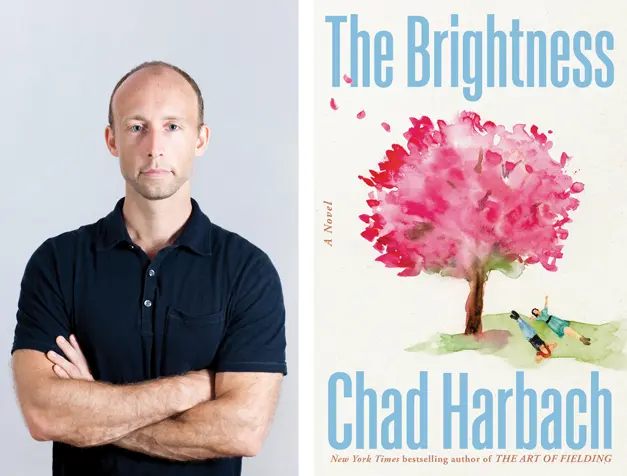
Fifteen years after that watershed publication—and following a decade and a half of near-total literary silence—Harbach is preparing to release his long-awaited second novel, The Brightness, published by Little, Brown.
Speaking via video link from his home near Palo Alto, California, the 50-year-old author reflects on the long, arduous road to completing the manuscript. Dressed casually in a Snap-on tools trucker hat and a black polo shirt, Harbach exhibits the quiet relief of a runner crossing a distant finish line. Just hours earlier, he put the final touches on The Brightness, bringing an end to a crafting process that nearly matched the 10-year development cycle of his debut.
The stakes for The Brightness could not be higher. Rather than pivoting to an entirely new landscape—the conventional wisdom for authors recovering from runaway debut successes—Harbach has chosen to return directly to the world of Westish College. However, the new book performs a dramatic thematic inversion. Where The Art of Fielding explored male athletic camaraderie, midlife crisis, and physical grace under pressure, The Brightness shifts its focus to female intellectual intimacy, campus political dynamics, and the institutional fallout of digital-era activism.
This comprehensive investigation examines Harbach’s career trajectory, the industry mechanics behind his legendary debut, the artistic philosophy driving his return to Westish, and the publishing landscape awaiting one of the decade’s most anticipated literary follow-ups.
Detailed Chronology: The Journey from The Art of Fielding to The Brightness
+-----------------------------------------------------------------------------------+
| CHAD HARBACH: PUBLISHING TIMELINE                                                |
+-----------------------------------------------------------------------------------+
|  1990s       - Attends Harvard University; meets future literary cohort.        |
|  2004        - Graduates from Univ. of Virginia (MFA); co-founds n+1 magazine.   |
|  2004–2010   - Writes 'The Art of Fielding' while copyediting for McKinsey.      |
|  2010        - High-profile bidding war yields $665,000 advance with Little, Brown|
|  2011        - 'The Art of Fielding' published to massive critical/commercial acclaim.|
|  2012        - Vanity Fair exposes backend publishing mechanics of the debut.     |
|  2015–2025   - Decadelong development of follow-up novel 'The Brightness'.       |
|  2026        - Completes edits on 'The Brightness' for autumn publication.       |
+-----------------------------------------------------------------------------------+
The Origins and the Harvard Circle
Chad Harbach was raised in Racine, Wisconsin, the son of an accountant and a Montessori school administrator. Self-described as "painfully shy" during his youth, Harbach matriculated at Harvard University in the 1990s, where he found himself surrounded by peers who seemed light-years ahead in intellectual posture and worldly sophistication.
After completing his undergraduate studies, Harbach earned a Master of Fine Arts at the University of Virginia in 2004. During this period, he co-founded the influential intellectual and literary journal n+1 alongside his Harvard classmate Keith Gessen and a tight-knit cohort of young critics. To support himself while quietly laboring over his fiction, Harbach worked as a freelance copy editor for the management consulting firm McKinsey & Company.
The 2010–2011 Bidding War and Mega-Debut
For nearly ten years, Harbach meticulously constructed The Art of Fielding, centering the narrative on Henry Skrimshander, an extraordinarily gifted yet introverted shortstop recruited to Westish College by team captain Mike Schwartz. The story branches out to include Westish President Guert Affenlight; Guert’s estranged daughter, Pella; and Henry’s roommate, Owen Dunne.
When the manuscript entered the market in 2010, it ignited a legendary publishing frenzy:
- Preempt and Bidding War: Harbach turned down a preemptive offer from Farrar, Straus and Giroux (FSG) as well as a higher financial offer from Scribner.
- The Final Deal: He accepted a $665,000 advance from Little, Brown, drawn primarily by the opportunity to be edited directly by Michael Pietsch, then publisher of Little, Brown (who later served as CEO of Hachette Book Group before retiring in 2025).
- The Aftermath: Published in September 2011, the novel became an instant bestseller, sparking international rights battles, an HBO option, and widespread critical raves. In late 2011, Keith Gessen penned an unprecedented, tell-all article for Vanity Fair detailing the financial and editorial mechanics behind the book’s deal, turning Harbach’s publishing journey into an industry case study.
The Long Recovery and the Conception of The Brightness (2012–2026)
Despite the extraordinary success, the intense scrutiny and public demands of literary stardom took a psychological toll on Harbach. The process of recovering from the whirlwind of publicity delayed his return to writing.
When he eventually resumed work, he found himself drawn back to Westish College—specifically to Pella Affenlight, who at the end of the first novel was contemplating entering Westish as a 23-year-old freshman after fleeing an early, failed marriage in San Francisco.
Over the next decade, Harbach quietly assembled The Brightness, maintaining a low profile in Northern California. In early July 2026, he officially submitted the finalized manuscript to Little, Brown for an October release.
Supporting Context & Metrics: Structural Evolution and Financial Context
To understand the weight of Harbach’s return, one must examine the metrics that defined his debut alongside the structural shift of his new work.
Key Metrics: Debut vs. Sequel Comparison
| Metric / Dimension | The Art of Fielding (2011) | The Brightness (2026) |
|---|---|---|
| Development Time | ~10 Years | ~14–15 Years |
| Reported Advance | $665,000 | Undisclosed (High-profile contract) |
| Editor | Michael Pietsch (Little, Brown) | Michael Pietsch (Little, Brown) |
| Primary Setting | Westish College (Wisconsin), 2009–2010 | Westish College & Block Island, 2015 |
| Central Perspective | Male athletic camaraderie & crisis | Female intellectual intimacy & political activism |
| Key Characters | Henry Skrimshander, Mike Schwartz, Owen Dunne, Guert Affenlight, Pella Affenlight | Pella Affenlight, Irma Friske, Dahlia, Pammy, Mike Schwartz, Owen Dunne |
+-----------------------------------------------------------------------------------+
| STRUCTURAL INVERSION IN HARBACH'S WESTISH DULOGY                                   |
+-----------------------------------------------------------------------------------+
|                                                                                   |
|   THE ART OF FIELDING (2011)                      THE BRIGHTNESS (2026)           |
|   +---------------------------------+             +-----------------------------+ |
|   | Focus: Male Friendship          |             | Focus: Female Friendship    | |
|   | Domain: Sports / Baseball Field |   ======>   | Domain: Campus Politics /   | |
|   | Conflict: Physical Yips &       |  Inversion  |         Digital Activism    | |
|   |           Internal Melancholy   |             | Conflict: Institutional     | |
|   +---------------------------------+             |           Protest & Fame    | |
|                                                   +-----------------------------+ |
+-----------------------------------------------------------------------------------+
Narrative Dynamics of The Brightness
Set in September 2015, The Brightness picks up four years after the events of the original novel:
- Pella’s New Horizon: Now 27, Pella Affenlight has graduated from Westish College and is engaged to Mike Schwartz, who has stepped up to coach both the university’s football and baseball programs.
- The Catalyst (Irma Friske): Pella eagerly awaits the campus return of her close friend and former study partner, Irma Friske, a brilliant scholarship student hailing from Wisconsin’s rural Driftless Area.
- The Protest: Rather than settling back into cozy academic routines with Pella, Irma aligns herself with two charismatic classmates, Dahlia and Pammy. Together, they execute a sharp, puckish act of campus protest targeting sexual assault and hyper-masculine jock culture. The action goes viral, placing Westish College under intense national media scrutiny.
- Metafictional Layering: In a subtle, reflexive narrative twist, Owen Dunne—Henry Skrimshander’s former roommate—has achieved nationwide fame as an author following the release of his debut novel (which mirrors the plot and title of The Art of Fielding). During a high-society wedding on Block Island, Pella (who quietly helped shape Owen’s early manuscript without public credit) and Irma (whose activist manifesto has made her a feminist media darling) collide with the Manhattan literary establishment.
Official Statements & Creative Philosophy
Harbach’s return offers rare insight into the psychological pressures of high-advance literary success and the philosophical choices facing contemporary novelists.
On the Burden of Early Stardom
Reflecting on the meteoric rise of The Art of Fielding, Harbach candidly addresses the double-edged sword of instantaneous literary renown:
"It was an author’s dream. Everywhere I went, people just really responded to the book. But it’s not easy to have that experience. It can be really hard and lonely. You’re supposed to be on cloud nine all the time, but you’re also dealing with something. I would not trade it for the world, and also it took me a really long time to recover from it."
On the Risk of Writing a Sequel
Harbach admits that returning to the universe of Westish College initially felt like an artistic trap:
"To be honest, I thought it was a really bad idea. Like, people loved The Art of Fielding—I can only write something they’re going to love less. But I was always thinking about Pella coming out of that experience. She’d be a 27-year-old college graduate who’s extremely talented, but also unsure what to do. Something about that situation really attracted me."
"I knew I wanted to go back to it in a very different way, and write what is very consonant with that book, but also in some ways the antithesis of it. That 'The Brightness' would take place in a world of female friendship, in the way that 'The Art of Fielding' took place in a world of male friendship, was crucial to the whole conception."
-- Chad Harbach
On Fiction, Autofiction, and Artistic Ambition
In an era increasingly dominated by autofiction and thinly veiled memoirs, Harbach remains an uncompromising defender of full-scale narrative invention:
"I don’t think there’s any one way to try to extract the deepest possible truths from the world. But, for me, it entails going to a very deep place where the actual happenings of real, phenomenal life get reconstituted. I want my books to feel a lot deeper and more lifelike than even the best version of the story about my day that I can tell you."
When pressed on his ultimate goals for his body of work, Harbach’s self-effacing demeanor gives way to intense artistic conviction:
"The ambition is to write Anna Karenina. Not that I have, or will, do that, but that’s the guiding principle—to do the form in the ultimate way that is going to justify the existence of the novel as a cultural institution."
Future Outlook: Publishing Impact and The High Stakes of the Follow-Up
The upcoming release of The Brightness represents a major moment for both Little, Brown and the broader trade publishing industry:
+-----------------------------------------------------------------------------------+
| INDUSTRY EXPECTATIONS & STAKEHOLDER IMPACT                                        |
+-----------------------------------------------------------------------------------+
|                                                                                   |
|  [PUBLISHING HOUSE]         [LITERARY MARKET]            [THE AUTHOR]             |
|  Little, Brown              Retail & Indie Bookstores    Chad Harbach             |
|  * Capstone edit for        * High anticipatory demand   * Vows faster output     |
|    Michael Pietsch.           driven by legacy fans.       for future novels.     |
|  * Major commercial         * Benchmark test for 2010s   * Goal: Re-establish     |
|    campaign planned.          literary follow-ups.         major literary presence. |
|                                                                                   |
+-----------------------------------------------------------------------------------+
1. The Editorial Legacy of Michael Pietsch
The Brightness serves as a capstone project for legendary editor Michael Pietsch, who personally edited Harbach’s debut and continued working on this manuscript leading up to his formal retirement as chairman of Hachette Book Group. The success of this follow-up will further cement Pietsch’s reputation as one of the premier fiction editors of his generation.
2. Market Reception and Literary Evolution
Publishers and booksellers will be watching closely to see how an audience that embraced a 2011 classic responds to a 2026 sequel set in the politically charged atmosphere of 2015. By tackling issues of institutional power, digital viral culture, and complex female relationships, Harbach is intentionally testing whether the fans of his classic sports-centric debut will follow his pivot into sharp social critique.
3. Overcoming the Prolonged Hiatus
Having taken a cumulative 25 years to produce two novels, Harbach is determined to shift his workflow for future projects. Expressing a firm desire to break free from decadelong writing cycles, he remains optimistic about his creative momentum moving forward:
"I intend to never take this long to write a book again. I think I can do it a lot more quickly."
Whether Harbach can indeed accelerate his pace remains to be seen. But with The Brightness, he has finally delivered his answer to one of modern publishing’s most enduring questions—proving that while his process may be slow, his commitment to the grand architecture of the American novel remains absolute.