

Executive Overview
For as long as modern web development has embraced dynamic user interfaces, front-end engineers have harbored a quiet, nagging frustration. Imagine a common scenario: you have a responsive grid of sleek, modern product cards, and you want them to cascade onto the screen sequentially, fading and sliding into place one after another. That staggered animation effect instantly elevates a UI from static to polished. It looks effortless, and conceptually, it should be simple.
Yet, historically, every implementation of this effect has felt like an exercise in workarounds.
Until recently, achieving a dynamic staggered cascade meant resorting to one of two undesirable extremes. Developers either had to construct pre-baked Sass loops outputting dozens of hardcoded :nth-child() rules—gambling that their lists would never exceed an arbitrary threshold—or lean on JavaScript to inject inline styles directly into the DOM (style="--index: 3"). Both solutions suffered from the exact same structural flaw: they forced engineers to tell the browser information it already possessed. The browser constructs and owns the DOM tree. It inherently knows which element is the third child. The data was always there; CSS simply lacked the keys to access it.
That era of friction is officially coming to a close. Part of the CSS Values and Units Module Level 5 specification, the introduction of native tree-counting functions—specifically sibling-index() and sibling-count()—marks a monumental shift in how we approach layout dynamics. Approved via W3C CSS Working Group (CSSWG) issue #4559, these native functions allow developers to execute complex staggered cascade effects, proportional sizing, dynamic color distributions, and mathematical layouts in a single line of CSS. They require no event listeners, no mutation observers, no preprocessor build loops, and zero JavaScript interventions.
As modern browsers roll out support—anchored by stable releases in Chrome, Edge, and Safari—the web development ecosystem stands on the brink of a cleaner, more performant architectural standard. This investigation explores the mechanics of sibling-index() and sibling-count(), evaluates high-impact design patterns, analyzes critical edge cases and "gotchas," and outlines the future trajectory of CSS tree-querying.
Detailed Chronology: From Preprocessor Hacks to Native Specs
To fully appreciate the elegance of sibling-index() and sibling-count(), one must examine the evolutionary ladder developers climbed to achieve even rudimentary tree-awareness in CSS.
The Preprocessor Era and Selector Bloat
In the golden age of CSS preprocessors like Sass and Less, developers faced a rigid structural wall: CSS could not query an element’s position relative to its parent dynamically. To work around this, engineers turned to programmatic loops. If a component library required staggered animations for up to 10 list items, developers wrote a loop to generate discrete rules:
/* One rule per item. Hope the list never grows beyond this limit. */
li:nth-child(1)  --idx: 1;
li:nth-child(2)  --idx: 2;
li:nth-child(3)  --idx: 3;
/* ... eight more of these ... */
li:nth-child(10)  --idx: 10;

li
  animation-delay: calc(var(--idx) * 100ms);
This approach carried an immediate maintenance tax. If a list expanded from 10 items to 50 items, the CSS payload expanded with it. Clever engineers, such as Roman Komarov, pushed preprocessors to their absolute limits, engineering ingenious $O(sqrtN)$ tree-counting and binary selector strategies to drastically reduce the number of required rules. While mathematically brilliant, these workarounds still demanded dozens or hundreds of compiled selectors to cover a few thousand elements, bloating stylesheets and complicating maintenance.
The JavaScript DOM Injection Alternative
Faced with unpredictable dynamic lists—such as user-generated comment threads or infinite-scroll feeds—developers abandoned preprocessors in favor of JavaScript orchestration. Scripts would query container children, calculate their indices, and inject inline style variables directly into the markup:
<div class="card" style="--index: 3;">...</div>While functional, this pattern fractured the separation of concerns. It forced layout and presentation logic into JavaScript execution threads. More insidiously, it created brittle codebases: six months later, an engineer might refactor a component’s markup or structure without realizing that downstream CSS relied entirely on a JavaScript-injected custom property, silently breaking the UI.
The W3C Standardization Pathway
Recognizing that developers were repeatedly inventing bespoke solutions to read structural data already stored in the browser’s internal tree, the CSS Working Group opened issue #4559 to formally explore native tree-counting capabilities.
Unlike string-returning features like the legacy counter() function—which remains strictly bound to generated content inside pseudo-element content properties—the newly minted sibling-index() and sibling-count() functions were designed from the ground up to evaluate as pure <integer> types. This core architectural decision allows them to plug seamlessly into native mathematical operations like calc(), min(), max(), trigonometric functions (sin(), cos()), and advanced rounding modules. The W3C specification transitioned from abstract proposal to formal draft within the CSS Values and Units Module Level 5, culminating in implementation milestones across major rendering engines in 2025.
Supporting Context & Metrics: Architecture and Syntax
To understand how these functions operate under the hood, it is essential to distinguish them from traditional selectors like :nth-child().
A common point of confusion among developers is attempting to treat :nth-child() as a value provider—for instance, writing invalid declarations such as calc(:nth-child() * 10px). :nth-child() is strictly a selector; it matches elements based on criteria, but it does not output a consumable numerical value.
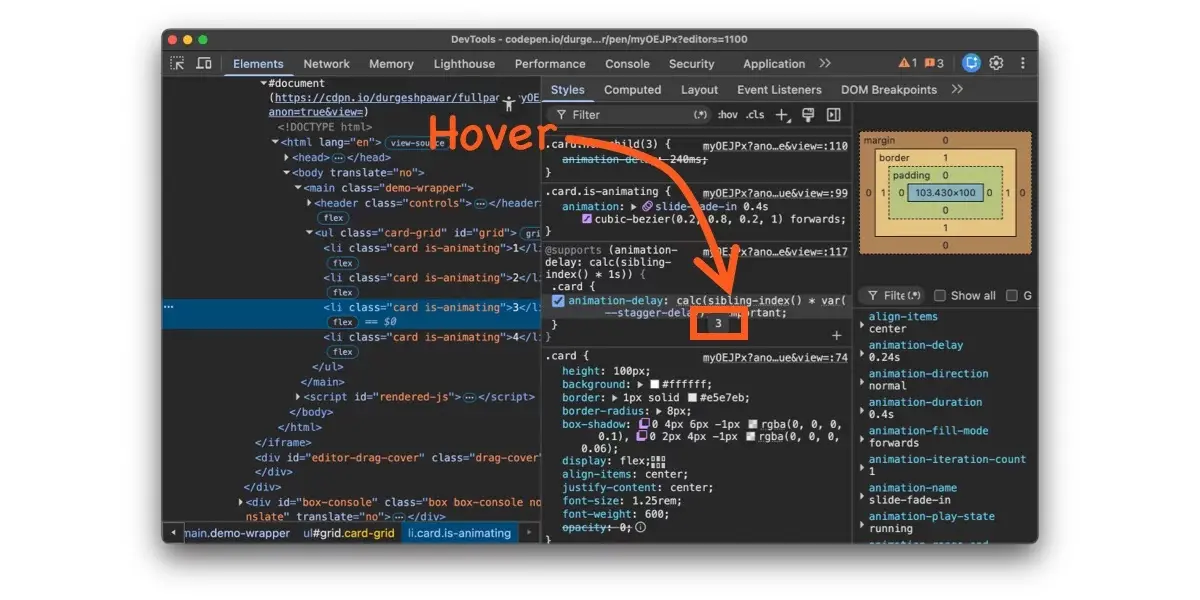
Conversely, sibling-index() and sibling-count() act as value-producing declarations. They take no arguments, evaluate instantly during the cascade phase, and return direct integers representing an element’s 1-based index among its sibling nodes and the total count of those sibling nodes, respectively.
li
  /* Evaluates natively: index multiplied by a time unit */
  animation-delay: calc(sibling-index() * 100ms);
High-Impact Patterns Worth Stealing
Once developers realize these functions return pure integers, a wave of powerful design patterns emerges, replacing complex utility scripts with concise, declarative CSS.
1. Reverse Stagger Animations
To create a natural visual rhythm where elements load from the bottom up or right to left—or simply to ensure the final item fires instantly without an awkward delay—developers can subtract the index from the total count:
.card
  animation: fade-in 0.4s ease both;
  animation-delay: calc((sibling-count() - sibling-index()) * 80ms);
Here, the final child resolves to (N - N) * 80ms = 0ms, executing immediately, while the first child calculates its delay from the total pool size.
2. Automatic Equal Widths for Dynamic Navigation
Manually adjusting percentage-based widths or writing fragile flexbox rules for dynamic tab bars is a relic of the past:
.tab
  width: calc(100% / sibling-count());
Whether a component features three tabs or eight, the layout calculates proportional widths on the fly without media queries or resize observers.
3. Native Color and Trigonometric Distributions
Complex visualizations—such as spreading hues evenly across a color wheel or arranging DOM elements into a circular radial menu—historically demanded heavy JavaScript math libraries. Combined with CSS trigonometric functions (sin() and cos()), tree-counting enables pure CSS geometric layouts:
.radial-item
  --angle: calc((360deg / sibling-count()) * sibling-index());
  --radius: 120px;

  position: absolute;
  left: calc(50% + var(--radius) * cos(var(--angle)));
  top: calc(50% + var(--radius) * sin(var(--angle)));
  transform: rotate(calc(var(--angle) * -1));
Adding or removing items instantly recalculates the hexagon or octagon coordinates natively within the rendering engine.
Critical Edge Cases and Implementation Gotchas
While the API is exceptionally clean, navigating its nuances requires a firm grasp of how browser engines parse DOM structures versus layout trees.
1. The Shadow DOM Boundary and Security Walls
sibling-index() and sibling-count() evaluate against the direct DOM tree, not the flattened visual tree. This distinction has profound implications for Web Components.

If a custom element wraps a shadow DOM containing a <slot> alongside internal structural helper elements, sibling-index() will evaluate against the internal shadow nodes, completely ignoring any light DOM children projected into the slot. Furthermore, to prevent malicious style sheets from probing the internal structural architecture of third-party encapsulation boundaries via ::part(), browsers deliberately return a flat 0 if an external stylesheet attempts to invoke tree-counting functions inside a shadow part selector.
2. The Hidden Trap of display: none
A subtle performance and layout trap involves hidden nodes. Elements styled with display: none are stripped from the visual layout tree and ignored by screen readers, but they remain fully active nodes in the DOM tree.
<ul>
  <!-- sibling-index() = 1 -->
  <li>Apple</li>
  <!-- sibling-index() = 2, but visually hidden -->
  <li style="display:none">Banana</li>
  <!-- sibling-index() = 3, NOT 2 -->
  <li>Cherry</li>
</ul>
Because sibling-index() reads the DOM, Cherry evaluates to 3, not 2. For staggered animations, this is usually harmless. However, for continuous calculations like radial menus or proportional tab widths, leaving filtered items in the DOM via display: none will introduce visual gaps. Developers must fully remove filtered nodes from the DOM or manage indices via script when strict sequential continuity is required.
3. Immediate Evaluation of Custom Properties
Attempting to abstract the index into a parent-level custom property will result in unexpected behavior:
.parent
  --idx: sibling-index(); /* Evaluates immediately to the parent's own sibling index! */
Because custom properties evaluate in context, defining the function on a parent locks in the parent’s specific index, causing all children to inherit that single static value. To ensure correct per-element calculations, the function must be declared directly on the target child elements:
.child
  --idx: sibling-index();
  animation-delay: calc(var(--idx) * 100ms);
Browser Support and Production Strategies
As of mid-2025, stable releases of Chrome and Edge (version 138 and above) have shipped native support for tree-counting functions, swiftly followed by Safari implementations. While Firefox has not yet enabled stable support, Mozilla’s standards position is explicitly positive, with active implementation tracks moving through Bugzilla.
Because major engines provide robust coverage across the majority of global web traffic, developers can safely adopt a progressive enhancement strategy utilizing @supports:
/* Baseline fallback for engines lacking support */
.item
  width: 25%;
  animation-delay: 0ms;


/* Progressive enhancement for supporting modern engines */
@supports (z-index: sibling-index())
  .item
    width: calc(100% / sibling-count());
    animation-delay: calc(sibling-index() * 80ms);
This dual-layer approach ensures that legacy or transitional environments receive stable, readable layouts, while modern browsers instantly unlock native mathematical orchestration.
Accessibility and Future Outlook
A vital reminder for engineers diving into these capabilities: tree-counting functions are strictly visual presentation layers.
Using sibling-index() math to visually reorder items via CSS grid or flex properties does not alter the underlying source order read by screen readers or navigated by keyboard tab orders. Creating a disconnect between visual presentation and semantic structure results in an immediate accessibility failure. Furthermore, interactive widgets leveraging tree-counting for layout must remain synchronized with native ARIA attributes (aria-posinset and aria-setsize), as assistive technologies have no awareness of CSS-calculated values.
Looking Ahead: What’s Next in the Spec
The CSS Working Group is already laying groundwork for future iterations of tree-counting. Prominent proposals include:
- Filtered Sibling Queries: The introduction of an
of <selector>argument (e.g.,sibling-index(of .active)), mirroring the filtering capabilities of modern:nth-child()rules. This will allow developers to count only elements matching specific classes or states without manual DOM manipulation. - Vertical Tree Metrics: Early exploratory discussions surrounding
children-count()anddescendant-count()functions, which would extend structural awareness from the horizontal sibling plane to the vertical parent-child hierarchy.
Conclusion
The nagging feeling that developers experienced when writing repetitive preprocessor loops for simple staggered animations was entirely justified. The missing architectural link was not developer ingenuity, but native browser capability. With sibling-index() and sibling-count() entering the Baseline standard, the web platform bridges a long-standing gap between DOM awareness and CSS expression, empowering engineers to build dynamic, high-performance interfaces with unprecedented elegance.
