

Executive Overview
In the high-stakes digital economy, the cost of a friction-heavy interface is no longer measured merely in "lost clicks"—it translates directly to millions of dollars in wasted engineering spend and evaporated business value. For decades, user experience (UX) was relegated to the periphery of corporate strategy, viewed by executives as a cosmetic preference or a purely visual overlay meant to make products "look nice."
However, as veteran UX designer and industry advocate Carrie Webster notes, this historical mischaracterization is rapidly dissolving. Today’s corporate leadership is recognizing that user experience is the primary engine of digital business survival. Modern UX design is as deeply anchored in quantitative research, cognitive psychology, and rigorous analytics as it is in pixels and typography.
By weaponizing hard data, product teams can successfully bridge the historical divide between design and the boardroom. Facts, metrics, and empirical realities do not merely advocate for the end-user; they prove unequivocally that UX is a non-negotiable prerequisite for a healthy bottom line. This report explores ten definitive, data-backed realities that redefine user experience not as a cost center, but as a high-yield financial investment capable of generating massive returns in saturated markets.
Detailed Chronology: The Evolution of UX from Aesthetics to Analytics
To understand how user experience reached its current status as an empirical business discipline, it is necessary to examine its operational evolution over the past two decades.
Phase 1: The Web-First and Early Mobile Era (Late 2000s–Early 2010s)
In the early days of modern web and mobile application development, digital products were frequently engineered feature-first. Design was deployed at the tail end of the software development lifecycle (SDLC) simply to skin functional code. Usability testing was considered an expensive luxury reserved for enterprise tech giants, and product decisions were driven primarily by internal stakeholder intuition ("HIPPO"—Highest Paid Person’s Opinion). The financial consequences of poor interfaces were obscured by a booming, less competitive digital frontier.

Phase 2: The Rise of Quantitative Metrics (Mid-2010s–2020)
As mobile applications saturated global markets, user acquisition costs skyrocketed, and attention spans began to shrink. Businesses could no longer afford high churn rates driven by confusing interfaces or sluggish performance. During this period, pioneering research institutions, usability laboratories, and conversion rate optimization (CRO) specialists began correlating micro-interactions with macro-financial outcomes. Metrics like Page Load Time, Bounce Rate, and Conversion Rate Optimization (CRO) became core key performance indicators (KPIs) shared by marketing, engineering, and product teams.
Phase 3: The Data-Driven Boardroom (2021–Present)
Today, UX has cemented its place in corporate financial strategy. Armed with comprehensive longitudinal studies from institutions like the IBM Systems Institute, Forrester Research, and McKinsey & Company, design leaders can now forecast the precise financial ROI of fixing bugs during the prototyping phase versus post-launch. In the modern corporate landscape, UX maturity is tracked alongside customer lifetime value (LTV) and operational efficiency, marking a permanent shift from subjective artistry to objective science.
Supporting Context & Metrics: The 10 Data-Backed Pillars of UX ROI
The following ten factual pillars outline the current reality of the digital marketplace. These are not merely design best practices; they are clinical, empirical drivers of financial growth.
1. Fixing Issues in the Design Phase is 100 Times Cheaper
One of the most compelling financial arguments for upstream UX investment is the 1:100 rule. Landmark studies from the IBM Systems Institute and Segue Technologies demonstrate that correcting a software defect or usability flaw after a product has been coded and launched can be up to 100 times more expensive than addressing it during the initial wireframing and prototyping phase.
Think of early-stage UX as "engineering insurance." By the time a developer writes production code, every user interaction should be rigorously validated. Discovering a fundamental navigation flaw post-launch incurs compounding penalties: technical debt, lost developer velocity, and massive revenue leakage as users abandon broken workflows.

2. Performance Directly Impacts User Experience and Revenue
A visually stunning interface is entirely worthless if the user bounces before it renders. Performance is the baseline infrastructure of user experience.
- 47% of users expect a web page to load in two seconds or less.
- A single-second delay reduces conversions by 20% and customer satisfaction by 16%.
- When mobile load times increase from one second to three seconds, bounce rates spike by 32%, and conversion rates plummet from 40% to 29%.
Conversely, minor performance optimizations yield massive financial gains. A microscopic 0.1-second improvement in mobile load times can elevate retail conversions by 8.4% and travel site conversions by 10.1%. Improving Largest Contentful Paint (LCP) benchmarks drives immediate, measurable increases in online sales.
3. Your Site Has 50 Milliseconds to Impress Your Customers
First impressions online are visceral, automatic, and aesthetic. Research indicates that users form an opinion about a website’s visual appeal in approximately 50 milliseconds (0.05 seconds). This split-second gut-feeling acts as an evolutionary survival mechanism, dictating whether a user stays to explore a value proposition or bounces instantly. Studies show that 94% of first impressions are strictly design-related. If an interface feels dated or unpolished, users subconsciously project that lack of quality onto the underlying product or service.
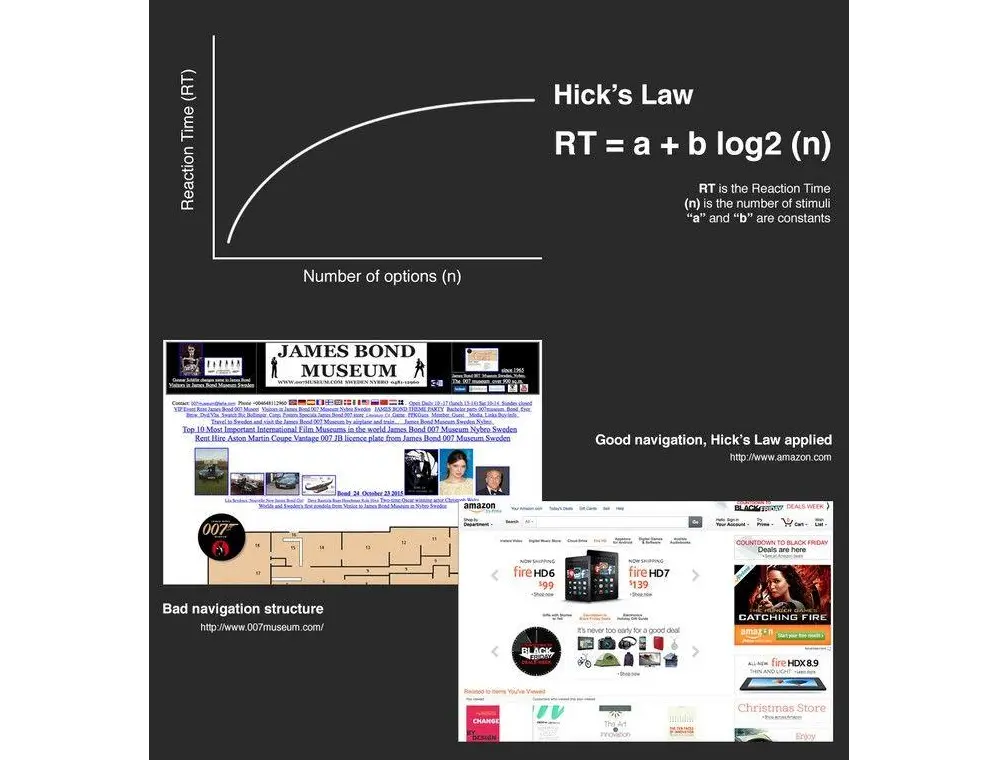
4. Hick’s Law: The Financial Cost of Overwhelm
Corporate stakeholders frequently operate under the false assumption that offering more choices equals delivering more value. Cognitive psychology proves the exact opposite. Hick’s Law dictates that the time it takes to make a decision increases logarithmically with the number of options available.
Every extraneous menu item, navigation link, or unnecessary form field imposes a cognitive tax on the user. Top-performing digital platforms leverage personalization and minimalist design to achieve conversion rates exceeding 11%, whereas unoptimized competitors languish below 3%. As a rule of thumb, eliminating a single redundant form field in a checkout flow can produce immediate revenue lifts.

5. White Space Improves Content Comprehension
Non-designers often view "white space" (negative space) as wasted digital real estate. In reality, it is a precision instrument for focus. Strategic use of white space can increase a user’s content comprehension by up to 20%.
By giving the user’s eyes room to rest, designers reduce cognitive load and guide attention naturally toward primary conversion elements, such as "Buy Now" or "Sign Up" CTAs. In an era where human attention spans hover around 8 seconds, visual simplicity is the ultimate luxury and a primary driver of sustained engagement.
6. The Power of "Fake" Progress (The Goal Gradient Effect)
One of the most fascinating psychological phenomena in digital product design is the Goal Gradient Effect, which proves that users become more motivated to complete a task as they perceive themselves to be closer to the destination.
In classic consumer psychology studies, loyalty cards pre-stamped with two bonus slots were completed significantly faster than blank cards requiring the identical total purchase count. In digital onboarding flows, initializing a progress bar at 15% simply for creating an account increases completion rates by over 40%. Effective UX design does not just arrange pixels; it actively manages user dopamine and momentum.
7. Typography and the Economics of Readability
Cramming dense text "above the fold" is a common mistake driven by stakeholder anxiety. Empirical data proves that proper typography—specifically optimized line spacing (leading), font weight, and paragraph width—can increase content comprehension and reading speed by up to 20%. Optimal line height reduces visual noise, allowing the human brain to process information with minimal cognitive strain. When text is difficult to read, perceived effort spikes, driving up bounce rates. Legibility is, fundamentally, a conversion tool.

8. Users Scan; They Do Not Read
Complementing the science of typography is the reality of reading behavior. Users do not read web pages word-for-word; they scan them. On a typical digital interface, users consume only 20% to 28% of the text. Because modern users naturally navigate via F-patterns or spotted reading layouts, designing long paragraphs of dense prose is a tactical error. Interfaces must be structured for scannability utilizing clear headers, bullet points, and high-contrast focal points.
9. User Testing with 5 People Is the Statistical Sweet Spot
Many organizations waste six-figure budgets and months of time on massive user studies with 100+ participants, only to become paralyzed by qualitative data noise. Usability engineering proves that testing with just 5 representative users uncovers approximately 85% of usability defects.
Beyond the fifth participant, teams hit a point of diminishing returns. The true competitive advantage belongs to organizations that practice agile, frequent, low-sample user testing—testing with 5 users, iterating rapidly, and testing again.
10. The Staggering Financial ROI of 9,900%
Perhaps the most persuasive argument for executive leadership is the cumulative financial return of design maturity. On average, every $1 invested in UX returns $100—a staggering 9,900% ROI. This return is driven by the dual engines of increased conversion rates (which can climb by up to 400% through optimized UX) and drastically reduced customer support overhead. When a digital product is inherently intuitive, the need for extensive call centers and customer service intervention drops precipitously.
Official Statements and Industry Insights
Industry leaders and global research institutions have codified these data points into formal frameworks that guide modern enterprise strategies.

-
Carrie Webster, Veteran UX Designer & Industry Advocate:
"UX design is no longer a team you hire to ‘make things look nice.’ It is the research-driven, data-backed discipline that ensures your digital product isn’t just a cost centre, but a revenue-generating machine… If the site isn’t instantaneous, the design hasn’t just failed — it effectively doesn’t exist."
-
McKinsey & Company (The Business Value of Design):
Research from McKinsey demonstrates that companies with high design maturity achieve 32% higher revenue growth and 56% higher total returns to shareholders (TRS) compared to industry peers. Mature organizations move beyond superficial "user delight" and focus on "user efficiency," reclaiming hundreds of thousands of dollars in annual employee productivity. -
The Bain & Company Experience Gap:
Data from Bain & Company highlights a startling disconnect in the market: 80% of companies believe they deliver a superior customer experience, yet only 8% of customers agree. This massive "experience gap" represents an unprecedented opportunity for data-driven organizations to capture market share left wide open by competitors.
Future Outlook: The Intersection of UX, AI, and Business Strategy
As we look toward the late 2020s, the operational landscape of user experience is undergoing a profound transformation driven by Artificial Intelligence (AI).

AI has not replaced the foundational psychological truths outlined in this report—human biology still dictates that we form aesthetic judgments in 50 milliseconds and struggle under the weight of cognitive overload (Hick’s Law). However, AI has vastly accelerated the velocity at which organizations can solve these UX challenges. Generative design systems, real-time predictive analytics, and hyper-personalized interfaces have turned static web architecture into living, breathing digital ecosystems.
Nevertheless, technology alone cannot override poor fundamentals. Organizations that continue to treat UX as an afterthought—ignoring page performance, accessibility, typography, and iterative user testing—will find themselves rapidly outpaced by competitors who leverage empirical data to build frictionless products.
Conclusion: The Strategic Imperative
The era of subjective design opinions and gut-feeling executive decisions has officially closed. The data is clear, the psychological principles are proven, and the financial ROI is undeniable. User experience is the definitive bridge between engineering spend and enterprise revenue growth. The only remaining question for modern business leaders is whether they will allow empirical data to guide their product strategy, or leave their market share vulnerable to competitors who already do.
