

Executive Overview
The intersection of public architecture, ego-driven real estate development, and modern American politics has long been defined by grand displays of power, but rarely has a single political figure so explicitly conflated personal branding with civic governance. Nearly six years after the symbolic demolition of the once-opulent Trump Plaza Hotel and Casino in Atlantic City—a structural and financial collapse that played out as a tragicomic coda to his initial tenure—President Donald Trump has brought the exact same playbook of hype, administrative mismanagement, and structural demolition to the heart of the nation’s capital.
From the unauthorized gutting of the historic East Wing of the White House to construct a sprawling, Grecian-style neo-classical ballroom, to recent legal filings demanding the structural alteration—or outright demolition—of the John F. Kennedy Center for the Performing Arts, the administration has systematically prioritized self-aggrandizement over institutional preservation.
What emerges from a comprehensive analysis of Trump’s decades-long trajectory in business and politics is a clear, unbroken pattern. The man who famously rode a wave of inherited wealth into a series of catastrophic corporate bankruptcies is now applying that same penchant for financial recklessness and operational failure to the federal government.
Following the implementation of sweeping, disruptive tariffs, draconian immigration policies that have severely strained the domestic labor market, and a discretionary foreign war in Iran that continues to destabilize global energy markets, the administration’s domestic agenda mirrors its architectural ambitions: gaudy, financially ruinous, and entirely disconnected from economic reality.
As legal battles intensify over the defacement and potential destruction of one of America’s most revered cultural institutions, the ongoing saga of the Kennedy Center serves as a stark parable for an administration whose fundamental ethos remains unchanged: hype above substance, appearance above utility, and the relentless, scorched-earth pursuit of personal legacy at any cost.
Detailed Chronology: From Atlantic City Ruins to Washington’s Monumental Overhaul
To understand the current threats facing Washington, D.C.’s architectural heritage, one must trace the timeline of Donald Trump’s real estate career—a history characterized by high-stakes speculation, reliance on borrowed capital, and a trail of abandoned or liquidated assets.
1. The Atlantic City Reckoning (1984–2021)
During the peak of the 1980s real estate boom, Trump expanded aggressively into the Atlantic City gaming market, opening the Trump Plaza, the Trump Castle, and later acquiring the ill-fated Trump Taj Mahal. Despite positioning himself as a master negotiator, the ventures were crippled by unsustainable debt loads and operational inefficiencies.
The Trump Plaza Hotel and Casino, which once hosted high-profile events and epitomized the hyper-commercialized luxury of the era, eventually fell into severe disrepair. Following years of corporate restructuring and bankruptcy filings, the property closed its doors permanently in 2014.
On February 17, 2021—just weeks after Trump left Washington for Mar-a-Lago—the long-neglected structure was reduced to rubble via a controlled implosion. Onlookers who had gathered to watch the demolition cheered as the casino came tumbling down, providing a literal and figurative bookend to a career built on fragile financial foundations.
2. The Return to Power and the Assault on the White House (2025–2026)
Upon securing a historic political comeback in the 2024 presidential election, Trump wasted little time translating his architectural fantasies into federal policy. In late 2025, the administration bypassed traditional oversight and historic preservation protocols to demolish the historic East Wing of the White House. In its place, contractors began erecting a monumental ballroom heavily criticized for its excessive scale and ostentatious Grecian-temple aesthetic.
The project marked the beginning of a broader campaign to rebrand the federal city. Proposals for a massive triumphal arch, plans to gild public monuments with gold leaf, and ongoing, costly renovations to the National Mall’s Reflecting Pool have transformed sections of the capital into what critics describe as an imperial pastiche blending Versailles with ancient Rome.
3. The Kennedy Center Controversy and the Threat of Demolition (2025–Present)
The escalation reached a critical threshold with the takeover of the John F. Kennedy Center for the Performing Arts. Following a concerted effort by a board stacked with political loyalists, the organization voted to emblazon Trump’s name across the nation’s official living memorial to the slain 35th president—a move a federal judge subsequently ruled unlawful.
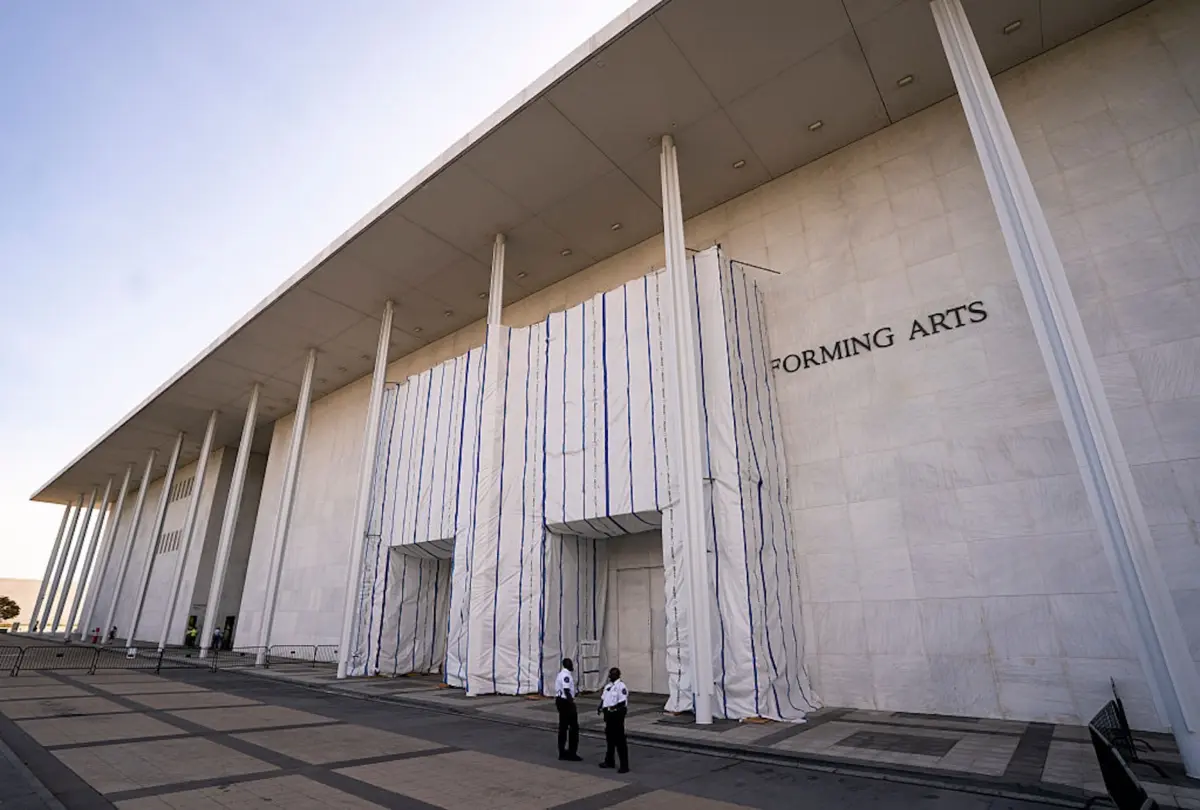
Rather than complying with the judicial order to remove the unauthorized signage, the center took the unprecedented step of covering its entire exterior nameplate with tarps and scaffolding.
The dispute escalated sharply when administration lawyers filed a formal legal brief demanding one of two outcomes: that the federal government be permitted to "restore" the building according to the president’s aesthetic specifications (featuring his name prominently displayed), or that the structure be entirely demolished. In its place, the filing proposed the construction of a large outdoor amphitheater, setting up a high-stakes constitutional and cultural showdown.
Supporting Context & Metrics: The Economics of Illusion
The parallels between Trump’s commercial failures and his current governance extend far beyond architectural vanity. Economists and financial analysts have long pointed out that the foundational myth of Trump’s business acumen is largely a construct of public relations.
The Inheritance and Opportunity Cost
According to extensive economic analyses—including estimates cited by economist Brad DeLong in his review of the financial biography Lucky Loser—had Donald Trump simply taken the estimated $500 million provided by his father, Fred Trump, and passively invested it in standard Manhattan commercial real estate indices, his net worth would easily have exceeded $80 billion by the time of his first presidential inauguration.
Instead, through a series of failed airline ventures, professional football investments, real estate missteps, and repeated casino bankruptcies, that wealth was systematically squandered. Forbes currently estimates his net worth at approximately $6.5 billion—a formidable sum by ordinary standards, but a fraction of the generational wealth he controlled and a testament to massive opportunity costs. As one prominent New York real estate developer noted, Trump’s reputation has long been a "mirage, built on inherited wealth, shady deals, and a relentless pursuit of appearances over substance."
Macroeconomic Missteps in the Second Term
This pattern of prioritizing short-term hype over sustainable management has directly impacted the broader American economy during Trump’s second term:
- Tariff Policies: Reintroducing aggressive, indiscriminate tariffs has disrupted global supply chains, raising input costs for domestic manufacturers and fueling persistent consumer inflation.
- Immigration Restrictions: Sweeping deportation initiatives and strict border controls have severely tightened labor markets, particularly within agriculture, construction, and hospitality, driving up operational costs across multiple sectors.
- Fiscal and Monetary Strain: Combined legislative packages featuring steep tax cuts weighted heavily toward corporations and high-net-worth individuals, alongside aggressive federal spending adjustments, have widened the national deficit while keeping interest rates elevated well above target projections.
- Geopolitical Energy Shocks: A discretionary military engagement in Iran has effectively destabilized critical Middle Eastern energy corridors, maintaining high global oil prices and embedding inflationary pressures throughout the domestic economy.
The Kennedy Center Financial Plunge
The administrative takeover of the Kennedy Center has mirrored these broader economic struggles on a micro-scale. According to a comprehensive analysis published by The Washington Post, ticket sales and overall venue revenue experienced a precipitous drop immediately following the announcement of the name change, culminating in a total financial cratering once the physical signage was altered. The institution, once a self-sustaining beacon of American arts and culture, now faces deep operational deficits requiring federal intervention or drastic restructuring.
Official Statements and Legal Posture
The escalating legal battle over the Kennedy Center has drawn sharp responses from preservationists, legal scholars, and administration officials.
In their August 2026 court filing, attorneys representing the administration defended the proposed alterations as an exercise of executive authority aimed at "modernizing and revitalizing public infrastructure to better reflect contemporary American leadership." The brief argued that current legal challenges represent an "obstructionist effort by municipal bureaucrats to micromanage federal properties."
Conversely, cultural preservation groups and descendants of the Kennedy family have condemned the actions as a direct assault on historic preservation laws and a desecration of a national monument. In a joint statement released following the filing of the demolition brief, a coalition of arts advocates stated:
"The John F. Kennedy Center for the Performing Arts is not a private commercial asset subject to the whims of transient political branding. It is a sacred national trust, consecrated to the memory of a fallen leader and dedicated to the elevation of the human spirit through the arts. To threaten its destruction in order to satisfy personal vanity is an unprecedented betrayal of public trust."
Legal analysts note that the administration’s demand to demolish a federally designated memorial building faces severe hurdles under the National Historic Preservation Act and various statutory protections governing federal land use in the District of Columbia. However, the willingness of the executive branch to test these legal boundaries underscores a broader governance strategy that views institutional norms as malleable obstacles to be overcome through sheer administrative force.
Future Outlook: Salvaging the Blueprint
The structural trajectory of both Donald Trump’s commercial real estate portfolio and his political career suggests a recurring cycle: aggressive over-leveraging, widespread public disruption, administrative decay, and eventual rescue or reclamation by more stable hands.
Historically, properties that suffered under the Trump brand name have frequently found renewed prosperity once removed from his direct influence. The former Trump Taj Mahal in Atlantic City, which languished through successive bankruptcies and severe physical decline under its original management, was successfully revived and transformed into the Hard Rock Hotel and Casino—a thriving entertainment hub that now contributes positively to the local economy.
Whether American democratic institutions, federal architectural landmarks, and the national economy can exhibit similar resilience remains the defining question of the current political era. As legal motions proceed regarding the fate of the Kennedy Center, and as the administration continues its contentious reshaping of Washington’s monumental core, the ultimate legacy of this chapter will likely be judged not by the temporary monuments of gold leaf and renamed plazas, but by the enduring strength of the constitutional guardrails designed to outlast them.
