

Executive Overview
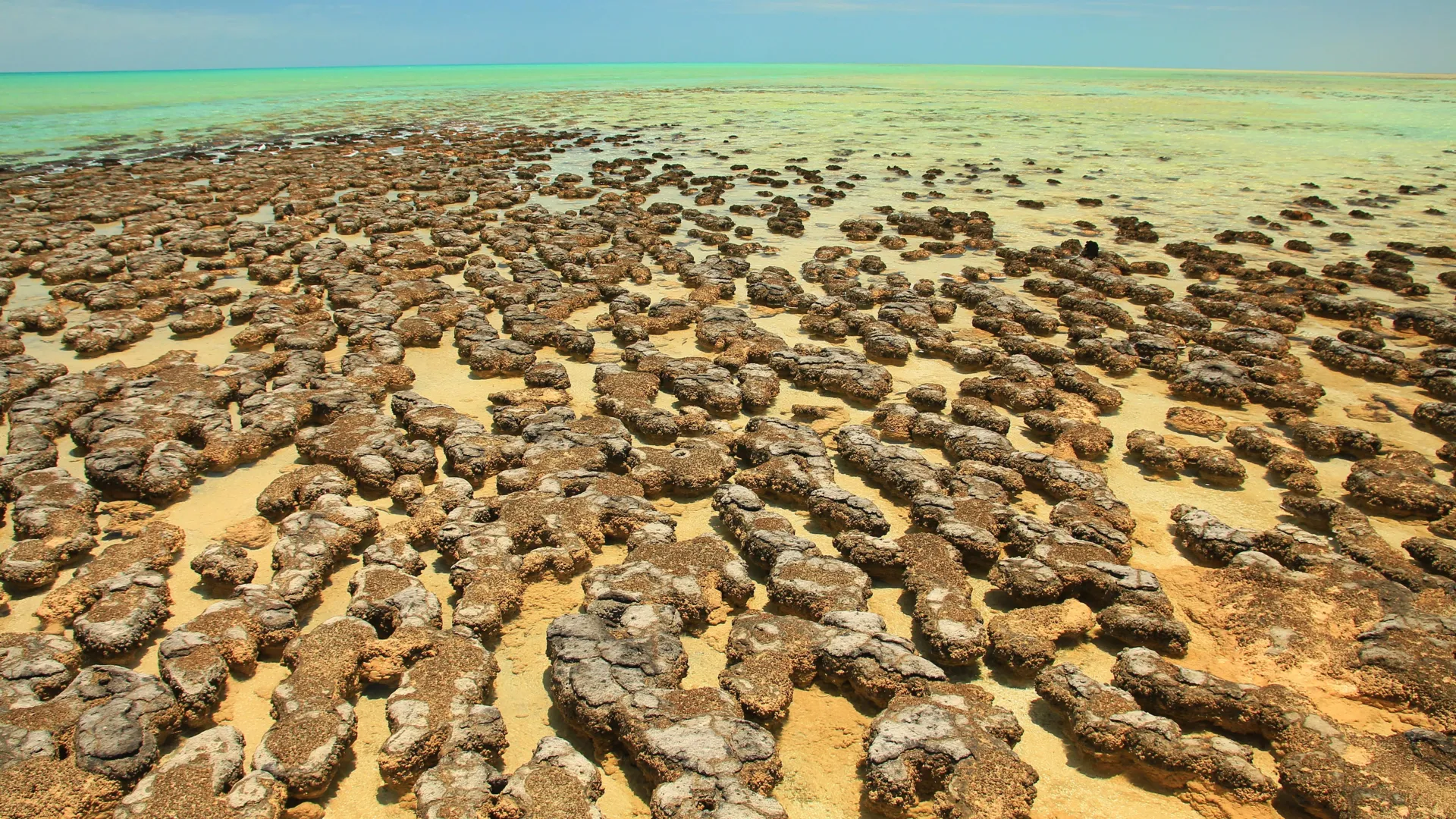
For centuries, the shallow, saline waters of Western Australia’s Shark Bay have harbored an unassuming geological marvel: stromatolites and microbial mats. To the casual observer, these structures resemble little more than dark, weathered rocks protruding from the seabed. Yet, beneath their austere exteriors lies a dynamic, densely packed, and layered metropolis built by microbial communities.
Long before the first animals walked the earth or plants claimed the land, these living fossils played a pivotal role in planetary evolution, releasing some of the earliest oxygen into Earth’s primordial atmosphere. Now, a groundbreaking study published in the journal Current Biology reveals that these resilient formations may hold the key to an even more profound evolutionary milestone: the emergence of complex life.
An international team of researchers—co-led by UNSW Sydney, the University of Technology Sydney (UTS), and The University of Melbourne—has successfully isolated and studied a previously unknown microbe thriving within these ancient ecosystems. The newly discovered organism belongs to the Asgard archaea, a mysterious and elusive group of microbes widely believed to be closely related to the evolutionary ancestors of eukaryotes. Eukaryotes represent the domain of life that encompasses all plants, animals, and fungi, as well as humans.
For the first time, scientists have captured direct visual evidence of an Asgard archaeon physically interacting with a bacterium through microscopic, tube-like bridges known as nanotubes. This unprecedented finding provides a tangible model for one of the greatest transitions in biological history: how simple, single-celled organisms formed symbiotic partnerships that ultimately gave rise to complex cellular machinery, including mitochondria, the energy powerhouses of human cells.
Beyond its evolutionary significance, the discovery bridges cutting-edge molecular biology with deep indigenous heritage. Named Nerearchaeum marumarumayae in consultation with the Malgana Traditional Owners of Shark Bay, the microbe bridges the gap between deep-time scientific inquiry and modern cultural stewardship. As researchers race to understand these fragile ecosystems amid escalating climate pressures, this milestone reminds us that the foundational history of life on Earth is written not just in stone, but in the cooperative bonds of the smallest living things.
Detailed Chronology: A Multi-Year Quest Into the Primordial Past
The journey to uncovering Nerearchaeum marumarumayae was fraught with technical hurdles, requiring nearly half a decade of painstaking laboratory work, advanced 3D imaging, and artificial intelligence.
The Hunt for Elusive Microbes
The project began in the World Heritage-listed waters of Shark Bay, a unique marine environment that mirrors the environmental extremes of early Earth. Associate Professor Brendan Burns, an evolutionary microbiologist at UNSW Sydney, and his colleagues collected sediment and microbial mat samples containing genetic signatures of Asgard archaea. While genetic sequencing confirmed the presence of these organisms within the environmental samples, cultivating them in a laboratory setting proved to be an extraordinary challenge.
"It took four or five years in the lab," A/Prof. Burns recounts. "A lot of time, optimizing and chasing different shadows."
Asgard archaea are notoriously difficult to maintain outside of their native habitats. Unlike many standard laboratory bacteria that can be grown in isolation, the research team repeatedly failed to establish a pure culture of the archaeon. This failure, however, illuminated a critical aspect of their biology: Asgard archaea are obligate dependents. They cannot survive alone because their metabolic survival relies entirely on an intricate web of chemical exchanges with neighboring organisms.
Breaking Through with Electron Cryotomography
To visualize what could not be cultured in isolation, the researchers turned to advanced microscopy, specifically electron cryotomography (ECT). This high-resolution 3D imaging technique allows scientists to examine cellular structures at the scale of a millionth of a millimeter without disrupting their natural state.
The resulting images provided a stunning look into a microscopic world. The ECT scans revealed an Asgard archaeon physically linked to a bacterium via extraordinarily thin bacterial nanotubes. Furthermore, the researchers observed the archaeon producing chains of budded vesicles and elaborate tube-like structures. Chemical analysis indicated that the two microbes engaged in a metabolic cross-feeding loop, exchanging vital compounds such as hydrogen, vitamins, and other essential nutrients.
Deep Learning and Ancient Cellular Machinery
To decipher the vast amounts of structural and genetic data generated by the microscopy, the team integrated artificial intelligence into their workflow. Coauthor Associate Professor Kate Mitchie from UNSW explained the role of machine learning in the discovery:
"We used this to predict the structures of proteins in these microbes," A/Prof. Mitchie notes. "And that’s exciting because we can start to see ancient versions of the cellular machinery that later became central to complex life."
By mapping these proteins, the team gained insight into the structural scaffoldings that preceded modern eukaryotic cells, providing empirical weight to decades of theoretical biology.
Supporting Context & Metrics: The Science of Symbiosis
To appreciate the gravity of the Shark Bay discovery, one must examine the prevailing theories regarding eukaryotic evolution and the ecological context of stromatolites.
The Endosymbiotic Origin of Complex Life
For decades, evolutionary biology has relied on the endosymbiotic theory to explain the transition from prokaryotes (simple cells without a nucleus, such as bacteria and archaea) to eukaryotes (complex cells with a defined nucleus and membrane-bound organelles).
- The Core Hypothesis: The theory posits that billions of years ago, an ancient archaeon engulfed or established an intimate metabolic partnership with a bacterium.
- The Result of Integration: Over millions of years, the engulfed bacterium evolved into the mitochondrion, the organelle responsible for generating adenosine triphosphate (ATP), which powers nearly all cellular processes in complex organisms.
- The Missing Link: While genetic evidence heavily favored the Asgard archaea as the closest living relatives to the host cell in this historic merger, scientists lacked visual or experimental proof of how such a physical relationship could initiate. The observation of nanotube bridges between the Shark Bay archaeon and its bacterial partner provides this missing physical framework.
The Ecosystem of Shark Bay
Shark Bay is not merely a scenic coastal inlet; it is a living laboratory that preserves geological processes lost to most of the modern world.
- Extreme Salinity: The high evaporation rates and restricted water flow in Hamelin Pool, Shark Bay, create hypersaline conditions that deter many grazing animals and competitors, allowing stromatolites to thrive much as they did in the Precambrian era.
- Microbial Architecture: Stromatolites are built layer by layer as cyanobacteria and other microbes trap sediment particles and precipitate calcium carbonate, cementing them into rocky mounds.
- Climatic Vulnerability: These fragile ecosystems face mounting pressures from rising ocean temperatures, changing salinity levels, and human encroachment, making the preservation and study of Shark Bay an urgent scientific priority.
Official Statements: Perspectives from the Research Consortium
The collaborative nature of the study spanned multiple Australian institutions, drawing on expertise in evolutionary microbiology, structural biology, and indigenous partnerships.
-
Associate Professor Brendan Burns (UNSW Sydney):
"Stromatolites could be more than ‘just’ a cradle of life where early microbial life flourished. They could also tell us how complex life first emerged… This could be a little model for how these kinds of partnerships started and ultimately formed eukaryotes."
-
Associate Professor Debnath Ghosal (The University of Melbourne):
"Directly capturing an interaction between an Asgard archaeon and a bacterium is particularly significant. This discovery brings us a few steps closer towards understanding how complex cells evolved from relatively simpler microbial life forms."
-
Associate Professor Iain Duggin (University of Technology Sydney):
"It’s as if we have slowly arisen from the bottom of the sea. It is remarkable to consider that microbes may have maintained partnerships like these in such environments for millions of years, eventually contributing to the emergence of complex life, including humans."
-
Associate Professor Kate Mitchie (UNSW Sydney):
"We used deep learning to predict the structures of proteins in these microbes. And that’s exciting because we can start to see ancient versions of the cellular machinery that later became central to complex life."
Honoring Heritage: The Naming of Nerearchaeum marumarumayae
The scientific naming of the newly isolated archaeon reflects a deep respect for the cultural landscape of Shark Bay. The species was designated Nerearchaeum marumarumayae through a rigorous collaborative process that honored both classical scientific nomenclature and the Indigenous heritage of the region.
- Etymology: The genus name Nerearchaeum honors Nereus, the ancient Greek sea god, signifying the marine origins of the organism. The species epithet marumarumayae is drawn from the Malgana language, translating to "ancient home."
- Cultural Consultation: The researchers worked closely with Kymberly Oakley, a foremost Malgana language expert, alongside Malgana elders and rangers. The traditional owners granted formal permission for the Malgana language to be integrated into the scientific record, celebrating a continuous cultural connection to the region that spans over 30,000 years.
- Caring for Country: Malgana elders and community members continue to act as stewards of Shark Bay, protecting local wildlife and managing the land. The convergence of microbiology and Indigenous land management highlights a shared ethos: preserving ecosystems that hold the secrets of our deep past so they may endure into the future.
Future Outlook: Expanding the Primordial Soup
With the successful isolation and imaging of Nerearchaeum marumarumayae, the research team is looking ahead to the next phase of discovery. A/Prof. Burns aims to identify and cultivate additional microbial partnerships, expanding what he describes as a "little primordial Asgard soup." By building a broader library of interacting ancient microbes, scientists hope to piece together a more comprehensive timeline of how cellular cooperation catalyzed the diversification of life on Earth.
At the same time, the researchers emphasize that the significance of the work extends far beyond academic curiosity. In an era defined by rapid environmental change, the microbial communities of Shark Bay serve as sentinel ecosystems.
As A/Prof. Burns reflects:
"Part of what makes this exciting is that it’s not just discovery, but connection. Not just across many years, but at a time when these fragile ecosystems face mounting threats from climate change and human activity… These microbes remind us that even the smallest partners can leave the deepest mark on our history."
