

Executive Overview
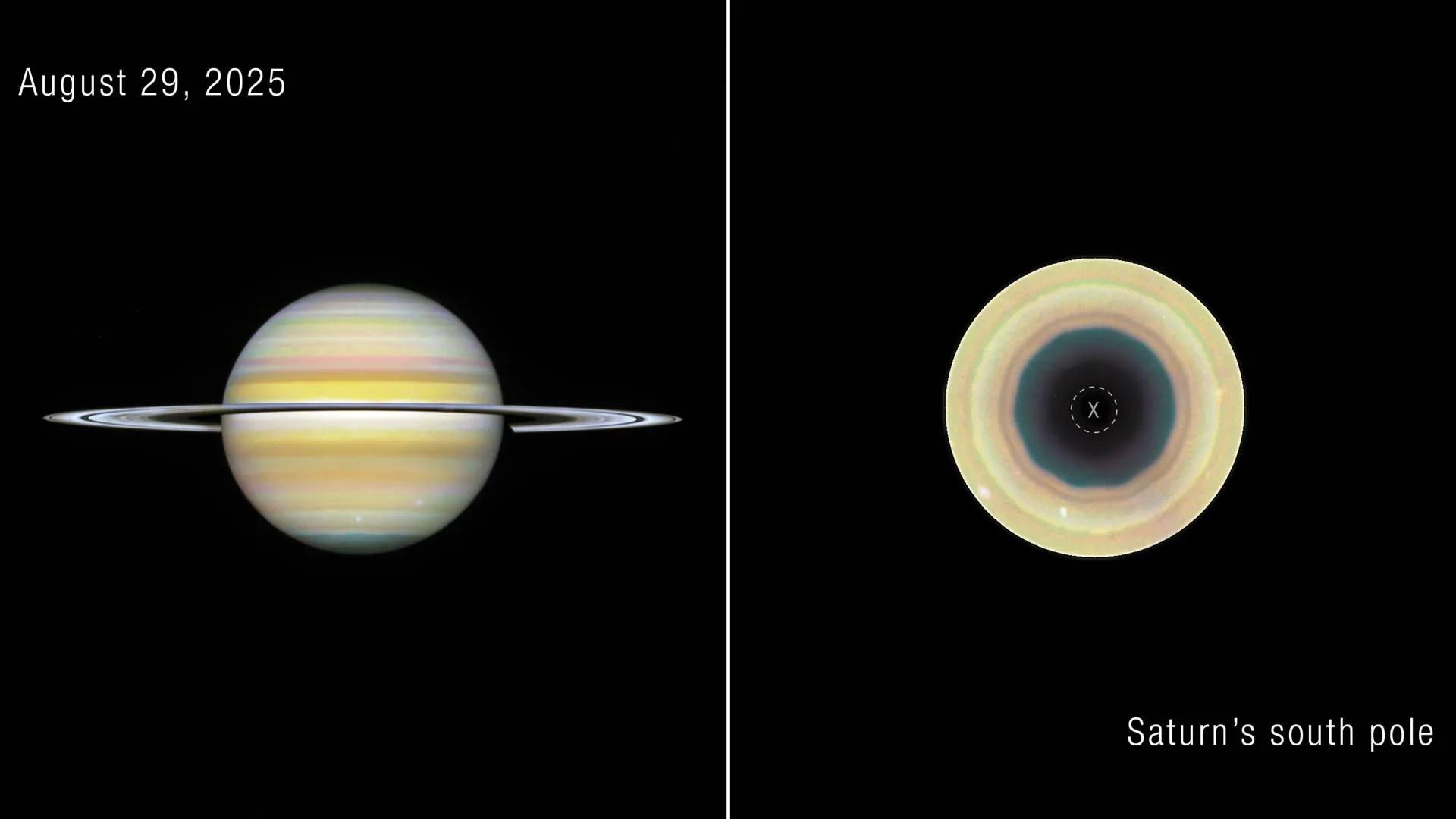
In a discovery that has captivated the planetary science community, NASA’s legendary Hubble Space Telescope has identified a striking, unprecedented atmospheric feature swirling near Saturn’s south pole: a massive, evolving 10-sided wave, or "decagon," that circles the planet’s polar region. Published in the prestigious journal Science Advances, this finding marks the first time scientists have ever observed a large, regularly shaped jet pattern in Saturn’s southern hemisphere.
For decades, astronomers have marveled at Saturn’s famous northern hexagon—a persistent, six-sided geometric jet stream that has remained locked in place at the north pole for over forty years, defying easy explanation. While the newly discovered southern decagon shares certain morphological similarities with its northern counterpart, important differences in its evolution, symmetry, and structure suggest researchers may be witnessing a distinct, actively developing atmospheric phenomenon take shape in real time.
The discovery was pieced together through a collaborative global effort bridging cutting-edge space-based imaging, ground-based astronomical monitoring, and the sharp eyes of citizen scientists. Researchers reconstructed the evolution of the feature by analyzing several years of archival data and recent observations captured by Hubble’s Outer Planet Atmospheres Legacy (OPAL) program, alongside amateur submissions coordinated through the Planetary Virtual Observatory Laboratory.
This unexpected cosmic formation not only challenges existing models of giant planet meteorology but also grants scientists a rare, front-row seat to the birth of a major planetary weather pattern. As researchers race to understand what triggered the decagon and whether it will stabilize into a permanent fixture like the northern hexagon, the discovery underscores the invaluable role of long-term planetary monitoring programs in unraveling the dynamic, ever-changing atmospheres of our solar system’s outer gas giants.
Detailed Chronology: From Faint Whispers to a Clear Decagon
The unraveling of Saturn’s southern decagon is a tale of modern astronomical detective work, relying on the convergence of amateur passion, institutional ground-based tracking, and the unmatched resolution of spaceborne observatories.
The First Clues: Global Collaboration and Amateur Astronomy
The story of the discovery begins with Saturn’s seasonal cycle. As the gas giant slowly moves along its 29.4-earth-year orbit around the Sun, its tilt brings alternating hemispheres into view. Recently, Saturn’s south pole gradually emerged from decades of winter darkness, becoming visible once again from Earth-based telescopes.
Astronomers tracking these seasonal transitions noticed anomalous wavy band patterns near the southern polar latitudes. The primary catalyst for tracking these early hints was the Planetary Virtual Observatory Laboratory (PVOL), a web-based repository operated by the University of the Basque Country in Spain. PVOL serves as a centralized hub where amateur astronomers from across the globe upload high-resolution ground-based images of solar system planets.
In 2024, study lead author Agustín Sánchez-Lavega, a researcher at the University of the Basque Country, joined forces with dedicated amateur astronomers Trevor Barry and Jean-Paul Oger. Analyzing a series of ground-based captures, the team flagged a faint, undulating atmospheric band near Saturn’s south pole. Ground observations gathered throughout subsequent months provided increasingly robust evidence that this subtle wave was organizing into a distinct geometric pattern.
Turning to Space: Hubble Confirms the Shape
Recognizing the limitations of ground-based viewing—where Earth’s turbulent atmosphere inevitably blurs fine details—the research team turned to NASA’s Hubble Space Telescope to cut through the atmospheric haze.
Because Hubble orbits high above the distortion of Earth’s atmosphere, it is capable of capturing razor-sharp images across complete planetary rotations. When researchers analyzed Hubble’s data sets, they received a stunning confirmation: the wavy band had evolved into a sharply defined 10-sided polygon, or decagon.
Pushing further back into the archives, the team utilized Hubble’s extensive historical database to trace the feature’s lineage. Surprisingly, images captured by the telescope revealed faint, rudimentary signs of the structure dating as far back as 2023.
To ensure the feature was not an artifact of past technological limitations, researchers cross-referenced archival data from NASA’s Cassini spacecraft, which orbited Saturn from 2004 until its intentional grand finale in 2017. Intriguingly, Cassini’s exhaustive high-resolution surveys of the southern hemisphere showed no inkling of a long-lived decagonal formation during its mission tenure. This realization solidified a profound conclusion: the southern decagon is not a permanent, multi-decadal fixture that was previously hidden, but a newly minted atmospheric phenomenon that materialized within the last few years.
Supporting Context & Metrics: Decoding Saturn’s Stratified Dynamics
To fully grasp the significance of Saturn’s southern decagon, scientists must analyze the physical parameters and atmospheric mechanics driving the wave. The discovery is not merely a surface-level curiosity; it represents a profound structural anomaly within the planet’s circulation systems.
A Vertically Extended Structure
One of the most critical revelations stemming from Hubble’s multi-wavelength imaging is that the decagon is not a superficial cloud-top decoration. Instead, the newly identified wave is embedded deep within one of Saturn’s immensely powerful jet streams, extending vertically through multiple distinct atmospheric layers.
Hubble achieved this insight by imaging the planet across various ultraviolet, visible, and near-infrared wavelengths. Because different wavelengths penetrate to different depths within Saturn’s dense atmosphere of hydrogen, helium, and trace gases, astronomers observed subtle geographical shifts in where the decagon’s vertices appeared. This layered displacement confirms that the wave possesses a profound vertical axis, influencing atmospheric dynamics from the upper troposphere down into deeper meteorological layers.
Comparing North and South: Symmetry versus Asymmetry
For decades, planetologists viewed Saturn as a study in high-latitude symmetry. The planet boasts intense eastward and westward jet streams mirroring each other in both hemispheres. Consequently, ever since the northern hexagon was discovered by the Voyager spacecraft in the early 1980s and later studied extensively by Cassini, astronomers had actively searched for a southern counterpart—effectively turning up empty-handed for over thirty years.
| Feature Comparison | Northern Hexagon | Southern Decagon |
|---|---|---|
| Shape | 6-sided (Hexagon) | 10-sided (Decagon) |
| Persistence | Stable for 40+ years (observed by Voyager, Cassini, Hubble) | Newly formed (first detected faintly in 2023, clear by 2024–2025) |
| Hemisphere | North Pole | South Pole |
| Depth | Extends deep into upper atmosphere | Vertically extended through multiple atmospheric layers |
| Status | Long-term permanent atmospheric fixture | Actively evolving, stability currently unknown |
The discovery of a 10-sided polygon rather than a 6-sided one shatters simple expectations of hemispheric symmetry. While the physical fluid dynamics that generate polygonal waves in high-speed polar jet streams—often modeled in terrestrial laboratories using rotating tanks of fluid—can theoretically produce various polygon shapes depending on shear velocity and gradient flows, observing a decagon actively strengthen on Saturn provides empirical validation for these complex mathematical models.
Official Statements and Expert Perspectives
The scientific community has responded to the discovery with a mixture of excitement, awe, and cautious curiosity regarding the underlying physics of giant gas planets.
Dr. Agustín Sánchez-Lavega, lead author of the study from the University of the Basque Country, emphasized the historical context of the search:
"Given Saturn’s symmetry in its north-south jet stream system, we have been searching for a counterpart to Saturn’s northern hexagon on the south pole in Hubble images since 1990. Images from NASA’s Cassini spacecraft showed no inkling of a long-lived formation, either. The Hubble data confirmed the feature’s presence back to 2023, proving we are watching a truly novel event."
Dr. Amy Simon, study co-author and principal investigator for the Hubble OPAL program at NASA’s Goddard Space Flight Center, highlighted the rare opportunity presented to researchers:
"We’ve never seen anything quite like this in Saturn’s southern hemisphere. The northern hexagon has been there every time we’ve looked for more than 40 years. This feature is different—it appears to be strengthening, giving us the rare opportunity to watch a giant atmospheric pattern develop. The most intriguing part to me is that this seems to have just formed recently. The question is, why did it suddenly form now when we haven’t seen one before?"
Dr. Mike Wong, a co-author of the study based at the University of California, Berkeley, underscored the indispensable value of long-term institutional science initiatives:
"When we started the OPAL program, we expected compelling surprises, but we didn’t know what to expect specifically. A lot of the discoveries we see coming from OPAL are not just based on one observation, but on years and years of data. Regular observations over time are enabling a lot of new findings that isolated snapshots could never provide."
Future Outlook: Unlocking the Mysteries of Planetary Atmospheres
As the ink dries on the Science Advances publication, planetary scientists are already plotting the next phase of research. The emergence of Saturn’s southern decagon opens up a multitude of critical scientific inquiries.
Key Questions Moving Forward
- Trigger Mechanisms: What precise meteorological, thermal, or seasonal shifts catalyzed the sudden formation of the decagon between 2020 and 2023?
- Longevity and Stability: Will the decagon persist for decades like its northern counterpart, or is it a transient atmospheric disturbance that will dissipate as Saturn’s seasons continue to progress?
- Dynamic Modeling: How do the differing rotational speeds, Coriolis forces, and zonal wind profiles at the south pole interact to support a 10-sided wave structure instead of a 6-sided one?
The Role of Advanced Observatories
To answer these questions, researchers plan to leverage a multi-tiered observational strategy. Continuous monitoring via the Hubble Space Telescope’s OPAL program will remain critical for tracking morphological changes in the cloud deck over annual cycles.
Simultaneously, astronomers are turning the infrared eyes of NASA’s James Webb Space Telescope (JWST) toward Saturn’s south pole. While Hubble excels at high-resolution visible and ultraviolet imaging of cloud tops, JWST can probe deeper thermal structures, mapping temperature variations and chemical abundances within the decagon’s core at unprecedented resolutions.
Furthermore, computational fluid dynamics experts are building sophisticated 3D atmospheric models. By feeding real-world data regarding Saturn’s wind speeds, density gradients, and thermal outputs into supercomputers, researchers hope to simulate the exact physical forces required to sculpt and sustain a stable 10-sided wave in a raging polar jet stream.
Ultimately, studying extremes of planetary weather on worlds like Saturn expands our understanding of fundamental fluid dynamics. By decoding how vast, geometric wave patterns form and maintain themselves in the crushing, hyper-fast atmospheres of gas giants, scientists gain universal insights into atmospheric turbulence and wave mechanics that apply not only across our solar system, but potentially to exoplanets orbiting distant stars throughout the galaxy.