

Executive Overview
The universe is slowly going dark, and astronomers are finally closing in on the culprit. Over the past 4.5 billion years—a mere blip in the 13.8-billion-year history of the cosmos—the rate at which new stars are born has plummeted to less than half of its historical peak. For decades, the prevailing scientific consensus pointed to a straightforward exhaustion model: galaxies were simply running out of gas.
However, groundbreaking research published online in Nature Astronomy on September 1 turns this conventional wisdom on its head. An international research team, spearheaded by scientists from the Chinese Academy of Sciences (CAS) in collaboration with the Dark Energy Spectroscopic Instrument (DESI) project, has revealed a striking cosmic mismatch. While stellar birthrates have crashed dramatically, the universe’s supply of neutral atomic hydrogen—the fundamental raw ingredient required for star formation—has barely budged.
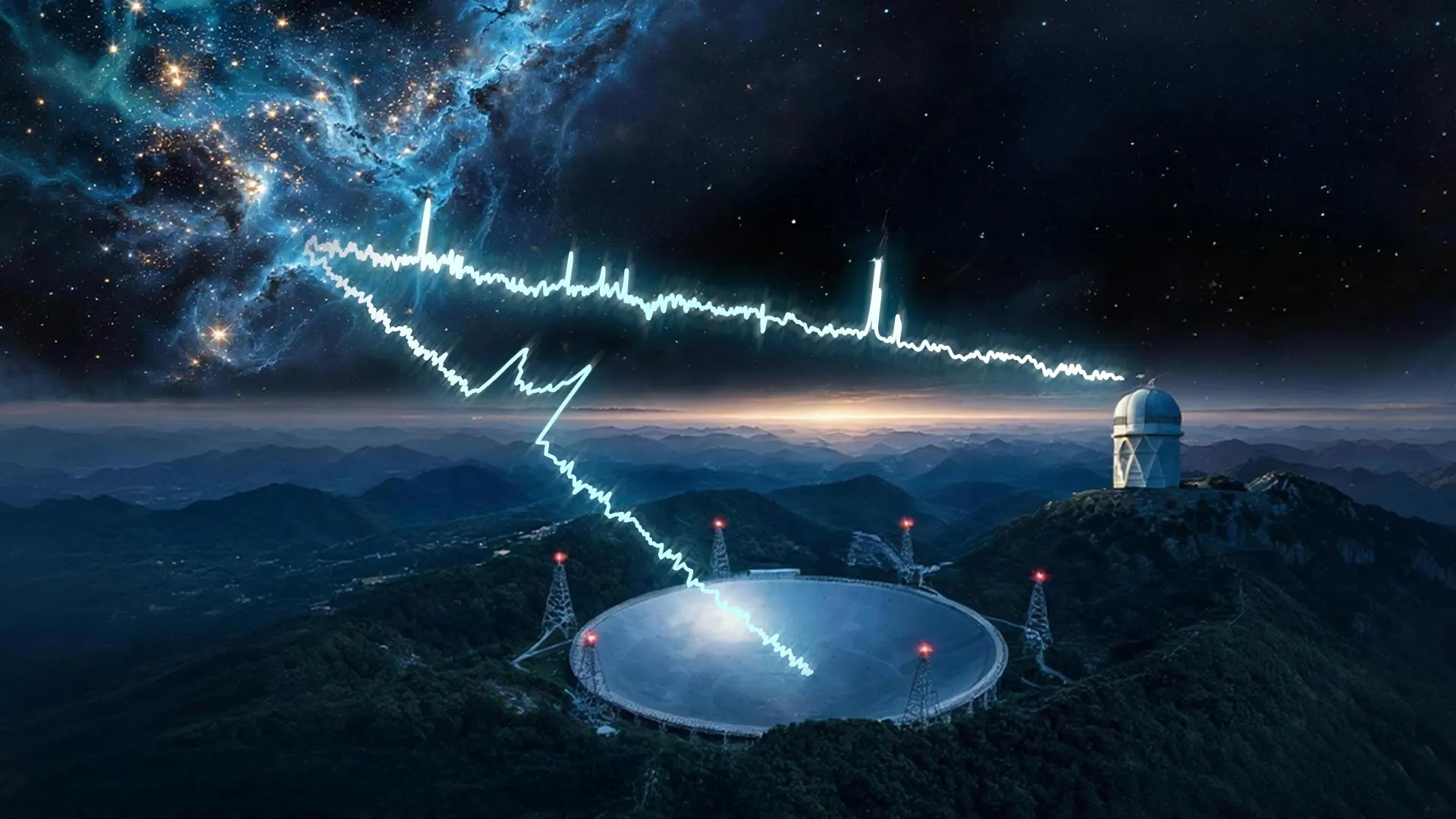
Utilizing the unprecedented sensitivity of China’s Five-hundred-meter Aperture Spherical radio Telescope (FAST) alongside the massive optical mapping power of DESI, researchers analyzed roughly 2.5 million galaxies spanning nearly one-third of the sky. Their findings indicate that neutral atomic hydrogen density has decreased only modestly over the past 4.5 billion years, dropping by a factor of just 1.4. In stark contrast, the cosmic star formation rate has fallen by a factor of 2.5.
This unexpected disconnect completely shifts the terms of modern astrophysics. The central mystery is no longer a question of vanishing fuel; rather, it forces scientists to confront a much deeper enigma: Why is it increasingly difficult for galaxies to turn abundant hydrogen reserves into newborn stars? The answer, experts suggest, lies not in the total volume of available gas, but in the intricate plumbing of the cosmic baryon cycle—how gas moves, cools, and transforms within the vast architectures of galaxies.
Detailed Chronology: Solving an Observational Impasse
To understand how researchers arrived at this paradigm-shifting conclusion, one must retrace the historical hurdles that hampered observational astronomy for decades. Pinpointing the evolution of neutral atomic hydrogen (HI)—the primary reservoir of cold gas within galaxies—has long been considered one of the most difficult challenges in observational cosmology.
The Radio Astronomy Bottleneck
Neutral atomic hydrogen is predominantly detected through its faint 21-centimeter radio emission line. While this spectral line acts as an invaluable beacon for tracking cosmic gas, capturing it from distant galaxies has historically pushed radio telescopes to their absolute limits. The signal is notoriously weak, easily swallowed by the roaring cacophony of cosmic background noise and radio frequency interference.
For years, astronomers faced a frustrating technological trade-off:
- Deep, Narrow Surveys: Instruments capable of achieving the necessary sensitivity to detect faint 21-centimeter emissions could only stare at very small patches of the sky, limiting statistical sample sizes.
- Wide, Shallow Surveys: Telescopes capable of scanning vast areas of the sky lacked the raw sensitivity required to pick up signals from galaxies billions of light-years away.
As a result, directly and reliably mapping how the universe’s total HI mass evolved across the low- to intermediate-redshift universe—spanning the last several billion years of cosmic history—remained frustratingly out of reach.
The Breakthrough: FAST Meets DESI
The logjam finally broke through a powerful cross-facility collaboration. The research team combined the unmatched radio collecting area and sensitivity of FAST—the world’s largest single-dish radio telescope—with the colossal optical spectroscopy dataset provided by DESI, an instrument renowned for mapping millions of galaxies to chart the expansion history of the universe.
By cross-referencing data from both projects, the team assembled a massive sample of approximately 2.5 million galaxies distributed across nearly a third of the celestial sphere.
Because individual HI signals from these distant galaxies remained too faint to isolate directly, the researchers deployed an advanced data-processing technique known as HI spectral stacking. By utilizing precise spectroscopic measurements of each galaxy’s redshift obtained by DESI, the team could accurately align the micro-signals of millions of individual galaxies. Stacking these signals constructively allowed the average HI signature to rise clearly out of the background noise.
This methodological triumph enabled the team to track the density and distribution of cosmic neutral hydrogen with an unprecedented combination of sample size and statistical precision, setting a new benchmark for low- and intermediate-redshift gas astronomy.
Supporting Context & Metrics: The Anatomy of a Cosmic Mismatch
The empirical data yielded by the FAST-DESI collaboration dismantle the long-held assumption that star formation drops simply because galaxies are starving. The metrics paint a vivid picture of a universe rich in potential yet increasingly barren of accomplishment.
The Numbers Behind the Decline
When examining the cosmic timeline across the last 4.5 billion years, the divergence between stellar birth and gas retention becomes glaringly apparent:
- Cosmic Star Formation Rate (SFR): Approximately 4.5 billion years ago, the universe was producing stars at a rate roughly 2.5 times higher than it is today.
- Neutral Atomic Hydrogen Density (HI): Over that exact same 4.5-billion-year window, the total density of neutral atomic hydrogen fell by only a minor factor, resting at roughly 1.4 times its present level.
| Epoch Comparison | Relative Star Formation Rate | Relative Neutral Hydrogen (HI) Density |
|---|---|---|
| 4.5 Billion Years Ago | ~2.5x Current Level | ~1.4x Current Level |
| Present Day | 1.0x (Baseline) | 1.0x (Baseline) |
The Mechanics of the Baryon Cycle
To interpret these metrics, astrophysicists must look closer at the lifecycle of cosmic gas, often referred to as the baryon cycle.
Neutral atomic hydrogen does not collapse directly into stars. Instead, HI occupies an intermediate, transitional phase:
- The Cosmic Web: Primordial and recycled gas flows inward from intergalactic space into the gravitational wells of galaxies.
- The HI Reservoir: This gas accumulates as a vast reservoir of neutral atomic hydrogen (cold gas) within and around the galaxy.
- Molecular Clouds: To form stars, HI must cool further and condense into extremely dense clouds of molecular hydrogen ($textH_2$). Only within these molecular nurseries can gravity overcome internal pressure to ignite nuclear fusion.
The new findings suggest that while the primary reservoir (HI) remains well-stocked, the conversion pipeline leading from HI to molecular hydrogen is severely bottlenecked. As the universe expands and ages, the smooth influx of gas from the cosmic web weakens, and the overall density of interstellar media decreases. Consequently, galaxies lose their efficiency in compressing and converting neutral atomic gas into the molecular fuel required to fire up their stellar nurseries.
Official Statements & Collaborative Perspectives
The international scope of the project underscores the collaborative nature of modern astrophysics, drawing expertise from major research hubs across Asia, North America, and Europe.
While individual statements from the leadership of the National Astronomical Observatories of China (NAOC), the Shanghai Astronomical Observatory (SHAO) of CAS, and Shanghai Jiao Tong University highlight the technical triumphs of the work, the consensus within the community focuses heavily on the philosophical shift the paper forces upon theoretical models.
"For decades, the field operated under the assumption that the fading of the universe’s star-forming glory was an elementary matter of consumption—galaxies eating through their pantry," noted one senior researcher involved with the study. "What FAST and DESI have shown us is that the pantry is still remarkably full. The problem is that the stove is no longer lighting."
Representatives from the DESI collaboration echoed this sentiment, emphasizing the immense synergy achieved by merging optical and radio astronomy. By pairing DESI’s massive redshift catalog—which maps the spatial distribution of galaxies with breathtaking accuracy—with FAST’s peerless capability to probe low-frequency radio waves, the collaboration has effectively established a new observational template for galaxy evolution studies.
The research team stresses that future theoretical models of galaxy formation must now pivot away from simple gas-depletion parameters. Instead, they must incorporate complex hydrodynamical simulations that account for feedback mechanisms, magnetic fields, turbulence, and thermal pressures that dictate how efficiently gas transitions from atomic states to molecular cradles.
Future Outlook: The Next Frontier in Galaxy Evolution
As the ink dries on the Nature Astronomy publication, the broader astrophysics community is already looking toward the horizon. The questions raised by the FAST-DESI findings are expansive, setting the agenda for observational and theoretical research for the coming decade.
Expanding the Redshift Horizon
The current study mapped gas evolution across the past 4.5 billion years—a crucial epoch representing the mature phase of the universe’s lifecycle. However, to fully understand the trajectory of star formation, scientists are eager to push these stacking techniques further back in time, probing earlier epochs when the universe was operating at peak star-forming efficiency, roughly 10 billion years ago.
Achieving this will require pushing radio stacking methodologies to even greater sensitivities. Future upgrades to existing radio facilities, as well as the ongoing development of next-generation instruments like the Square Kilometre Array (SKA), will be instrumental in determining whether the mismatch between atomic hydrogen and star formation persists across deeper cosmological epochs.
Refining Theoretical Frameworks
On the theoretical front, astrophysicists are racing to update galaxy evolution simulations. Current models must now be tested against the empirical constraint that HI is remarkably resilient over the last 4.5 billion years. Theorists are focusing heavily on:
- Stellar and Active Galactic Nuclei (AGN) Feedback: Investigating how winds and jets driven by supermassive black holes or supernova explosions inject energy into the circumgalactic medium, heating gas and preventing it from condensing into molecular clouds.
- Environmental Processing: Examining how gas reservoirs behave differently in dense galaxy clusters versus isolated field galaxies.
- Cosmic Web Dynamics: Modeling how the deceleration of gas accretion from intergalactic filaments starves galaxies of the dynamic pressure needed to drive rapid star formation.
Ultimately, the revelation that the universe’s star factories are fading not from a lack of fuel, but from a failure of conversion, transforms our understanding of cosmic history. The cosmos is not an empty dining room where the food has run out; it is a sprawling, complex kitchen where the chefs have lost the ability to ignite the burners. Solving this mystery will be central to charting the ultimate destiny of our stellar-studded universe.