

Executive Overview
Every website hits its operational and aesthetic zenith on the exact day it launches. The final git branch is merged, DNS records propagate, and the site goes live precisely as envisioned by its creators—briefly, perfectly, and unsustainably.
From that moment forward, a silent, relentless decay begins. It is rarely caused by catastrophic outages or sudden code failures. Rather, websites age because the digital landscape moves underneath them. Competitors launch streamlined user journeys, typography systems shift, accessibility standards evolve, and the messaging that once felt sharp gradually drifts out of alignment with the company it represents. Within a year, a state-of-the-art web property can easily morph into a digital period piece: functional, perhaps, but fundamentally behind the curve.
For decades, digital product teams, designers, and developers have treated this slow degradation as an immutable law of nature—a logistical tax paid for maintaining an online presence.
However, the rapid maturation of autonomous artificial intelligence agents promises to fundamentally rewrite this dynamic. Platforms like Fimo are pioneering a new paradigm: websites that continuously optimize, correct, and update themselves long after the initial launch party ends. Yet, as developers and designers rush to embrace full autonomy, they are encountering a counterintuitive psychological and operational hurdle: almost nobody actually wants a website that changes entirely on its own.
This investigative report examines the friction between complete AI automation and human agency, exploring how builders are discovering that true website autonomy is not about removing human oversight entirely, but rather about strategically carving up labor, defining dynamic boundaries, and eradicating digital decay.
Detailed Chronology: From Static Artifacts to Self-Healing Systems
To understand why autonomous websites represent a seismic shift in web architecture, one must trace the historical trajectory of how we build and maintain digital real estate.
Phase 1: The Static Era and Manual Upkeep
In the early days of the web, updates were entirely manual. Every hyperlink, text modification, and image replacement required direct code manipulation. As Content Management Systems (CMS) like WordPress emerged in the mid-2000s, updating content became democratized, but the architectural and structural upkeep remained heavily manual. If a global design token changed—such as a primary brand color or a spacing grid—developers had to manually re-theme templates or rely on cascading stylesheets that frequently broke under legacy code weight.
Phase 2: The Continuous Deployment Era
The 2010s ushered in CI/CD (Continuous Integration and Continuous Deployment) pipelines. Modern frontend frameworks (React, Vue, Svelte) and headless CMS architectures made deploying code faster than ever. Yet, velocity created its own problems. Teams rushed features out the door to meet quarterly goals, frequently bypassing accessibility compliance, shipping uncompressed image assets, or leaving broken metadata tags in their wake. The speed of shipping outpaced the capacity for routine maintenance.
Phase 3: The Genesis of AI-Driven Autonomy
Enter the era of agentic workflows. Instead of merely executing static scripts or waiting for human developers to push hotfixes, modern AI agents possess the capability to reason, inspect DOM trees, verify accessibility guidelines, and propose or execute code changes in real-time.
When builders initially conceptualized platforms designed for autonomous web management, the baseline assumption was straightforward: build capable agents, hand them the keys to the entire repository, let them write, edit, and publish, and get out of the way.
This total-delegation model, however, immediately collided with human reality. When put in front of real stakeholders—product managers, brand directors, engineers, and copywriters—the reaction was not unbridled enthusiasm, but deep hesitation. The hesitation did not stem from a lack of trust in artificial intelligence; rather, it exposed a fundamental structural truth about organizations: websites have no single owner.
Different compartments of a digital property belong to different stakeholders, and each stakeholder demands a vastly different threshold of autonomy. Consequently, the engineering challenge shifted from a technical puzzle of AI capability to a nuanced design problem of boundary-setting.
Supporting Context & Metrics: The Anatomy of Digital Decay
To quantify the value of autonomous maintenance, it is helpful to dissect where human energy is actually expended across the lifecycle of a web property. Industry observations and developer platform telemetry suggest that website management tasks can be cleanly partitioned into three distinct categories:
+-----------------------------------------------------------------+
                    THE WEBSITE LABOR SPECTRUM
+----------------------------------+------------------------------+
| CATEGORY                         | APPROXIMATE WORKLOAD SHARE   |
+----------------------------------+------------------------------+
| 1. Rule-Bound Maintenance (Chores)| ~80%                         |
| 2. Shared/Variable Territory     | Variable (Department-Dependent)|
| 3. Untouchable Brand Taste       | ~5% - 10%                    |
+----------------------------------+------------------------------+
1. The Rule-Bound 80%: The Chore Pile
The vast majority of website upkeep is entirely repetitive, rule-bound, and devoid of creative fulfillment. This includes:
- Enforcing WCAG accessibility compliance as new components are introduced.
- Propagating design system updates across disparate pages when a design token changes.
- Identifying broken meta tags, uncompressed images, or dead outbound links resulting from URL restructuring three sprints ago.
None of these tasks require human intuition or artistic taste. Nobody joins a digital agency because of a deep-seated passion for auditing alternative text attributes on stock imagery. This is the heavy lifting that agents excel at. When an AI agent quietly monitors and corrects this layer in the background, it acts as a tireless janitor, wiping out the tedious 80% of web maintenance without threatening anyone’s core livelihood.
2. The Variable Middle: Territory and Ownership
Between routine chores and untouchable creative decisions lies a vast, ambiguous middle ground. Crucially, the boundary between what should be automated and what must be manually approved varies wildly depending on who is looking at the task.
Consider a practical, highly common website modification: setting dark mode as the default user experience upon landing.
- From a Developer’s Perspective: This is often a straightforward, rational one-line configuration update backed by clear performance or user-preference telemetry. A developer would happily delegate this decision to an autonomous agent and move on to complex backend logic.
- From a Designer’s Perspective: The default theme is far from a trivial setting; it is a foundational brand statement. It dictates how the organization wishes to present its visual identity to first-time visitors. The brand designer wants strict, manual oversight over this call.
The exact same task, performed on the exact same codebase, carries entirely different levels of judgment depending on the stakeholder. Therefore, a monolithic "autonomy toggle" baked into software products is fundamentally flawed. Control must be granular—configured per-task and per-person.
3. The Untouchable Core: Human Taste
At the apex of the pyramid sits the work that cannot be delegated at any price: establishing the emotional resonance, narrative voice, and creative direction of the digital experience. An agent can verify contrast ratios, confirm heading hierarchies, and match style guides, but it cannot authentically decide what a page feels like or whether a bold creative gamble is worth taking. That human judgment is precisely why design and product teams exist.
Official Insights & Architectural Philosophy
Reflecting on the engineering realities behind building autonomous web platforms, Pierre Burgy, co-founder and CEO of Fimo, highlights the psychological shift required to make autonomous systems successful:
"The point of autonomy was never to remove you from your website. It was to remove the decay."
Burgy notes that early iterations of autonomous platforms made the mistake of treating autonomy as an all-or-nothing switch. Users were confronted with binary choices: either give the agent total control or manage everything manually.
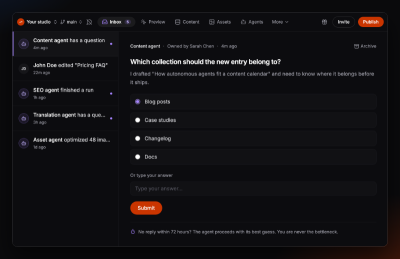
Instead, modern agentic systems must allow builders to compose their agents. Rather than choosing from a static menu of pre-packaged behaviors, teams can construct specialized agents with precise operational boundaries:
- The Accessibility Agent: Given high autonomy to continuously monitor and patch DOM accessibility regressions without human intervention.
- The Content Agent: Kept on a tight leash, requiring mandatory human sign-off for any customer-facing copy changes that impact brand voice.
- The Asset Agent: Granted medium autonomy to compress oversized images, generate WebP variants, and update source tags automatically.
Crucially, trust in these systems is earned dynamically over time. As agents log their runs, display transparent before-and-after change diffs, and accurately execute low-level tasks, the friction of delegation dissolves. The boundary line between human and machine is not a static configuration set on day one; it is a living threshold that shifts outward as the AI demonstrates competence.
Future Outlook: The Self-Healing Digital Enterprise
As we look toward the remainder of the decade, the concept of the "frozen website" will likely be viewed as an archaic relic of early web development.
The traditional web development cycle—comprising a massive upfront investment, a dazzling launch day, a multi-year plateau of slow decay, and an eventual expensive redesign—is economically inefficient. Enterprises hemorrhage millions of dollars in unrealized conversions, SEO decay, and compliance violations simply because human teams are too overburdened with firefighting to keep static assets dynamically aligned with market realities.
The emergence of agent-driven web architecture points toward a self-healing future:
- Autonomous SEO Adaptation: Agents will analyze real-time search engine algorithm fluctuations and instantly adjust semantic HTML markup to preserve organic visibility.
- Dynamic Localization: Translation agents will not only translate text strings but culturally contextualize layouts and imagery based on regional user behavior patterns.
- Continuous Compliance Auditing: Legal and regulatory compliance updates (such as evolving privacy disclosures or accessibility mandates) will propagate automatically across thousands of enterprise pages within seconds of enactment.
Ultimately, the future of the web is not about replacing human creativity with robotic efficiency. It is about liberating human talent from the soul-crushing drag of digital maintenance. By delegating the rule-bound chores to autonomous agents, digital creators can finally reclaim their most valuable asset: the time and mental bandwidth to focus purely on what is novel, imaginative, and profoundly human.
