

Executive Overview
The landscape of user experience (UX) design has shifted tectonic plates. What began as a subtle industry fascination with generative artificial intelligence has morphed into an aggressive market redefinition of the digital creator’s role. Long gone are the days when a UX designer’s primary deliverable was a high-fidelity Figma prototype accompanied by user journey maps and rigorous accessibility audits. Today, the modern job description demands something entirely unprecedented: AI-augmented development, technical orchestration, and production-ready code.
As we navigate through 2026, the age-old, cyclical debate of “Should designers code?” has been violently settled not by industry consensus or pedagogical evolution, but by the sheer, unyielding force of market mandates. Recruiters are no longer just looking for empathy, information architecture, and cognitive load management. They are searching for the mythical “Solo Full-Stack Designer”—an individual expected to conjure both the visual “vibe” and the underlying React components simultaneously, bridging technical chasms via AI prompting agents.
However, beneath the shiny veneer of unprecedented productivity lies a dangerous corporate delusion. Businesses are increasingly prioritizing the speed of output over the quality of the experience, inadvertently trapping designers in an “average competence” dilemma. When a visual designer is forced to act as an impromptu software engineer, the result is rarely mastery. Instead, it breeds a tidal wave of technical and structural debt, draining engineering resources, violating accessibility standards, and ultimately failing the human on the other side of the screen. This deep-dive investigation explores what is gained, what is drastically lost, and why UX designers must refuse to become mere prompt operators, remaining instead the ultimate guardians of the user experience.
Detailed Chronology: The Evolution of the "Design-Engineer" Mandate
To understand how the UX industry arrived at this precipice, we must examine the rapid convergence of design tooling and software engineering over the past several years.
The Pre-AI Era: The Great Divide
For decades, the boundaries between design and engineering were distinct, if not heavily guarded. Designers conceptualized the product using tools like Sketch, Adobe XD, and early iterations of Figma, focusing exclusively on visual hierarchy, typography, and human-computer interaction (HCI) principles. Engineers then took these static deliverables, painstakingly translating pixels into production code using HTML, CSS, JavaScript, and various backend frameworks. While design systems helped bridge the gap, a clear line remained: designers understood humans; engineers understood machines.
The Rise of Generative Prototyping (2023–2024)
As early generative AI models entered the mainstream, design tools began integrating features that allowed users to generate layouts and copy via text prompts. Initially, these features were framed as creative assistants—helpers designed to lift the administrative burden of wireframing, allowing creators to focus on higher-level problem solving. However, as large language models (LLMs) matured in their ability to write functional syntax, software companies began pushing the envelope. Tools emerged promising seamless transitions from canvas to code, suggesting that the distance between a design file and a production repository could be bridged with a single click.
The Market Shock of 2025–2026: Role Creep and the LinkedIn Pressure Cooker
By early 2026, the macroeconomic landscape and the proliferation of AI integration platforms created a profound shift in hiring practices. Companies realized that AI tools could theoretically compress two roles into one. Consequently, job postings on platforms like LinkedIn underwent a radical mutation.
UX roles began explicitly demanding production-ready prototyping, code generation, and repository management. The expectation shifted from designing for development to delivering the development. Designers found themselves trapped in a competency trap, where their value was no longer measured by how well they solved user pain points, but by how fast they could push a functional component to a GitHub branch—regardless of whether they understood the underlying system architecture.
Supporting Context & Metrics: The Reality Behind the Hype
The statistical realities of the current job market paint a complex, dual-natured picture of the design profession. According to industry outlook data, while traditional graphic design roles face a sluggish growth projection of roughly 3% through 2034, UX, UI, and product design roles are projected to surge by an impressive 16% over the same period.
However, this growth comes with a heavy asterisk. "Design skills" have surged to become the most in-demand capability in AI product development, outranking traditional cloud infrastructure and raw coding capabilities in certain sectors. Yet, this high demand masks a fundamental friction point between executive expectations and technical reality.

| Metric / Finding | Data Point | Source / Context |
|---|---|---|
| Product Design Growth | 16% projected growth (2024–2034) | Bureau of Labor Statistics / Design Outlook |
| AI Collaboration | 73% of designers view AI as a primary collaborator | Industry UX Trends Survey |
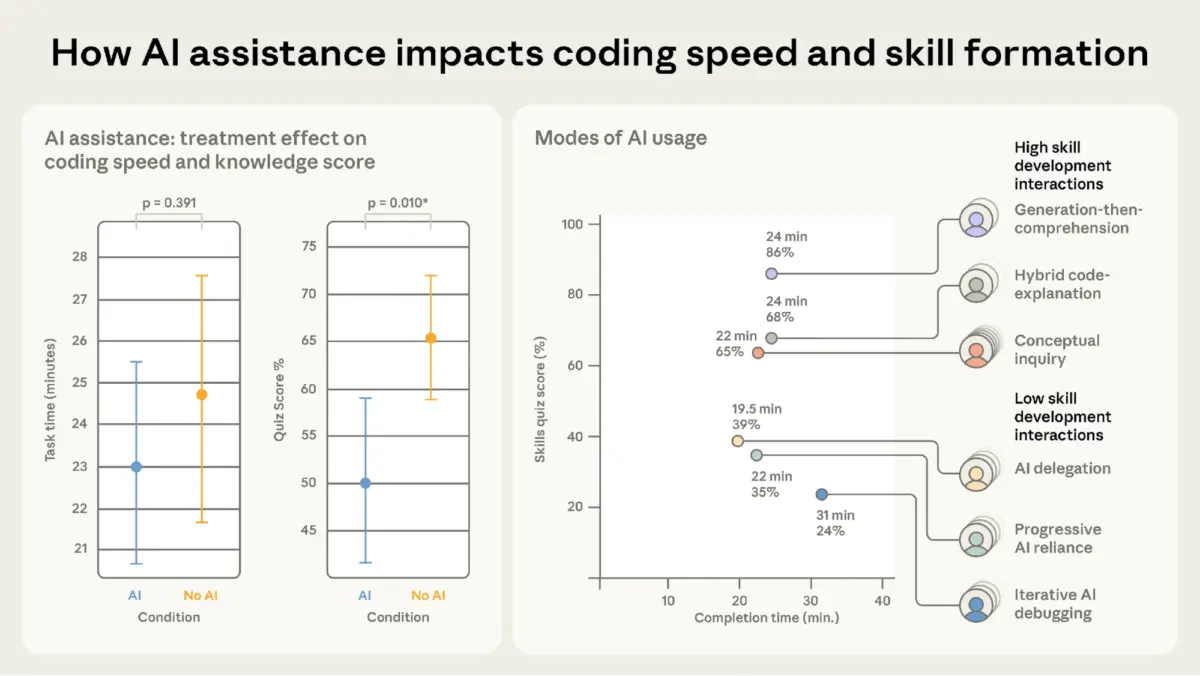
| The Coding Speed Fallacy | AI tools accelerate initial syntax generation but impede deep skill formation | Anthropic Research on AI-Assisted Coding |
| Quality Debt Accumulation | Significant rise in unoptimized code, security vulnerabilities, and accessibility gaps | Software Development Quality Reports |
The "Averagely Competent" Dilemma
The core danger of the modern design-engineer mandate lies in what can be described as the "Averagely Competent" dilemma. Expecting a senior UX designer—someone who has spent years mastering ethnographic research, interaction design patterns, and cognitive psychology—to simultaneously operate as a senior-level software engineer is akin to asking a master culinary chef to also run the commercial plumbing because "they both work in the kitchen."
While an AI agent can help the chef turn on the faucet, it does not teach them how to fix a burst pipe when the water pressure spikes under heavy load. When a designer ships an AI-generated component that fails during a high-traffic event and they lack the foundational computer science knowledge to manually trace and debug the logic, they are no longer an asset. They have become an operational liability.
The High Cost of Unoptimized Code and the "Rework Tax"
The promise sold by AI tool vendors is that designers can bypass engineers entirely, shipping features at lightning speed. In practice, this has birthed the "Rework Tax"—an invisible drain on engineering resources across the tech sector.
When a designer hands off AI-generated code that ignores internal corporate naming conventions, state-management patterns, or security protocols, they aren’t saving time. They are creating a puzzle that an actual software engineer must painstakingly deconstruct and rebuild. Common issues in designer-generated AI code include:
- Accessibility Failures: Missing ARIA labels, unoptimized tab orders, and broken screen-reader navigation.
- Bloated Architecture: Excessive, redundant CSS and JavaScript libraries pulled in by hallucinating LLM prompts.
- Security Blind Spots: Unsanitized user inputs and insecure data handling baked directly into front-end components.
- Design System Drift: Components that look correct on the surface but break core token structures, fragmenting the brand’s digital ecosystem.
Official Industry Perspectives and Expert Insights
As the tech sector grapples with the fallout of the full-stack designer experiment, voices from both the design and engineering communities are calling for a rational recalibration of expectations.

"Businesses are beginning to value the speed of output over the quality of the experience, fundamentally changing what it means to be a ‘successful’ designer in today’s landscape."
— Carrie Webster, UX Industry Analyst
Engineering leaders have also voiced growing frustration regarding the influx of unvetted, AI-generated code entering production pipelines. While AI is exceptionally powerful at generating syntax, it lacks intent, contextual awareness, and empathetic judgment.
Industry veterans argue that the obsession with the "Solo Full-Stack Designer" is a transient corporate phase driven by infatuation with automation rather than long-term product sustainability. Companies that continue to sideline engineering oversight in favor of rapid, designer-shipped code will inevitably face a severe reckoning characterized by technical debt, compliance failures, and costly accessibility lawsuits.
Future Outlook: Reclaiming the Human Center
The UX designer’s nightmare will only end when the industry stops trying to compete with AI tools at what they do best—generating raw syntax—and pivots back toward what AI can never replicate: deep empathy and the navigation of human complexity.
The path forward does not lie in the extinction of the UX designer, nor does it require every designer to moonlight as a full-stack software engineer. Instead, the future points toward a symbiotic model of true designer-engineer collaboration:

- AI as an Ideation Partner: Utilizing generative AI to rapidly prototype multiple conceptual directions, test copy variations, and map out initial wireframes during the discovery phase.
- Clear Boundary Maintenance: Allowing designers to focus on user advocacy, interaction design, information architecture, and accessibility testing, while leaving production code optimization and system architecture in the hands of specialized engineers.
- Design-to-Code Translation Guardrails: Establishing organizational protocols where AI-generated prototypes serve strictly as high-fidelity interactive specifications rather than direct-to-production deployment code.
Summary Checklist for Forward-Thinking UX Designers
- [ ] Refuse the "Prompt Operator" Trap: Maintain your focus on human-centric problem solving rather than merely churning out syntax.
- [ ] Partner with Engineering: Use AI tools to communicate intent and user flows more clearly to your engineering counterparts, rather than attempting to bypass them.
- [ ] Audit for Accessibility: Never assume an AI-generated UI component meets WCAG standards; rigorously test for inclusivity.
- [ ] Champion Quality Over Velocity: Push back against unrealistic corporate timelines that sacrifice user experience and system stability for raw speed.
Ultimately, the true value of a UX designer has never resided in their ability to write a CSS Flexbox rule or manage a Git branch. It lies in their unyielding capacity to advocate for the human being sitting on the other side of the screen. By embracing AI as an augmentative cognitive tool while fiercely protecting our specialized craft, we can move past the mirage of the full-stack designer and secure a more sustainable, impactful future for the entire digital ecosystem.