

Executive Overview
The prevailing narrative across the tech sector suggests a universal, insatiable public appetite for artificial intelligence. Corporate boardrooms, venture capital firms, and enterprise software giants operate on the silent, foundational assumption that consumers and employees are eagerly waiting for every process, product, and workflow to be infused with generative AI. We are told that users crave AI-driven assistants, automated art generators, synthetic narratives, and autonomous digital agents that magically erase the friction of modern existence.
Yet, a stark reality check is underway. Across industries, high-profile AI features are experiencing low adoption rates, disappointing retention metrics, and mounting user resistance. Far from sparking joy or boosting productivity, uninvited AI integrations frequently demand high delivery costs, introduce unpredictable operational risks, and damage brand reputations.
The core issue is not a lack of technological capability, but a profound misapprehension of value. AI is not a value proposition in its own right; it is merely a tool. When companies treat "powered by AI" as a substitute for solving actual user problems, they amplify existing organizational shortcomings—such as poor data hygiene, technical debt, and disjointed communication channels—and hand those friction points directly to the user.
Ultimately, people do not want more AI for its own sake. They do not dream of algorithmic art museums, synthetic relationships, or endless chatbot interfaces. What they desire—and what the market is failing to deliver—is an "AI-second" approach: humble, ambient technology that quietly absorbs tedious, soul-squeezing labor, leaving humans free to focus on authentic, creative, and interpersonal endeavors.
Detailed Chronology: The Escalation of Forced AI Adoption
To understand how the tech industry arrived at this precipice of user fatigue and skepticism, it is helpful to trace the rapid escalation of the AI boom over recent years:
Phase 1: The Gold Rush of Generative Capabilities (2022–2023)
Following the public debut of advanced large language models and generative media tools, enterprise software developers rushed to embed AI features into legacy products. The prevailing philosophy was "move fast and break workflows." Features were slapped onto existing software ecosystems as standalone sidebars or chat boxes, driven by the fear of missing out (FOMO) rather than user-centric design principles.
Phase 2: The Proliferation of Disconnected Systems (2024)
As organizations integrated these disparate AI tools, workplace fragmentation accelerated. Rather than streamlining operations, companies inadvertently created a new layer of digital overhead. Employees found themselves hopping on and off multiple disconnected platforms, forced to manage yet another system that demanded constant attention. The cost of verifying AI hallucinations and editing synthetic drafts began to eclipse the time saved by initial generation.
Phase 3: The Productivity Paradox and Worker Backlash (2025–2026)
Comprehensive workplace productivity studies began painting a grim picture of AI integration. Far from reducing working hours, enterprise AI tools correlated with an explosion in digital noise. Email volumes, messaging frequency, and weekend work hours spiked, while deep-focus time plummeted. Workers reported rising anxiety over job security, viewing uninvited AI rollouts not as productivity enablers, but as threats to their professional agency and craft.

Supporting Context & Metrics: The Human and Economic Cost
The friction between corporate AI ambitions and human preferences is starkly illustrated by emerging empirical data and enterprise studies.
The Productivity Illusion
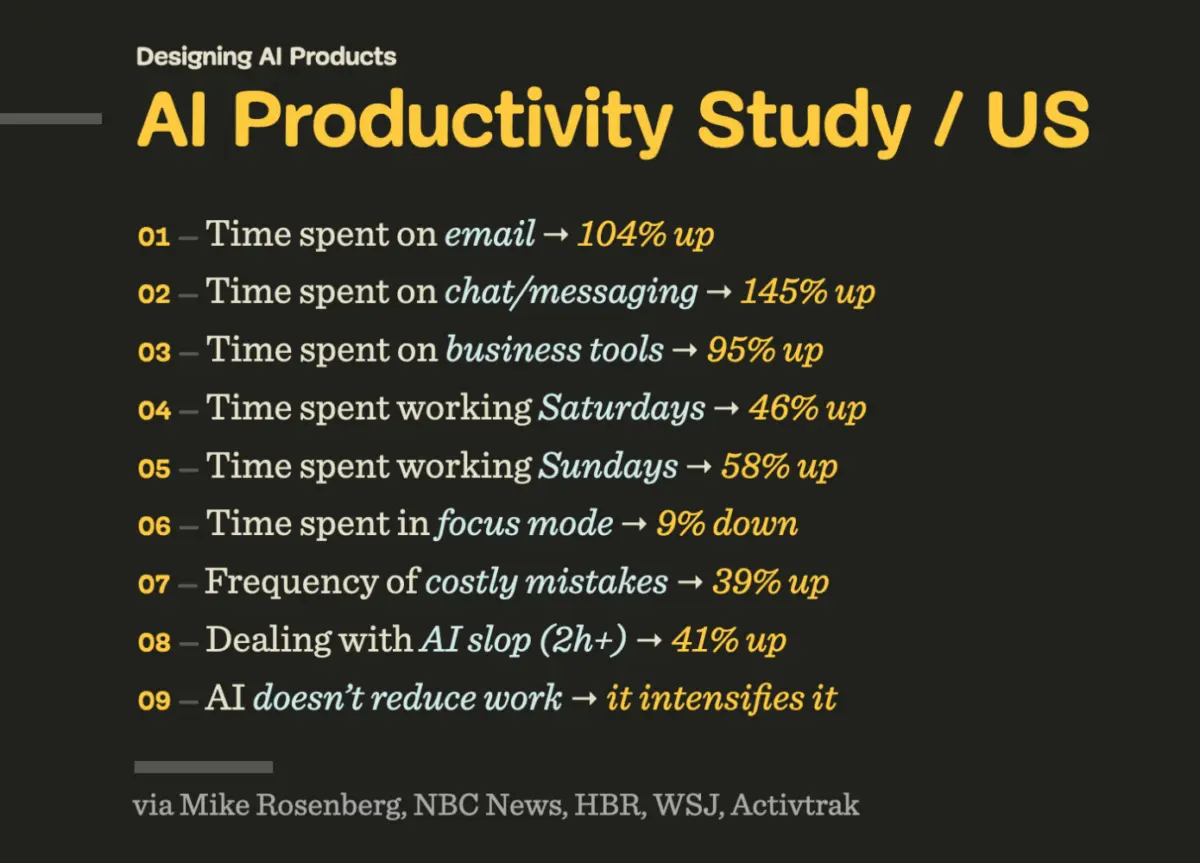
Recent workplace productivity audits from organizations tracking enterprise software usage reveal an alarming paradox. Rather than lightening the cognitive load, the aggressive deployment of generative AI has intensified workloads across multiple vectors:
- Digital Communication Surges: Email handling times and internal messaging frequencies have risen dramatically following AI tool adoption.
- Extended Workweeks: Weekend labor—particularly on Saturdays and Sundays—has increased as employees struggle to catch up on administrative overhead.
- Erosion of Focus: Deep-focus time has declined, displaced by the endless task of managing, prompting, and cleaning up after automated systems.
- The "AI Slop" Tax: Employees report spending a significant percentage of their day reviewing, correcting, and filtering out low-quality, AI-generated content (often referred to as "AI slop").
+-----------------------------------------------------------------+
|              THE AI PRODUCTIVITY PARADOX METRICS                |
+-----------------------------------------------------------------+
|  Email Volume / Time Spent         :  +104%                     |
|  Chat & Messaging Tool Usage       :  +145%                     |
|  Business Tool Fragmentation       :  +95%                      |
|  Weekend Work (Saturdays/Sundays)  :  +46% to +58%              |
|  Decrease in Deep Focus Mode       :  -9%                       |
|  Increase in Costly Errors         :  +39%                      |
|  Time Spent Managing AI "Slop"     :  +41%                      |
+-----------------------------------------------------------------+
AI as an Amplifier of Organizational Dysfunction
A recurring fallacy in digital transformation is the belief that introducing an advanced model can fix systemic rot. AI cannot magically resolve years of accumulated technical debt, broken corporate cultures, or conflicting internal politics. Instead, it acts as an amplifier. If an organization suffers from poor data quality or ambiguous decision-making hierarchies, an AI tool will simply process those inconsistencies faster, generating conflicting outputs that land squarely on the user’s desk to untangle.
Furthermore, software interactions are comparative. Users do not evaluate AI tools by comparing them against the unreliable nature of human error; they compare them against other software features. If a traditional interface functions predictably every single time, and an AI-driven feature hallucinates or produces erratic results, users will predictably reject the unpredictable option. Reliability remains the ultimate currency of user experience.

Official Statements and Industry Insights
Thought leaders across UX design, enterprise strategy, and technology ethics are increasingly sounding the alarm about the misalignment between AI supply and human demand.
"I don’t want to read books written by AI. I don’t want to gaze upon paintings by AI. I don’t want AI to teach my children. I don’t want to have an AI therapist. I don’t want AI making my medical decisions. I want AI to do all the physical and mental labor that taxes me so I can read books written by humans and go to art galleries to engage with art made by humans. I want AI that makes my life easier rather than forces me to change myself."
— Bo Young Lee, Corporate Strategist and Speaker
This sentiment underscores a vital psychological boundary: people cherish human endeavor, culture, and connection. When technology attempts to automate the soul of human expression—art, therapy, parenting, storytelling—it triggers profound resistance.

Product designers and UX veterans echo these concerns. Vitaly Friedman, creator of specialized design pattern courses for digital interfaces, notes that artificial intelligence must find its proper home in the business architecture:
"AI goes in Key Activities and Key Resources—not in Value Propositions. New AI features don’t magically make for happy or excited customers when they are bolted onto workflows as separate, disruptive tools."
Rather than demanding that users completely overhaul their mental models to accommodate a conversational chat box or an autonomous agent, successful technology must respect human habits built over decades.
Future Outlook: The Rise of "AI-Second" Design
As the initial hype cycle matures into sober retrospection, the path forward for product development requires a fundamental philosophical pivot: moving from AI-first to AI-second design.

1. Relegating AI to the Background
The most successful enterprise and consumer tools of the future will not market themselves aggressively as "AI-powered." Instead, they will be subtle, humble, calm, and ambient. Like spellcheck or automatic image compression in past decades, the underlying intelligence will operate quietly in the background, performing heavy computational lifting without demanding constant dialogue, prompt engineering, or error-checking from the user.
2. Augmentation Over Replacement
The goal of automation should never be the eradication of human agency, but the elimination of drudgery. Many professions exposed to automation possess deeply rewarding, creative dimensions that require intuition, taste, and lived experience. By offloading monotonous, mentally exhausting administrative tasks—data sorting, routine formatting, baseline compilation—AI can protect and expand the time humans spend on creative and interpersonal problem-solving.
3. Prioritizing Predictability and Joy
Ultimately, human desires have not fundamentally changed. People want tools that are fast, accessible, reliable, predictable, and useful every single time they use them. They want to enjoy their work and savor the feeling of genuine achievement, rather than rushing through a fragmented landscape of vibe-coded changes and unreliable outputs.
The companies that thrive in the next era of technology will not be those that force the most artificial intelligence into every corner of human life. They will be the ones disciplined enough to use intelligence sparingly, purposefully, and respectfully—automating the boring stuff so that humans can get back to being human.