

Executive Overview
In the rapidly accelerating landscape of artificial intelligence and digital content creation, few brand resurrections are as unexpected—or as strategically timed—as the modern evolution of LimeWire. Once notorious as a peer-to-peer (P2P) file-sharing titan that defined the wild west of early-2000s internet culture, LimeWire has officially shed its controversial legacy. Today, it has re-emerged as a cutting-edge, decentralized generative AI publishing platform and creator economy ecosystem.
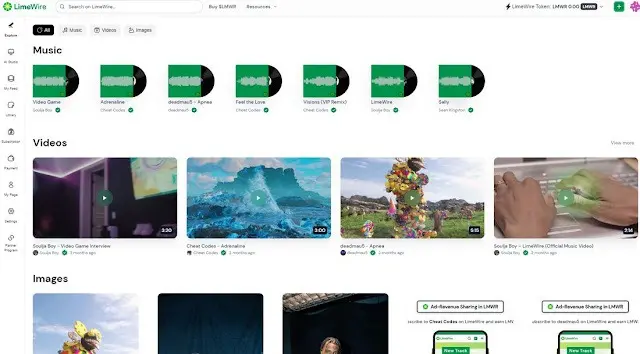
By merging state-of-the-art machine learning models with blockchain technology, LimeWire has constructed a multifaceted hub where digital artists, musicians, designers, and everyday enthusiasts can generate, publish, monetize, and trade AI-generated assets. Prominent public figures and artists—ranging from electronic music pioneer Deadmau5 to hip-hop icons Soulja Boy and Sean Kingston—have already gravitated toward the platform to release exclusive NFT music, videos, and visual artworks.
This comprehensive investigative report explores the technological architecture, economic models, and strategic ambitions driving LimeWire’s current incarnation. We examine its advanced AI image generation toolsets, its automated Non-Fungible Token (NFT) minting mechanics, its native token economy powered by LMWR, and its tiered subscription structures designed to democratize high-end creative production.
Detailed Chronology and Platform Evolution
The P2P Era and the Long Silence
To understand the significance of LimeWire’s current platform, one must contextualize its origins. Launched in 2000 as a free P2P file-sharing client built on the Gnutella network, LimeWire quickly became a cultural phenomenon. At its peak, it was installed on millions of computers globally, serving as the primary gateway for users to trade music, software, and movies. However, the platform became the epicenter of intense legal battles regarding copyright infringement. In 2010, a federal court injunction forced LimeWire to permanently shut down its file-sharing operations, rendering the brand dormant for over a decade.
The Web3 and AI Pivot
The modern chapter of LimeWire began with a strategic acquisition by Austrian entrepreneurs Julian and Paul Zehetmayr. Recognizing the massive paradigm shifts occurring simultaneously in generative artificial intelligence and decentralized Web3 technologies, the leadership team envisioned a platform that could solve a modern dilemma: how digital creators can sustainably produce, protect, and monetize AI-generated content.
Rather than remaining a generic prompt-to-image generator, LimeWire was engineered from the ground up as a studio and social publishing network. Creators do not merely generate images and discard them; they build profiles, amass followers, publish digital portfolios, and establish direct economic relationships with their audiences. The integration of blockchain protocols transformed every published piece of art into an authentic, tradeable digital asset, bridging the gap between automated creation and digital property rights.
Technological Architecture: AI Studio and Multimodel Integration
At the heart of the modern ecosystem is the LimeWire AI Studio, a browser-based interface designed to lower the technical barrier to entry for digital art creation while offering deep customization options for professional designers.
Supporting Advanced Generative Models
LimeWire does not rely on a single proprietary engine. Instead, it aggregates some of the industry’s most powerful open-source and commercial generative models, giving users the flexibility to switch between distinct rendering engines seamlessly. The platform currently supports:
- Stable Diffusion 2.1: Renowned for its photorealistic output and robust handling of complex text prompts.
- Stable Diffusion XL (SDXL): A high-parameter model capable of producing hyper-detailed textures, improved composition, and vivid color profiles.
- DALL-E 2: OpenAI’s influential image generator, integrated to provide distinct artistic interpretations and rapid prototyping capabilities.
Furthermore, LimeWire’s engineering team is actively developing a proprietary AI model. This upcoming native engine signals the platform’s transition from an aggregator of third-party models to a primary innovator in generative art technology.
Granular Customization and Styles
The user experience caters to both novices and seasoned prompt engineers. Users can initiate a creation with a simple, conversational text prompt or fine-tune their outputs using advanced parameters. LimeWire distinguishes itself by allowing creators to toggle across various design styles effortlessly, including:
- Cinematic: Emulating dramatic lighting, depth of field, and high-budget film aesthetics.
- Digital Art & Pixel Art: Tailored for graphic designers, game developers, and retro art enthusiasts.
- Anime: Capturing distinct Japanese animation linework and color grading.
- Analog Film: Mimicking the grain, warmth, and imperfection of vintage 35mm photography.
Additional features such as samplers, prompt guidance sliders, and negative prompts allow creators to isolate specific elements, suppress unwanted artifacts, and achieve pinpoint precision in their final renders.
Supporting Context, Blockchain Integration, and Monetization Metrics
LimeWire’s economic framework is designed to address one of the most pressing criticisms of the modern creator economy: the lack of fair compensation for independent artists. By fusing AI generation with blockchain infrastructure and ad-revenue sharing, LimeWire has built a robust financial ecosystem.
Automated NFT Minting
Once a creator finalizes an image, music track, or video clip within the LimeWire Studio, they are met with a streamlined publishing workflow. Upon hitting publish, the platform automatically mints the creation as a Non-Fungible Token (NFT) on either the Polygon or Algorand blockchain.
This automated process requires zero technical knowledge of smart contracts or gas fee optimization on the part of the creator. The resulting NFT provides an immutable digital signature, ensuring cryptographic proof of authenticity and verified ownership. Creators retain absolute control over how these minted assets are distributed:
- Public Release: Content is indexed globally across the LimeWire community, discoverable by any user, and open to public trading.
- Subscriber-Only Exclusivity: Creators can lock specific posts behind a paywall, making them accessible exclusively to paying subscribers, thereby fostering an intimate, VIP community experience.
The Royalty and Trading Economy
When a creator’s NFT is traded on the secondary market within the LimeWire ecosystem, a 2.5% creator royalty is automatically routed back to the original artist. This establishes a continuous passive income stream that scales proportionally with the creator’s popularity and secondary market activity.
Ad Revenue Sharing Model
Beyond NFTs and subscriptions, LimeWire introduces a groundbreaking ad-revenue sharing model. When users browse, view, and interact with content on the platform, ad impressions generate revenue. LimeWire distributes a significant portion of this ad revenue directly back to the creators:
- 50% to 70% Revenue Share: Depending on the creator’s subscription tier, they receive between 50% and 70% of all ad revenue generated by views on their images, music, and videos.
The LMWR Token Economy
All earnings distributed by the platform are paid out in LMWR tokens, LimeWire’s native utility cryptocurrency.
- Liquidity and Exchange: LMWR tokens are fully liquid and can be traded on major centralized and decentralized cryptocurrency exchanges, including Kraken, Bybit, and Uniswap.
- Platform Utility: Beyond cashing out earnings, users can utilize LMWR tokens to purchase additional generation credits, pay for premium prompts, and access advanced platform features.
Official Statements and Platform Roadmap
Leadership at LimeWire has consistently emphasized that the platform is not merely riding the AI wave, but actively shaping the infrastructure of the decentralized creator economy. Julian Zehetmayr, co-CEO of LimeWire, has repeatedly highlighted the democratization of art as the company’s core mission.
"We are building an ecosystem where the line between creator and consumer is fluid," platform representatives have noted in development briefs. "By removing the technical barriers of AI generation and combining it with instant Web3 monetization, we are empowering a new generation of digital artists to make a living doing what they love."
The Near-Future Roadmap: AI Music and Video Generation
While LimeWire’s current utility is heavily anchored in AI image generation, the platform’s public roadmap outlines an aggressive expansion into multi-modal content creation.
- AI Music Generation: Upcoming tools will allow musicians and hobbyists to generate original audio tracks, instrumentals, and vocal layers using text prompts, catering directly to the needs of producers and content creators.
- AI Video Generation: As foundational video models mature, LimeWire plans to integrate cinematic video-generation toolsets, enabling creators to produce short-form video content, animations, and visual loops natively within the Studio.
Pricing Plans and Membership Tiers
To accommodate users ranging from casual hobbyists to high-volume commercial designers, LimeWire operates on a freemium subscription model. Each tier scales in generation credits, rendering speed, ad revenue percentages, and exclusive perks.
| Plan Tier | Monthly Cost | Monthly Credits | Est. Image Generations | Ad Revenue Share | Pro Badge & Perks |
|---|---|---|---|---|---|
| Free Tier | $0 | 10 credits | Up to 20 images/day | 50% | Basic access |
| Basic Plan | $9.99 | 1,000 credits | Up to 2,000 images | 50% | Pro badge, fast generation, ad-free |
| Plus Plan | $29.00 | 3,750 credits | Up to 7,500 images | 60% | Pro badge, fast generation, ad-free |
| Pro Plan | $49.00 | 5,000 credits | Up to 10,000 images | 70% | Pro badge, fast generation, ad-free |
| Advanced Plan | $99.00 | 11,250 credits | Up to 22,500 images | 70% | Pro badge, fast generation, ad-free |
All paid tiers include early access to newly integrated AI models, complete creation histories, prioritized rendering queues, and an ad-free browsing experience.
Future Outlook
LimeWire’s transformation from an infamous P2P file-sharing protocol into a sophisticated, Web3-enabled AI content studio stands as one of the most fascinating corporate pivots in digital history. By addressing the critical needs of modern creators—accessibility, copyright protection, automated monetization, and multi-stream revenue—LimeWire has carved out a unique defensible niche in a crowded generative AI market.
As the platform prepares to roll out its native proprietary AI model alongside long-awaited music and video generation tools, the stakes are high. If LimeWire successfully executes its multi-modal vision while maintaining a frictionless user experience, it may well establish the blueprint for how creative economies operate in an AI-driven, decentralized future. For digital artists, designers, and enthusiasts, the platform offers an inviting, feature-rich sandbox to experiment, publish, and monetize their artistic vision.
