

Executive Overview
In the relentless quest to decode the origins of planetary systems across the Milky Way, astronomers have struck a profound goldmine of cosmic data. Comet 3I/ATLAS—only the third confirmed interstellar object ever detected journeying through our solar system, following the landmark discoveries of 1I/’Oumuamua and 2I/Borisov—is continuing to upend conventional astrophysical models.
Recent, highly sensitive observations secured by the Atacama Large Millimeter/submillimeter Array (ALMA), a premier astronomical facility in which the U.S. National Science Foundation National Radio Astronomy Observatory (NSF NRAO) serves as a key international partner, have revealed that this wanderer from deep space possesses an astonishingly high concentration of methanol.
The implications of this discovery stretch far beyond the behavior of a single icy vagabond. By analyzing the molecular fingerprint of 3I/ATLAS, scientists are essentially holding a pristine chemical time capsule forged in a distant, alien star system. The comet’s volatile inventory—specifically a methanol abundance that towers over nearly all known comets native to our own solar system—provides a rare, unprecedented window into the birth environments of planets and planetesimals light-years away.
This comprehensive report details the chronological unfolding of the ALMA observations, analyzes the profound chemical metrics that set 3I/ATLAS apart from local cometary bodies, incorporates official statements from leading researchers, and evaluates what this cosmic anomaly means for the future of interstellar astronomy.
Detailed Chronology: Tracking the Interstellar Visitor
The unfolding story of Comet 3I/ATLAS is a masterclass in modern, multi-facility astronomical coordination. From its initial detection to the latest high-resolution submillimeter mapping, the investigation of this interstellar traveler has moved at a rapid pace, driven by the urgency of catching the object before it swings past the inner solar system and returns to the interstellar void.
The Inbound Journey and Early Discoveries
Long before ALMA locked its antennas onto the target, 3I/ATLAS captured the attention of the global astronomical community due to its hyperbolic trajectory, confirming its extrastolar origins. As the comet began its aggressive descent inward toward the warmth of our Sun, researchers mobilized a fleet of space- and ground-based telescopes.
Earlier in its inbound journey, observations conducted with the state-of-the-art James Webb Space Telescope (JWST) provided the first major clues regarding the comet’s volatile nature. JWST data indicated that the coma—the fuzzy, dynamic cloud of gas and dust surrounding the solid nucleus—was unusually dominated by carbon dioxide ($CO_2$) while the comet was still positioned at a considerable distance from the Sun. This early anomaly hinted that 3I/ATLAS did not play by the standard rules governing native Oort Cloud or Kuiper Belt comets.
Late 2025: Deploying the Power of ALMA
As 3I/ATLAS drew closer to the Sun in late 2025, solar heating intensified, stripping volatile ices from the solid nucleus and supercharging the expansion of the coma. This active outgassing phase presented the optimal scientific window for the Atacama Large Millimeter/submillimeter Array, specifically utilizing its Atacama Compact Array configuration situated high in the Chilean Andes.
The research team targeted 3I/ATLAS across several distinct observation dates in late 2025. By leveraging ALMA’s exceptional resolving power at submillimeter wavelengths, astronomers were able to pierce through the dense cloud of dust and gas to examine the rotational spectral signatures of specific molecules. The focus locked tightly onto two chemical tracers: methanol ($CH_3OH$), a complex organic alcohol, and hydrogen cyanide ($HCN$), a nitrogen-bearing organic compound ubiquitous in cometary research.
Rather than confirming a standard chemical profile, the ALMA data revealed a dramatic spike in methanol production, setting off intensive cross-checks and collaborative data analyses across international institutions.
Supporting Context & Metrics: A Chemical Fingerprint from Afar
To fully grasp why the measurements of Comet 3I/ATLAS have sent shockwaves through the planetary science community, one must examine the specific quantitative metrics gathered by ALMA and contrast them against the baseline chemistry of our own solar system.
Decoding the Molecular Signatures
Comets are essentially deep-freeze preservation units. Composed of primordial dust, rock, and frozen gases left over from the formation epoch of a planetary system, they experience minimal thermal alteration over billions of years—that is, until they venture close enough to a star for solar radiation to sublimate their ices.
When this happens, the escaping gas expands into the coma, where molecules absorb and emit specific frequencies of light in the millimeter and submillimeter spectrum. ALMA excels at detecting these faint rotational transitions.
By measuring the relative intensities of methanol and hydrogen cyanide signatures, the research team calculated the methanol-to-HCN ratios across multiple observation runs. The results were stark:
- Measured Ratios: On two separate observation dates, the methanol-to-HCN ratio in 3I/ATLAS was calculated at roughly 70 and 120.
- Solar System Comparison: For context, the vast majority of native comets in our solar system exhibit much lower ratios of methanol relative to hydrogen cyanide. A ratio exceeding 100 places 3I/ATLAS safely into an elite, highly anomalous tier of composition.
The Mechanics of Interstellar Outgassing
Beyond the raw abundance ratios, ALMA’s spatial resolution allowed scientists to track the origin points of these molecules within the coma, revealing a fascinating physical process.
In typical solar system comets, molecules like hydrogen cyanide originate almost exclusively from the sublimation occurring directly at the solid central nucleus. The ALMA data confirmed that this holds true for hydrogen cyanide in 3I/ATLAS as well.
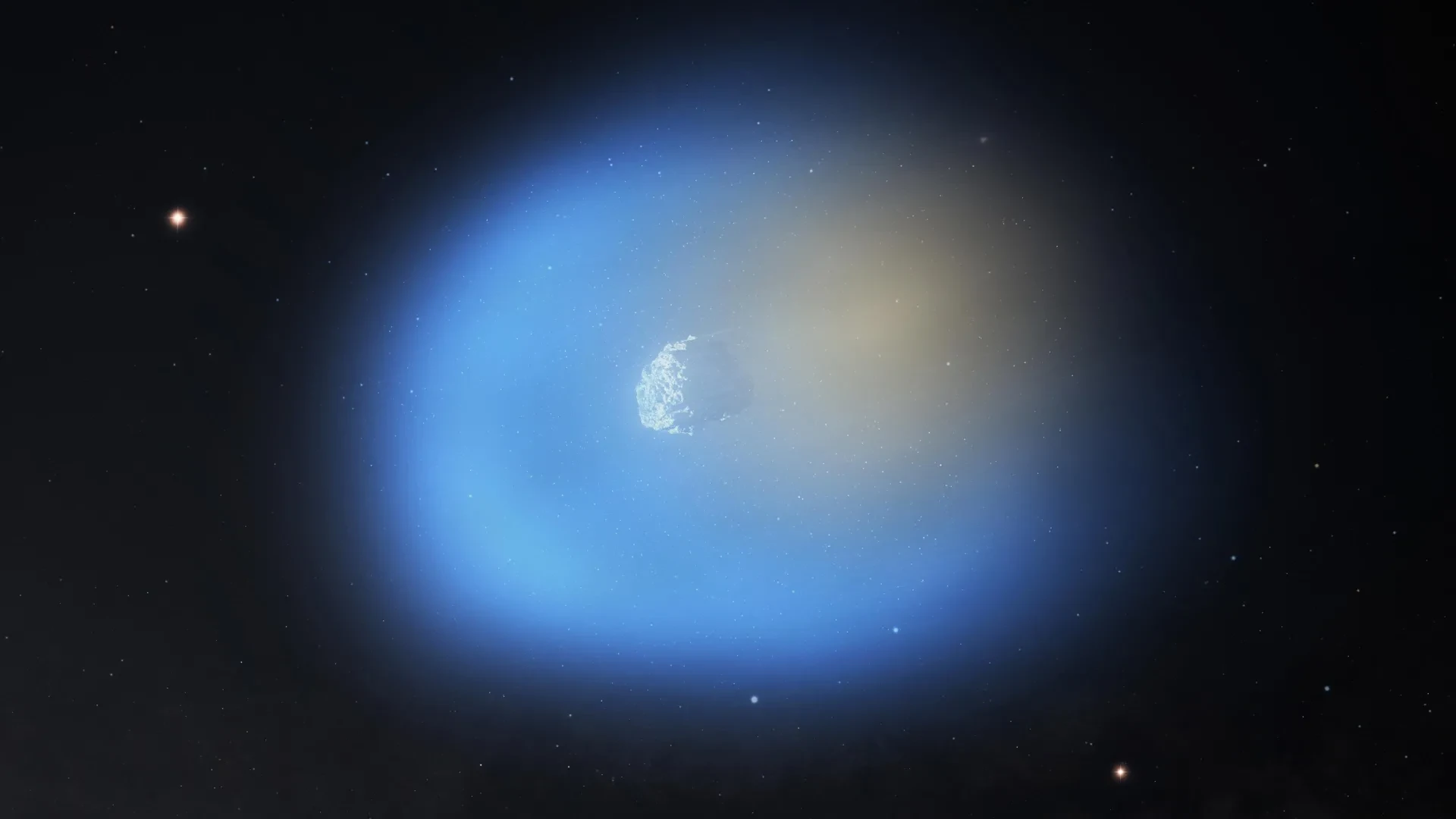
Methanol, however, told a radically different and more complex story. The spatial mapping demonstrated that methanol was emanating not just from the nucleus, but also distributed throughout the extended coma, pouring out of tiny, microscopic ice grains drifting away from the core.
As 3I/ATLAS approaches the Sun and experiences escalating thermal stress, these minute ice grains effectively function as an armada of "mini-comets." As they float through space, the ice within these individual grains warms, undergoes phase transition, and releases secondary bursts of methanol gas. While this phenomenon has been documented in a small handful of exceptional native solar system comets, 3I/ATLAS represents the first time scientists have been able to trace the intricate micro-physics of distributed outgassing in an object born around an entirely different star.
Official Statements and Expert Insights
The uniqueness of the findings has elicited strong reactions from the scientific leadership driving the research. The intersection of high-precision radio astronomy and interstellar dynamics has opened a new frontier in comparative planetology.
"Observing 3I/ATLAS is like taking a fingerprint from another solar system," shares Nathan Roth, lead author of the research and a professor at American University.
Explaining the weight of the discovery, Roth elaborated: "The details reveal what it’s made of, and it’s bursting with methanol in a way we just don’t usually see in comets in our own solar system. Every molecule we detect adds a brushstroke to a portrait of a planetary nursery that we may never be able to visit in person."
Astrophysicists emphasize that studying objects like 3I/ATLAS bypasses the immense technological and temporal barriers of interstellar travel. Instead of building a probe capable of journeying light-years to another star system, nature delivers the building blocks directly to our cosmic doorstep.
The convergence of JWST’s early carbon dioxide detections with ALMA’s late-stage methanol revelations paints a picture of a planetary system governed by chemistry vastly different from the primordial nebula that birthed Earth and its celestial neighbors. Whether this heavy enrichment of methanol points to specific cold-trap mechanisms in the parent protoplanetary disk, or highlights intense cosmic ray exposure in the interstellar medium over eons, remains an active subject of debate among theorists.
Future Outlook: The Expanding Horizon of Interstellar Science
The detection, tracking, and chemical dissection of Comet 3I/ATLAS marks a watershed moment, but it is by no means an isolated scientific milestone. To date, astronomy has officially confirmed only three interstellar interlopers:
- 1I/’Oumuamua (discovered in 2017), which lacked a traditional cometary coma entirely and exhibited puzzling non-gravitational acceleration.
- 2I/Borisov (discovered in 2019), an active comet whose carbon-chain chemistry showed subtle variations from native solar system comets.
- 3I/ATLAS, now cemented in literature for its staggering methanol abundance and distributed grain outgassing.
The Next Generation of Discovery
As astronomical survey capabilities undergo a revolutionary upgrade—spearheaded by upcoming facilities like the Vera C. Rubin Observatory with its Legacy Survey of Space and Time (LSST)—the rate of interstellar object detections is projected to climb dramatically. Where astronomers once waited years between anomalies, future automated sky sweeps are expected to identify numerous interstellar visitors per decade.
Each new interstellar visitor acts as an independent data point in a vast galactic census. By comparing the chemical fingerprints of 3I/ATLAS with future arrivals, scientists will soon be able to categorize interstellar bodies into distinct "families," mapping out the chemical diversity of the broader galaxy.
Broader Implications for Astrobiology
The presence of complex organic molecules like methanol and hydrogen cyanide in interstellar comets also holds profound implications for astrobiology. Comets are widely theorized to have delivered vital water and prebiotic organic molecules to the early Earth, kickstarting the chemical pathways that eventually led to life.
Knowing that distant star systems routinely manufacture and distribute complex organics—albeit in wildly different proportions than our local neighborhood—suggests that the chemical ingredients for life are ubiquitous across the cosmos, even if the specific recipes vary drastically from one stellar cradle to another.
As Comet 3I/ATLAS continues its fleeting transit through our inner solar system before vanishing back into the cold dark of interstellar space, the global astronomical community remains poised. Every square arcsecond of data captured by ALMA, JWST, and supporting ground stations ensures that this mysterious visitor will leave a permanent mark on our understanding of how worlds are built across the universe.