In the high-speed ecosystem of modern digital publishing, time is not merely money—it is the foundational currency of professional survival. For freelance writers, journalists, and content creators who rely on subject matter expert (SME) interviews to drive authoritative content, the transcription bottleneck has historically been a major point of friction. A standard 20-minute interview routinely generates upwards of 3,000 words of dynamic, unstructured dialogue. Historically, capturing these conversations accurately required frantic note-taking or tedious, multi-pass scrubbing of audio files—processes that routinely consumed an hour or more of post-interview labor for every 20 minutes of tape.
Enter AI-powered transcription software. Among the crowded field of digital assistants, Otter.ai has emerged as a cornerstone tool for independent writers since its widespread adoption around 2020. This comprehensive evaluation examines the utility, financial return on investment (ROI), operational limitations, and overall viability of Otter.ai’s Pro tier ($100/year) for professional freelance writers. Through the lens of veteran fintech writer and Location Rebel operator Liz Froment, this report investigates whether automated transcription can genuinely accelerate the modern writing workflow without compromising editorial integrity.
Detailed Chronology: The Evolution of the Interview Workflow
To truly understand the value proposition of modern AI transcription platforms, one must look at how the mechanics of interviewing and reporting have transformed over the last decade.
The Pre-AI Era: The Analog Bottleneck
Prior to the mainstreaming of real-time speech-to-text models, the typical lifecycle of an interview-based article looked like this:
The Live Conversation: The writer dials into a conference line or video call. Armed with a notepad, they attempt a delicate balancing act—listening actively to the SME while furiously scribbling quotes, or typing keystrokes that inevitably bleed into the audio recording. Divided attention frequently led to superficial follow-up questions and missed narrative angles.
The Audio Review: Post-call, the writer loaded the audio file into media player software, jumping back and forth five or six times to verify quotes, capture specific nomenclature, and map out the overarching structure of the piece.
Drafting: Only after securing a rough set of handwritten notes or a partial DIY transcript could the writer begin the outlining and drafting process.
The Rise of Automated Speech Recognition (ASR)
As neural networks and machine learning models matured around 2018–2020, platforms like Otter.ai introduced cloud-based automated speech recognition tailored for meetings, interviews, and lectures. For writers, this introduced a structural shift in how material was gathered:
Passive Capture: Conversations could be recorded cleanly via software integrations (with explicit participant consent), liberating the interviewer’s cognitive load entirely.
Immediate Indexing: Transcripts populated in real time or within moments of call termination, completely bypassing the multi-hour lag of manual review.
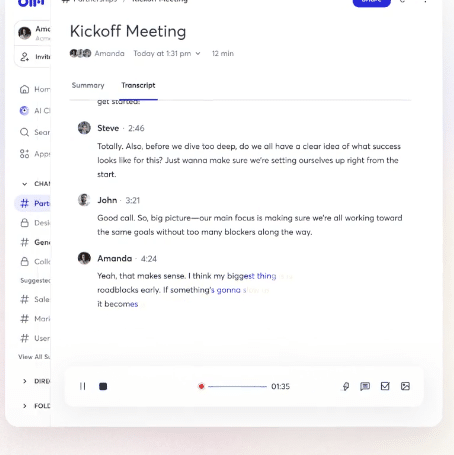
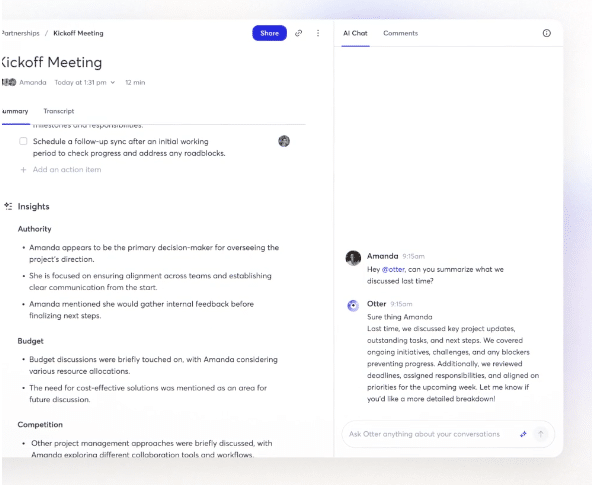
Searchable Repositories: Writers could query transcripts using keyword searches or AI-driven chat prompts to unearth specific insights, transforming raw audio into a searchable database of quotes and concepts.
Supporting Context & Metrics: The Economics of Time Savings
For independent contractors operating on tight project margins, tools must justify their subscription costs through measurable efficiency gains. Let’s examine the financial and temporal ROI of integrating Otter.ai into a standard freelance writing workflow.
The Time-Savings Calculus
Consider a standard assignment: producing a 1,000-word reported article featuring one SME interview, commanding a flat fee of $1,200.
Traditional Workflow Breakdown:
Research & Interview Preparation: 1 hour
Conducting the Interview & Manual Note-Compiling: 1 hour (plus 1 hour of post-call audio scrubbing)
Outlining, Drafting, and Revisions: 3 hours
Total Time Invested: 6 hours
Effective Hourly Rate: $200/hour
AI-Assisted Workflow (Using Otter.ai):
Research & Interview Preparation: 1 hour
Conducting the Interview (with background transcription): 1 hour
By shaving nearly an hour of tedious transcription and deep audio scrubbing off every assignment, writers unlock hidden capacity. For a professional completing three to four interview-based pieces per month, the time saved easily scales to three to five hours monthly—turning the $100 annual investment of Otter Pro into a self-funding asset within the very first month of deployment.
Feature Breakdown and Tier Analysis
Otter.ai structures its offerings across three primary tiers, each tailored to different volumes of communication:
Basic Plan (Free):
Provides 300 monthly transcription minutes with a strict 30-minute cap per individual recording.
Utility: Ideal for novices or those wishing to test out automated speech recognition before committing capital. It comfortably accommodates one or two short calls a month.
Pro Plan ($8.33/month billed annually, ~ $100/year):
The undisputed sweet spot for freelance writers. Offers expanded monthly limits and a 90-minute cap per recording session, easily accommodating lengthy SME deep-dives or industry webinars.
Business Plan ($19.99/month billed annually):
Geared toward agencies, large teams, and heavy enterprise users requiring advanced administration, centralized billing, and custom vocabulary management.
Operational Realities: Features, Friction Points, and Limitations
While the efficiency gains are undeniable, editorial professionals must navigate specific operational hurdles when relying on AI-generated transcripts.
Core Strengths That Drive Value
Cognitive Freedom During Interviews: Removing the physical or mental burden of transcription allows writers to be fully present. The conversation flows organically, enabling spontaneous follow-ups and deeper exploration of unexpected narrative threads.
AI Chat Search Functionality: Modern transcription tools feature conversational chatbots that allow users to query the transcript directly. If an expert rambles across tangents regarding "algorithmic bias" or "cross-border payment friction," a quick prompt surfaces the precise timestamp and context summary.
Linked Audio Playback: Clicking any line in the text interface triggers the corresponding audio playback. This feature is crucial for auditing questionable phrasing, verifying garbled terminology, and ensuring factual accuracy prior to publication.
Inherent Limitations and Friction Points
No technological solution is without its flaws. Writers deploying Otter.ai must remain vigilant regarding several constraints:
The Speaker Mode Catch: When using standard headphones during a call, automated tools often capture only the user’s voice through the microphone, failing to pick up the remote participant via internal routing unless configured through specific desktop speaker settings. This necessitates a quiet environment or a dedicated workspace where computer speakers can capture both sides of the dialogue.
Accuracy Variances: While promotional materials claim up to 95% accuracy, real-world conditions—such as accented speech, overlapping dialogue, background noise, and specialized industry jargon—typically land actual accuracy between 80% and 85%. Niche technical terms and proper nouns are frequently mangled. Consequently, responsible journalism demands that writers never copy-paste directly without verifying against the primary audio.
Speaker Diarization Inconsistencies: Multi-speaker recordings or conference calls can confuse the software’s diarization algorithms, resulting in misattributed dialogue or generic labels ("Speaker 1," "Speaker 2") that require manual correction.
Official Statements and Industry Perspective
To contextualize the broader adoption of AI tools within independent media, industry operators emphasize that technology should augment—not replace—human editorial oversight.
"Otter isn’t perfect. Accuracy requires verification; speaker identification can be wonky; and you need to pay attention to your setup. But it has saved me a mountain of time over five years of SME interviews and client work. For $100 a year—roughly the cost of one hour of billable work—it pays for itself almost immediately if you do any regular interviewing."
— Liz Froment, Full-Time Freelancer and Operations Lead at Location Rebel
Industry analysts note that while human transcription services (such as specialized agencies or human-in-the-loop freelancers) offer near-100% precision, their turnaround times of three to five business days are fundamentally incompatible with the rapid-fire turnaround schedules demanded by modern digital media outlets. When a writer has a strict one-week deadline to source an expert, conduct an interview, complete background research, and file a polished draft, waiting days for an external transcription file introduces unacceptable deadline risk. Instantaneous ASR bridges this gap, provided the writer performs a rapid, 10-minute editorial audit.
Future Outlook: The Trajectory of AI in Content Creation
As natural language processing models and speech-to-text algorithms continue to advance at a rapid pace, the boundary between raw audio capture and polished prose will continue to blur. Several trends are poised to shape the future of freelance reporting:
Hyper-Niche Custom Vocabularies: Future iterations of transcription tools will likely allow users to upload bespoke glossaries containing industry-specific acronyms, proprietary financial terminology, and complex medical or technical jargon, driving real-world accuracy rates closer to the elusive 95%+ threshold.
Deeper DAW and CMS Integration: We can anticipate more seamless embedding of transcription engines directly into content management systems and digital audio workstations, transforming spoken dialogue into structured outlines with a single click.
Ethical and Legal Guardrails: As the usage of recorded conversations expands, questions surrounding data privacy, consent, and proprietary ownership of voice data will prompt tighter regulatory frameworks. Professional writers will need to maintain rigorous consent protocols with their interview subjects regarding cloud-stored AI processing.
The Verdict: Should You Buy In?
For freelance writers, journalists, and content marketers who conduct regular interviews, investing $100 a year in a tool like Otter.ai represents a high-yield operational upgrade. While it demands minor operational adjustments—such as verifying technical terms and managing audio routing—the time reclaimed from the editing room directly translates to enhanced productivity, reduced stress, and increased earning potential.
For those hesitant to make an upfront financial commitment, the generous free tier provides a risk-free testing ground. Run two or three live interviews through the platform, test the search features against your workflow, and judge for yourself whether automated transcription deserves a permanent seat in your modern writer’s toolkit.