


Executive Overview
The conversation surrounding artificial intelligence in the modern workforce has evolved past initial panic and hyperbole. AI tools are no longer experimental novelties; they are baseline infrastructure. For independent contractors, copywriters, and freelance journalists, opting out of these technologies is no longer a principled stand for authenticity—it is a self-imposed operational handicap.
Yet, a stark dichotomy has emerged across the freelance landscape. On one side are thriving professionals who use AI to automate the administrative drag of their businesses, freeing up cognitive bandwidth for high-value tasks: strategic thinking, investigative reporting, interviewing, and relationship building. On the other side are struggling writers who fall into two equally damaging traps: ignoring the technology entirely out of skepticism, or treating large language models (LLMs) as ghostwriters to churn out homogeneous, low-effort content that clients and editors can spot instantly.
Artificial intelligence does not replace the human elements that make a writer valuable. Instead, it serves as an analytical co-pilot, a research assistant, and an organizational backbone. This report details ten practical, high-impact strategies for integrating AI into a professional freelance workflow, alongside critical guidelines on what tasks must remain strictly human.

Detailed Chronology: The Evolution of AI in Independent Writing
To understand where freelance writing stands today, it is helpful to examine how artificial intelligence transitioned from a theoretical computer science project into an everyday commercial tool:
- The Pre-2020 Era (The Manual Workflow): Freelance writing relied entirely on manual execution. Writers stared at blank documents, conducted tedious manual web searches, and managed client pipelines using static spreadsheets that were frequently neglected. Administrative overhead consumed up to 40% of a writer’s working hours.
- 2020–2022 (The Rise of Basic Automation): Early machine-learning tools entered the market primarily as grammar checkers (such as basic Grammarly features) or primitive sentence expanders. These tools offered minor corrections but lacked contextual understanding or creative capabilities.
- Late 2022–2023 (The Generative AI Explosion): The public launch of foundational LLMs like ChatGPT and Claude introduced conversational AI capable of drafting text, outlining articles, and summarizing complex reports. This sparked widespread industry anxiety, with many predicting the immediate obsolescence of human writers.
- 2024–Present (The Maturation of the AI Co-Pilot): The industry has settled into a pragmatic middle ground. Advanced multimodal models, specialized web-search hybrids like Perplexity, and integrated workplace assistants (such as Claude Cowork) have transformed AI from a scary replacement into a standard operational partner. Today, successful freelancers view AI not as a writer, but as an assistant that handles the friction points of the creative process.
Supporting Context & Metrics: The Modern Freelancer’s Toolkit
Adopting AI effectively requires moving past generic prompts and building structured, repeatable workflows. Below are ten specific methodologies that elevate the quality, speed, and profitability of freelance writing operations.
1. Conquering the Blank Page Paralysis
The psychological barrier of starting a new project remains one of the greatest time-wasters for writers. Staring at an empty document waiting for divine inspiration is inefficient.
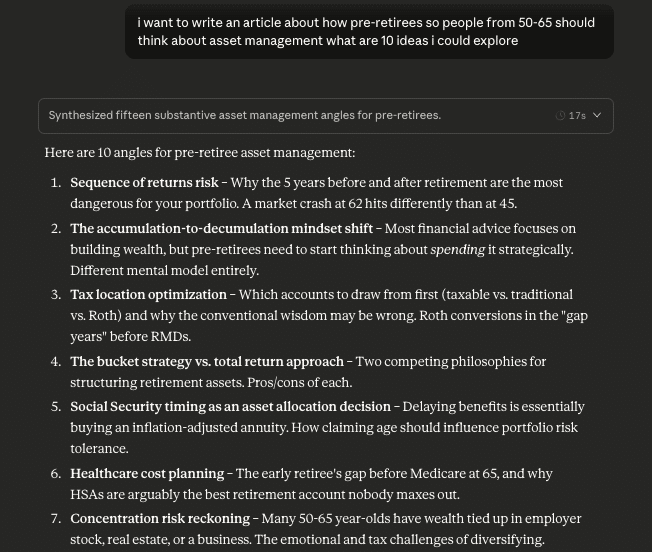
- The Workflow: Instead of asking ChatGPT or Claude to write an article, use them to generate 10 distinct structural angles, alternative opening paragraphs, or a list of questions a skeptical reader might ask.
- The Value: The goal is not to use the generated text verbatim, but to break cognitive paralysis. Responding to a flawed or mediocre AI-generated draft is psychologically easier than creating perfection from nothing.
2. Streamlining the Outlining Process
Professional writing requires structural integrity. Before drafting a blog post, white paper, or pitch, an outline is essential.
- The Workflow: Feed your topic, target audience, and primary goals into your preferred LLM. Ask it to suggest subheadings, thematic sections, and reader expectations. You can even build customized prompt templates that ask intake questions about your research, quotes, and data before generating tailored outline options.
- The Value: This accelerates structural planning and frequently surfaces logical angles or sub-topics you might have overlooked during initial brainstorming.
3. Deploying AI as a Research Assistant
Freelance journalism and content marketing involve sorting through dense reports, academic studies, and extensive web data.
- The Workflow: Use specialized search engines like Perplexity to perform rapid web research with verified citations, ensuring your data is current and accurate. Alternatively, paste long reference articles into an LLM and prompt it to extract key statistics, summarize core arguments, or analyze transcripts from industry webinars and YouTube videos.
- The Value: This allows you to triage source material efficiently. Instead of spending 30 minutes reading an irrelevant report, you can verify its usefulness in seconds—preventing the frustrating discovery of outdated data halfway through a project.
4. Drafting Cold Outreach and Letters of Introduction (LOIs)
Securing new clients requires consistent outreach, but writing personalized Letters of Introduction (LOIs) from scratch for every prospect leads to severe burnout.

- The Workflow: Prompt an AI model to draft a cold outreach email tailored to a specific marketing agency or corporate client. Instruct it to generate multiple variations of differing lengths. Critically, use the tool to research recent company news, such as a recent award or product launch.
- The Value: AI provides the structural framework, but the human writer must craft the opening personalized sentence. This hybrid approach ensures efficiency while maintaining the authenticity required to land high-paying clients.
5. Engineering High-Converting Headlines and Hooks
A brilliant article fails if the headline doesn’t earn the click. Crafting compelling, non-clickbait titles is a distinct art form that benefits greatly from iteration.
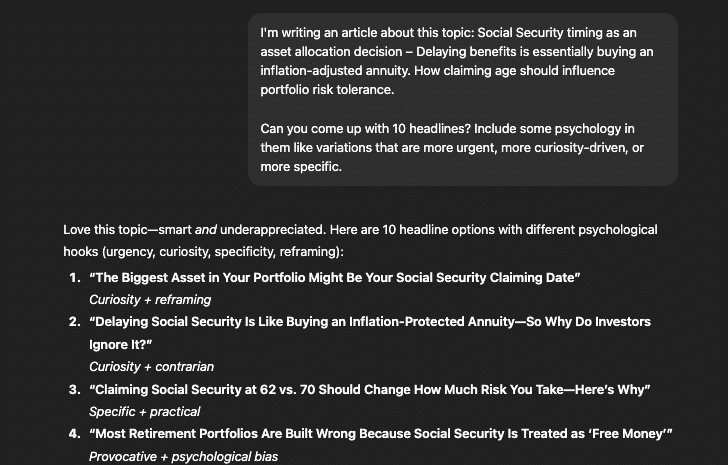
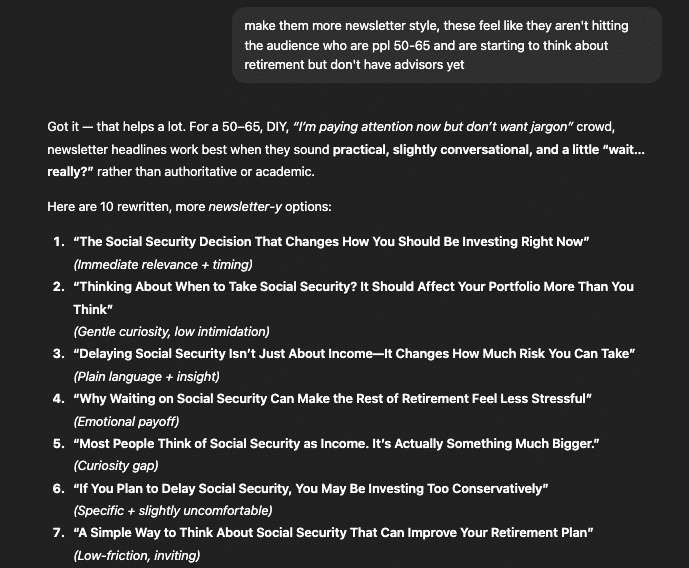
- The Workflow: Ask your AI assistant to generate 10 headline variations categorized by tone: urgent, curiosity-driven, highly specific, or authoritative. You can also ask it to punch up an existing draft headline.
- The Value: Reviewing a diverse list of headlines sparks creativity. Often, you will find yourself combining elements from two or three AI suggestions to land on the perfect hook for your piece.
6. Advanced Editing and Proofreading
Human eyes naturally gloss over recurring errors in our own writing because our brains anticipate what should be there rather than reading what is actually on the page.
- The Workflow: Utilize dedicated proofreading software like Grammarly for real-time syntax checks, and paste complex drafts into Claude or ChatGPT to flag wordiness, logical gaps, or awkward phrasing. Furthermore, instruct the AI to role-play as your target audience, providing feedback on what parts of the text are confusing or underwhelming.
- The Value: This acts as a reliable preliminary editor, catching oversights before the manuscript reaches your client or professional human editor.
7. Strategic Content Repurposing
Producing a 1,500-word article is only half the battle; promoting it across multiple channels is what drives business growth.
- The Workflow: Feed your completed article into an LLM with precise instructions. Ask it to extract five distinct data points to serve as LinkedIn hooks, generate a multi-part Twitter/X thread, or summarize key takeaways for an email newsletter.
- The Value: This maximizes the return on your initial writing investment. Instead of staring at your published article wondering how to promote it, you can instantly generate a month’s worth of promotional micro-content derived directly from your primary piece.
8. Intelligent Interview Preparation
Securing insightful quotes from Subject Matter Experts (SMEs) requires asking sharp, non-generic questions.
- The Workflow: Provide your AI tool with background information on your interview subject, the core topic, and recent industry data gathered via Perplexity. Ask the model to generate 10 targeted interview questions designed to elicit specific, engaging anecdotes.
- The Value: This ensures you do not waste an expert’s valuable time asking basic questions that could have been answered via a simple Google search. It also helps structure the conversation logically when you are exploring unfamiliar industries.
9. Managing and Mining Interview Transcripts
Conducting expert interviews often results in lengthy audio recordings and messy transcripts that take hours to review.
- The Workflow: Use transcription services with built-in chat capabilities (such as Otter.ai). Once your interview is transcribed, query the transcript directly to extract specific quotes, summarize core themes, or locate exact mentions of niche topics.
- The Value: This eliminates the need to read through a 10,000-word transcript multiple times. Note: Every extracted quote must always be verified against the original audio recording prior to publication to ensure absolute accuracy.
10. Automated Marketing Tracking and CRM Management
Many creative professionals struggle with administrative tasks, particularly maintaining marketing spreadsheets and tracking client outreach pipelines.
- The Workflow: Use structured conversational tracking (such as Claude Cowork) to log your outreach activities. At the end of every marketing session, feed the tool the date, contact name, outreach medium, and response status. Request a monthly or weekly summary report.
- The Value: Over time, the AI can analyze your pipeline performance, highlighting response rates, conversion metrics, and patterns in your niche outreach. This gamified scorecard keeps you motivated and provides actionable data without the friction of updating complex spreadsheets manually.
Official Industry Perspectives & Guidelines
Industry leaders and veteran independent publishers emphasize a clear boundary when it comes to artificial intelligence integration. The consensus across professional journalism and copywriting associations highlights that AI should augment—not substitute—human authority.
"The freelancers who are thriving right now use AI to handle the tedious parts of the job so they can focus on the work that actually matters: the thinking, the interviews, the expertise, and the relationships," notes Sean Ogle, founder of Location Rebel. "AI can make you faster, but it cannot make you better if you use it to outsource the very things that make you valuable."
Editors universally reject unedited, raw AI-generated prose. The market value of a freelance writer lies in their unique lived experience, original reporting, critical analysis, and interpersonal trust with sources. When a writer outsources these core competencies to a language model, they commoditize their own labor, reducing themselves to low-wage prompters competing in a race to the bottom.

What NOT to Do With Artificial Intelligence
To maintain professional integrity and client trust, freelancers must avoid several critical missteps:
- Direct Copy-Pasting: Never publish raw, unedited AI text. Clients can identify generic LLM phrasing, repetitive transitions, and formulaic structures immediately.
- Outsourcing Critical Thought: Never let AI determine the core argument, thesis, or journalistic angle of your reporting. Your unique worldview is your product.
- Failing to Verify Facts and Quotes: AI models are prone to hallucinations. Relying on unverified statistics or unconfirmed interview quotes will destroy your professional credibility.
- Neglecting Human Relationships: Business development in freelance writing is built on trust, empathy, and communication. Automating client communications entirely removes the personal touch that builds long-term partnerships.
Future Outlook
The trajectory of the freelance writing industry is clear: human writers will not be replaced by artificial intelligence, but human writers who use AI will increasingly replace those who do not.
As generative tools become more deeply embedded in daily workflows, the baseline expectation for output speed and volume will rise. To remain competitive without burning out, professionals must master the art of hybrid productivity. By offloading administrative tracking, preliminary research, outlining friction, and content repurposing to intelligent systems, writers can reclaim the hours needed to double down on what machines can never replicate: deep original reporting, rigorous critical thinking, and authentic human connection.