

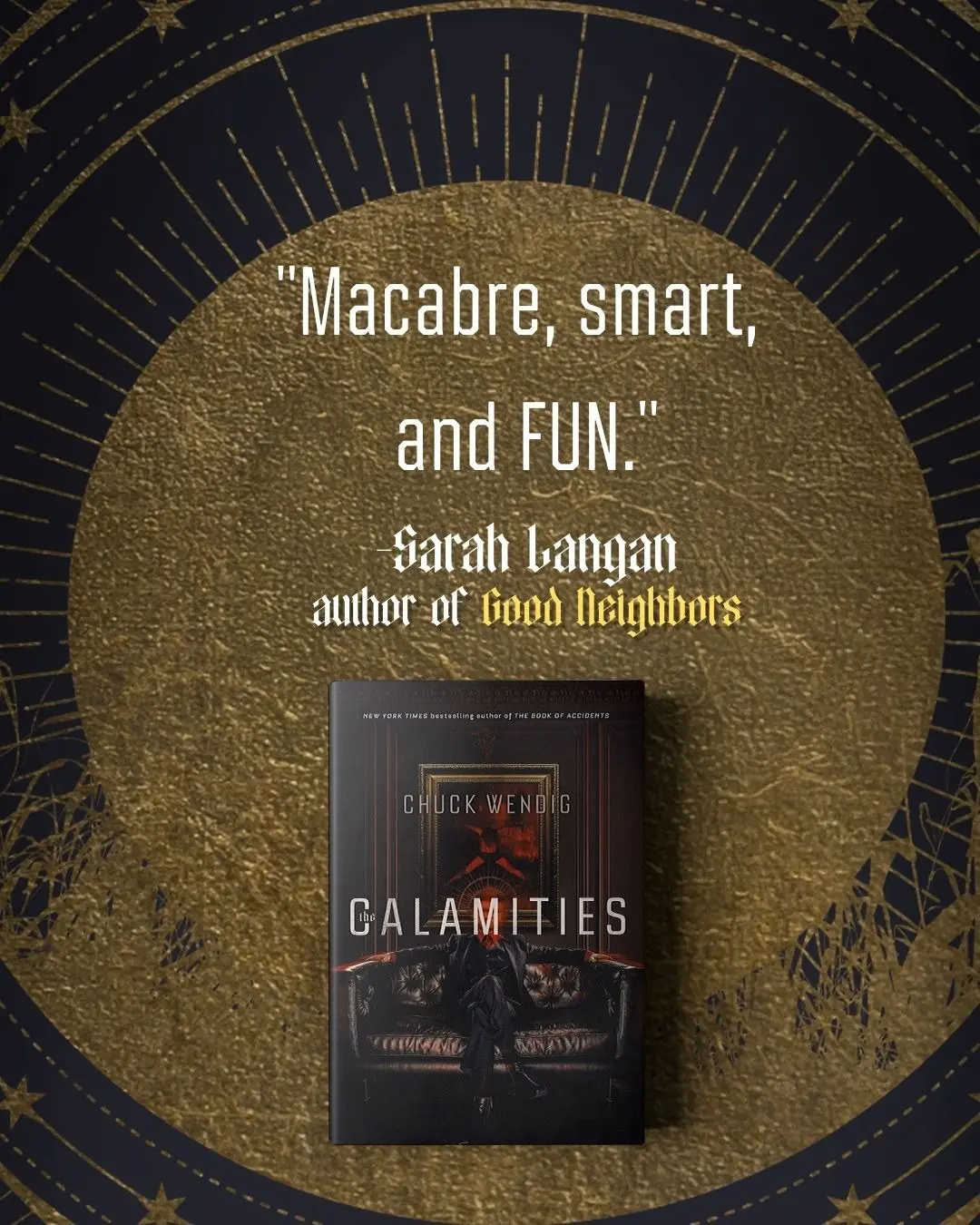
In the ever-shifting landscape of dark fantasy and horror literature, few contemporary creators command a literary footprint as erratic, ferocious, and prolific as Chuck Wendig. Marking his 34th novel, the bestselling author has unleashed The Calamities—Book One of The Fiends series—into the world. Published to an immediate wave of critical acclaim, the novel positions itself at the intersection of ink-black Gothic tradition, high-stakes urban fantasy, and brutal family saga, drawing direct conceptual comparisons to modern prestige television thrillers like Succession, channeled entirely through a demonic, gore-stained looking glass.
The Calamities introduces readers to a contemporary society secretly manipulated by the "fiends"—half-human, half-demon bloodlines who derive their immense power from trafficking in human souls. As an ancient, unstable structure known as the "Configuration" begins broadcasting a dread siren song across the spiritual fabric of the world, an unlikely ensemble of morally compromised protagonists is dragged into a global nightmare. Driven by a desire to craft something unapologetically fun, dark, and wild, Wendig has stepped away from the raw, emotional excavation of past works to deliver what peers are calling a "seven-course demon-dinner" of cosmic proportions.
The launch of The Calamities arrives complete with extensive independent and major-publisher distribution, an unabridged multi-narrator audiobook adaptation, a physical author tour, and fierce, unyielding pushback against the encroachment of generative artificial intelligence in the creative arts. This report provides a comprehensive examination of the novel’s release, thematic underpinnings, critical reception, structural position in Wendig’s expanding bibliography, and future trajectory.
Detailed Chronology: From Concept to Unleashing
The genesis of The Calamities marks a distinct tonal pivot in Chuck Wendig’s writing career. Following the completion of The Staircase in the Woods—a project Wendig has described as a deeply internal, emotionally exhausting form of literary surgery that required scraping raw vulnerability onto the page—the author deliberately sought a different creative challenge. Craving a return to pure, unadulterated narrative adrenaline, Wendig pivoted toward horror-fantasy escapism. He wanted to construct a playground populated by "the best of the worst people"—fucked-up, nightmare-driven characters embarking on a world-ending adventure.
Writing The Calamities was not an exercise in streamlined algorithmic efficiency; rather, it presented the distinct friction that Wendig believes defines true artistic integrity. Approaching his 34th novel, Wendig maintains that writing should never truly become easy. The difficulty, the trickiness, and the ever-shifting nature of each new manuscript serve as vital guardrails against creative complacency.
The production pipeline for the novel spanned months of meticulous coordination between author, editorial teams, and the publisher, resulting in a physical and digital artifact designed to stand out on shelves. By mid-August, the promotional campaign ramped up with the release of exclusive tour merchandise, author appearances, and the simultaneous rollout of print, digital, and audio editions. Release day itself brought the familiar, complex mix of alienating isolation and electrifying connection that defines modern publishing. While the digital and logistical "machine" of distribution operates largely behind the scenes, bridging the gap between factory floors and library shelves, Wendig actively sought out the tangible energy of his readership through a multi-city tour alongside fellow dark fiction luminaries.
Supporting Context & Metrics: The Mechanics of a Demonic Epic
To fully understand the scope of The Calamities, one must examine the complex geopolitical and spiritual economy of its fictional universe. The core premise establishes that the true currency of the world is the human soul. The fiends—members of ancient demonic broods—do not forcibly steal souls; rather, they rely on a far more insidious transaction. Humans willingly forfeit their spiritual essence in exchange for the classic vices: wealth, power, love, revenge, and property.
However, a systemic rot has taken root. Those driven to trade their souls are increasingly bereft of character, conscience, and ethical codes. Because these soul-bartering individuals frequently ascend to positions of global power, the spiritual fundament of human civilization has been systematically chewed through, much like a foundation eaten away by termites. With the global soul torn to tatters, holes have opened, allowing external horrors to crawl through.
Key Characters Driving the Calamity
- Mourning Mayne: The reluctant, bisexual "fuckboy" and exiled heir to Agares House, a massive empire of wealth and power under the control of his terrifying father, Hadrian Mayne. Mourning desires nothing more than a blissed-out, hedonistic lifestyle, but finds himself dragged into a global conspiracy and profound calamity.
- Key Simone: A sober-living snapper-upper of human souls who is haunted by past mistakes. Kept on a tight leash by her keepers in The Dantalion, Key attempts to keep her head down, only to be forced back into a high-stakes cosmic game.
- Quinn: An out-of-work artist in Philadelphia and an unawakened fiend. Quinn receives the strongest, most erratic broadcasts from the mysterious tower known as the Configuration, rendering them unknowingly pivotal to the fate of the fiends.
- Silas Borne: Formerly known as "The Cleaver," a notorious serial killer who has since been supernaturally gelded. Now posing as sweet as pie, Silas has been dispatched by his keepers to investigate the dimensional anomalies—and to satisfy a deep, volatile craving for adventure.
Formats, Distribution, and Accessibility
The Calamities is available across an exhaustive array of retail channels, ensuring maximum accessibility for readers regardless of preference. Physical copies are distributed via major independent bookstores (such as Doylestown Bookshop and Powell’s), national chains (Barnes & Noble, Books-A-Million), and online cooperatives (Bookshop.org, Amazon). Digital formats span Kindle, Kobo, and Apple Books, while physical copies boast striking cover design and high-end print production values.

For audiobook enthusiasts, the production features an ensemble cast of four distinct narrators:
- Dani Martineck
- Nicole Cash
- MacLeod Andrews
- Xe Sands
For readers facing financial barriers, the novel is heavily supported via public library acquisitions, with authors routinely encouraging patrons to request library purchases to foster community engagement and long-tail discoverability.
Official Statements & Critical Reception
The critical response to The Calamities has been overwhelmingly enthusiastic, cementing Wendig’s reputation for narrative versatility. High-profile figures within the speculative fiction and horror communities have praised the novel’s relentless pacing and visceral world-building.
1 New York Times bestselling author Veronica Roth praised the novel, stating:
"Vivid, unsettling, and darkly compelling, The Calamities is Chuck Wendig at his best."
Horror author Keith Rosson noted the book’s unique structural complexity:
"The Calamities is a twisting, winding river of darkness—part ink-black Gothic tale, part brutal family saga, and housed in a demonic nesting doll of a dark fantasy novel. Taken as a whole, it reminds me yet again of Wendig’s wildly lethal range and versatility when it comes to horror. The guy is, simply put, unstoppable."
Chris Panatier, author of Daytide and Worry Box, highlighted the chilling human element:
"The most terrifying thing about these demons is how human they are. The Calamities is a delightfully brutal and inventive take on demonology from the blast furnace of Wendig’s imagination. A gore-stained epic."
Additional praise came from Sarah Langan, who called it "a massively ambitious, classic horror free-for-all that’s macabre, smart, and FUN," and Christopher Golden, who drew explicit stylistic comparisons to master of horror Clive Barker, observing that despite Wendig’s diverse bibliography ranging from tech-horror to folk horror, The Calamities represents an entirely unexpected and lethal escalation of his craft.

A Firm Stance on Generative AI
In an industry climate increasingly disrupted by automated technologies, Chuck Wendig issued an unambiguous, fiery repudiation of generative artificial intelligence. Addressing whether AI was utilized in any capacity during the writing, editing, or research phases, Wendig stated:
"HahahahahahahahahahahahahahAaAAAAAAHHHHH no I jolly well did not. Didn’t use it to write it, to edit it, to research it, to get ideas for it. I did not use AI in any part of the ideation or creation of this book and nor did (to my knowledge) my publisher. I fucking hate gen-AI. It sucks. It stole my shit and is fucking up the world and making everything somehow even less trustworthy than it was before."
Defending his stylistic signature—specifically his frequent use of em dashes—against automated skepticism, Wendig quipped that he would "summon a literal demon" before ever relying on artificial intelligence to generate prose.
Future Outlook & Bibliographic Trajectory
As The Calamities establishes its foothold on bestseller lists and dominates horror reading circles, questions naturally turn to the future of the property. The Calamities is officially Book One of a planned duology under the overarching banner of The Fiends.
Wendig confirmed that work is already well underway on the sequel, provisionally titled Chaos Reigns. Currently sitting at approximately the halfway mark in its drafting phase, Chaos Reigns promises to expand upon the nightmarish mythology introduced in the first volume, offering more of the same horrific, high-octane storytelling that fans have come to expect. While no official publication date has been established for the sequel, the active progress ensures that readers will not be left indefinitely stranded in the abyss.
Furthermore, astute readers following Wendig’s broader bibliography will find subtle, rewarding interconnectivity within The Calamities. While the novel functions perfectly as an independent entry point, familiar faces—including a certain, unmistakable orange cat—make appearances, signaling that Wendig has been quietly constructing an expansive, interconnected narrative universe across multiple releases.
For fans eager to support the ongoing campaign, options extend far beyond standard retail purchases. Reader engagement via social media reviews, library requests, physical attendance at the author’s ongoing book tour, and the acquisition of official tour merchandise remain vital components of the modern author-reader ecosystem.
As The Calamities continues its dark march across the cultural zeitgeist, Chuck Wendig remains firmly entrenched at the vanguard of contemporary horror—reminding us all that while humanity may occasionally bargain away its soul, a master storyteller knows precisely how to harvest the resulting nightmares for our collective entertainment.