

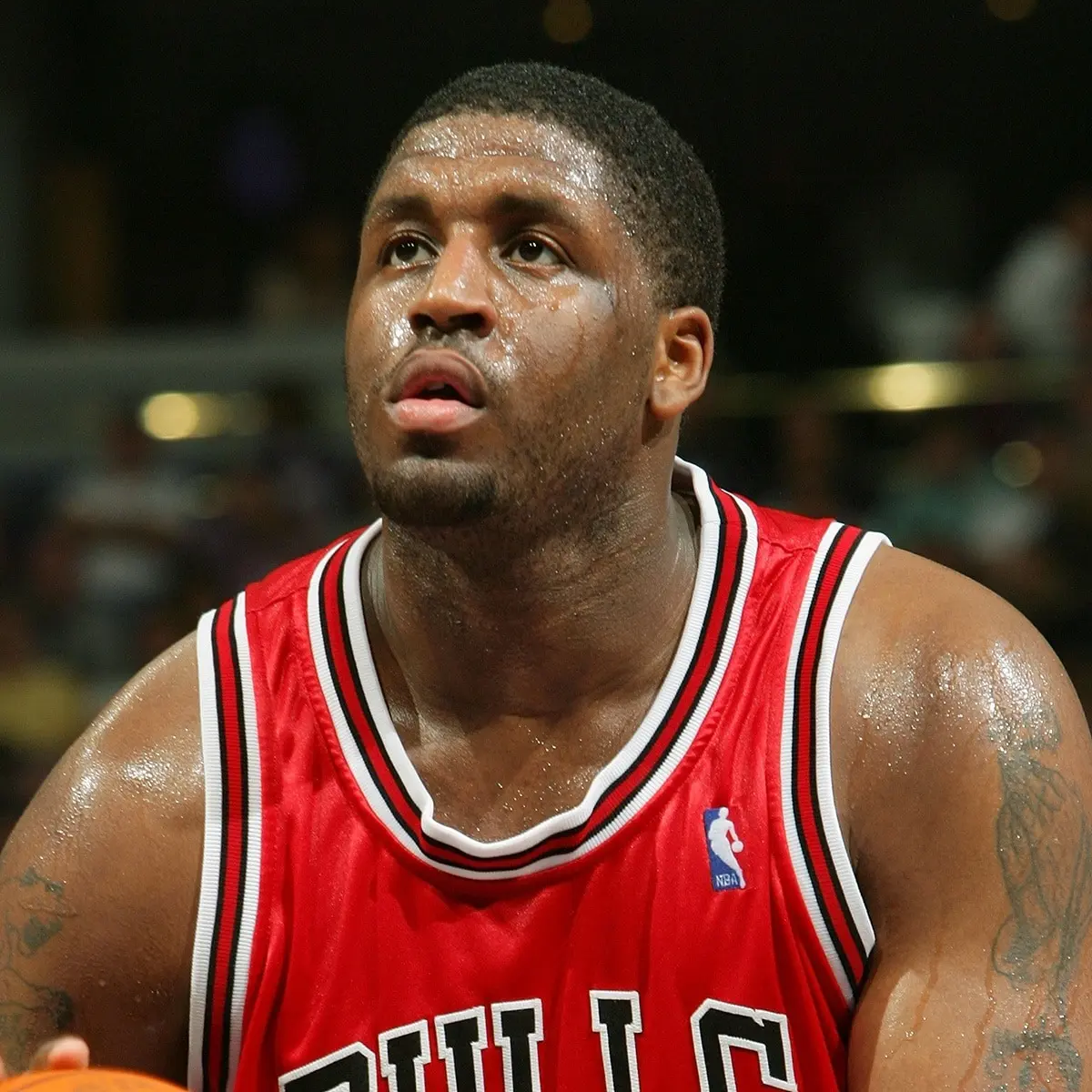
Executive Overview
The global basketball community is in mourning following the untimely passing of Michael Sweetney, a former standout power forward and center for both the New York Knicks and the Chicago Bulls, as well as an iconic collegiate star for the Georgetown Hoyas. Sweetney passed away on September 16, 2026, at the Newark Beth Israel Medical Center in New Jersey. He was 43 years old.
The heartbreaking news was first shared with the public by his wife, India Sweetney, through an emotional statement posted to social media on September 17. While a definitive medical cause of death has not yet been formally released by authorities or family representatives, the sudden loss of the former lottery pick has sent shockwaves through the sports world. Tributes have poured in from former teammates, opposing players, collegiate programs, and the professional franchises he once represented.
Beyond his physical prowess on the basketball court—highlighted by a stellar collegiate career and a top-ten selection in the 2003 NBA Draft—Sweetney’s legacy is increasingly defined by his profound transparency regarding mental health. In his post-playing years, Sweetney became a passionate advocate for athletes struggling with depression, anxiety, and the psychological burdens of professional sports. Having navigated his own public battles with mental health during and immediately after his time in the NBA, Sweetney dedicated a significant portion of his later life to mentoring younger athletes, coaching at the collegiate level, and breaking the lingering social stigmas surrounding psychological vulnerability in men’s sports.
This retrospective explores Michael Sweetney’s journey from a dominating low-post presence at Georgetown to the bright lights of Madison Square Garden, the personal and professional hurdles he faced, his courageous battle for mental wellness, and the enduring impact he leaves behind for his family, friends, and the game of basketball.
Detailed Chronology: From Accokeek to the Association
Early Life and Collegiate Ascendancy at Georgetown
Born on July 25, 1983, Michael Sweetney grew up displaying an innate talent for basketball. He developed his game into a dominant force, eventually attending Riverdale Baptist School in Maryland before committing to Georgetown University.
Under the legendary lore of the Georgetown Hoyas basketball program, Sweetney rapidly established himself as one of the most formidable interior players in the NCAA. Known for his exceptional footwork, soft touch around the rim, extraordinary rebounding instincts, and formidable body control, Sweetney became an offensive focal point for the Hoyas.
During his collegiate tenure, he earned numerous accolades, cementing his status as a modern throwback center who could score at will against double-teams. His close relationship with his father, who was famously present at nearly every single game, served as both his emotional anchor and his primary motivator. However, the tragic passing of his father during his early professional years would fundamentally alter Sweetney’s emotional landscape, triggering a cascade of personal and psychological challenges that he would spend years learning to navigate.
The 2003 NBA Draft and New York Knicks Tenure
Sweetney’s dominant collegiate output caught the attention of professional scouts ahead of the historic 2003 NBA Draft—a legendary class that included LeBron James, Carmelo Anthony, Dwyane Wade, and Chris Bosh. On June 26, 2003, the New York Knicks selected Sweetney in the first round as the ninth overall pick.
Entering the league with the heavy expectations of a top-ten draft pick in the world’s media capital, Sweetney faced an uphill battle from day one. In a 2017 interview with HoopsHype, Sweetney reflected candidly on the stark transition from being a beloved collegiate superstar whose father attended every game to entering a high-pressure professional environment:
"I went from being a star at Georgetown and having my father at every game, to losing him and not even playing in the NBA. I knew I wasn’t going to be given a chance as a rookie because my coach told me, ‘Hey, I’m not going to play you.’ I was in New York, battling this while the media was writing articles about me, and I felt like I had nowhere to go. I just kept digging myself into a deeper hole of depression."
Despite the internal turmoil and limited playing time under early-career coaching rotations, Sweetney displayed flashes of his immense talent when given the floor. In his sophomore and junior campaigns with the Knicks, he provided physical rebounding, efficient low-post scoring, and toughness off the bench, endearing himself to fans who appreciated his relentless work ethic.
Transition to Chicago and Conclusion of NBA Career
In August 2006, Sweetney was included in a blockbuster multi-player trade that sent him from New York to the Chicago Bulls, alongside teammate Tim Thomas and guard Jalen Rose, in exchange for perennial all-star center/forward Eddy Curry.
In Chicago, Sweetney sought a fresh start under head coach Scott Skiles. While he carved out a role as a dependable interior reserve who could spell the team’s starting frontcourt, injuries and the lingering mental health battles that stemmed from his rookie years continued to hinder his professional trajectory. Sweetney played his final NBA season during the 2006–07 campaign, concluding a four-year professional career in which he appeared in 233 regular-season games, averaging 6.5 monetary points and 4.5 rebounds per contest.
Following his departure from the NBA, Sweetney continued to play professional basketball internationally, spending time in various overseas leagues—including stints in China, Puerto Rico, Italy, and Uruguay—where he continued to showcase his low-post dominance before officially hanging up his sneakers to focus on coaching and personal wellness.
Supporting Context & Metrics: Career Statistics and Analytical Profile
To fully appreciate Michael Sweetney’s impact on the hardwood, it is valuable to examine his statistical production both at the collegiate level and within the National Basketball Association.
Collegiate Statistics (Georgetown University)
- Years Active: 2000–2003 (3 Seasons)
- Scoring Average: Over 17 points per game across his career, peaking at over 22 points per game in his junior season.
- Rebounding: Consistently averaged nearly 10 rebounds per game, establishing himself as one of the premier rebounders in the Big East Conference.
- Accolades: Named First-Team All-Big East and earned All-American recognition, cementing his status as one of the elite college basketball players of the early 2000s.
NBA Career Metrics
- Draft Position: 1st Round, 9th Overall (2003 NBA Draft by the New York Knicks)
- Total Seasons: 4 (2003–2005 with New York Knicks; 2005–2007 with Chicago Bulls)
- Games Played: 233 Regular Season Games
- Career Totals: 1,514 Points, 1,048 Rebounds, 137 Assists
- Per-Game Averages: 6.5 Points, 4.5 Rebounds, 0.6 Assists in approximately 15.3 minutes per contest.
- Field Goal Percentage: Career 48.2% from the floor, reflecting his efficiency as a traditional low-post scorer.
Beyond raw statistics, Sweetney’s basketball IQ and understanding of physical positioning made him a valued teammate in both New York and Chicago locker rooms. Despite the external narratives driven by media scrutiny during his early years in Manhattan, peers consistently praised his team-first mentality and genuine character.
Mental Health Advocacy: Transforming Pain Into Purpose
Perhaps Michael Sweetney’s most enduring legacy lies outside the white lines of the basketball court. In the years following his departure from the professional ranks, Sweetney became one of the sports world’s most courageous and vocal advocates for mental health awareness.
Long before mental health transparency became widely championed across professional sports leagues, Sweetney was openly discussing his battles with severe clinical depression, suicidal ideation, and the crushing weight of grief following the loss of his father.
In candid retrospectives with media outlets like HoopsHype, Sweetney detailed how the combination of sudden bereavement, media criticism, professional isolation, and athletic under-performance plunged him into an unrelenting psychological abyss during his early twenties. He openly discussed surviving a suicide attempt, crediting his inner circle of family and friends—led steadfastly by his wife, India—for pulling him back from the brink of despair.
Rather than hiding from his struggles, Sweetney chose to weaponize his vulnerability to save others. He transitioned into coaching, serving as an assistant coach at Yeshiva University in New York, where he combined tactical basketball instruction with pastoral care for young student-athletes. He routinely spoke at high schools, universities, and athletic symposiums, counseling young athletes on the importance of prioritizing their mental well-being over athletic output.
In an era where athletes are frequently viewed merely as entertainment commodities, Michael Sweetney’s willingness to bare his soul helped normalize conversations about psychological vulnerability, leaving an indelible mark on how sports organizations approach player wellness today.
Official Statements and Tributes
The sudden passing of Michael Sweetney prompted an outpouring of grief, respect, and remembrance from across the basketball world, with organizations, former colleagues, and loved ones releasing heartfelt statements.
India Sweetney and Family Statement
The most poignant words came from his wife of nearly 20 years and partner of 30 years, India Sweetney, who shared the news via Facebook on September 17, 2026:
"With the heaviest hearts, we are deeply saddened to announce the passing of our beloved Michael. To know Mike Sweetney was to love him. No one loved him more and he loved no one more than his family. His children were the light of his life, and he lived every day to give them the best life possible. He’s been my best friend for 30 years and my husband for almost 20. I’m not sure what we or I will do without him."
India also expressed profound gratitude for the overwhelming community support, emphasizing that Michael was "the best son, brother, family member, friend, father, and husband ANYONE could ask for."
New York Knicks Organization
As the franchise that drafted Sweetney into the NBA in 2003, the New York Knicks released an official statement honoring his memory:
"The New York Knicks organization is deeply saddened by the passing of Michael Sweetney. Drafted ninth overall in 2003, Michael proudly wore the orange and blue and remained a cherished member of the Knicks family. Beyond his contributions on the court, we remember Michael for his courage, his dedication to mentoring the next generation, and his tireless advocacy for mental health awareness. Our deepest condolences go out to his wife, India, his children, and his entire family during this difficult time."
Chicago Bulls Organization
The Chicago Bulls, where Sweetney played the concluding chapters of his NBA career, also shared their condolences:
"The Chicago Bulls family is heartbroken to learn of the passing of Michael Sweetney. During his time in Chicago, Michael brought toughness, professionalism, and warmth to our locker room. We are equally inspired by the courageous work he did in his post-playing career to support mental health awareness and help young people navigate their own struggles. We send our thoughts and deepest sympathies to the Sweetney family."
Collegiate Tributes and Athletic Community
The Georgetown University athletic department and numerous former Big East rivals also took to social media and official channels to remember the Hoya legend. Former teammates highlighted his gentle giant persona off the court, contrasting sharply with his ferocious competitiveness in the low post.
Future Outlook: Preserving a Legacy of Resilience and Compassion
As the basketball community comes to terms with the loss of Michael Sweetney at the young age of 43, attention naturally turns toward how his legacy will be preserved and honored in the years to come.
- Advancing Mental Health Initiatives in Sports: Sweetney’s life and advocacy serve as a powerful reminder of the ongoing need for robust mental health infrastructure within professional and collegiate athletics. Educational institutions and professional sports leagues are increasingly adopting comprehensive psychological support systems—measures that echo the very conversations Sweetney bravely pioneered over a decade ago.
- Perpetuating His Coaching Legacy: Through his work at institutions like Yeshiva University and various youth basketball camps, Sweetney touched the lives of countless young players. Those mentored by him have vowed to carry forward his coaching philosophy, which prioritized character development, emotional resilience, and mutual support above all else.
- Supporting the Sweetney Family: In the wake of this tragedy, the broader sports community, former teammates, and fans have rallied around India Sweetney and their children, ensuring that the family receives the emotional and financial resources necessary to navigate the road ahead.
Michael Sweetney’s journey was one of profound triumphs and equally profound trials. He soared to the heights of collegiate stardom, faced the crushing weight of professional expectations, battled personal demons in the public eye, and ultimately emerged as a beacon of hope and healing for others. While his life was cut far too short, his impact on the basketball court, in the coaching ranks, and within the mental health advocacy space will resonate for generations to come.