

Executive Overview
Every second of every day, an invisible storm of subatomic particles sweeps through the Earth. Unseen, unheard, and entirely unfelt by human senses, these tiny messengers zip through our bodies, penetrate deep underground, and pass straight through solid stone as if it were empty air. Originating from the most violent, cataclysmic events in the distant cosmos—such as exploding stars, colliding black holes, and the active hearts of distant galaxies—these cosmic rays carry secrets about the origins and evolution of our universe.
For generations, studying these high-energy phenomena required million-dollar facilities, massive arrays of specialized sensors, and racks of bulky, delicate electronics typically confined to elite research institutions. High school classrooms and undergraduate laboratories could rarely offer hands-on access to particle physics, leaving the field locked behind institutional gatekeepers.
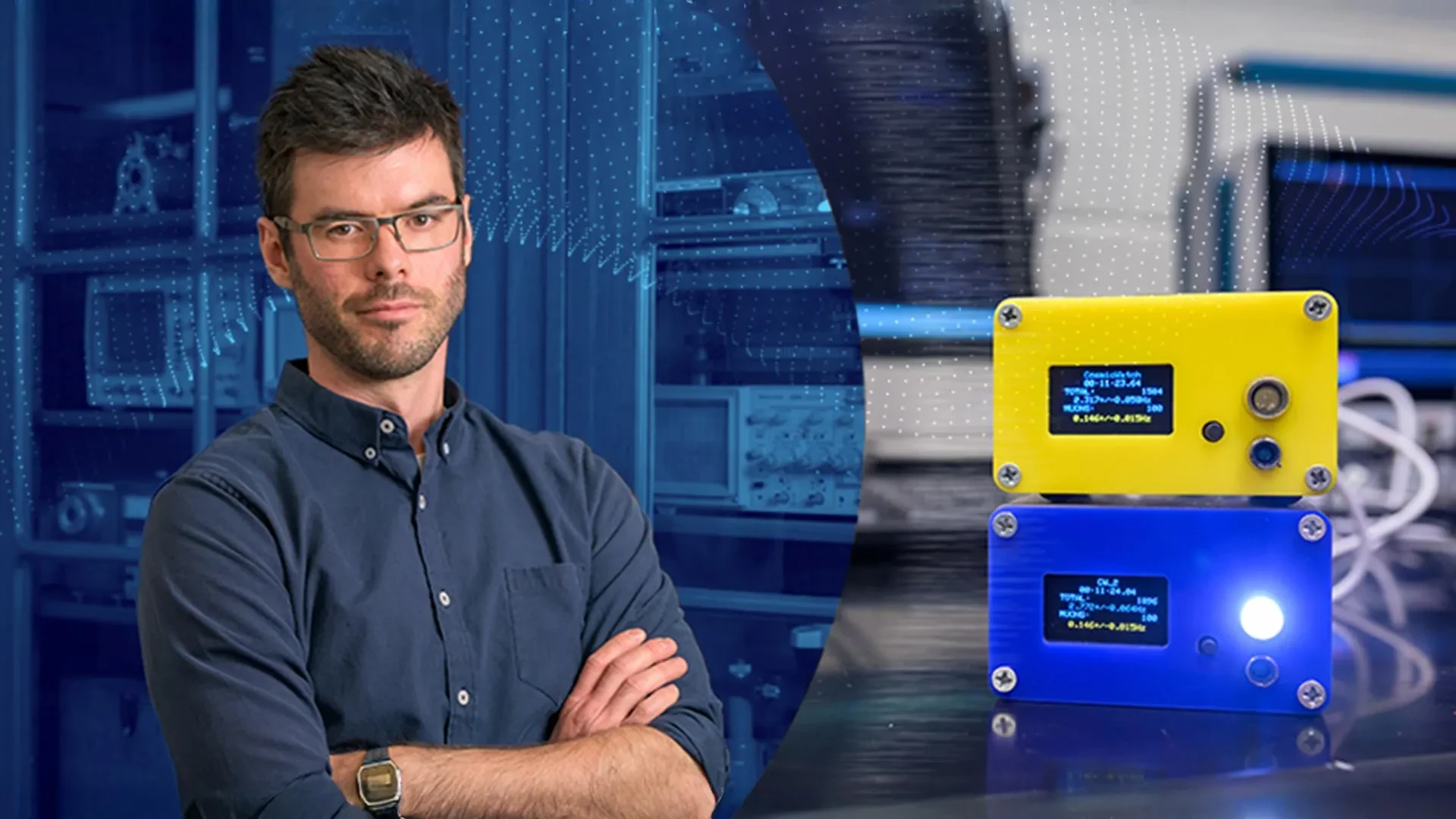
That paradigm is undergoing a radical shift. Developed by University of Delaware physicist Spencer Axani, CosmicWatch is a palm-sized, $100 detector that is democratizing particle physics. Roughly the dimensions of a box of animal crackers, this portable electronic device flashes and logs data whenever a muon—a secondary particle born when cosmic rays strike Earth’s upper atmosphere—passes through it.
What began in 2017 as a humble graduate student project at the Massachusetts Institute of Technology (MIT) has rapidly evolved into an international phenomenon. Today, CosmicWatch detectors are utilized not only in cutting-edge university labs and national research facilities like the Coherent CAPTAIN-Mills (CCM) dark matter detector, but also on high-altitude weather balloons near the edge of space. By lowering the financial and physical barriers to particle detection, Axani’s invention is bridging the gap between theoretical classroom study and authentic experimental science, while laying the groundwork for a potential global citizen-science network capable of monitoring high-energy particle radiation worldwide.
Detailed Chronology: The Evolution of CosmicWatch
Phase I: The Antarctic Genesis (2017)
The genesis of CosmicWatch traces back to Spencer Axani’s time as a doctoral student at MIT. At the time, Axani was heavily involved in preparations for the IceCube Neutrino Observatory, a massive, cubic-kilometer-scale particle detector buried deep beneath the Antarctic ice sheet. IceCube’s primary mission is to detect elusive neutrinos—ghostly subatomic particles that travel across the universe largely uninterrupted.
However, IceCube researchers faced a persistent hurdle: atmospheric muons. Created constantly by cosmic ray collisions overhead, these abundant muons rained down into the ice, threatening to swamp the delicate signals of the rare extraterrestrial neutrinos the observatory aimed to capture. To solve this calibration and background-noise challenge, Axani needed a compact, energy-efficient muon detector that could operate reliably in extreme environments. Out of this engineering necessity, the first iteration of CosmicWatch was born.
Phase II: The Educational Pivot
As Axani finalized the design, he realized that the core technology possessed a dual utility far beyond the frozen expanses of the South Pole. Traditional muon detectors used in undergraduate laboratories required cumbersome racks of specialized electronics, often occupying space equivalent to a small bookshelf and costing thousands of dollars.
By streamlining the circuitry and utilizing inexpensive, commercially available electronic components, Axani discovered he could manufacture a fully functional particle detector for roughly $100. Recognizing the profound impact this could have on science education, he pivoted the project into an open-source outreach tool. The device was designed so that students could assemble it themselves, learning the fundamentals of high-speed electronics, soldering, and coding while interacting directly with fundamental physics.
Phase III: Institutional Expansion and Iteration (2022–Present)
When Axani joined the faculty at the University of Delaware in 2022, he brought the CosmicWatch project with him, immediately integrating it into the institution’s particle, nuclear, and astrophysics curricula.
Recognizing that the device’s utility extended well beyond the classroom, Axani and his research team continued refining the architecture. In October, the team published details of the third-generation CosmicWatch detector in the Journal of Instrumentation. This latest iteration represents a significant technological leap: it features upgraded microcontrollers capable of monitoring environmental surroundings, enhanced durability to tolerate high radiation environments, and optimized data-gathering speeds that make it suitable for advanced calibration roles in professional research facilities.
Supporting Context & Metrics: The Physics of Muons
To understand why CosmicWatch has captured the imagination of the global physics community, one must understand the nature of the particles it tracks.
Cosmic Rays and Atmospheric Showers
Primary cosmic rays are predominantly high-energy protons and atomic nuclei accelerated to near-light speeds by cataclysmic astrophysical engines, such as supernovae remnants, gamma-ray bursts, and active galactic nuclei (blazars). When these energetic particles collide with the nuclei of nitrogen and oxygen atoms residing in Earth’s upper atmosphere, they trigger a cascading particle shower.
Among the myriad secondary particles generated in these atmospheric collisions are muons. Heavier cousins of the electron, muons possess roughly 200 times the mass of an electron. Because of their mass and relativistic speeds, they are capable of punching through the atmosphere and penetrating deep underground before decaying into stable particles.
Historical and Practical Significance
Muons occupy a storied place in the history of modern physics. In the early 1940s, precise measurements of muon lifetimes and flux rates provided scientists with one of the earliest experimental confirmations of Albert Einstein’s theory of special relativity, specifically demonstrating relativistic time dilation.
In the modern era, muons serve as an invaluable non-destructive imaging tool. Because they can travel through solid matter—such as concrete walls, dense rock, and entire mountains—without causing structural damage or posing health hazards, scientists can track their trajectories to "see" inside dense objects. This technique, known as muon radiography, made global headlines in 2016 when researchers used cosmic-ray muons to discover an previously unknown, massive internal void within the Great Pyramid of Giza.
Despite these remarkable applications, widespread muon research has historically been choked by logistical bottlenecks. Traditional research-grade detectors are heavy, stationary, and economically prohibitive for widespread deployment. CosmicWatch shattered these limitations by packing the detection capabilities of a traditional laboratory rack into a device no larger than a pocket dictionary.
Official Statements and Laboratory Perspectives
The impact of CosmicWatch is best articulated by the students, researchers, and educators whose daily work has been transformed by the technology.
Dr. Spencer Axani highlights the democratization of experimental physics enabled by his creation:
"CosmicWatch detectors allow us to do far more physics at a dramatically lower cost, in a compact and portable form, opening the door to many new kinds of experiments and outreach opportunities."
Reflecting on how the project expanded beyond its educational origins into heavy research domains, Axani notes:
"Although it started as an educational program, it’s found a use in a lot of different areas of physics. It’s pretty cool."
Masooma Sarfraz, a doctoral student in Axani’s UD laboratory and the primary author of the recent Journal of Instrumentation paper, emphasizes the bridge the device builds between abstract theory and empirical reality:
"Even though I had studied cosmic rays, I didn’t fully appreciate the rich physics behind the working of these detectors to actually ‘see’ the world and atmospheric particle production. For a student like me who has been working on theoretical ideas, this was a perfect opportunity to dive into the experimental side. It also connects beautifully to my current broader research work with particle physics."
At Cornell University, Natasha Holmes, the Ann S. Bowers Associate Professor of Physics, utilizes CosmicWatch in introductory undergraduate courses. She observes a marked psychological shift in students when they interact with the hardware:
"The students seem really excited about doing this thing that is more like what particle physicists and experimental physicists actually do. They get to learn some coding with it, and sometimes they break the devices, and then we have to talk to them about being careful with your equipment. It’s very different from a typical physics lab. We’ve had students say they’re doing ‘real science’ after using it."
The enthusiasm extends across interdisciplinary boundaries. Musarate Shams, a doctoral student in UD’s quantum science and engineering program, modified a CosmicWatch unit by integrating bespoke temperature and pressure sensors to investigate cosmic ray dynamics at extreme altitudes. Describing a high-altitude balloon flight that carried his modified detector to 100,000 feet near the edge of space, Shams remarked:
"It’s a very cool thing to build something in the lab in a couple of days that’s able to detect these cool particles from hundreds of light-years away."
Future Outlook: From Dark Matter to Global Citizen Science
As CosmicWatch enters its eighth year of existence, its trajectory points toward even more ambitious frontiers.
Advanced Research Applications
Beyond educational settings, the latest generation of CosmicWatch detectors has integrated seamlessly into high-stakes institutional research. The devices are currently deployed as calibration instruments in the NuDot experiment at the University of Delaware and within the Coherent CAPTAIN-Mills (CCM) dark matter detector located at the Los Alamos National Laboratory in New Mexico. Furthermore, aerospace engineers are currently designing specialized variants capable of operating directly on rockets and spacecraft to measure primary cosmic rays before they interact with Earth’s atmosphere.
The Vision of a Global Citizen Science Network
With thousands of units already built and deployed globally, Axani envisions an even grander scale: a worldwide citizen-science network.
Under this decentralized framework, amateur scientists, high school students, and hobbyists across disparate geographic locations could operate CosmicWatch units, log local muon flux rates, and upload their data to a centralized online repository. Aggregated on a global scale, these distributed measurements could grant astrophysicists unprecedented, real-time mapping of atmospheric particle activity and space weather fluctuations driven by solar winds and geomagnetic storms.
Intelligent Satellite Constellations
Looking toward orbital infrastructure, Axani’s team is also developing derived detector systems designed to safeguard space assets. By outfitting satellite constellations with particle-sensing nodes, spacecraft could dynamically communicate with one another regarding localized radiation spikes. Should a sudden solar flare erupt, the system could automatically alert neighboring satellites, allowing vulnerable electronics to enter protective sleep modes and preventing catastrophic hardware failures in orbit.
From a modest graduate student prototype designed to filter noise in the Antarctic ice, CosmicWatch has blossomed into a multi-faceted scientific instrument. By placing the universe’s most energetic particles directly into the hands of students and researchers alike, Axani’s $100 invention proves that profound scientific discovery no longer requires massive budgets—sometimes, all it takes is a spark of ingenuity and a box the size of animal crackers.