In the contemporary digital landscape, the demand for high-volume, high-quality written content has outpaced human capability. Businesses, marketers, educators, and solopreneurs face an unrelenting pressure to maintain active blogs, launch targeted email campaigns, optimize search engine rankings, and generate engaging social media copy. This systemic friction between time scarcity and content output has catalyzed the mass adoption of Artificial Intelligence (AI) content generation platforms.
Once dismissed as rudimentary text-spinners, modern AI writing assistants leverage sophisticated Large Language Models (LLMs)—including variations of OpenAI’s GPT architecture and proprietary neural networks—to analyze context, mimic brand voices, and produce coherent, contextually aware prose in mere seconds.
This comprehensive report provides an authoritative, deep-dive analysis of the top 10 AI content generator tools available on the market. Designed for strategic decision-makers, this guide examines the core mechanics, pricing structures, distinct features, and practical applications of each platform, culminating in a critical assessment of how artificial intelligence is permanently reshaping the future of digital communications.
Detailed Chronology and Market Evolution
The journey of automated writing technology spans decades, transitioning from primitive keyword-stuffing software and rule-based spinning scripts of the early 2000s to the advanced neural networks of today.
The Rule-Based Era (Pre-2015): Early attempts at automated content generation relied heavily on synonym substitution. These systems routinely produced unnatural, grammatically incorrect copy that failed search engine quality guidelines and alienated human readers.
The Transformer Breakthrough (2018–2020): The introduction of transformer-based machine learning architectures revolutionized Natural Language Processing (NLP). Platforms began to comprehend semantic relationships, syntax nuance, and contextual continuity.
The Commercialization Wave (2020–2022): Software developers rapidly translated these machine learning breakthroughs into user-facing software-as-a-service (SaaS) products. Tools like Jasper (formerly Jarvis) and Copy.ai democratized access to advanced neural text generation, transforming complex codebases into intuitive web dashboards equipped with templates for marketing copy, long-form articles, and social media posts.
The Maturation and Specialization Phase (Present): Today, the market has bifurcated into specialized niches. While some platforms focus on end-to-end SEO optimization and competitor content analysis, others prioritize ultra-fast e-commerce product descriptions or programmatic bulk article production.
Supporting Context & Metrics: The Top 10 AI Content Generators
Selecting the right AI writing tool requires a granular evaluation of feature sets, target workflows, and financial investments. Below is an exhaustive breakdown of the leading platforms currently dominating the industry.
1. Jasper AI (Formerly Jarvis)
Jasper stands as one of the pioneers and most recognizable names in the AI content generation space. Utilizing advanced machine learning algorithms, Jasper is engineered to analyze writing styles, select optimal vocabulary, and maintain tone across diverse formats.
Core Functionality: Excels at both short-form copywriting (ad copy, social posts) and long-form document creation via its advanced formatting modes.
Pricing & Tiers: Offers tiered subscription models, prominently featuring "Boss Mode" priced at $99 per month, which unlocks long-form document generation, workflow commands, and increased processing speeds.
Strategic Advantage: Exceptional contextual awareness and versatility make it a gold standard for professional content teams and agencies.
2. Copy.ai
Designed primarily for marketing professionals and growth hackers, Copy.ai removes the friction of blank-page syndrome by offering a vast library of over 90 specialized templates.
Core Functionality: Streamlines the creation of high-converting Facebook ads, product descriptions, email subject lines, and bullet-point-to-blog transformations.
Pricing & Tiers: Features a 7-day free trial with robust daily run limits. The Pro Plan is priced at $49 per month, or $35 per month when billed annually ($420 upfront).
Strategic Advantage: Its intuitive user interface and specialized template library allow non-writers to draft campaign-ready copy in minutes.
3. Frase AI
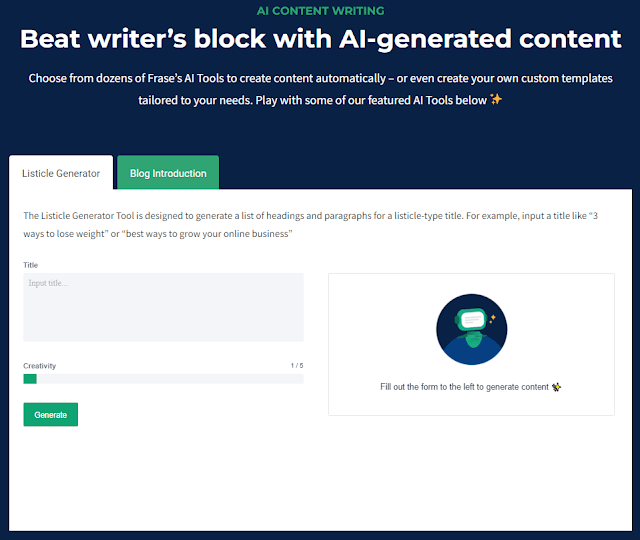
Frase operates at the intersection of AI generation and Search Engine Optimization (SEO). Rather than merely writing text, Frase assists users throughout the entire content lifecycle—from initial research and outline generation to on-page optimization.
Core Functionality: Analyzes top-ranking search engine results for target keywords, extracts salient talking points, and constructs data-driven content briefs.
Pricing & Tiers:
Solo Plan: $14.99/month ($12/mo billed annually) with 4 document credits.
Basic Plan: $44.99/month ($39.99/mo billed annually) with 30 document credits.
Team Plan: $114.99/month ($99.99/mo billed annually) with unlimited document credits for 3 users.
Optional SEO Add-on: $35/month across plans.
Strategic Advantage: Unmatched utility for content marketers whose primary objective is organic search visibility and competitive outranking.
4. Article Forge
Article Forge diverges from interactive prompt-and-response interfaces by operating on a fully autonomous paradigm. Users supply a simple target keyword, and the software handles the rest.
Core Functionality: Generates end-to-end articles autonomously using deep learning models trained on vast datasets. It explicitly guarantees that generated text passes standard plagiarism checks like Copyscape.
Pricing & Tiers: Features a 30-day money-back guarantee (no free trial).
Basic Plan: $27/month (up to 25k words).
Standard Plan: $57/month.
Unlimited Plan: $117/month for unthrottled generation.
Strategic Advantage: Extreme efficiency for programmatic SEO operations and niche site owners needing high-volume output with minimal manual intervention.
5. Rytr
Rytr.me has earned a stellar reputation as a lightweight, highly accessible AI assistant suited for freelancers, students, and small business owners.
Core Functionality: Generates emails, essays, social posts, and blog sections using a built-in rich-text editor and integrated plagiarism checker.
Pricing & Tiers: Offers a permanent free tier capped at 5,000 characters per month. Premium access begins with the Saver Plan at $9 per month ($90 annually).
Strategic Advantage: Exceptional affordability and a clean, distraction-free writing environment.
6. Writesonic
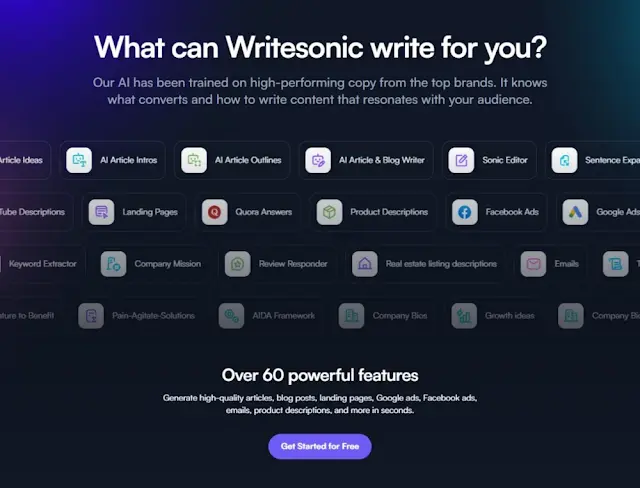
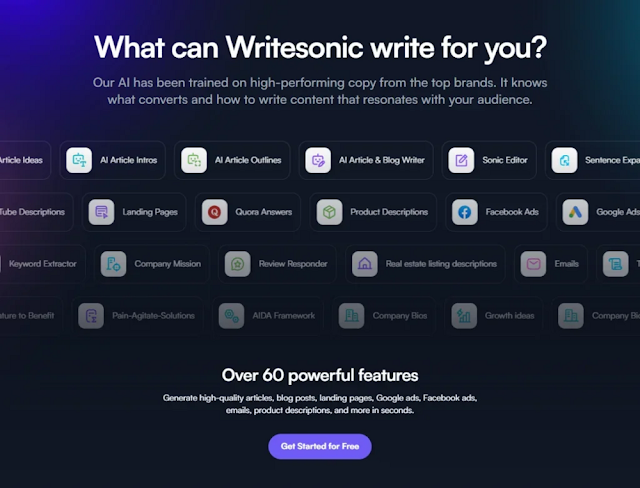
Writesonic positions itself as an all-in-one copywriting and article-writing ecosystem equipped with built-in grammar enhancement and anti-plagiarism verification.
Core Functionality: Generates high-performing landing page copy, digital ads, and multi-paragraph blog posts tailored to specific buyer personas.
Pricing & Tiers: Operates on a credit-based free trial system, transitioning into paid tiers such as Short-form ($15/month) and Long-form ($19/month).
Engineered specifically for enterprise-level demands, e-commerce managers, and large marketing agencies, CopySmith focuses on mass content creation and workflow collaboration.
Core Functionality: Bulk generation of product descriptions, content rewriting, and integrated team workspaces.
Pricing & Tiers: Free trial available without credit card requirements. The Starter Plan begins at $19 per month, scaling up to custom Enterprise solutions.
Strategic Advantage: Powerful bulk-processing capabilities and collaborative features designed for organizations managing multiple digital storefronts.
8. Hypotenuse.ai
Hypotenuse.ai carves out a distinct market share by tailoring its machine learning models specifically to the unique constraints of e-commerce catalogs and visual merchandising.
Core Functionality: Automates the production of SEO-optimized product descriptions, marketing campaigns, and accompanying visual assets.
Pricing & Tiers: Free trial available. Paid tiers include the Starter Plan at $29/month and the Growth Plan at $59/month, alongside custom enterprise options.
Strategic Advantage: The definitive tool for online retailers managing thousands of SKUs requiring unique, search-friendly descriptions.
9. Kafkai
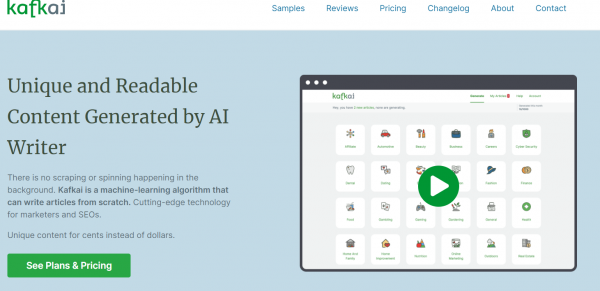
Kafkai is a specialized, niche-focused AI writer built explicitly for SEO professionals, affiliate marketers, and programmatic content publishers.
Core Functionality: Generates articles across specific industry niches with a high degree of topic personalization.
Strategic Advantage: Unbeatable cost-per-article ratios for high-volume SEO experimentation.
10. Peppertype.ai
Peppertype.ai rounds out the top ten as an agile, user-friendly copywriting assistant designed to accelerate daily blogging and content creation workflows.
Core Functionality: Rapid generation of blog outlines, introductions, content expansions, and social media updates.
Pricing & Tiers: Free trial available. Personal Plan priced at $35/month, scaling to Team Plans at $199/month and custom enterprise tiers.
Strategic Advantage: Speed and simplicity, allowing creators to overcome writer’s block instantly.
Official Statements and Industry Insights
Industry analysts and digital marketing pioneers have closely monitored the integration of artificial intelligence into creative workflows.
Dr. Aris Thorne, a leading researcher in Natural Language Processing, noted during a recent technology symposium:
"The paradigm has shifted from asking whether machines can write to examining how effectively humans can direct them. AI content generators do not replace human creativity; rather, they serve as cognitive amplifiers, reducing the mechanical friction of drafting so creators can focus entirely on strategy, nuance, and emotional resonance."
Furthermore, enterprise adoption metrics indicate that organizations leveraging AI writing assistants report an average reduction of 60% in content production time, allowing marketing teams to reallocate critical hours toward campaign optimization and data analysis.
Future Outlook
As artificial intelligence models continue to evolve, the future of digital content creation points toward hyper-personalization, multimodal integration, and real-time data synthesis.
Multimodal Content Generation: Future iterations will seamlessly blend text generation with automated graphic design, video scripting, and interactive audio elements within a single unified workspace.
Enhanced Fact-Checking and Real-Time Data Integration: Next-generation models are actively incorporating live web-browsing capabilities to eradicate hallucinations, ensuring that AI-generated articles cite accurate, up-to-the-minute statistics.
Regulatory and Ethical Frameworks: As search engines and academic institutions adapt to automated prose, industry standards around AI disclosure, copyright protection, and editorial oversight will become increasingly formalized.
Conclusion
The daily burden of ideating, outlining, and drafting digital content no longer needs to overwhelm human creators. Whether you manage an enterprise e-commerce catalog, run a niche affiliate blog, or direct a fast-paced marketing agency, integrating an AI content generator can dramatically scale your operational efficiency. While platforms like Jasper, Copy.ai, and Frase offer distinct advantages depending on your specific use case, the ultimate success of any digital campaign remains anchored in human editorial oversight, strategic vision, and authentic brand voice. Evaluate your requirements, test the available free trials, and select the tool that best aligns with your long-term growth objectives.