

Executive Overview
In modern American politics, the machinery of outrage operates on a well-oiled, predictable cycle: a high-profile Republican politician manufactures a dramatic accusation, right-wing media outlets and digital influencers amplify the charge into a viral "gotcha" moment, and conservative commentators use the narrative to energize the base before any underlying facts can be verified. This dynamic was designed to reach a fever pitch during a high-profile Senate Judiciary Committee hearing featuring former special counsel Jack Smith.
Instead of delivering a calculated political strike, Missouri Republican Senator Eric Schmitt handed Washington one of the most thoroughly documented and widely ridiculed self-inflicted blunders in recent congressional history. Armed with unvetted intelligence, a custom poster board, and a conspiratorial framing, Schmitt attempted to trap Smith in a perjury snare regarding an alleged clandestine meeting with a local prosecutor.
The entire premise dissolved in real-time when it became clear that the senator’s incriminating text messages—referencing a "Hawks" basketball game—did not point to a secret rendezvous with Fulton County District Attorney Fani Willis in Atlanta, Georgia. Rather, they placed Smith at a women’s college basketball game in College Park, Maryland, watching Caitlin Clark and the Iowa Hawkeyes.
The immediate fallout laid bare the systemic vulnerabilities of a political media ecosystem optimized for speed over accuracy. While right-wing influencers rushed to amplify the narrative before deleting their tracks, Republican colleagues looked on in open dismay, and staff members watched their career trajectories tilt toward jeopardy. Far from an isolated comedy of errors, the episode serves as a case study in modern legislative theater, highlighting the hazards of weaponizing unvetted opposition research in the pursuit of viral validation.
Detailed Chronology: From Media Rollout to Committee Collapse
The Build-Up: A Day Designed for Ascension
The morning of Tuesday, September 29, 2026, began with every indication that Senator Eric Schmitt was stepping into a moment of carefully engineered political ascent. Hours before the gavel sounded in the Hart Senate Office Building, Axios co-founder Jim VandeHei published a glowing profile placing Schmitt at the very top of the speculative short list to serve as Vice President JD Vance’s running mate in 2028. Admirers quoted in the piece lauded Schmitt as trustworthy, highly articulate, and a deft political operator.
The timing was hardly coincidental. The profile served as an advance launchpad for Schmitt’s starring role in a hearing titled "Oversight of Jack Smith’s Abuse of Authority and the Targeting of Republicans and Related Matters." Convened by veteran Republican Chairman Chuck Grassley of Iowa, the session was framed by the GOP as a long-overdue accounting of a weaponized Department of Justice. For months, Smith had stood as MAGA public enemy number one, having led the federal investigations that indicted Donald Trump over efforts to overturn the 2020 election results and the alleged mishandling of classified documents.
As the hearing commenced, Smith remained characteristically unbowed. Defending the integrity of his mandate, he told the committee:
"Our investigation developed proof beyond a reasonable doubt that President Trump engaged in serious crimes against our nation."
With the midterm elections looming just a month away, Republican lawmakers on the panel sought to relitigate January 6 and unearth any shred of ammunition to invigorate the conservative base. For Schmitt, the convergence of a flattering national profile and a televised grilling of Smith offered a prime opportunity to cement his standing as an aggressive standard-bearer for the right.
The Trap is Sprung: The Atlanta Interrogation
The climax of Schmitt’s strategy arrived near the conclusion of his allotted questioning time. Directing his focus toward Smith, the Missouri senator zeroed in on a specific date: February 3, 2024.
Schmitt asked Smith whether he had attended an NBA game between the Golden State Warriors and the Atlanta Hawks on that evening. Visibly caught off guard by the hyper-specific query, Smith paused and asked what city that particular matchup would have taken place in.
"Atlanta," Schmitt replied.
"No," Smith answered plainly.
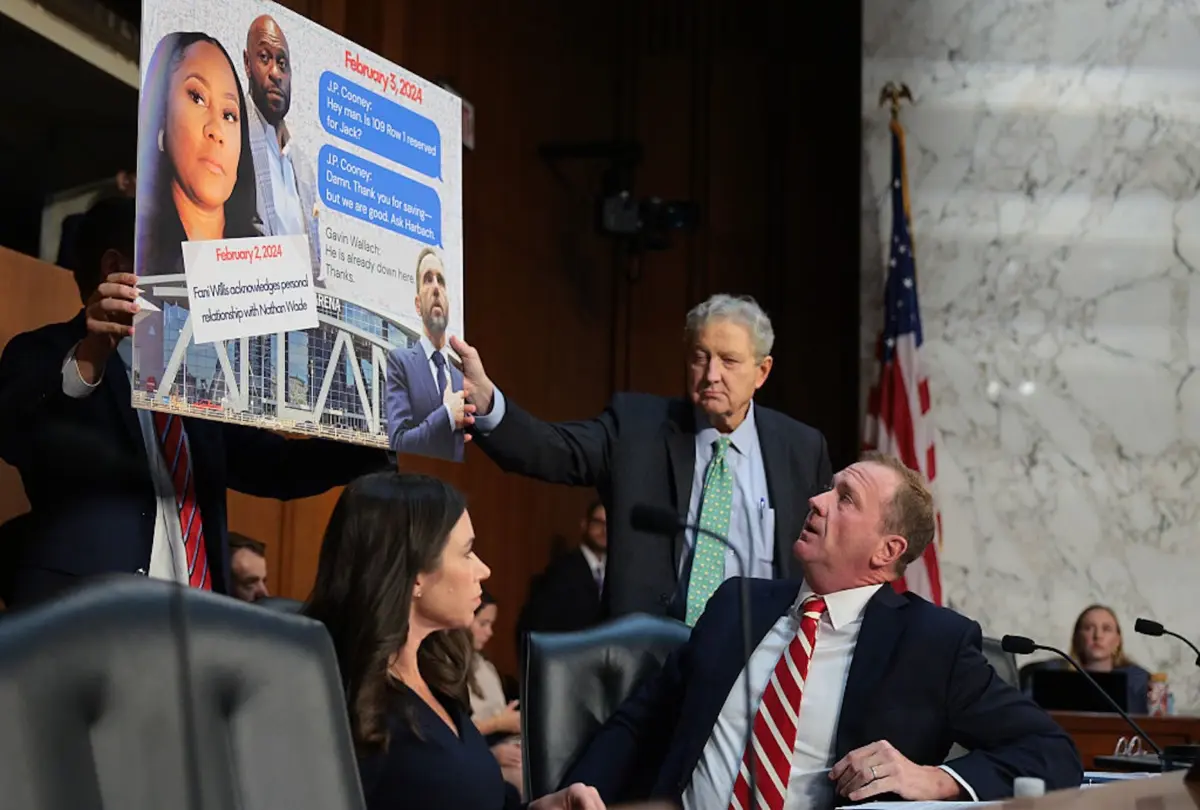
With the stage set, Schmitt introduced a layer of heavy innuendo. He reminded the room that just one day prior, on February 2, 2024, Fulton County District Attorney Fani Willis had publicly acknowledged her romantic relationship with special prosecutor Nathan Wade, who was spearheading the Georgia racketeering indictment against Donald Trump. The implicit thread Schmitt sought to weave was clear: Smith had allegedly slipped down to Georgia under the guise of attending a professional basketball game to coordinate lawfare efforts with Willis.
Leaning into the theater, Schmitt claimed to possess a series of text messages from Smith’s team placing the former special counsel at the game. Directing a warning toward the witness, Schmitt declared:
"I’ll give you a second to process it so you don’t, you know, perjure yourself."
On cue, a legislative staffer hoisted a large poster board behind the senator. The display featured purported text logs alongside side-by-side images of Smith, Willis, Wade, and an exterior shot of Atlanta’s State Farm Arena. Having laid the trap, Schmitt proclaimed that Smith had likely already committed perjury, dismissing him as a "total dirtbag."
Almost immediately, however, the momentum evaporated. Realizing the underlying documents did not support the narrative, the staffer yanked the poster board down with ungraceful speed, exposing the fragility of the entire operation to the gallery cameras.
The Unraveling and the Mascot Confusion
The structure of Schmitt’s trap collapsed under close examination during the questioning by Minnesota Democrat Senator Amy Klobuchar. Methodically unpacking the exchange, Klobuchar exposed the fundamental flaw in the timeline and documentation: the text messages did not mention Atlanta at all. They merely referenced a "Hawks" game.
Schmitt and his legislative team had committed a staggering oversight. Operating on unvetted intelligence supplied to the committee, they had searched for men’s professional basketball schedules matching the date, landing on the Atlanta Hawks. They had entirely failed to account for collegiate sports, where the Iowa Hawkeyes share a common bird moniker with professional franchises.
The game Smith had actually attended on February 3, 2024, was a high-profile women’s college basketball matchup in College Park, Maryland, featuring the Maryland Terrapins and the University of Iowa Hawkeyes—a team anchored at the time by national phenom Caitlin Clark.
What began as a calculated, high-stakes accusation of high-level government collusion turned out to be a conspiracy theory grounded in basic geographic and athletic illiteracy.
Supporting Context & Metrics: The Mechanics of Digital Amplification
The incident highlights a broader transformation in how political messaging travels from Capitol Hill committee rooms to the digital feeds of millions of Americans. Modern congressional hearings are frequently choreographed not to persuade legislative colleagues across the aisle, but to generate isolated, 30-second video clips optimized for algorithmic distribution.
| Stage of Amplification | Primary Actors | Mechanism | Outcome |
|---|---|---|---|
| 1. Ideation & Sourcing | GOP Committee Staff / White House Contacts | Gathering raw, unvetted opposition research | Introduction of flawed premises into formal inquiries |
| 2. The Legislative Stage | Sen. Eric Schmitt | High-visibility questioning backed by visual props | Immediate public exposure of factual errors on live television |
| 3. Digital Seeding | Right-wing Influencers (Sean Hannity, Benny Johnson) | Pre-planned social media deployment of "gotcha" narratives | Viral spread of false allegations before fact-checking cycles catch up |
| 4. Retraction & Spin | Conservative Media / Sen. Schmitt | Deletion of posts; pivoting to "just asking questions" defense | Institutional hardening against accountability; doubling down on narrative |
The speed of this ecosystem was on full display within minutes of Schmitt’s presentation. A pre-planned chorus of conservative influencers and media figures had their talking points loaded into queue cards, ready to deploy the moment the senator’s accusation dropped.
Fox News host Sean Hannity initially posted a triumphant message on X (formerly Twitter) applauding Schmitt’s line of questioning, only to quietly delete the post as the factual reality of the Iowa-Maryland basketball game emerged. Right-wing commentator Benny Johnson similarly broadcasted that Schmitt had caught Smith red-handed in perjury, while other digital accounts circulated clipped footage as definitive proof of administrative corruption, before quietly abandoning the claims.
When confronted outside the Capitol by reporters from TMZ regarding his presence at the Iowa-Maryland game, Schmitt offered a defiant defense:
"My job is to ask the question."
This sentiment mirrors a growing political defense mechanism among populist figures. When prominent leaders like JD Vance were caught spreading demonstrably false claims about Haitian immigrants in Springfield, Ohio, the response was not a retraction, but an argument that the fabrication served a larger, more important narrative truth. In Schmitt’s case, his defenders argued that even if the specific details of the Georgia meeting were fictitious, the aggressive posture toward the Justice Department remained fundamentally justified.
Official Statements and Institutional Fallout
The fallout within the Republican caucus was swift, visible, and deeply uncomfortable. The spectacle left several GOP senators visibly distancing themselves from the quality of the staff work that underpinned the committee presentation.
- Senator Joni Ernst (R-Iowa): Speaking to Raw Story in the wake of the hearing, Ernst offered a pointed critique of the methodology behind the stunt:
"There’s something to be said about the staff work, and verifying before we do something like that publicly."
- Senator Katie Britt (R-Ala.): Video footage capturing Britt looking on from the dais with an expression of stunned disbelief quickly went viral, encapsulating the silent mortification felt by many of her colleagues.
- Anonymous Republican Sources: Reports surfaced indicating that the bad intelligence may have originated from external sources, with one unnamed GOP senator suggesting the faulty tip sheet traced back toward White House channels.
Inside Schmitt’s own operation, the professional cost was immediate. General counsel Ethan Harper, the staffer who stood directly behind the senator holding the now-infamous poster board, found his career trajectory—including a prospective White House staff appointment—placed in immediate jeopardy as party leadership sought to assign accountability for the public embarrassment.
Meanwhile, local media in the senator’s home state offered zero sanctuary. Mark Maxwell, the political editor of KSDK-TV in St. Louis, openly mocked the senator’s blunder on social media, reflecting the disconnect between national partisan posturing and local accountability.
Future Outlook: The Resilience of Political Theater
As the midterm elections draw closer, the Eric Schmitt affair serves as a sobering preview of the legislative battles yet to come. Rather than encouraging a return to rigorous evidentiary standards or institutional caution, the incident underscores how modern political survival often rewards spectacle over substance.
For the conservative base, the narrative arc—wherein a Republican lawmaker valiantly confronts a symbol of the "deep state"—remains intact in digital echo chambers, regardless of how thoroughly the underlying facts were debunked in the committee room. The willingness of political actors to double down on discredited premises rather than acknowledge error ensures that the boundary between fact and fabrication will remain porous in future oversight hearings.
Ultimately, the committee room clash demonstrated that while high-tech poster boards and unvetted texts can manufacture a fleeting moment of viral dominance, they cannot withstand the basic mechanics of public scrutiny. For Senator Schmitt, the journey from speculative 2028 vice presidential contender to the architect of Capitol Hill’s most comical misfire stands as a cautionary tale of what happens when rapid-response propaganda outruns basic research.