The landscape of search engine optimization has fundamentally shifted. Gone are the days when a weekly keyword ranking check pasted into a static spreadsheet could provide actionable intelligence for a modern brand. As search engines integrate generative artificial intelligence—such as Google’s AI Overviews, advanced natural language processing models, and hyper-localized intent-driven algorithms—SERP (Search Engine Results Page) real estate has become volatile, dynamic, and fiercely contested.
For digital marketing agencies, enterprise organizations, and e-commerce giants alike, relying on outdated ranking data is no longer just an operational inefficiency; it is a direct threat to the bottom line. Modern SERP tracking tools do much more than simply report numbers on a grid. They are sophisticated business intelligence platforms capable of monitoring over 50 distinct SERP features, measuring granular zip-code-level local visibility, analyzing competitor positioning, and directly correlating organic visibility shifts with bottom-line revenue and conversion data.
This comprehensive, in-depth review evaluates the 7 best SERP tracking tools for 2025. By analyzing both specialized standalone rank trackers and robust all-in-one SEO suites, this guide will help you select the exact software required to validate your SEO investments, protect your organic market share, and scale your digital growth.
Detailed Chronology: The Evolution of Rank Tracking
To understand the necessity of modern SERP tracking technology, it is essential to trace how search monitoring has evolved over the past two decades.
The Early 2000s (The Static Era): In the nascent days of search optimization, keyword tracking was manual and rudimentary. SEO practitioners would open clean browser windows (frequently in incognito modes to avoid personalized search history bias), manually type in primary keyword phrases, and scroll through pages of results to log their positions in Microsoft Excel or Google Sheets. Data was sparse, updates were irregular, and competitor benchmarking was largely guesswork.
The 2010s (The Rise of Automated SaaS): As search engine algorithms grew more complex—incorporating real-time indexing, local pack results, and personalized geo-targeting—manual tracking became untenable. The market responded with the first generation of automated SaaS rank trackers. These platforms utilized data scrapers to check keyword positions across daily or weekly schedules, sparing teams hundreds of hours of manual labor.
The Early 2020s (The Feature-Rich SERP Era): Search engines evolved past simple "ten blue links." Google introduced a proliferation of SERP features: Featured Snippets (Position #0), People Also Ask (PAA) boxes, Knowledge Cards, local map packs, video carousels, and instant answer boxes. Rank trackers had to mature from simple position-checking lists into complex feature-monitoring dashboards that could track whether a domain owned the primary snippet or was pushed below the fold by paid ads.
2025 and Beyond (The AI-Driven Predictive Era): Today, search is defined by generative artificial intelligence and semantic search engines. With AI Overviews answering complex user queries directly at the top of the results page, organic click-through rates (CTR) are experiencing unprecedented disruption. Modern SERP trackers must now operate with real-time on-demand capabilities, cross-engine compatibility (Google, Bing, Baidu, Yandex, YouTube), and advanced integrations with analytics suites to connect a rank change directly to a drop in revenue.
Supporting Context & Metrics: Why Professional SERP Tracking is Mandatory
Investing in enterprise-grade SERP tracking software is not an arbitrary line item; it is a critical strategic imperative for validating marketing spend and driving verifiable business growth.
Granularity and Business Alignment
According to industry benchmarks, over 70% of enterprise SEO campaigns fail to secure ongoing executive buy-in when they rely solely on high-level traffic metrics. Stakeholders and CFOs demand accountability: How does a three-position jump for a core commercial keyword affect revenue?
The right SERP tracking software bridges this gap by mapping keyword movements directly to landing page performance, conversion rates, and revenue generation. By integrating with analytics platforms like Google Analytics or Adobe Analytics, advanced trackers consolidate organic traffic metrics, bounce rates, and transactional data into unified, executive-ready reports.
Key Features to Demand in 2025
When evaluating any SERP tracking solution on the market, software buyers should audit tools against a strict framework of core capabilities:
On-Demand Ranking Updates: Standard 24-hour automated checks are no longer enough during major core algorithm updates. Leading tools must offer instant, on-demand data refreshes at the click of a button.
SERP Feature Tracking: The ability to monitor over 50+ SERP features (including AI Overviews, featured snippets, and local packs) to identify immediate "quick-win" optimization opportunities.
Multi-Engine Support: Comprehensive tracking across Google, Bing, Baidu, Yandex, and YouTube to support diverse international campaigns.
Granular Location & Device Filtering: The capacity to track visibility down to the city, state, or postal code level while separating mobile and desktop device performance.
Historical Performance Analysis: Deep-dive historical data charting to visualize long-term ranking trends and benchmark against aggressive competitors.
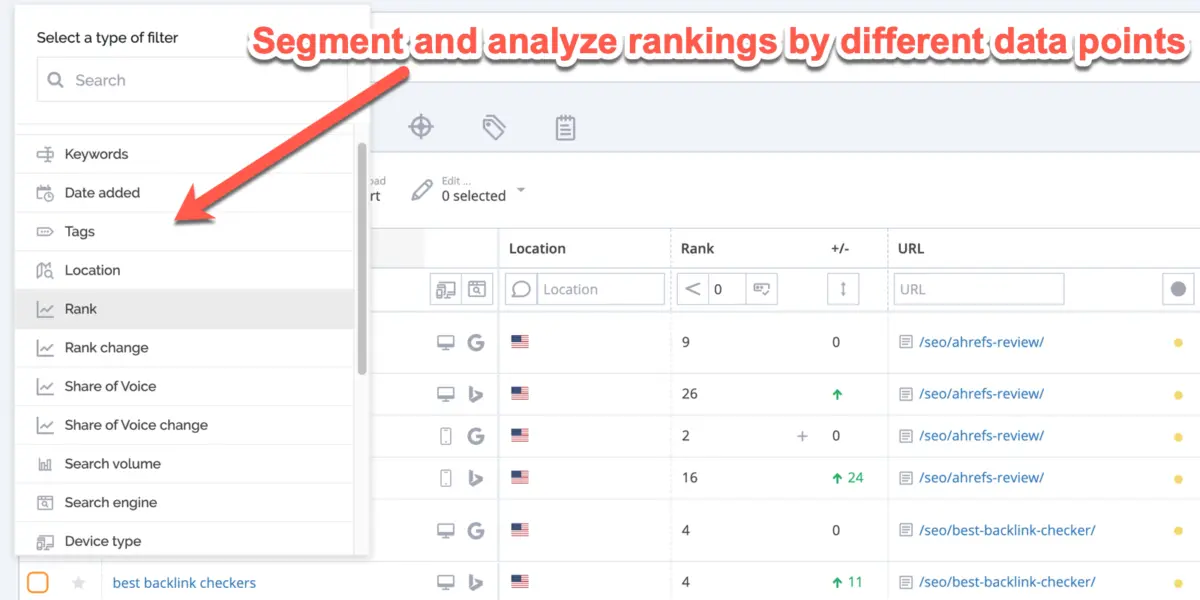
Advanced Keyword Tagging & Segmentation: Organizing keywords by funnel stage, product category, or content asset type to easily isolate and analyze specific campaign segments.
White-Label Reporting & API Integrations: Native white-label reporting engines and robust connectors for tools like Google Looker Studio (formerly Data Studio) and Databox.
The 7 Best SERP Tracking Tools for 2025
There are countless rank-tracking solutions available today, but only a select few deliver the speed, accuracy, and depth required for professional environments. Below is our curated shortlist, divided into dedicated standalone trackers and all-in-one SEO platforms.
1. AccuRanker (Best Standalone SERP Tracker)
Trusted by over 32,000 global companies—including major enterprises like HubSpot, IKEA, and Kinsta—AccuRanker is widely recognized as the industry standard for high-speed, data-dense standalone rank tracking.
Best Features: AccuRanker updates keyword sets automatically every 24 hours, but its standout feature is the ability to trigger on-demand data refreshes instantly with a single click. It features a comprehensive SERP Analysis tool that tracks 50+ SERP features in a unified dashboard, alongside robust Share of Voice (SoV) metrics.
Integrations: Deep integrations with Google Analytics, Adobe Analytics, and seamless connectors for Google Looker Studio and Databox.
Pricing: Subscription tiers scale based on keyword volume, starting at approximately $116/month for up to 1,000 tracked keywords.
2. Semrush Position Tracker & SERP Gap Analyzer (Best All-in-One SEO Suite)
Serving over 10 million digital marketing professionals and enterprise brands like Samsung, Vodafone, and Booking.com, Semrush is an industry titan. While it is an all-in-one marketing suite, its Position Tracking tool rivals the accuracy of any dedicated standalone tracker.
Best Features: Daily rank updates with granular filtering from national campaigns down to local map packs and zip codes. Furthermore, the newly launched SERP Gap Analyzer (available in the Semrush App Center) scans SERPs for a given topic, identifies under-optimized content, and utilizes Google Search Console integration to recommend low-hanging fruit optimization opportunities.
Target Audience: Digital marketing agencies, enterprise e-commerce brands, and in-house teams seeking a complete SEO ecosystem combined with elite rank tracking.
Used by over 60,000 customers globally, ProRankTracker is a powerful standalone tracking and reporting solution designed for high-volume users who require multi-language support and deep geographical precision.
Best Features: Comprehensive multi-engine tracking (Google, YouTube, Bing, Yahoo, Amazon), exceptional localization at the city and zip-code level, and advanced automated client reporting engines.
Target Audience: Agencies, international corporations, and video marketers needing precise, multilingual rank tracking at a competitive price point.
Pricing: Entry-level plans begin at an accessible $39/month.
4. Advanced Web Ranking – AWR (Best for Enterprise Customization)
Advanced Web Ranking (AWR) is a veteran standalone SERP tracker utilized by thousands of SEO professionals and major brands (including Microsoft) for its developer-friendly flexibility and extensive reporting options.
Best Features: Unlimited user seats on most plans, exceptional white-label reporting customization, highly scalable cloud infrastructure, and deep competitor visibility metrics.
Target Audience: In-house SEO teams, large agencies, and enterprise organizations requiring robust data governance and custom reporting suites.
Pricing: Plans start at $99/month.
5. SERPWatcher by Mangools (Best for Simplicity & SMBs)
Developed by the team behind Mangools, SERPWatcher is an intuitive, visually engaging rank tracker trusted by high-growth brands like Airbnb and Adidas.
Best Features: The proprietary Performance Index metric, which calculates organic traffic potential based on current rankings and search volumes. Combined with its clean, jargon-free user interface, it makes tracking effortless.
Target Audience: Startups, small business owners, freelancers, and small agencies looking for straightforward, beautiful reporting without a steep learning curve.
Pricing: Mangools bundles its tools starting at $29.90/month.
6. SE Ranking (Best Feature-Rich Value Platform)
SE Ranking is a comprehensive all-in-one SEO platform equipped with a powerful Position Tracking tool that simulates genuine user behavior across targeted search locations and devices.
Best Features: 100% accurate localized tracking, comprehensive competitor historical data, automated professional reporting, and a built-in website audit tool.
Target Audience: Small-to-medium businesses and digital agencies looking for balanced, all-in-one functionality without enterprise-level software costs.
Pricing: Plans start at $52/month for daily updates on 500 keywords.
7. Nightwatch (Best for Global & Localized Enterprise Tracking)
Nightwatch is a modern, high-precision daily SERP tracker trusted by major tech enterprises including Shopify, Scotiabank, and Coinbase.
Best Features: Access to exact search engine rankings from over 107,000 locations worldwide, highly customizable dashboard filters, and advanced site-auditing capabilities that ingest data from multiple search engines.
Target Audience: From agile freelancers and SMBs to massive global agencies managing complex, multi-region campaigns.
Pricing: Offers a 14-day free trial, with paid tiers starting at $32/month for up to 250 keywords.
Official Statements & Industry Perspectives
Industry leaders continue to emphasize the vital role that automated, integrated rank tracking plays in modern organic strategy:
"It’s by far the best keyword ranking tracker in the market and has a ton of great reporting functions. If you want visibility on large volumes of keywords housed within a nice dashboard — this is for you."
— Matthew Howells-Barby, Co-Founder, TrafficThinkTank
"The thing that really got me using them heavily in the last month or two is their Looker Studio connector. Combining the tag feature, as well as the Share of Voice metric… has been a big help in making these reports immediately digestible."
— Ian Howells, Co-Founder, Traffic Think Tank
Future Outlook: The Next Wave of SERP Intelligence
As we look deeper into the future of search, several clear technological trajectories are emerging for SERP tracking tools:
Generative Engine Optimization (GEO) Tracking: As search engines increasingly answer user intent directly within AI-generated conversational boxes (such as Google’s Search Generative Experience / AI Overviews), rank trackers are rapidly adapting to monitor brand citations, source links, and conversational query visibility. Traditional positional tracking (Position #1 through #10) will be augmented—and in some cases replaced—by Share of Model and citation frequency metrics.
Predictive Volatility Modeling: Future tracking platforms will leverage machine learning to predict how upcoming core algorithm updates will impact specific content clusters based on historical volatility patterns, allowing teams to proactively adjust content before traffic dips.
Unified Omnichannel Visibility: The boundary lines separating traditional web search, video search (YouTube), app store optimization, and e-commerce marketplace algorithms (Amazon) will continue to blur. The most successful SERP tracking tools of tomorrow will offer unified omnichannel dashboards that aggregate visibility across every platform where potential customers search for answers.
Conclusion: Which Tool Should You Choose?
Selecting the right SERP tracking software ultimately comes down to your operational scope and budget:
If you need a dedicated, lightning-fast standalone tracker with unmatched on-demand data refreshes and robust agency reporting, choose AccuRanker.
If you require a comprehensive all-in-one marketing ecosystem that combines elite position tracking with powerful content gap analysis tools, choose Semrush.
Evaluate your keyword volume, geographical requirements, and reporting needs against this shortlist, invest in the right platform, and take absolute control of your search visibility today.


![7 Best SERP Tracking Tools for 2022 [In-Depth Review]](https://www.robbierichards.com/wp-content/uploads/2020/05/Best-SERP-Trackers.jpg)
![7 Best SERP Tracking Tools for 2022 [In-Depth Review]](https://www.robbierichards.com/wp-content/uploads/2020/04/image16-2.png)
![7 Best SERP Tracking Tools for 2022 [In-Depth Review]](https://www.robbierichards.com/wp-content/uploads/2020/04/image2-3.png)
![7 Best SERP Tracking Tools for 2022 [In-Depth Review]](https://www.robbierichards.com/wp-content/uploads/2020/04/image6-2.png)
![7 Best SERP Tracking Tools for 2022 [In-Depth Review]](https://www.robbierichards.com/wp-content/uploads/2020/04/image15.jpg)
![7 Best SERP Tracking Tools for 2022 [In-Depth Review]](https://www.robbierichards.com/wp-content/uploads/2020/04/image12-1.png)
![7 Best SERP Tracking Tools for 2022 [In-Depth Review]](https://www.robbierichards.com/wp-content/uploads/2020/04/image13-2.png)
![7 Best SERP Tracking Tools for 2022 [In-Depth Review]](https://www.robbierichards.com/wp-content/uploads/2020/04/image3.jpg)
![7 Best SERP Tracking Tools for 2022 [In-Depth Review]](https://www.robbierichards.com/wp-content/uploads/2018/08/rj-employee_Robbie-color-new.png)
![7 Best SERP Tracking Tools for 2022 [In-Depth Review]](https://www.robbierichards.com/wp-content/uploads/2020/05/Databox-SEO-dashboard-1.jpg)
![7 Best SERP Tracking Tools for 2022 [In-Depth Review]](https://www.robbierichards.com/wp-content/uploads/2020/04/image4-2.png)
![7 Best SERP Tracking Tools for 2022 [In-Depth Review]](https://www.robbierichards.com/wp-content/uploads/2020/04/image5.jpg)
![7 Best SERP Tracking Tools for 2022 [In-Depth Review]](https://www.robbierichards.com/wp-content/uploads/2020/05/AccuRanker-Google-Data-Studio-integration.jpg)
![7 Best SERP Tracking Tools for 2022 [In-Depth Review]](https://www.robbierichards.com/wp-content/uploads/2018/11/Ian-Howells2.png)
![7 Best SERP Tracking Tools for 2022 [In-Depth Review]](https://www.robbierichards.com/wp-content/uploads/2019/01/Google-Data-Studio-KW-rankings-dashboard.png)
![7 Best SERP Tracking Tools for 2022 [In-Depth Review]](https://www.robbierichards.com/wp-content/uploads/2025/01/AccuRanker-home-page.jpg)
![7 Best SERP Tracking Tools for 2022 [In-Depth Review]](https://www.robbierichards.com/wp-content/uploads/2015/01/matthew-barby.jpg)
![7 Best SERP Tracking Tools for 2022 [In-Depth Review]](https://www.robbierichards.com/wp-content/uploads/2022/06/image1-1.png)
![7 Best SERP Tracking Tools for 2022 [In-Depth Review]](https://www.robbierichards.com/wp-content/uploads/2025/01/Semrush-SERP-Gap-Analyzer-1024x447.png)
![7 Best SERP Tracking Tools for 2022 [In-Depth Review]](https://www.robbierichards.com/wp-content/uploads/2025/01/Semrush-SERP-Gap-Analyzer-Search-Console-integration.png)
![7 Best SERP Tracking Tools for 2022 [In-Depth Review]](https://www.robbierichards.com/wp-content/uploads/2020/04/image10-2.png)